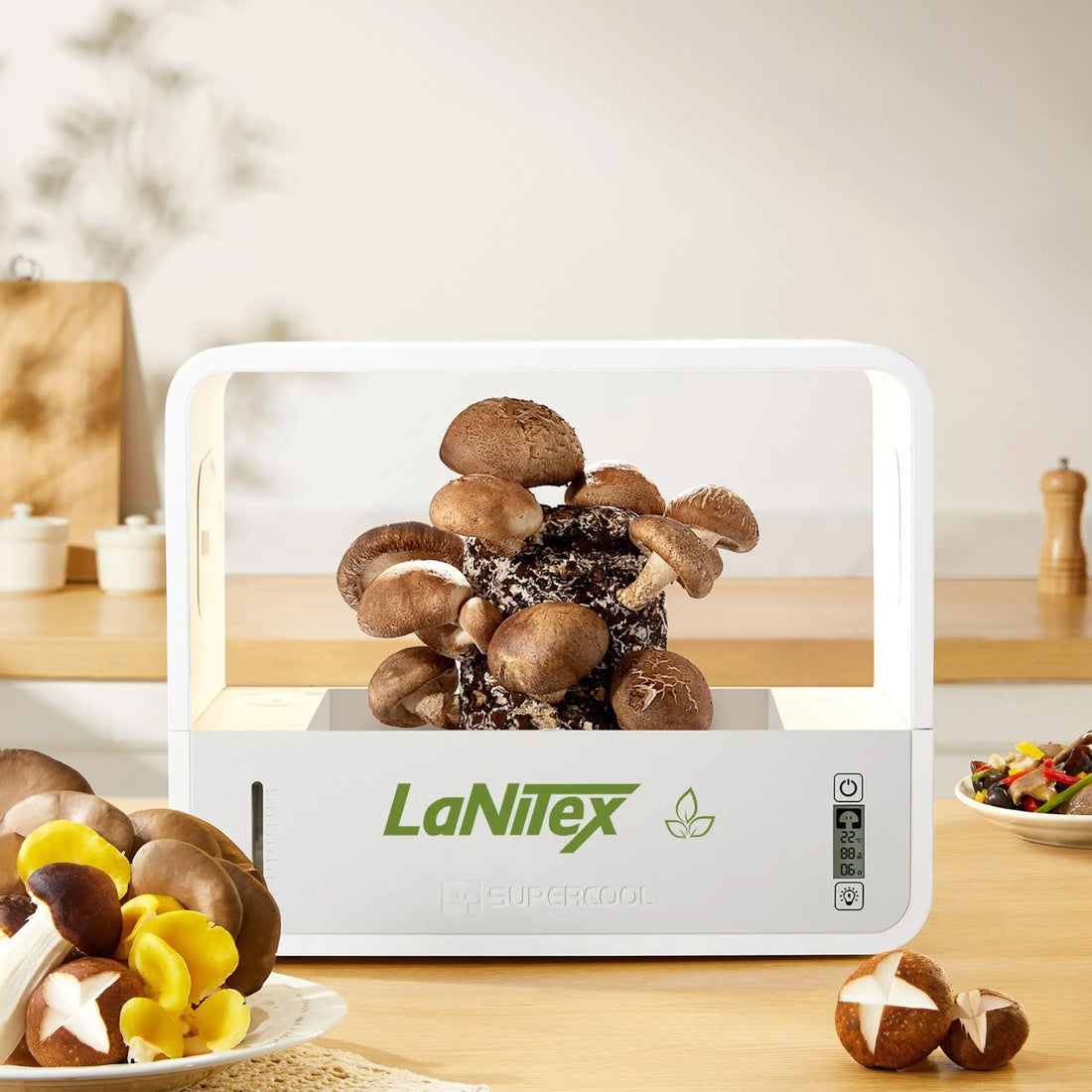

Growing microgreens at home in Australia takes a week, a windowsill and no garden - and a month's worth costs less than one supermarket punnet. Here's the whole method, from seed to scissors.
Best for: Beginners to intermediate microgreen growers across all 7 Australian capital cities.
Quick answer: Microgreens are young vegetable greens harvested 7-10 days after sowing. Growing microgreens indoors needs no garden, just a windowsill or a small grow light, a clean germination mat and good airflow, in any season. How to grow microgreens at home in Australia means sowing seeds on a clean germination mat or seed-raising mix, misting for 48 hours under blackout, then giving them light, bottom watering, and good airflow until the first true leaves appear. A reusable indoor gardening kit on the kitchen counter delivers fresh greens year-round in every Aussie climate.
Key takeaways:
- Microgreens go from seed to harvest in 7-10 days indoors, year-round, in every Australian climate zone from Darwin to Hobart.
- Mould is the single biggest cause of failed first flushes; airflow, bottom watering, and clean germination mats prevent it.
- A reusable smart microgreen kit ($129-$189) plus $1.49-per-flush germination mats beats single-flush competitor kits within four weeks of use.
- Beginners should start with broccoli, radish, sunflower, pea shoots, and a microgreen salad mix from one of five trusted Australian seed suppliers.
- Australian seed supply for microgreens is solid: The Seed Collection, Mr Fothergill's, Eden Seeds, Greenharvest, and Seedmart all ship nationwide.
What are microgreens, and how do they differ from sprouts and baby leaves?
Microgreens are young, edible vegetable greens harvested between 7 and 14 days after sowing, once the seedlings have produced their cotyledons and the first true leaves are just starting to appear. They are not the same thing as sprouts (which are eaten whole, seed included, after 2-5 days), and they are not baby leaves (which keep growing for another 2-3 weeks until the plant matures to 8-12 cm tall). Microgreens sit precisely in the middle. Stems stay tender. The flavour packs more punch per gram than baby leaves of the same plant.
A typical supermarket punnet of microgreens in Australia costs $4-6 for a 50 g pack that wilts within three days of purchase. The same volume costs roughly $2 in seeds and growing medium when grown at home, with the freshness measured in minutes between snip and plate. That's the cost-of-living-hacker reason most readers land on this guide. The grower-on-the-Sunshine-Coast angle is the second reason: a countertop garden lets households produce nutrient dense greens whether they live in a Brisbane apartment, a Hobart cottage, or anywhere in between.
A 2012 study by Xiao et al. in the Journal of Agricultural and Food Chemistry found that the cotyledon leaves of microgreens carry higher nutritional densities than the corresponding mature leaves in the USDA National Nutrient Database, particularly for vitamins and carotenoids. In simple terms: a smaller leaf, the same vitamins. That makes them a sensible kids kitchen gardening project and a useful kitchen tool for hobby chefs after fresh garnish.
Five beginner-friendly varieties anchor the rest of this guide: broccoli, radish, sunflower, pea shoots, and a microgreen salad mix. Each gets a deeper look further down, and dedicated species guides now live alongside this pillar - explore the full Microgreen Varieties guide covering all 22.
You'll also see microgreens sold as micro herbs (or microherbs). It's the same crop under a chef's name. In Australian kitchens, micro herbs usually means the herb-flavoured microgreens you grow as micro herbs for garnish: basil, coriander, chives and dill. The types of micro herbs and the types of microgreens overlap almost completely, so everything in this guide works whether you call them microgreens or micro herbs.
Are microgreens actually good for you?
Yes - and the freshness is half the reason. The Xiao et al. (2012) study found microgreens often carry higher concentrations of vitamins and carotenoids than the same plant's mature leaves, gram for gram. Across the varieties tested, the standouts were vitamin C, vitamin E, vitamin K, and beta-carotene (the orange-red carotenoid the body converts toward vitamin A). The practical Australian angle is the part most guides skip: because you snip microgreens minutes before they reach the plate, none of that nutrition is lost to days of cold storage, long-haul transport, or heavy cooking the way it is with a supermarket punnet that has already travelled and sat for a week. Eaten raw as a garnish or folded through a salad, they are a genuinely nutrient-dense addition to everyday meals rather than a superfood cure-all.
The nutrition payoff is real, but freshness is the multiplier: home-grown microgreens reach the plate before the vitamins fade.

How do you grow microgreens across 7 Australian capital-city climates?
Australian climate zones swing from tropical wet-dry in Darwin to cool temperate in Hobart, and your best microgreens to grow at home strategy shifts city by city. The kit and the seeds stay the same. What changes is your airflow plan and the timing of your germination window.
Brisbane and the Sunshine Coast (humid subtropical)
Summer humidity climbs above 70% indoors without active ventilation, which is precisely the condition microgreens hate. Run the desk fan after the blackout phase ends, not during. (Running airflow during blackout dries seeds and hinders germination per DPI NSW guidance.) Replace mats each flush; rinsing carries spores across cycles. Winter is your easy season: 18-23°C indoor temperatures, manageable humidity, and 7-day cycles like clockwork.
Sydney (temperate coastal)
The harbour city's milder summers mean less mould pressure than Brisbane. Pea shoots and sunflower do particularly well in Sydney's autumn.
Melbourne (temperate dry)
Dry summers and damp winters flip the airflow problem. In summer, you may need to mist the seeds twice a day to keep the surface alive; in winter, the same kit that hummed along in Brisbane will need a heated nook (above 18°C) to avoid stalled germination.
Adelaide (mediterranean dry)
Growers in Adelaide face generally lower mould risk thanks to drier summers, but the highest under-watering risk. Bottom watering twice daily during 30°C-plus summers keeps the growing medium moist but not waterlogged.
Perth (mediterranean hot)
The hot dry summer profile sits between Adelaide and Darwin. Smart microgreen kit owners on the WA coast typically run the LED grow light for 14 hours rather than 12 during peak summer to compensate for high evaporation.
Hobart (cool temperate)
The Tasmanian capital's winters drop indoor temperatures into single digits without heating. A bedroom or kitchen nook above 16°C is essential or germination drags from 2 days to 5. The trade-off: lower mould risk thanks to cool dry indoor conditions.
Darwin (tropical wet-dry)
The hardest climate for microgreens grown at home Australia-wide. The wet season punishes anything without forced airflow. A small clip-on USB fan running 24/7 alongside the kit, with the door of the room cracked open, is non-negotiable. Dry-season growing is straightforward.
Same indoor kit across all 7 capitals. What changes per city is the airflow strategy season by season. Each city above maps to a specific Brisbane and Sunshine Coast climate variant, a Sydney coastal pattern, or a Melbourne dry equivalent. Once you've matched your city, the rest of this guide applies unchanged.
How our microgreen kit changed our kids' relationship with vegetables
Honest question: how many times have you tried to "hide" vegetables in your kids' food? The Smart Microgreen Kit on our kitchen counter on the Sunshine Coast completely changed that game for us. The best part is that we're not the ones putting greens on their sandwiches anymore. They love walking over to the kit themselves, snipping the fresh, living microgreens, and proudly garnishing their own breakfast. Healthy eating turned into a game and a daily ritual at our place.
The lived-in version: we tested five varieties at home over twelve weeks across late summer and autumn 2026 in Sippy Downs. Broccoli microgreens went from sown to snipped in 8 days, a mildly peppery flavour, yields averaging around 90-110 g per flush in the smart microgreen kit tray. Radish microgreens were the fastest at 6-7 days, sharp pink stems, a smaller 70-90 g yield but a flavour the kids genuinely asked for. Sunflower took 10-12 days, nutty and crunchy, the highest single-flush yield in our trial at 130-150 g. Pea shoots ran 12-14 days, sweet and juicy, around 100-120 g. The microgreen salad mix delivered a varied taste in 9-11 days and became the standard breakfast garnish.
The best part is that we're not the ones putting greens on their sandwiches anymore. They do it themselves, with pride.
Laszlo Bulatko, founder, LaNiTex Hydro Garden
The hedge worth stating in plain English: we haven't run a side-by-side on every exotic variety. Red amaranth, mizuna, red cabbage, kohlrabi, mustard, fennel, and beet microgreens all have legitimate cultivation guidance from Penn State Extension and from customer feedback across QLD, NSW, VIC, SA, and TAS. The five-variety starter pack above is what we can speak to from our kitchen counter; the rest of the Microgreen Cluster will fill in as we grow each one. The kids-on-the-counter pattern is the real win: a daily snip-and-garnish ritual turns reluctant vegetable eaters into proud microgreen growers in about a week.
Where can you buy microgreen seeds in Australia?
LaNiTex Hydro Garden sells the indoor hardware: the smart microgreen kit, the wooden variant, and the germinating mats. We don't sell seeds. That's deliberate, because Australia already has an excellent specialist seed supply chain, and our job is to send you to the right partner rather than become a generic seed reseller.
The five Australian seed suppliers we recommend, in alphabetical order:
- Eden Seeds: organic and heritage varieties; strong on broccoli and brassica microgreen seed.
- Greenharvest: the broadest variety-pack range, ideal once you've moved past the starter five.
- Mr Fothergill's: the easiest to find in person; sold in Bunnings, Coles, and Woolworths nationwide.
- Seedmart Australia: microgreen-specific blends with seeding-rate guidance on every packet.
- The Seed Collection: the broadest dedicated microgreen range and the most detailed growing notes.
One technical point worth understanding when you compare packets: microgreen seeds should be untreated, food-grade seeds. The Seed Collection's 2018 guide on growing microgreens at home puts it well: "Because of microgreens' short growing time, any chemicals or other additives have no time to disperse or dilute before harvest." That's not a marketing claim. It's a practical food-safety reality of the 7-10 day cycle.
Buy untreated, food-grade seeds; the short cycle means chemicals never have time to disperse. That single rule prevents most of the avoidable problems beginners actually run into.
How to grow microgreens at home: a step-by-step method
The method is the same whether you're growing microgreens or growing micro herbs at home. Here's the step-by-step.
This is the core method we run on the counter. It works across every variety in the starter five and most of the Microgreen Cluster species blogs. The same six steps run on the smart microgreen kit, the wooden kit, or a DIY tray-plus-mat setup.
Step 1: Pick your seeds and growing medium
Match the variety to your patience: radish if you want a 6-day cycle, sunflower if you want crunch. Choose a seed-raising mix, a coconut coir mat, or a hemp growing mat as your growing medium. The reusable LaNiTex germinating mats handle most varieties, including broccoli, radish, and pea shoots. Skip cheap potting mix, it holds too much moisture and triggers damping off. Microgreens grow perfectly with no soil at all - a soil-free germination mat is the cleanest option and the easiest to clean up after harvest.
Step 2: Sow at the right density
Seed-density discipline is the most common beginner mistake. For broccoli and radish, aim for a single layer of seeds with each seed just touching its neighbour, roughly 10-15 g of seed per 25 x 18 cm tray. For sunflower and pea shoots (larger seeds), spread more sparsely: 35-45 g per tray. Overcrowding traps moisture and accelerates mould.
Step 3: Mist gently then cover for blackout (48-72 hours)
Mist the seeds with a gentle misting from a spray bottle until evenly damp but not pooling. Cover with the kit's blackout dome or a second inverted tray. Keep at 18-23°C. The blackout phase encourages strong root anchoring and uniform germination.
Step 4: Uncover, light, and bottom-water
After 48-72 hours, lift the blackout cover. Switch on the LED grow light (12-14 hours per day for most varieties). From this point, water from below only. Bottom watering means topping up the kit's reservoir so the mat wicks moisture upward, keeping seeds and stems dry. Never spray the canopy after the blackout phase ends.
Step 5: Maintain airflow (open window + small fan)
Open a window during the day or run a clip-on USB fan on its lowest setting near the tray. Penn State Extension recommends opening the window occasionally to enhance air circulation for exactly this reason, it prevents the still warm humid pocket where mould thrives. Good air flow is the single biggest mould preventer.
Step 6: Harvest at first true leaves (day 7-10)
Watch for the appearance of the first true leaves above the rounded cotyledons. This is the flavour and nutrient peak. Cut just above the mat with clean kitchen scissors. Rinse only if needed and dry on a clean tea towel. Eat within 2-3 days for peak flavour, though microgreens keep in a sealed container in the fridge for up to a week.
That's it. Six steps, 7-10 days, repeatable on every flush across every starter-pack variety.
Microgreen growing chart (timings at a glance)
Use this quick-reference chart to plan each tray. Times assume the Smart Microgreen Kit's integrated LED at normal Australian room temperature (18 to 23 degrees Celsius); a cooler room adds a day or two.
| Variety | Pre-soak seeds? | Blackout | Ready to harvest | Seed per tray |
|---|---|---|---|---|
| Radish | No | 2 to 3 days | 6 to 9 days | 10 to 15 g |
| Broccoli | No | 2 to 3 days | 7 to 10 days | 10 to 15 g |
| Salad mix | No | 2 to 3 days | 7 to 10 days | 12 to 15 g |
| Sunflower | Yes, 8 to 12 hours | 2 to 3 days | 9 to 12 days | 35 to 45 g |
| Pea shoots | Yes, 8 to 12 hours | 2 to 3 days | 10 to 14 days | 35 to 45 g |
For the full range of 22 varieties with flavour and climate notes, see the microgreen varieties guide.
Get a fresh grow guide like this every fortnight
Join the LaNiTex Hydro Garden newsletter for practical hydroponic, microgreen and mushroom growing tips for Australian homes. Subscribe to download a free hydroponics starter guide (PDF) and get 10% off your first order.
Join the newsletter →What are the best microgreens for beginners (the 5-variety starter pack)?
Start narrow, master the technique, then branch out. These five varieties cover the flavour spectrum and grow reliably on the same kit settings with no special tweaks.

Broccoli microgreens: 7-10 days from sow to harvest, mildly peppery flavour with a hint of cabbage sweetness. Broccoli microgreens are the household favourite because the flavour is approachable for kids and the nutrient profile (per the Xiao et al. 2012 study cited in our Sources) supports the case for nutrient dense greens in everyday meals. Typical first-flush yield: 80-110 g per kit tray.
Radish microgreens: 6-9 days, the fastest variety in the starter five. Sharp pink stems make it visually distinctive on a plate, and the bite is closer to wasabi than soil-grown radish. Yield: 70-90 g per tray. Best for hobby chefs and adults who like a peppery edge.
Sunflower microgreens: 9-12 days, nutty and crunchy, the highest single-flush yield in the starter pack at 130-150 g. The thick stems give sunflower microgreens a heft other varieties lack; they're a meal ingredient rather than just a garnish.
Pea shoots: 10-14 days, sweet and juicy, with tendrils that look beautiful on photographs. Great for sustainable indoor food production: a single pea shoot flush is the most filling of the starter five and works as a side salad rather than a topping.
Microgreen salad mix: 7-10 days, a varied taste from a multi-seed blend (typically broccoli + radish + arugula). The mix is the easiest gateway flush because it forgives slight timing drift, and the visual variety on the plate is appealing.
Start with these five; once you've harvested each twice, branch out to mustard, kohlrabi, or amaranth. Each variety now has its own dedicated guide - browse the full list of 22 microgreen varieties for Australian growers.
Choosing the right microgreen kit: smart kit, wooden, or DIY trays with mats?
Three sensible paths exist for an Australian household choosing a microgreen growing kit. The chooser table below summarises the trade-offs:
| Option | Up-front cost | Per-flush cost | Reusable? | Best for |
|---|---|---|---|---|
| LaNiTex Smart Microgreen Kit Black Metal | $129 AUD | ~$1.49 (mat only) | Yes, years of flushes | Any grower - matte-black finish |
| LaNiTex Smart Microgreen Kit Wooden | $189 AUD | ~$1.49 (mat only) | Yes, years of flushes | Any grower - wood-grain finish |
| DIY trays + LaNiTex Germinating Mats 10-pack | $40-60 setup | ~$1.49 (mat only) | Trays yes; mats consumable | DIY tinkerers, larger volumes |
| Single-flush starter kit (e.g. Mr Fothergill's at Bunnings) | $25-40 | $25-40 (one-and-done) | No | One-off experiment |
Same kit, two styles. The Black Metal and Wooden options are the identical Smart Microgreen Kit inside - same 16W LED, same self-watering reservoir, same blackout dome. Only the enclosure finish differs, so choose on looks and budget alone, not function.
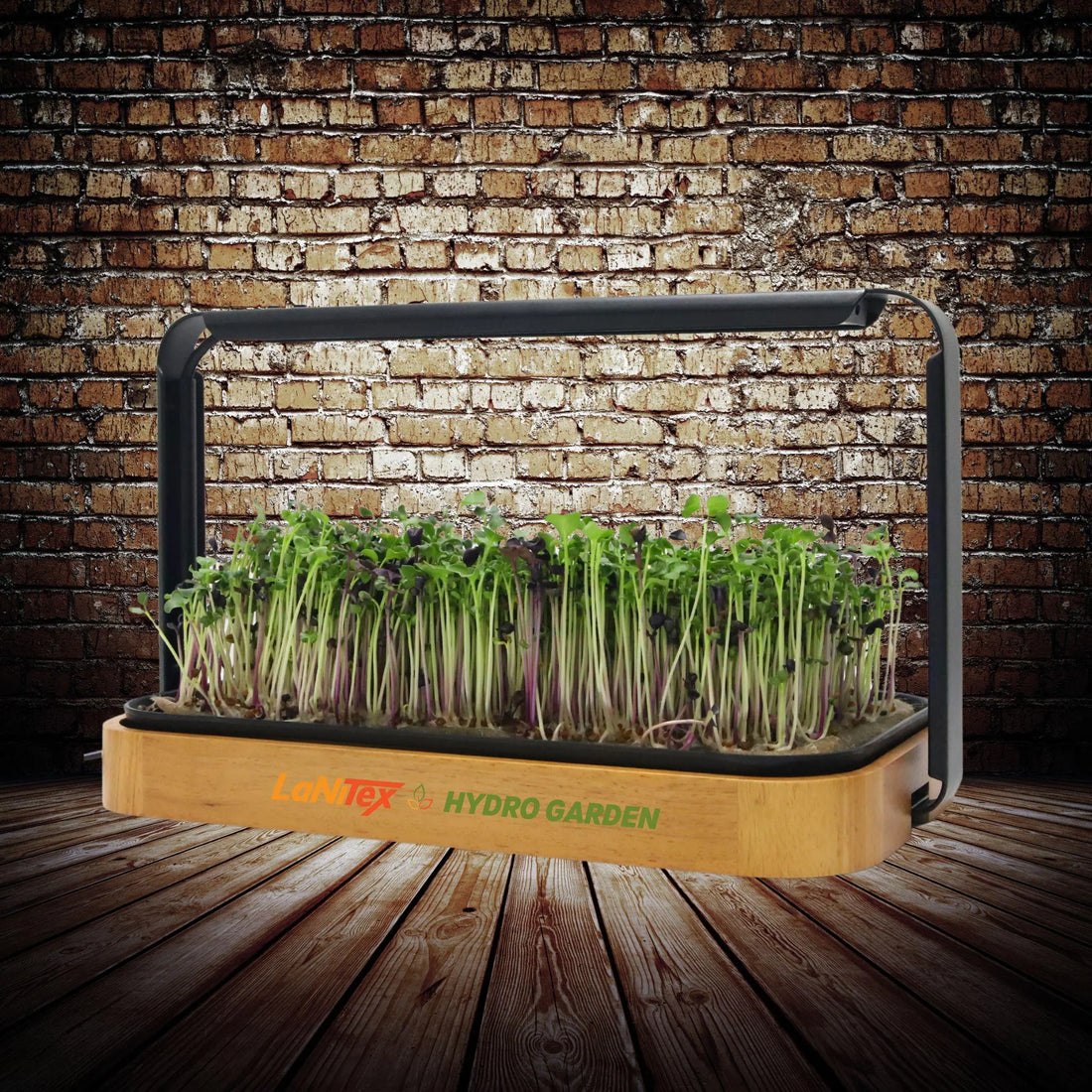
The microgreen growing kit (Black Metal) at $129 is the lowest-friction entry. Automatic LED on a timer plus a self-watering reservoir below. The matte-black finish fits most kitchen counters without looking like science equipment. The wooden microgreen kit at $189 is the same machine inside a warmer countertop garden enclosure for households that prefer the look.
The reusable hardware platform model matters because of mat economics. A 10-pack of LaNiTex Germinating Growing Mats costs $14.90, which works out to $1.49 per flush. Single-flush competitor kits at $25-40 cover one harvest and then need replacing entirely. A reusable hardware kit plus a 10-pack of mats at $1.49 per flush beats single-flush kits within four weeks of use. That's the cost-of-living-hacker case.
The DIY path uses standard microgreen growing trays and wins on flexibility (any tray size works) and lower entry cost. The trade-offs are no automated lighting, no automatic bottom-water reservoir, and a fiddlier learning curve. Growing several trays at once? Stack them on a shelf or a dedicated microgreen growing rack and run a rotation, so a fresh tray is always days from harvest.
Not sure which kit suits your kitchen and budget? Our honest microgreen kit comparison weighs the Smart Metal, Wooden and DIY tray-and-mat options with real AUD prices.

Fresh microgreens on your kitchen bench in 7—14 days — the self-watering tank and full-spectrum LED do the daily work. You supply the seeds.
Start your first tray →Personally tested at home on the Sunshine Coast before listing.
How do you prevent mould on microgreens in Australian conditions?
This is the question we hear most about, and the most common mistake first-time growers make. Mould (and the related fungal collapse called damping off) is preventable in every Australian climate zone, including humid Brisbane and Sydney summers, with five simple disciplines.
- Use a free-draining seed-raising mix or a germination mat. Soggy potting mix is the most common cause of mould. The polyester-fibre LaNiTex germinating mats drain freely while wicking moisture from the reservoir below, and they handle the AU climate zones from Darwin to Hobart.
- Bottom watering only after blackout. Never spray from above once the seeds have germinated. Top-spraying soaks the canopy and traps moisture between leaves; top up the kit reservoir instead.
- Open a window and run a small desk fan during the day. Penn State Extension is explicit on this: "Water should be provided only if necessary, avoiding excess moisture and allowing drainage to prevent mold development." Air circulation is the single biggest preventer.
- Don't overcrowd the seed tray. Stick to the seeding densities in Step 2 of the method above. Crowded seeds trap moisture and almost guarantee mould.
- Replace the germination mat after each flush. The $14.90 10-pack of LaNiTex mats covers roughly ten flushes, about $1.49 per harvest. Reusing a mat past one cycle is the easiest way to import mould spores from one flush to the next.
Local context matters. Northey Street City Farm, a Brisbane non-profit, has a candid line on the QLD reality: "I live in Queensland, so temperature control is a real issue." That's true for humidity too. The five disciplines above are the AU-specific airflow strategy that beats the climate.
Mould is preventable. Drainage + airflow + clean mats solves it in every Aussie climate.
People also ask
How much do microgreens cost to grow at home in Australia?
Roughly $2 in seeds and germination mat per flush once you own a kit. The kit pays back in about 6-8 flushes against the supermarket-punnet price ($4-6 per 50 g pack).
Can you grow microgreens without a grow light?
Yes, if you have a north-facing windowsill that gets 4+ hours of direct daylight. Yields will run 20-30% lower than under a dedicated LED grow light, and pea shoots and sunflower will lean toward the window. The integrated LED in the smart microgreen kit removes the variable.
What grow light do microgreens need?
After the 2 to 3 day blackout, microgreens need bright light for 8 to 14 hours a day to green up and grow sturdy. A north-facing windowsill can work, but yields run about 20 to 30 percent lower and the seedlings lean toward the glass. A dedicated LED grow light gives even, reliable growth with no guesswork - the Smart Microgreen Kit has an integrated full-spectrum LED on an automatic timer, so there is no windowsill to find. If you are choosing a standalone light, see our guide to LED grow lights in Australia.
What's the best soil-free growing medium for microgreens?
Polyester-fibre germinating mats, hemp growing mats, or coconut coir mats - a simple hydroponic microgreen setup. All three drain freely and wick moisture from below the seedling, which keeps the canopy dry. Replace the mat between flushes - reusing one carries over mould spores. The LaNiTex 10-pack is the easiest plug-and-play for the smart microgreen kit.
How long do microgreen kits last?
The LaNiTex Smart Microgreen Kit (Metal or Wooden) is designed for years of weekly flushes. LED lifespan is rated above 50,000 hours, and the polycarbonate self-watering tray is dishwasher-friendly between flushes.
Are home-grown microgreens safe for kids to eat?
Yes, they're safer than commercial sprouts because of the short harvest cycle and the high-humidity-free growing method described above. Use untreated, food-grade seeds from one of the five AU suppliers above and rinse leaves before serving.

Restock the refill your kit runs on — ten soil-free germinating mats, one per flush, so a fresh tray is always ready to sow.
Stock up on mats →Personally tested at home on the Sunshine Coast before listing.
The full range
Find the microgreen kit that suits your kitchen


Supported in Australia - every model tested before listing.
Frequently asked questions
How to grow microgreens indoors?
Indoors is where microgreens do best - no garden, no sunny weather, just a benchtop or windowsill, a clean germination mat and a bit of airflow. Sow the seeds onto a damp mat, keep them covered in the dark for two to three days, then move them to bright light (a north-facing windowsill or a small grow light) and bottom-water until the first true leaves show at day 7-10. For the full walk-through see our step-by-step method above, and if you'd rather not fuss over watering or light timing, the Smart Microgreen Kit handles both for you.
What is the difference between microgreens and sprouts?
Sprouts are eaten whole, root, seed, and stem, after 2-3 days of germination in water. Microgreens are eaten only above the growing medium, after 7-10 days, once cotyledons or first true leaves have formed. Microgreens carry a lower food-safety risk than sprouts because they aren't bathed in standing water.
How often should I water my microgreen kit?
Once at sowing (mist the seeds), then nothing for 48-72 hours during blackout. After uncovering, bottom-water every 1-2 days by topping up the kit reservoir. Never spray the canopy after germination, that's the fastest path to mould.
How do I stop my microgreens going mouldy in a humid Aussie climate?
Five fixes work together: free-draining seed-raising mix or germination mat, bottom watering only after blackout, an open window plus a small desk fan during the day, sensible seeding density (not overcrowded), and replacing the germination mat after every flush. Penn State Extension confirms drainage and airflow as the key levers.
Can I reuse the growing mats from the LaNiTex kit?
The germinating growing mats are designed as single-flush consumables. Reusing a mat carries over mould spores from the previous cycle and is the most common cause of repeat failure. The 10-pack at $14.90 ($1.49 per flush) keeps the economics sensible.
What's the best variety for first-time growers?
Broccoli microgreens. They grow reliably in 7-10 days from sowing to harvest at room temperature, the flavour is mild enough for kids, and the yield (80-110 g per tray) gives a satisfying first harvest. Radish is a fast second choice for adults who want sharper flavour.
How much yield do I get from one flush?
It depends on the variety. Our 12-week home trial averaged: broccoli 80-110 g, radish 70-90 g, sunflower 130-150 g, pea shoots 100-120 g, salad mix 90-120 g. First flushes tend to come in at the lower end; flushes 3+ usually hit the higher figure.
Do microgreens need fertiliser?
No. The seed itself contains everything the plant needs to reach the cotyledon and first-true-leaf stage. Adding fertiliser is unnecessary and can introduce salts that burn the seedling roots.
How do I harvest without crushing the stems?
Use sharp kitchen scissors or a chef's knife. Cut about 5 mm above the mat in a single confident slice. Don't pull, that uproots the whole mat and damages the remaining seedlings.
What temperature do microgreens need to germinate?
The sweet spot is 18-23°C indoors. Below 16°C, germination slows significantly; above 27°C, mould risk climbs sharply. Hobart growers need a heated nook in winter; Darwin growers need active ventilation year-round.
Can the kids do this safely on their own?
The growing part, sowing, watering, watching, harvesting with adult supervision on the scissors, is absolutely a kids kitchen gardening project. We supervise the cutting step. Beyond that, the smart microgreen kit is touch-safe and runs on a low-voltage 12 V adapter.
Can you grow microgreens to sell, or start a microgreen business in Australia?
Yes - plenty of Australian home growers scale a spare-room setup into farmers' market or cafe supply. The economics are the same reusable-hardware ones from the kit chooser: DIY growing trays plus germination mats at about $1.49 a flush keep per-tray costs low, and a staggered rotation gives a steady weekly harvest. Start small, master consistency and food safety on the five starter varieties, then add trays as demand grows. One step to sort out first: because microgreens are a leafy vegetable under the Food Standards Code, selling to the public makes you a food business, so check your state or territory and local council food-safety registration or notification rules before you sell. Margins depend on your local market, so we make no income promises - but the trays and mats scale cleanly from one tray to a full shelf.
Which microgreens are the most nutritious?
All microgreens are nutrient-dense, but microgreens nutrition figures vary widely by species. In the Xiao et al. (2012) study, red cabbage, amaranth, radish, and coriander microgreens ranked among the highest for vitamins C, E and K and carotenoids. Pea shoots add useful plant protein, and broccoli is a popular nutrient-dense beginner pick. Rather than chasing a single best variety, grow a rotation of several - that's the simplest way to cover the full spectrum.
Are microgreen seeds different from regular seeds?
Not really - most microgreen seeds are the same species as ordinary garden seeds, just bought untreated, food-grade, and in bulk because you sow them densely. Avoid anything sold as treated (chemically coated against fungus), since the short 7-10 day cycle leaves no time for coatings to wash off. A few large seeds (sunflower, pea) benefit from an 8-12 hour pre-soak. Stored cool, dry and airtight, most microgreen seeds stay viable for 2-3 years.
Can you grow microgreens outside?
Yes, with a couple of caveats. Microgreens are an indoor crop by design, because climate control is what gives you consistency. A covered balcony, patio or verandah can work if you give them bright indirect light (harsh direct Australian sun cooks the tray and dries the mat), shelter from wind and rain, and insect netting. Skip the open garden: birds, slugs and rain splash raise the contamination risk. In summer a shaded outdoor spot can actually run cooler than a closed room; in winter, bring them back inside. The kit and germination mats work the same outside as they do indoors.
Can microgreens grow in water?
A jar of water grows sprouts, not microgreens. Sprouts are soaked and rinsed seeds eaten whole after 2-3 days. Microgreens grow on a surface (a germination mat or thin medium), get light, and are cut above the mat at 7-10 days, which a sealed jar can't do. The closest no-soil method is a damp germination mat that wicks water from below: no standing water, and far less mould. If you actually want jar sprouts, that's a separate and quicker project.
Why are my microgreens not growing?
Usual culprits, in rough order: seeds too old or chemically treated (use fresh, untreated, food-grade seed); too cold (below 16°C germination stalls, so aim for 18-23°C); blackout skipped or too short (most varieties need 48-72 hours of cover to root before they see light); the mat drying out (bottom-water to keep it damp, not waterlogged); or seed sown too thinly (microgreens push up best with a dense, even sow). Pale, leggy stems are a different problem: too little light after blackout, so move them under a grow light or onto a bright windowsill. Seeds that sit wet and never sprout usually point to old seed or a cold spot.
Will microgreens regrow after cutting?
Mostly no - microgreens are grown as a single harvest. They're cut at 7-10 days, before they've stored the energy to push a strong second flush, so once you cut a tray it's usually done. Pea shoots are the main exception: leave a little stem, keep them watered, and they'll often give a smaller second cut. For everything else it's cleaner and more reliable to start a fresh mat each week than to chase regrowth.
Are microgreens high in oxalates?
Most aren't, but a few are. Oxalate hasn't been measured for every variety, yet the families known to be high in it - spinach, beet/beetroot and amaranth - carry that through to their microgreen stage, so go easy on those if you manage kidney stones or watch your oxalate intake. The popular beginner varieties (broccoli, radish, pea, sunflower, kale) are low to moderate, and microgreens are eaten as a garnish rather than a bowl, so the load is usually small. If you have a medical reason to limit oxalates, check with your GP or dietitian.
How do you eat microgreens?
Eat them raw to keep the nutrients and the crisp texture: snip them over salads, sandwiches, toast, eggs, soups or curries, adding them at the end so they don't wilt in the heat. Don't wash them until you're about to eat - wet microgreens spoil fast. To store, cut them dry and keep them in an airtight container lined with a dry paper towel in the fridge, where they'll hold for 5-7 days. Simpler still, cut what you need straight off the tray and leave the rest growing.
Can microgreens be grown hydroponically?
Yes - growing hydroponic microgreens at home is easy, and a microgreen kit is the simplest version of it. The LaNiTex Smart Microgreen Kit runs as passive hydroponics: seeds germinate on a germination mat above a water reservoir, with no soil, no nutrient dosing and no pumps - you just top up the water. Compared with a soil tray it's less mess and easier to keep clean, and the whole mat lifts out at harvest. If you'd rather DIY, any tray with a germination mat and shallow bottom-watering works the same way.
Further reading
- Choosing LED grow lights for microgreens and seedlings in Australia, companion guide on lighting choices, including mounting distance for seedlings and microgreens.
- The LaNiTex Desktop Grow Box hydroponic system, for households that want to step up from microgreens to herbs and leafy greens.
- Term-Grow primary school hydroponics programme in Queensland, classroom growing kits and the 10-week curriculum we run with QLD schools.
- Northey Street City Farm, Brisbane non-profit on growing microgreens at home, local QLD perspective on indoor growing through Brisbane's wet season.
- Sustainable Gardening Australia, edible gardening hub, broader AU food-growing reference.
All 22 microgreen growing guides
Every variety has its own step-by-step Australian guide. Pick your next tray.
Brassicas (fast & easy)
Crunchy & filling
Herbs, alliums & speciality
Sources
- Di Gioia, F. (2023). A Step-by-Step Guide for Growing Microgreens at Home. Penn State Extension. https://extension.psu.edu/a-step-by-step-guide-for-growing-microgreens-at-home/
- The Seed Collection (2018). How to Grow Microgreens. https://www.theseedcollection.com.au/blog/How-to-Grow-Microgreens
- Northey Street City Farm. Growing microgreens at home. https://nscf.org.au/growing-microgreens-at-home/
- Xiao, Z., Lester, G. E., Luo, Y., Wang, Q. (2012). Assessment of vitamin and carotenoid concentrations of emerging food products: edible microgreens. Journal of Agricultural and Food Chemistry, 60(31), 7644-7651. DOI: 10.1021/jf300459b. https://pubmed.ncbi.nlm.nih.gov/22812633/
Key terms
- Microgreen: A young, edible vegetable green harvested 7-10 days after sowing, between the sprout and baby-leaf stages.
- Cotyledon: The first pair of seed leaves that emerge from a germinating seed; this is what you eat in most microgreen varieties.
- True leaves: The second set of leaves that appear after the cotyledons; their appearance signals harvest readiness.
- Damping off: A fungal disease that collapses microgreen stems at soil level; caused by excess moisture and poor airflow.
- Bottom watering: A watering method where water is added to a reservoir below the growing tray so the mat wicks moisture upward, keeping seeds and stems dry.
- Germination mat: A polyester-fibre pad used as a soil-free growing medium for microgreens; LaNiTex sells a 10-pack at $14.90.
- Blackout phase: The first 48-72 hours after sowing during which the seed tray is covered to encourage strong root anchoring.
Ready to start your microgreen kitchen? The LaNiTex Smart Microgreen Kit Black Metal at $129 AUD is the lowest-friction entry, automatic LED, bottom-watering reservoir, Australia-wide shipping from the Sunshine Coast within the same week. Prefer kitchen aesthetics? The Smart Microgreen Kit Wooden at $189 AUD is the same machine in a warmer finish, with the same harvest-in-7-10-days specification. Then grab the Germinating Growing Mat 10-pack at $14.90 to keep growing for months at $1.49 per flush.
Hit reply with your first harvest yield and we'll cheer you on.
About the writer
Laszlo Bulatko built LaNiTex Hydro Garden around a simple idea: fresh food you grew yourself should be within reach of every Australian home - flat or house, balcony or kitchen bench. From the Sunshine Coast he makes smart indoor growing simple and affordable - hydroponic grow boxes, a benchtop Mini Grow Pot, and the Smart Microgreen Kit - and runs the Term-Grow Enrolment programme placing grow boxes in Queensland primary school classrooms. He launched LaNiTex in December 2024 and personally tested every product at home before listing it - drawing on 15 years of earlier brand-building in the Hungarian fishing-tackle trade. Read more on the About Laszlo founder page. ABN 47 682 768 967.