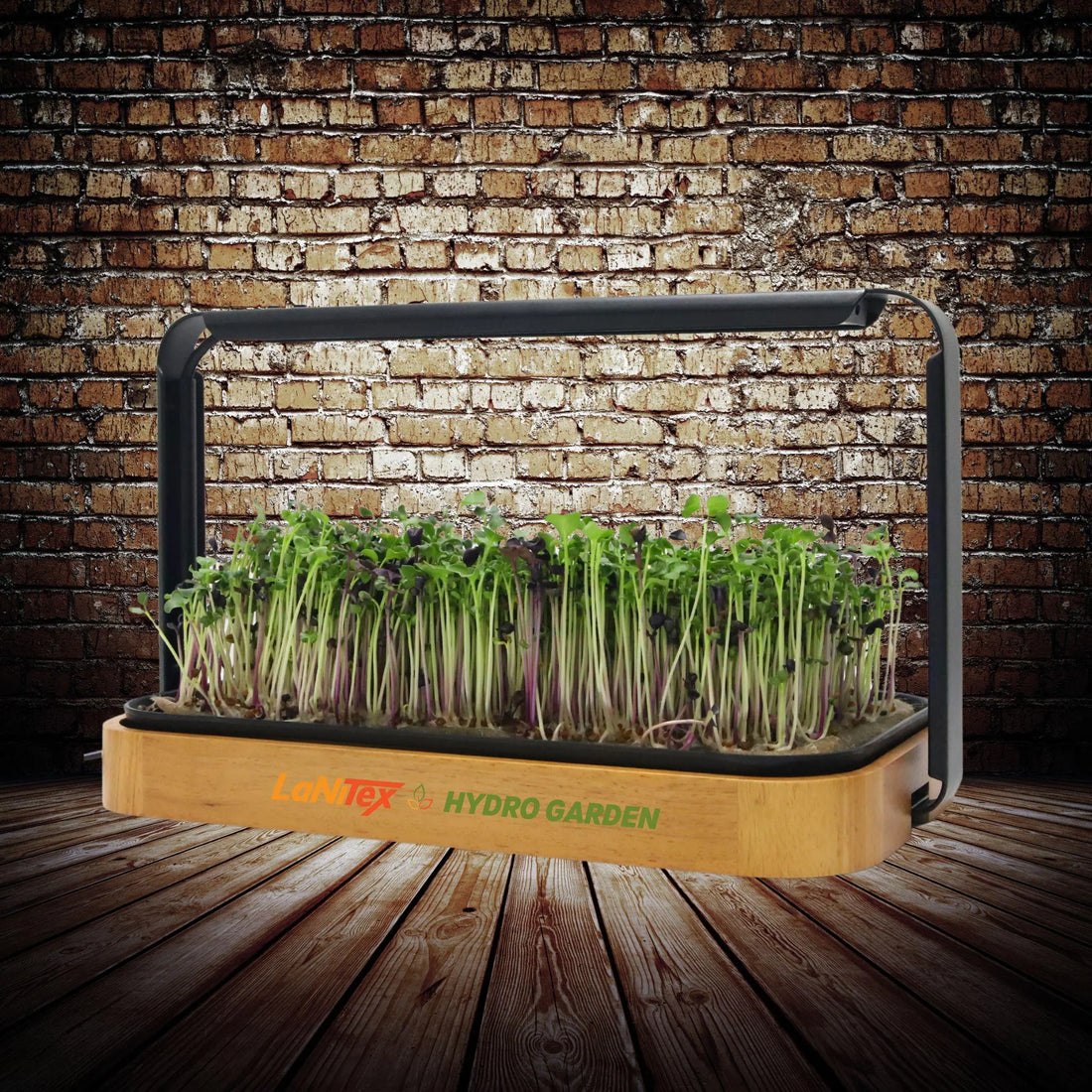

Most microgreens get a thin soil cover after sowing. Chia is one of the rare crops that must stay bare on the surface, because the seeds form a gel coating the moment they touch water.
Quick answer. Chia microgreens are the young, leafy shoots of Salvia hispanica, harvested 8 to 14 days after sowing at 5 to 8 cm tall. The rule that decides whether your crop succeeds or rots is simple: surface-sow the seeds in a single dense layer on a damp growing mat, never bury them under soil. Indoors at 18 to 24 degrees C, on a bench inside a microgreen growing kit (Black Metal) ($129 AUD), a single tray gives a fresh garnish supply for two weeks. Pantry chia from an Australian supermarket works, provided it is plain raw seed with no roasting or flavouring. Mild grassy flavour pairs well with smoothies, yoghurt, and breakfast bowls.
At a glance
| Field | Value |
|---|---|
| Species | Salvia hispanica (Lamiaceae family) |
| Days to harvest | 8 to 14 days |
| Typical yield | ~25 to 30 g per tray (about an ounce) |
| Difficulty | Medium (mucilage moisture management) |
| Taste | Mild grassy, gentle crunch |
| Best uses | Smoothies, yoghurt bowls, salads, breakfast garnish |
| Recommended kit | Smart Microgreen Kit Black Metal ($129 AUD) |
What are chia microgreens?
Chia microgreens are the young leafy shoots of Salvia hispanica, a flowering plant in the Lamiaceae mint family. Microgreens are harvested 8 to 14 days from sowing, once the seedlings reach 5 to 8 cm tall and have produced their first pair of true leaves above the cotyledons. They are cut above the growing mat or medium and eaten fresh as a garnish, salad ingredient, or smoothie bulk.

The Lamiaceae family puts chia alongside basil, mint, oregano, rosemary, and thyme as a mint-family microgreen. If you have already grown basil microgreens at home, chia rotates in as a complementary mild-grassy variety on the same kit.
Confusing point worth fixing now: chia microgreens are not the same as chia sprouts. Sprouts are grown 3 to 5 days in a jar or sprouter and eaten as the whole seed plus emerging root and shoot together. Microgreens grow longer, develop chlorophyll and true leaves under light, and get harvested above the mat. The flavour, texture, and nutrient profile differ.
Across the LaNiTex microgreen guide library, chia sits with herb and specialty crops as a nutrition-focused, slow-grow option for cooks who want a mild green that does not overpower sweeter dishes.
The mucilage rule: why chia microgreens must be surface-sown
Chia seeds are mucilaginous. The moment they touch water, the outer seed coat releases a gel-like layer of soluble polysaccharide-rich fibre called mucilage. This hydrocolloid gel binds water tightly around each seed and is what gives chia pudding its signature texture.
For chia microgreens, this gel is both the gift and the trap. The gel keeps moisture in contact with the seed coat through germination, which means chia does not need a separate humidity dome. But if you bury chia under soil or thick growing medium, the gel traps moisture against the seed, blocks oxygen, and tips germination into anaerobic rot before the radicle emerges.
The fix is the mucilage rule. Surface-sow chia in a single dense layer on top of a damp growing mat. Skip any cover. The gel keeps each seed wet enough to germinate while the surface still gets the airflow the seed needs.
This is not a stylistic preference. Peer-reviewed work by Capitani and colleagues at the National University of Central Buenos Aires documented chia's mucilage as a soluble polysaccharide-rich hydrocolloid that needs surface oxygen for germination (see Sources). Burying chia under soil is a common failure mode, not a forgivable beginner mistake. Skip the soil cover.
A short answer to the question that pulls a lot of search traffic: chia seeds form a gel coating of soluble fibre when wet, which traps water and starves the seed of oxygen if buried, so surface sowing in a single layer with airflow is the only reliable method.
What I have learned about growing chia microgreens from research
Honest disclosure: chia microgreens were not part of the LaNiTex Smart Microgreen Kit pre-launch validation crop list personally tested in Sippy Downs (Sunshine Coast, QLD 4556) before stocking the kit, radish, broccoli and sunflower were the three calibration crops. The guidance below combines Capitani 2012 peer-reviewed chia physicochemical research (the widely-cited source on Salvia hispanica mucilage hydrocolloid properties), The Seed Collection AU chia growguide, Travel and Happiness AU hobbyist growing notes, microgreensworld.com generic technique guides, and AU climate-specific adaptation for this mucilage-coated Lamiaceae mint-family microgreen. The mucilage rule (surface-sow, never cover) is a well-documented seed-physiology principle, not a stylistic preference, burying chia under soil traps moisture against the gel and triggers anaerobic rot before germination completes. Local results may vary by climate zone; the troubleshooting section names the mucilage-gel-trapped-moisture mould, leggy-low-light, patchy-germination and roasted-or-flavoured-pantry-chia-failure pitfalls most likely to bite AU growers in humid QLD summer vs cooler southern winter.
Why grow chia microgreens at home? Nutrient density without the hype
Chia gets called a superfood so often the label has lost meaning. The honest take: chia microgreens are a fresh leafy green, and like other microgreens they add vitamins, minerals and antioxidants to a meal for very few kilojoules. Worth knowing: the microgreen is not the seed. The young shoot does not carry the concentrated omega-3, protein and fibre that mature chia seeds are known for, so enjoy it as a fresh garnish green rather than a seed substitute. They are not a remedy. Variety in the diet does the heavy lifting; one tray on the bench adds one item to the rotation.
What chia microgreens give you that a punnet of supermarket microgreens does not is freshness and continuity. Supermarket microgreen punnets in Australia run $4 to $7 each (more at specialty retailers), often wilted within a few days of opening. One Smart Microgreen Kit on a kitchen bench, paired with a $14.90 ten-pack of growing mats, gives fresh garnishes for months from the same setup.
Apartments and townhouses are a fit. The Australian Bureau of Statistics 2021 Census recorded that 70 per cent of dwellings were separate houses, 13 per cent were townhouses, and 16 per cent were apartments. Roughly 29 per cent of Australian dwellings are townhouses or apartments where outdoor garden space is typically limited. A chia microgreen tray fits on a benchtop smaller than a chopping board.
Ready to skip wilted supermarket microgreens?
Same Smart Microgreen Kit, choose your style:
- Smart Microgreen Kit Black Metal ($129 AUD), entry-tier, modern matte finish.
- wooden microgreen kit ($189 AUD), warm timber finish, same internals.
Both ship Australia-wide from Sippy Downs the same week.
How chia microgreens grow in Australia: climate-zone breakdown
Chia microgreens grow indoors year-round in Australia at 18 to 24 degrees C. Climate matters mainly for two things: humidity (mould risk) and ambient daylength (when supplementary light helps). Here is the practical breakdown.
| Zone | Cities | Practical note |
|---|---|---|
| Subtropical | Brisbane, Sunshine Coast | Year-round indoor; gentle constant airflow December to February to manage 65 to 80 per cent RH |
| Temperate | Sydney, Adelaide | Year-round indoor; small grow light helps April to September short daylength |
| Cool-temperate | Melbourne, Hobart | Warm room (18 to 24 degrees C) required June to August; grow light recommended |
| Mediterranean | Perth | Year-round indoor; cool to ambient summer holds well |
| Tropical | Darwin, Cairns | Air-conditioned room recommended; mucilage mould risk highest |
In Sippy Downs (Sunshine Coast, QLD 4556), humidity sits around 70 to 80 per cent through summer. The Smart Microgreen Kit's vented design plus a small desk fan on low cuts mould risk to a manageable level for chia, the most moisture-sensitive of the common microgreens we work with.
For comparison context, sunflower microgreens and pea shoots tolerate humidity better and forgive beginner errors more readily, chia takes a more deliberate hand.
Step-by-step: growing chia microgreens from seed to harvest
Here is the full procedure for growing chia microgreens in a Smart Microgreen Kit. Total time from sowing to harvest is 8 to 14 days.
- Prepare the kit and mat. Place a fitted growing mat in the kit tray and saturate with clean filtered water until damp through (in regions with hard or heavily chlorinated tap water, use rainwater, RO, or let tap water stand for 24 hours to dechlorinate). Tip out any standing water from the reservoir.
- Surface-sow the chia seeds. Spread roughly 10 g of untreated food-grade chia seeds (about 1 to 2 teaspoons for the kit-size tray) evenly across the mat in a single dense layer, sowing them dry straight from the packet. Do not cover with soil or additional medium, and do not pre-soak chia the way you would larger seeds such as peas or sunflower. It gels the moment it touches water, so a pre-soak just turns the seed into a sticky clump that will not spread. The seeds will start absorbing water and forming mucilage within minutes; this is correct.
- Apply a ventilated blackout. Cover the kit lightly with the ventilated lid for 2 to 3 days. Avoid heavy lids or cling-wrap that compresses the gelled seed layer; the seeds need contact pressure, not weight. Skip the cling-wrap blackout some guides recommend.
- Move to bright indirect light. Once seedlings reach 1 to 2 cm and visible cotyledons appear, remove the blackout and move the kit to bright indirect light or under a grow light. Aim for about 12 hours of light a day. A windowsill with morning sun and afternoon shade, or a grow light on a timer, works in most AU rooms.
- Water gently. Top-water lightly with a spray bottle, or bottom-water through the kit reservoir. Keep the mat moist, not waterlogged. Tip out standing reservoir water daily.
- Maintain temperature and airflow. Hold the room at 18 to 24 degrees C. A small fan on low (or an open window) keeps gentle air moving across the seedlings. This is the single biggest mould-prevention lever, especially in QLD summer.
- Harvest at 8 to 14 days. When seedlings are 5 to 8 cm tall with the first true leaves formed above the cotyledons, cut above the mat with clean scissors. Yield is modest by microgreen standards: a single tray gives roughly an ounce (about 25 to 30 grams) of fresh chia, enough for 4 to 6 yoghurt bowls or salad toppings. Chia does not reliably regrow a second usable crop, swap the mat for the next round.
Surface-sow, ventilate, harvest in two weeks. The whole process fits on a kitchen bench smaller than a chopping board.
Common chia microgreen problems and how to fix them
Chia carries a different troubleshooting profile to other microgreens because of the mucilage. Most problems trace back to one of four mechanisms.
Mucilage-trapped-moisture mould. Slimy mat surface, grey-green fuzz around clumped seeds, sour smell. Cause: too much standing water plus poor airflow. Fix: tip out the reservoir, increase fan setting, remove the blackout cover sooner, sow more evenly next round.
Leggy seedlings, pale colour. Cause: insufficient light. Fix: move closer to the window or under a grow light immediately after blackout removal. Chia grown in low light stretches and loses flavour density.
Patchy germination. Cause: uneven seed distribution or dry spots on the mat. Fix: thoroughly saturate the mat before sowing and spread seeds in a single dense layer with no bare patches.
Roasted or flavoured pantry chia did nothing. Cause: heat-treated, flavoured, or oil-coated chia is very unlikely to germinate. Fix: use plain raw chia only, labelled untreated or food-grade.
A fresh mat from a clean kit cuts the mucilage-moisture mould risk meaningfully. Try the Smart Microgreen Kit Black Metal ($129 AUD) with the fitted growing mat, the bottom-watering tray keeps the chia layer moist not waterlogged, and the vented kit profile gives the constant airflow chia needs in subtropical AU rooms.
Avoid tightly sealed cling-wrap blackout for chia. It traps too much humidity on the gelled seed layer, so use a ventilated dome or lid instead.
Get a fresh grow guide like this every fortnight
Join the LaNiTex Hydro Garden newsletter for practical hydroponic, microgreen and mushroom growing tips for Australian homes. Subscribe to download a free hydroponics starter guide (PDF) and get 10% off your first order.
Join the newsletter →Chia microgreens in the kitchen: smoothies, yoghurt bowls, and breakfast
Chia microgreens have a mild, slightly grassy flavour with a gentle crunch. They are not peppery like mustard or strongly flavoured like radish microgreens, which makes them one of the most versatile microgreens in everyday cooking.

Five practical uses that work in Australian kitchens:
- Smoothies. Blend a small handful into fruit-based smoothies for added green bulk without overpowering sweet ingredients like banana or mango.
- Yoghurt bowls. Stir through plain yoghurt or sprinkle on overnight oats with honey, blueberries, and a few extra chia seeds.
- Salad and grain bowls. Toss through rocket, quinoa, or rice bowls; pair particularly well with avocado and a citrus dressing.
- Avocado toast. Top with a fresh garnish layer, salt, and lemon zest, ready in under a minute.
- Soup and omelette finish. Sprinkle as the final garnish on pumpkin soup, scrambled eggs, or an omelette.
Chia microgreens stay fresh in the fridge for 4 to 5 days if cut and stored in a sealed container with a paper towel. For peak flavour, cut what you need each morning straight from the tray.
Where to source chia seeds for microgreens in Australia (pantry chia vs garden seed)
Most AU guides will tell you to buy specialty microgreen seed online. Honest take: untreated food-grade pantry chia from a supermarket or health-food shop works fine, provided it is plain raw seed with no roasting, flavouring, or oily coating. The chia in your pantry is likely the same Salvia hispanica species sold as microgreen seed, often grown in Australia or South America.

Grow your own chia microgreens on the kitchen bench, any season — the self-watering tank and full-spectrum LED handle the daily watering and light. You supply the seeds.
Start your first tray →Personally tested at home on the Sunshine Coast before listing.
Where to look in Australia:
- Supermarkets and health-food shops (Coles, Woolworths, IGA, health-food independents) for plain raw chia, often labelled organic or untreated. Look at the ingredients panel: chia seeds should be the only item.
- Bulk food stores (Source Bulk Foods, The Wholefoods Refillery) often run higher turnover, which means fresher seed with better germination.
- The Seed Collection (Melbourne) for catalogue chia and microgreen-specific seed mixes.
- Mr Fothergill's, Eden Seeds, Greenharvest, Seedmart for AU-grown garden seed if you prefer a horticultural-specified source. Greenharvest in Maleny is closest to our base on the Sunshine Coast.
What to avoid: roasted chia (very unlikely to germinate), flavoured or sweetened chia (sugar coatings encourage mould), and any chia listed with added oil. If the label has any ingredient other than chia, skip it.
Heads up: LaNiTex sells the Smart Microgreen Kit and growing mats, not the seeds themselves. The kit is the hardware; you source the seed.

Restock the soil-free refill your kit runs on — ten germinating mats, ready for your next chia sowing.
Stock up on mats →Personally tested at home on the Sunshine Coast before listing.
Chia microgreens FAQ
What are chia microgreens and how are they different from chia sprouts?
Chia microgreens are the young leafy shoots of Salvia hispanica grown for about 8 to 14 days until they develop their first true leaves. They are cut above the mat or medium and eaten as a fresh garnish or salad ingredient. Chia sprouts, by contrast, are grown for a shorter time (3 to 5 days) in a jar or sprouter, eaten as seed plus emerging root and shoot together. Microgreens have a more developed flavour, more chlorophyll, and a slightly different texture due to time photosynthesising under light.
Why do chia microgreens need to be surface sown and not covered with soil?
Chia seeds are mucilaginous: when they get wet, they form a gel-like coating of soluble fibre around each seed. If you bury them under soil or thick medium, this gel can trap too much moisture around the seed and restrict oxygen, leading to poor germination or rotting. Surface sowing, spreading seeds in a single layer on top of moist mat or fine medium, keeps the gel in contact with moisture and air, supporting even germination and reducing fungal risk. Skip any cover with chia.
How do I grow chia microgreens at home in Australia?
(1) Use a shallow microgreen tray or smart kit with a fitted growing mat. (2) Moisten the mat thoroughly with clean water, damp not waterlogged. (3) Surface sow chia seeds evenly across the surface in a single dense layer (do not cover). (4) Apply a ventilated lid for 2 to 3 days darkness (avoid heavy weight that squashes gelled seeds). (5) Once seedlings are 1 to 2 cm tall, move to bright indirect light or grow light with gentle airflow. (6) Top-water lightly with a spray bottle, or bottom-water if the kit allows. (7) Harvest at 8 to 14 days at 5 to 8 cm with first true leaves.
What do chia microgreens taste like and how can I use them in food?
Chia microgreens have a mild, slightly grassy or herbaceous flavour with a gentle crunch. They are not as peppery as mustard or as strong as radish microgreens, which makes them versatile in everyday dishes. Common uses: stirred through salads and grain bowls; fresh topping for avocado toast; blended into smoothies for added green bulk and mild flavour; sprinkled over yoghurt or overnight oats; garnish for omelettes, soups, and roasted veg. They pair well with fruit-based smoothies and breakfast bowls without overpowering sweeter ingredients.
How many days do chia microgreens take to harvest and how do I know they are ready?
Under typical indoor Australian conditions (about 18 to 24 degrees C with good light), chia microgreens take about 8 to 14 days from sowing to harvest (some growers cut tender shoots as early as 5 to 7 days). They are ready to cut when: 5 to 8 cm in height (or earlier at the cotyledon stage); the first pair of true leaves has formed above the seed leaves (cotyledons); upright with good colour and no signs of mould or sliminess on the mat. Harvest slightly earlier for delicate texture and milder flavour, or within the 14-day window for stronger taste and more leaf mass. They generally do not regrow a second usable crop.
How can I prevent mould when growing chia microgreens, given the seeds form a gel?
The mucilage around chia seeds holds a lot of water, so humid conditions favour mould if not managed. Practical steps: (1) Clean setup, wash and dry trays between crops, fresh growing mat. (2) Avoid overwatering, keep the mat moist not saturated; tip out standing water. (3) Good airflow, gentle air movement or a small fan on low; do not seal airtight. (4) Balanced blackout, cover only the first 2 to 3 days with ventilation; remove as soon as seedlings establish. (5) Sow evenly, thick clumps of mucilaginous seed encourage fungal growth.
Where can I buy chia seeds for microgreens in Australia and what should I look for?
For chia microgreens, use untreated food-grade chia seeds rather than specialised garden seed, provided they are plain seeds with no roasting, flavouring, or added oils. In Australia these are commonly sold as pantry staples. Options: supermarkets and health-food shops (plain raw chia); bulk food stores with high turnover; online seed and microgreen suppliers specifying suitable for sprouting or microgreens. Check: untreated (no fungicide or pellet coating), raw not roasted (roasted is very unlikely to germinate), no added ingredients (skip flavoured, sugary, or oily chia).
What equipment do I need to grow chia microgreens and how do microgreen kits help?
Basic needs: a shallow tray with drainage or reservoir, an inert growing mat (hemp, cellulose, or coir), a spray bottle, and good light (windowsill or small grow light). A purpose-built microgreen kit integrates these: a tray and stand sized for mats with easy bottom watering; compatible growing mats cut to fit (helps chia stay evenly moist on the surface); optional lighting and positioning. On the Sunshine Coast or in QLD humidity, a compact smart kit makes indoor growing more predictable because water, airflow, and light are easier to control, particularly useful for mucilaginous seeds like chia where moisture balance is critical.
Are chia microgreens good for you?
Chia microgreens are a fresh, nutritious leafy green and a healthy, low-kilojoule addition to a varied diet. Like other microgreens, they are best eaten raw and soon after cutting, whether as a garnish, in a salad, or blended into a smoothie. They are a food, not a remedy, so dietary variety matters more than any single ingredient. This is general information, not medical advice.
Ready to grow chia microgreens at home?
Set up the Smart Microgreen Kit Black Metal ($129 AUD) (or the Wooden style at $189 AUD for a warm timber finish) on your kitchen bench. Sprinkle the chia from your pantry across the fitted mat, ventilate for two to three days, then move to bright light. Harvest in 8 to 14 days.
And grab the 10-pack of germination mats for $14.90 AUD to keep growing for months without buying new substrate.
Have a green day with LaNiTex Hydro Garden!
Explore other microgreen varieties
Grown Chia once? These pair naturally with the same Smart Microgreen Kit & Germinating Growing Mats.
More aromatic greens
Easy to start with
Nutrition powerhouses
→ Browse all 22 microgreen varieties | → Microgreens growing guide
About the writer
Laszlo Bulatko started LaNiTex Hydro Garden because he believes every Australian family should be able to grow fresh food at home, even in a small apartment. From its base on the Sunshine Coast, LaNiTex makes that easy and affordable — hydroponic grow boxes, a benchtop Mini Grow Pot, and the Smart Microgreen Kit — alongside the Term-Grow Enrolment programme in Queensland primary school classrooms. He set up LaNiTex in December 2024 and personally tested every product at home before it went in the catalogue, bringing 15 years of brand-building from the Hungarian fishing-tackle trade. Full background on the About Laszlo founder page. ABN 47 682 768 967.
The full range
Find the microgreen kit that suits your kitchen


Supported in Australia - every model tested before listing.
Sources
Australian Bureau of Statistics. Housing: Census 2021. Released 28 June 2022. "70 per cent were separate houses, 13 per cent were townhouses and 16 per cent were apartments." Available at: https://www.abs.gov.au/statistics/people/housing/housing-census/latest-release
Sustainable Gardening Australia. The Pros and Cons of Hydroponic Growing. Published 31 August 2019. "Farms utilizing hydroponics use up to 90 percent less water." Available at: https://www.sgaonline.org.au/the-pros-and-cons-of-hydroponic-growing/
Capitani MI, Spotorno V, Nolasco SM, Tomas MC (2012). Physicochemical and functional characterization of by-products from chia (Salvia hispanica L.) seeds of Argentina. LWT - Food Science and Technology 45(1): 94-102. DOI: 10.1016/j.lwt.2011.07.012. The widely-cited peer-reviewed reference documenting chia mucilage as a soluble polysaccharide-rich hydrocolloid requiring surface oxygen for germination.