
Thick, crunchy and faintly nutty, sunflower microgreens are the closest a tray of seedlings gets to a snack you eat by the handful - fast to grow and forgiving of a beginner's first mistakes.
Quick answer: Sunflower microgreens are nutty, crunchy two-leaf shoots of Helianthus annuus that reach harvest in 8 to 14 days. In Australia, they need a 6 to 12 hour pre-soak, deeper media, and a weighted blackout phase to germinate evenly, the three steps most beginners skip on a first try.
Key takeaways:
- Pre-soak black oil sunflower seeds for 6 to 12 hours before sowing, the single biggest first-try failure preventer.
- Sow on 3 to 5 cm of moist coco coir or potting mix; sunflower needs deeper media than other microgreens.
- Cover with a second weighted tray for 3 to 4 days in the dark, misting daily, the weight method drives strong rooting.
- Mould risk peaks in humid Queensland summers; use bottom-watering and a small fan from day 5 to keep airflow up.
- Harvest at the two-leaf stage (8 to 14 days, 7 to 10 cm tall), sunflower gives the heaviest yield per tray of any common microgreen.
At a glance:
| Field | Detail |
|---|---|
| Species | Helianthus annuus |
| Days to harvest | 8 to 14 |
| Difficulty | Moderate (pre-soak + weight method required) |
| Taste | Nutty, crunchy, mildly lettuce-like |
| Best uses | Salads, grain bowls, sandwiches, smoothies |
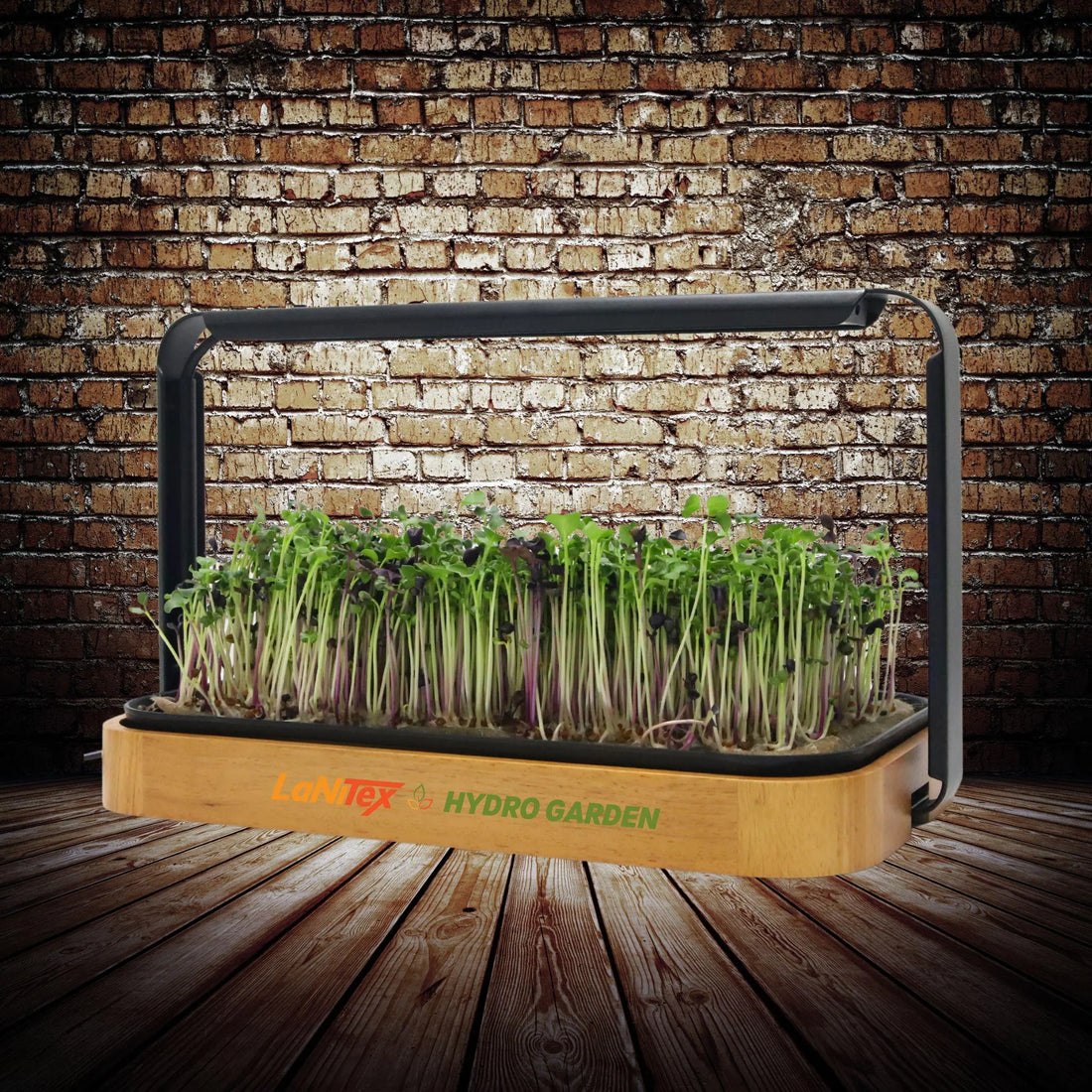
| Recommended kit | Smart Microgreen Kit (Black Metal OR Wooden style) |
How to grow sunflower microgreens in Australia comes down to three steps most beginner guides skim past for humid Australian summers: a proper pre-soak, deeper media than most species need, and a weighted blackout phase. Get those right and sunflower microgreens become the most generous variety in any home kitchen -- not the trickiest.

What are sunflower microgreens?
Sunflower microgreens are the young leafy shoots of Helianthus annuus, grown densely in shallow trays and harvested at the two-leaf cotyledon stage. They are thick, crunchy, and mildly nutty, often described as somewhere between baby lettuce and a fresh sunflower seed. From sow to harvest takes about 8 to 14 days indoors or on a bright windowsill. Their cotyledons are large and meaty for a microgreen, which is why their yield per tray is so high. The seed used is black oil sunflower seeds, not the striped confectionery type.
One quick clarification, because the seed packets blur it: sunflower sprouts and sunflower microgreens are not the same crop. Sprouts are germinated in a jar over a few days and eaten whole, seed and root included. Microgreens are grown in a shallow bed of media, given light, and cut just above the surface at the two-leaf stage after 8 to 14 days. This guide covers the microgreen method, which gives the bigger, crunchier shoot most people picture when they search for sunflower shoots.
Why sunflower microgreens are harder than broccoli or radish
Most beginners grow broccoli or radish first because both can be sown dry on a thin mat. Sunflower is different. The seeds are large, the hulls cling stubbornly to the cotyledons, and germination is uneven without a pre-soak. On top of that, humid Australian summers push mould risk higher than in cooler climates.
Every one of those problems has a known fix. Skip one and a tray that looked promising on day three turns into stuck hulls, leggy stems, or fuzzy mould by day six. The three sunflower-specific moves, pre-soak, weighted blackout, daily hull-loosening mist, separate a heavy first harvest from a failed first try.
What we've learned about growing sunflower microgreens from research
Honest disclosure: Laszlo has not personally grown sunflower microgreens at the Sippy Downs test bench on the Sunshine Coast yet. Sunflower is the variety LaNiTex customers most often flag as a failed first try, because of stuck hulls and uneven germination under humid Queensland conditions. The protocols below draw on Quantum Microgreens' weight-and-blackout method, Attainable Sustainable's homestead approach, The Seed Collection's Australian supplier guidance, and feedback from LaNiTex customers who dialled in the pre-soak timing. First-person observations will be added in a refresh once sunflower trays have run through both Smart Microgreen Kit styles.
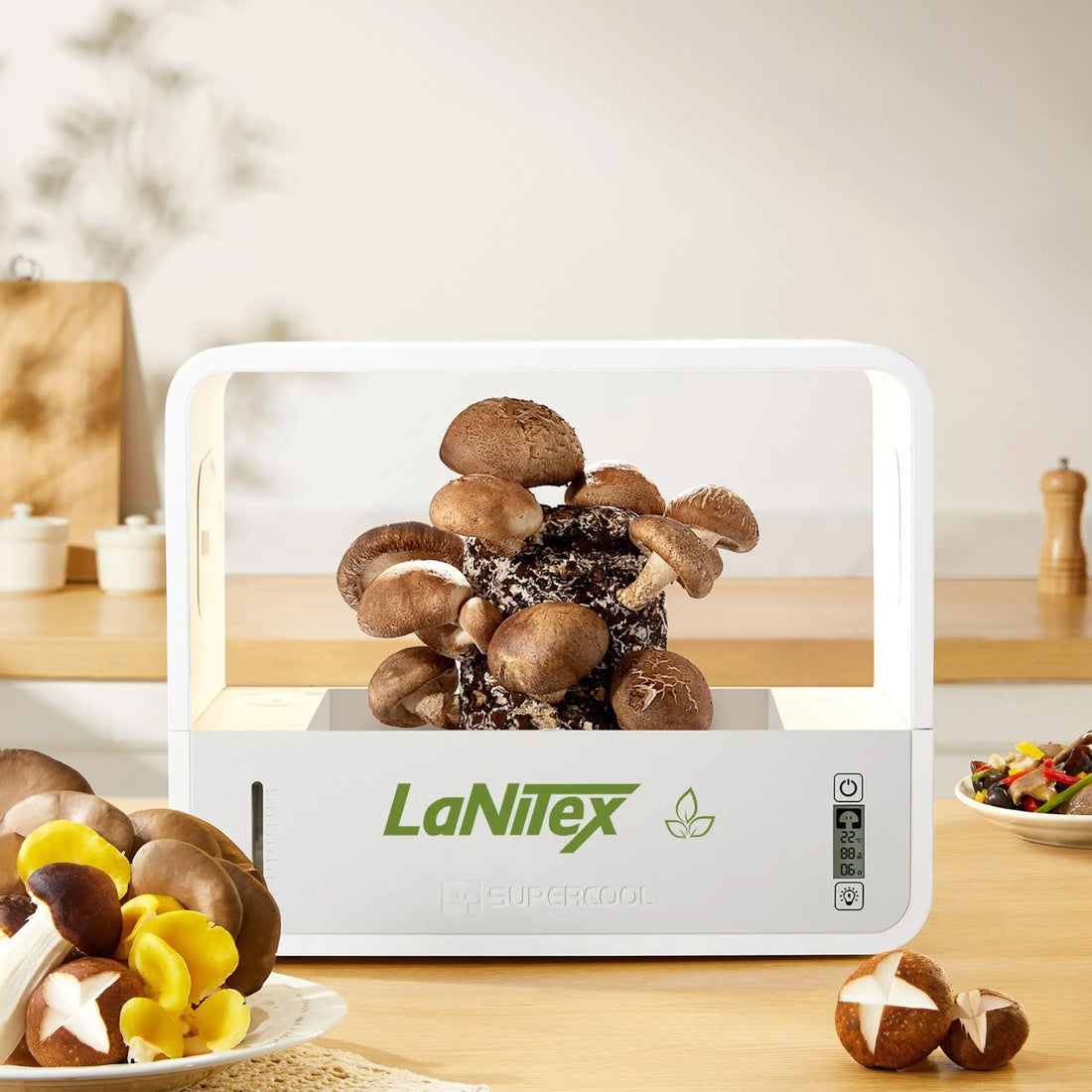
If you want hardware that handles the lid, light schedule, and integrated water automatically, choose the Smart Microgreen Kit. Both styles run the same LED, integrated water reservoir, and reusable lid, only the tray aesthetic differs. The microgreen growing kit (Black Metal) suits a workshop or apartment counter; the wooden microgreen kit suits a kitchen feature wall. Same kit, two styles.

Grow your own sunflower microgreens indoors, harvest in 7–14 days — the self-watering tank and full-spectrum LED handle the daily work. You supply the seeds.
Start your first tray →Personally tested at home on the Sunshine Coast before listing.
Step-by-step: pre-soak, weight method, and harvest
The workflow below covers the three sunflower-specific moves. Order matters.
Pre-soak the seed (6 to 12 hours)
Rinse black oil sunflower seeds in a fine sieve. Tip them into a jar, cover with twice their volume of clean water, and leave on the counter for 6 to 12 hours, or overnight. The shorter window suits a warm Queensland afternoon; the longer suits a cool Hobart morning. Drain, rinse twice, then sow. The pre-soak sunflower seeds method softens the hull and evens germination, the single biggest first-try failure preventer.
Sow on 3 to 5 cm of moist coco coir or potting mix
The sunflower microgreens growing medium needs depth, 3 to 5 cm of coco coir (rinsed if salty) or fine seed-raising mix. A thin hemp mat is not enough; the roots punch down hard. The coco coir vs potting mix choice is mostly about price and water retention, both work if pre-moistened to the wrung-out sponge feel. Spread the soaked seed in a dense single layer. Growers who would rather skip soil can run sunflower on a reusable growing mat instead, though the heavy roots need more anchorage than lighter species: double the mat up, or lay it over a shallow 1 to 2 cm bed of coir so the tray does not lift and dry out mid-grow.
Weighted blackout phase (3 to 4 days)
Cover with a second empty tray, then add a brick or about 2 kg of weight. The weight method keeps every seed in firm contact with the media, drives strong rooting, and helps hulls loosen. The germination lid blackout period drives tall, uniform stems before light hits. Mist once a day. Keep the stack in a dark cupboard.
Light phase (3 to 5 days) and bottom watering
When shoots push the weighted tray up 2 to 3 cm, remove the weight and lid. Move the tray under a grow light or onto the brightest windowsill. Switch to bottom watering: pour into a solid tray underneath the holed seed tray. Bottom watering microgreens at this stage keeps the canopy dry and slashes mould risk.
Daily mist and harvest at the two-leaf stage
Mist the canopy once a day and gently brush a hand across the tops to dislodge hulls. Sunflower microgreens are ready when the cotyledons are fully open, 7 to 10 cm tall, and the first true leaves are just visible (days 8 to 14 from sow). Cut just above the media line. Harvest before true leaves arrive; once they do, the flavour turns bitter and stems stringy.
Sunflower hull removal: the daily mist-and-brush
Stuck hulls are the number one searcher pain for sunflower. Sunflower hull removal is mechanical, not chemical. Mist the canopy each morning and run a clean hand across the tops, moisture softens the hull, friction releases it. A second pass with a soft brush on day 8 to 10 picks up stragglers. Any hulls that survive harvest can be flicked off during the rinse. Fair point: nobody warned you. Now you know.
Common problems: mould, leggy growth, and uneven germination
Mould first, because Queensland humidity makes it the loudest worry. Sustainable Gardening Australia notes that "Farms utilizing hydroponics use up to 90 percent less water", a reminder that semi-hydroponic microgreen setups already run at lower humidity than open soil. Even so, mould on microgreens spikes in February to March on the Sunshine Coast and across northern New South Wales.
Three fixes for mould, in order: bottom-water from day 5, run a small fan from day 5 (gentle airflow, not a gale), never let the canopy sit damp overnight. Grey fuzz that is white and fine around the seed is root hair, normal. Anything green or black: bin and restart.
Leggy growth means the blackout went too long or the light phase is too dim. Aim for 3 to 4 days weighted, then 12 to 16 hours bright light.
Uneven germination almost always traces back to a skipped pre-soak. The pre-soak is non-negotiable for sunflower.
Cost-conscious households ask: is it worth it? Sunflower microgreens give the heaviest yield per tray of any common variety, roughly 2 to 3 times the gram weight of basil or amaranth from the same footprint. In practical terms, a standard 10 by 20 inch tray returns somewhere around 225 to 450 g of cut microgreens depending on variety and sowing density, and sunflower sits at the heavy end of that range. That is why sunflower microgreens Australia has been quietly trending in cost-of-living forums.
For the easiest workflow, the Smart Microgreen Kit Black Metal Style ($129) or Wooden Style ($189) handle lid, lighting, and integrated water. Same kit, two styles -- pick the aesthetic.
Get a fresh grow guide like this every fortnight
Join the LaNiTex Hydro Garden newsletter for practical hydroponic, microgreen and mushroom growing tips for Australian homes. Subscribe to download a free hydroponics starter guide (PDF) and get 10% off your first order.
Join the newsletter →How to store sunflower microgreens after harvest
Cut sunflower microgreens keep best when they go into the fridge dry. It is tempting to wash a fresh tray straight away, but surface moisture is exactly what turns the shoots slimy within a day or two, the same airflow logic that keeps mould out of the growing tray. Lay the harvest loosely in a lidded container with a sheet of paper towel to wick stray moisture, and store it in the crisper. Treated this way they hold for about 5 to 7 days, and the paper towel can be swapped if it dampens. Rinse only the handful you are about to eat, then pat it dry. Sunflower is at its crunchiest straight off the tray, so for the best texture grow on a short rotation rather than storing one large batch.
Are sunflower microgreens good for you?
Yes, sunflower microgreens are a genuinely nutrient-dense leaf, and their nutrition is a big part of the appeal. Research led by the United States Department of Agriculture found that microgreens generally carry higher concentrations of vitamins and antioxidants, gram for gram, than the same plant grown to maturity (Xiao et al., 2012). Most of the benefits people look for come from that density: sunflower shoots in particular bring plant protein, vitamin E and a spread of minerals to a salad or sandwich for very little effort or outlay. Treat them as a fresh garnish you grow on the bench rather than a supplement: a handful scattered over a finished plate is the simplest way to work them in.

Keep a clean, soil-free base ready for your next sowing — ten reusable germination mats that rinse out and run tray after tray.
Stock up on mats →Personally tested at home on the Sunshine Coast before listing.
Sunflower microgreens FAQ
What are sunflower microgreens?
Sunflower microgreens are the young, leafy shoots of Helianthus annuus grown densely in shallow trays and harvested at the two-leaf (cotyledon) stage. They're thick, crunchy and mildly nutty, often compared to baby lettuce or sunflower seeds in flavour. Grown indoors or on a bright windowsill, they're ready to harvest in about 8 to 14 days.
How do I grow sunflower microgreens at home in Australia?
To grow sunflower microgreens in Australia, pre-soak black oil sunflower seeds for a few hours, then sow a dense single layer on 3 to 5 cm of moist coco coir or potting mix in a tray with drainage. Cover with a second tray and weight for 3 to 4 days, misting daily. Once they push the lid up, move them to bright light and bottom-water until harvest at 8 to 14 days.
Do sunflower microgreens need to be soaked before planting?
Yes, sunflower microgreens grow more reliably if you pre-soak the seeds. Rinse them, then soak in clean water for 6 to 12 hours to soften the hull and speed germination. Drain and rinse well before sowing. This is especially helpful for the larger black oil seeds, which can otherwise be slow and uneven to sprout.
What is the weight method for sunflower microgreens?
The weight method means stacking a second tray directly on top of freshly sown sunflower seeds and placing a brick or similar weight on it. This keeps the seeds in firm contact with the moist medium, encourages strong rooting, and helps hulls loosen. Keep them weighted in the dark for a few days, misting daily, until the shoots push the tray up.
How long do sunflower microgreens take to grow?
Sunflower microgreens usually take 8 to 14 days from sowing to harvest. You'll see germination within 2 to 4 days, then a rapid growth phase once they're in the light. Harvest when they're about 7 to 10 cm tall and still at the two-leaf stage, before true leaves appear and the flavour becomes stronger and more fibrous.
What do sunflower microgreens taste like and how can I use them?
Sunflower microgreens have a crunchy texture and a mild, nutty flavour, a bit like fresh sunflower seeds crossed with baby lettuce. They're excellent in salads, grain bowls, sandwiches and wraps, or simply scattered over eggs, soups and stir-fries after cooking. Their sturdy stems also make them ideal as a snack on their own.
Why are my sunflower microgreens mouldy, leggy or covered in stuck hulls?
Mould usually comes from over-watering, poor airflow or very humid weather; use bottom-watering, good drainage and a small fan if needed. Leggy, pale growth means they stayed in the dark too long or don't have enough light. Stuck hulls are normal with sunflower; mist the canopy and gently brush your hand across the tops each day to loosen them.
Where can I buy sunflower microgreen seeds in Australia?
In Australia, you can buy sunflower microgreen seed from online seed companies such as The Seed Collection, Mr Fothergill's, Eden Seeds, Greenharvest and Seedmart, from hydroponic and microgreen suppliers, or local nurseries that stock black-oil sunflower seed for sprouting. Look for untreated, food-grade seed labelled for microgreens or sprouts, as standard garden seed packets are usually too small and more expensive per tray.
The full range
Find the microgreen kit that suits your kitchen


Supported in Australia - every model tested before listing.
Sources
- Sustainable Gardening Australia, "The Pros and Cons of Hydroponic Growing" (31 August 2019). Retrieved 26 May 2026 from sgaonline.org.au. Direct quote on water efficiency.
- Australian Bureau of Statistics, "Housing: Census" (2021 Census). 16% of Australian households live in apartments and 13% in townhouses, indicating strong demand for compact indoor growing setups.
- Xiao, Z., Lester, G.E., Luo, Y. and Wang, Q., "Assessment of Vitamin and Carotenoid Concentrations of Emerging Food Products: Edible Microgreens" (2012). Journal of Agricultural and Food Chemistry, 60(31), pp. 7644-7651 (US Department of Agriculture / University of Maryland). Cited for microgreen nutrient density relative to mature leaves.
Explore other microgreen varieties
Grown Sunflower once? These pair naturally with the same Smart Microgreen Kit & Germinating Growing Mats.
Quick & easy to grow
Easy to start with
Pairs well in the kitchen
→ Browse all 22 microgreen varieties | → Microgreens growing guide
About the writer
Laszlo Bulatko built LaNiTex Hydro Garden around a simple idea: fresh food you grew yourself should be within reach of every Australian home — flat or house, balcony or kitchen bench. From its base on the Sunshine Coast, LaNiTex makes that easy and affordable — hydroponic grow boxes, a benchtop Mini Grow Pot, and the Smart Microgreen Kit — alongside the Term-Grow Enrolment programme in Queensland primary school classrooms. He founded LaNiTex in December 2024 and personally tested every product at home before it went in the catalogue, bringing 15 years of brand-building from the Hungarian fishing-tackle trade. More on the About Laszlo founder page. ABN 47 682 768 967.