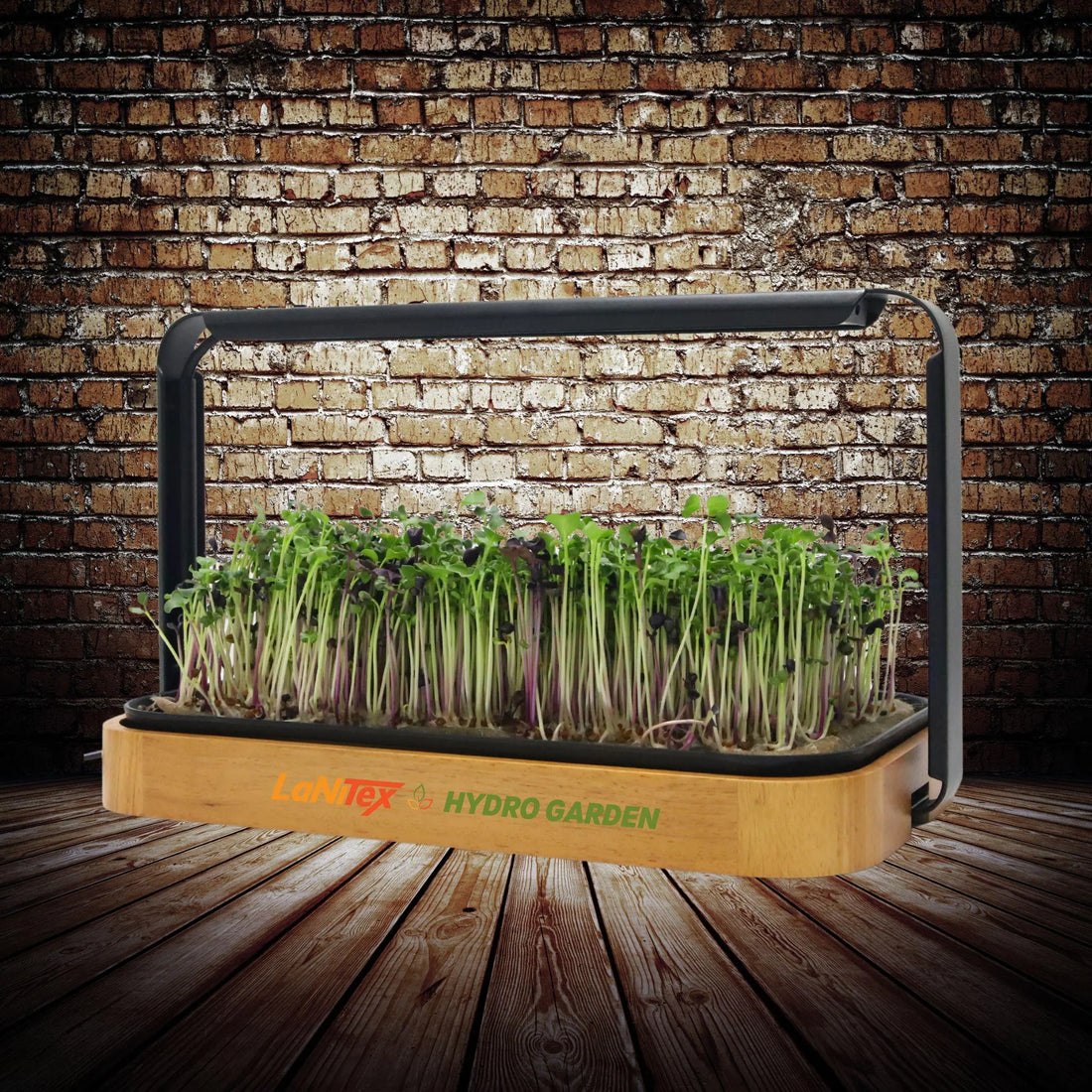

By next Sunday lunch, peppery rocket microgreens could be snipping off a kitchen bench in Sippy Downs, Spring Hill or South Melbourne, ten to fourteen days from seed to scissors, no garden bed required.
Quick answer: Rocket microgreens (Eruca sativa) are the young seedlings of rocket, harvested 10-14 days after sowing when the cotyledon leaves stand around 5-7 cm tall. They deliver the classic peppery, nutty rocket bite in about a third of the time mature rocket leaves need outdoors. Sow 5 g of seed per punnet-sized tray, blackout for 2-3 days, light phase 12-16 hours daily, mist daily, harvest with clean scissors above the medium.
Key takeaways:
- Rocket microgreens are ready in 10-14 days under indoor LED at 20-24 deg C.
- Supermarket rocket leaves arrive 3-5 days post-harvest, wilted in plastic clamshells; home-grown rocket microgreens hit the bowl alive.
- Mould is the #1 cause of cheap-kit failure on dense brassica microgreens. Airflow + surface-dry watering + light = the three-leg fix.
- LaNiTex sells the Smart Microgreen Kit ($129 Black Metal or $189 Wooden, same kit, two styles) and the Germinating Growing Mats 10-pack ($14.90). LaNiTex does NOT sell rocket seed; AU growers source seed from The Seed Collection, Mr Fothergill's, Eden Seeds, Greenharvest or Seedmart.
- Honest disclosure: Laszlo's pre-launch testing in Sippy Downs covered radish, broccoli and sunflower, not rocket. The guidance below combines Australian + global authority sources.
At-a-glance:
| What | When | Where |
|---|---|---|
| Primary keyword | Rocket microgreens | This guide |
| Eruca sativa | 10-14 days harvest | Indoor 20-24 deg C |
| 5-7 cm tall | Cotyledon stage | Cut with clean scissors |
| Same Smart Microgreen Kit | $129 Black Metal / $189 Wooden | Ships Australia-wide |
What are rocket microgreens?
Rocket microgreens are the young seedlings of Eruca sativa (also classified Eruca vesicaria subsp. sativa), harvested 10-14 days after sowing when the cotyledon leaves are 5-7 cm tall. They taste strong, peppery and slightly nutty, the classic rocket bite people expect from the mature leaf, concentrated into a tender baby green. Most Australian growers use salad rocket (Eruca sativa); wild rocket (Diplotaxis tenuifolia) is a slower-growing, narrower-leafed cousin with an even sharper, more pungent bite, so reach for salad rocket if you want a faster, milder first tray.
Rocket microgreens belong to the Brassicaceae (brassica) family, the same broad group as broccoli microgreens, radish microgreens, kale microgreens and mustard. The family trait matters: brassicas germinate fast (2-3 days under cover), grow dense, and are prone to surface mould if airflow drops. The protocol that works for broccoli microgreens works for rocket with one small tweak (seed density). Same family, same fix list when problems hit.
A note on terminology: AU and UK gardeners call this plant rocket. US growers call the same plant arugula. So US-English readers may search this as "arugula microgreens", same plant, same protocol. The rest of this guide uses rocket as the primary term, with one FAQ cross-reference.

Why grow rocket microgreens at home?
Three reasons most home growers in Australia switch from supermarket rocket to home-grown microgreens: flavour, freshness, cost.
Supermarket rocket leaves are picked 3-5 days before they hit the shelf, then sit under fluoro light losing colour, flavour and crunch. Home-grown rocket microgreens hit the bowl 10 to 14 days from sowing: peppery, upright, alive. Flavour per gram is higher than the mature leaf. To put a number on the payoff: commercial growers report a full 10 x 20-inch tray of rocket (arugula) microgreens yields around 280 g (10 oz) in roughly two weeks (Garden Gear Shop); a punnet-sized home tray uses a fraction of that seed, so it finishes four to six salads.
Cost stacks up across a year. A 30-50 g supermarket punnet runs $4-5 in QLD and NSW (more in Hobart). Buy one per week and you spend $208-260 a year. A $129 Smart Microgreen Kit plus a $14.90 mat 10-pack pays back in about seven months, and the kit lasts years.
For apartment dwellers (about 16 per cent of Australian households per the 2021 Census), the kitchen-bench microgreen is the no-garden shortcut to fresh-grown food. A tray takes up about A4 paper of bench space.
There is a nutrition angle, too. A USDA-linked study of 25 edible microgreens found their young cotyledon leaves generally pack higher concentrations of vitamin C, vitamin E, vitamin K and carotenoids than the mature leaves of the same plants (Xiao et al., 2012), so a freshly snipped tray of rocket microgreens delivers that peppery bite with a dense nutrient hit.
What Laszlo has learned about growing rocket microgreens from research
Honest disclosure: rocket microgreens were not part of the LaNiTex Smart Microgreen Kit pre-launch validation crop list personally tested in Sippy Downs (Sunshine Coast, QLD 4556) before stocking the kit; radish, broccoli and sunflower were the three calibration crops. That still counts for rocket: radish and broccoli are brassicas too, so the lessons from those test trays carry over almost directly, fast 2-3 day germination, a dense canopy that moulds the moment airflow drops, and surface-dry bottom-watering to stay ahead of it. The species-specific detail below adds Urban Revolution AU's home-grower protocol, the National Sustainable Agriculture Coalition Foundation's brassica-family research, Northey Street City Farm's mould-prevention advice, and AU horticultural sources like The Seed Collection and About The Garden Magazine.
Local results vary by climate zone. Brisbane growers face higher mould risk in humid summer; Hobart growers face slower germination in winter. The troubleshooting section names the mould, light and watering pitfalls most likely to bite AU growers in each climate band.
Skip the soil-vs-water debate for rocket. Both work. The Smart Microgreen Kit uses Germinating Growing Mats by default; a seed raising mix tray works fine too.
How rocket microgreens grow in Australia
Rocket microgreens grow indoors year-round in every Australian climate zone. The crop sweet spot is around 20-24 deg C (the broader 18-24 deg C range also works), bright but not direct hot sun, daily mist plus bottom-watering, 12-16 hours of light per day. City-by-city:
| AU climate zone | Indoor temp range | Days to harvest | Watering frequency |
|---|---|---|---|
| Brisbane (humid subtropical) | 22-26 deg C | 10-12 | 2-3 times daily mist + airflow critical |
| Sydney (coastal temperate) | 18-23 deg C | 11-13 | 1-2 times daily mist |
| Melbourne / Adelaide (temperate) | 18-22 deg C | 12-14 | 1 time daily mist |
| Perth (Mediterranean dry) | 20-24 deg C | 11-13 | 2 times daily mist + airflow |
| Hobart (cool temperate) | 16-20 deg C | 13-15 | 1 time daily mist + heat mat assist |
Where to source rocket seed in Australia: LaNiTex sells the kit, not the seed. AU growers source rocket seed from:
- The Seed Collection (organic + standard rocket microgreen seed packs)
- Mr Fothergill's (via Bunnings, mass-retail)
- Eden Seeds (certified organic)
- Greenharvest (Sunshine Coast supplier, bonus local provenance)
- Seedmart (microgreen-specific seed product pages)
A 50 g rocket microgreen seed pack from Seedmart Australia runs about $5-7 and sows 10 punnet-sized trays at the recommended density.
Ready to skip the supermarket punnet?
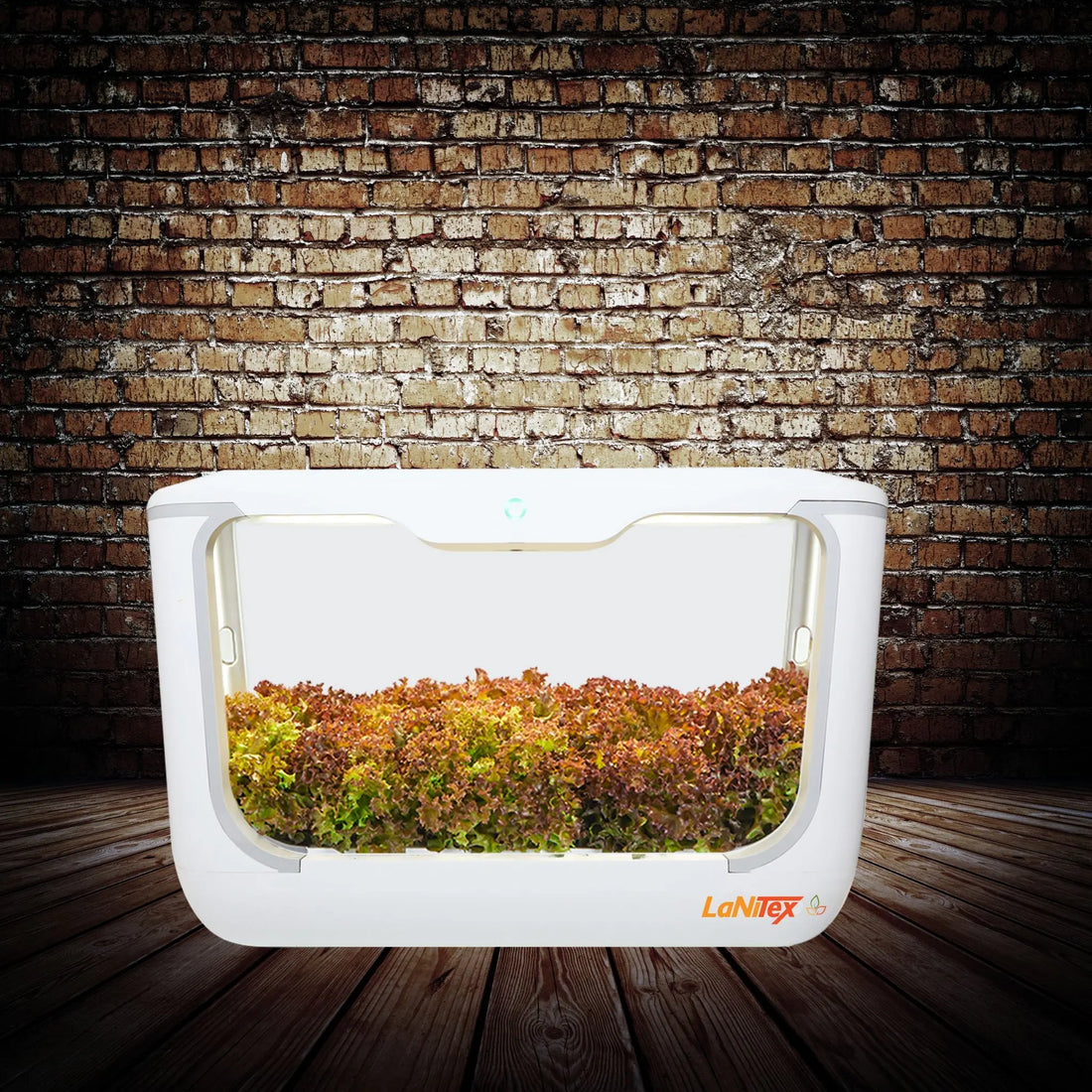
Most apartment growers in Brisbane, Sydney, Melbourne, Adelaide, Perth and Hobart hit the same wall: a bargain plastic-tray kit lasts one or two flushes, then mould or leggy stems set in. The Smart Microgreen Kit handles the blackout phase, the 16W LED light cycle, and the bottom-watering reservoir automatically. Sow, mist, snip.
Same Smart Microgreen Kit, choose your style:
| Style | Price | Best for |
|---|---|---|
| microgreen growing kit (Black Metal) | $129 | Modern, clean, kitchen-bench-friendly |
| wooden microgreen kit | $189 | Warm, Scandi-style, lives well on open shelving |
3-year warranty. Ships Australia-wide from Sippy Downs (Sunshine Coast, QLD 4556).

Fresh microgreens on your kitchen bench in 7–14 days — the self-watering tank and full-spectrum LED do the daily work. You supply the seeds.
Start your first tray →Personally tested at home on the Sunshine Coast before listing.
Step-by-step: growing rocket microgreens from seed to harvest
The six steps below cover the full seed-to-scissors sequence for the Smart Microgreen Kit. The same protocol applies to a DIY tray with one substitution (seed raising mix instead of Germinating Growing Mat). Total active time: about 15 minutes spread across 14 days.
Step 1. Choose your kit and set up the tray
Place a Germinating Growing Mat in the Smart Microgreen Kit tray, or fill a clean DIY tray with seed raising mix to about 2 cm depth. Pre-moisten with filtered or rain water until the medium feels damp, not soggy. Drainage holes matter; a soaking-wet medium triggers fungal growth on day 3.
"Microgreens are best grown in seedling trays or recycled styrofoam boxes. They differ from sprouts in that they are grown in sunlight and usually harvested when there are 4 or more true leaves."
-- Green Harvest (AU)
Step 2. Sow at the right density
Scatter 5 g of rocket seed evenly across one punnet-sized tray (about one level teaspoon). Press lightly so each seed contacts the medium; do not bury. Too thin gives patchy harvests; too thick feeds mould.
"Sow Rate: 5 grams per small (punnet-sized) tray... Harvest in 7-14 days when plants reach 5-7 cm tall."
-- Seedmart Australia
Pre-soak is not required for rocket. Brassicas germinate fine from dry.
Step 3. Blackout phase (2-3 days)
Cover with the Smart Microgreen Kit lid or a second tray to block light for 2-3 days. The cover is optional for rocket (it can germinate under light) but gives a more even canopy. Keep in a dark, warm spot at 20-24 deg C. Without the blackout phase, some seeds sprout days late and the canopy ends up uneven.
Once a day is enough; don't peek every hour.
Step 4. Light phase (12-16 hours daily)
Once cotyledons appear (day 3 in Brisbane, day 4-5 in Hobart), move under the Smart Microgreen Kit 16W LED for 12-16 hours, or to a bright window with no direct hot sun. North-facing QLD summer windows scorch cotyledons by noon; the LED removes the guesswork.
Step 5. Mist and bottom-water
Mist once or twice daily. When the medium feels dry on top, bottom-water from the kit reservoir so roots draw moisture without wetting leaves. Top-watering wet leaves is the #1 mould trigger.
Step 6. Harvest at 5-7 cm in 10-14 days
Around day 10-14, when greens stand 5-7 cm tall and the first true leaves begin to form, cut with clean scissors just above the medium. Don't wait past day 14; flavour gets sharper and texture coarser.
Store wrapped in damp paper towel in a sealed container in the fridge. Eat within 3-5 days.
"Microgreens are grown to the point either just before their first set of true leaves come through or just after. Only the leaf and stem are eaten."
-- Balcony Permaculture (AU)
Get a fresh grow guide like this every fortnight
Join the LaNiTex Hydro Garden newsletter for practical hydroponic, microgreen and mushroom growing tips for Australian homes. Subscribe to download a free hydroponics starter guide (PDF) and get 10% off your first order.
Join the newsletter →Common problems and how to fix them
Most rocket microgreen failures come back to four causes in order of likelihood: mould, leggy stems, uneven germination, drying out. The fixes overlap.
1. Mould prevention (searcher fear #1)
Mould is the most common rocket microgreen failure, especially in Brisbane summer. Brassicas are dense, the canopy traps moisture, and warm wet conditions feed Fusarium and damping-off fungi quickly, often within 24-48 hours when trays are crowded or poorly ventilated.
"The real danger for microgreens is root stem fungus infection. They can be perfect one day but dead the next morning. To combat this, you will need constant airflow."
-- Northey Street City Farm (AU)
The three-leg fix:
- Surface-dry watering. Bottom-water from the kit reservoir; mist sparingly. Surface damp like a wrung-out cloth, not wet.
- Constant airflow. Crack a window, run a small fan, or use the Smart Microgreen Kit's vented humidity lid.
- Clean trays and fresh water. Wash trays in hot soapy water between flushes.
Don't drown the tray.
2. Leggy stems (insufficient light)
If rocket microgreens stretch tall, thin, and pale, they're reaching for light. Move under the Smart Microgreen Kit LED or to a bright window within 24 hours of cotyledon emergence.
3. Uneven germination (seed density)
Patchy trays mean uneven scatter. Use a salt shaker or fine-mesh sieve to spread seed evenly across the whole surface.
4. Drying out
If the medium dries before harvest, switch to bottom-watering twice a day in Perth dry summer or Sydney warm autumn. Keep the reservoir topped up.
Mould, leggy stems, uneven germination, drying out, the fix
The mould risk is the single biggest reason cheap plastic-tray kits get returned. Rocket microgreens are a fast, dense, brassica-family crop: they crowd, they sweat, they rot. The Smart Microgreen Kit's integrated humidity lid plus 16W LED light helps manage all three triggers (excess surface moisture, poor airflow, low light), though good mould control still depends on steady airflow and clean trays.
Same Smart Microgreen Kit, choose your style: Black Metal $129 or Wooden $189. 3-year warranty. Australia-wide shipping.
How to use rocket microgreens in the kitchen

Rocket microgreens punch above their size in the kitchen. The peppery flavour lifts:
- Salad base. Toss 30 g with mature rocket leaves, shaved parmesan, lemon olive oil, crushed walnut.
- Sandwich layer. Heap under sourdough, prosciutto, ricotta.
- Egg topper. Strew over scrambled eggs or poached-egg toast last second.
- Toast garnish. Avocado smash on sourdough with a fistful of microgreens, chilli flake, sea salt.
- Pizza finisher. Add to a Margherita after it comes out of the oven.
- Grilled-meat sidekick. A small pile beside lamb cutlets or barbecued steak.
Light recipe: 50 g rocket microgreens, 1 tbsp lemon olive oil, grated parmesan, crushed walnuts, sea salt. Serve as a starter or with grilled fish. Store in damp paper towel inside a sealed container; eat within 3-5 days.

Restock the refill your kit runs on — 10 soil-free growing mats, ready for your next sowing.
Restock your mats →Personally tested at home on the Sunshine Coast before listing.
Rocket microgreens FAQ
What are rocket microgreens?
Rocket microgreens are the young seedlings of rocket, grown just after germination and harvested when the first true leaves begin to form. They have a strong peppery, nutty flavour and are ready fast, usually in 10-14 days. They're popular for salads, sandwiches, and garnishes because they deliver classic rocket taste in a small, tender crop.
Is rocket the same as arugula?
Yes. In Australia and the UK, the leafy green is called rocket. In the US, the same plant is commonly called arugula. For microgreens content in Australia, use rocket as the primary term and mention arugula as the US cross-reference so readers can recognise both names.
How do you grow rocket microgreens at home in Australia?
Fill a clean tray with seed raising mix or a growing mat, pre-moisten it, scatter rocket seeds thickly, and lightly cover or press them in. Keep them dark and warm for germination, mist daily, then move them into bright light once they sprout. Harvest with clean scissors when they reach about 10-14 days.
What do rocket microgreens taste like?
Rocket microgreens taste strong, peppery, and slightly nutty, with the classic rocket bite people expect from the mature leaf. The flavour is bold enough to lift salads, eggs, toast, wraps, and grilled dishes. If you want a microgreen with a familiar but punchy taste, rocket is one of the best choices.
How long do rocket microgreens take to harvest?
Rocket microgreens are usually ready in 10-14 days. In warm indoor conditions with good light, they can be cut as soon as they are dense, upright, and big enough to snip above the growing medium. The fast turnaround makes rocket one of the easiest microgreens for beginners.
Why do rocket microgreens get mould?
Rocket microgreens get mould when the tray stays too wet, airflow is poor, or the seeds are overcrowded without enough ventilation. Keep the surface damp, not soggy, water from the bottom when possible, and give the tray steady airflow. Clean trays and fresh water also help prevent mould.
Why are my rocket microgreens leggy?
Rocket microgreens become leggy when they are stretched for light. Move them into a bright window or under grow lights as soon as they sprout, and keep the tray close to the light source. Healthy rocket microgreens should be compact, upright, and evenly green.
Are rocket microgreens easy for beginners?
Yes. Rocket microgreens are easy for beginners because they sprout quickly, need only a shallow tray, and are ready to harvest in about two weeks. With a moist growing medium, bright light, and a little airflow, you can grow a reliable crop indoors at home.
Are rocket microgreens good for you?
Yes. Like other microgreens, rocket microgreens are nutrient-dense for their size. Research on edible microgreens found their cotyledon leaves generally carry higher concentrations of vitamin C, vitamin E, vitamin K and carotenoids than the mature leaves of the same plant. They are a fresh, low-kilojoule way to add colour, flavour and nutrients to everyday meals.
Are rocket microgreens the same as rocket sprouts?
No. Rocket microgreens are grown in light and cut above the growing medium, so you eat just the stem and leaves once the first true leaves appear, around 10-14 days. Rocket sprouts are germinated in the dark over a few days and eaten whole, seed, root and shoot, usually rinsed from a jar. Microgreens give you the fuller, peppery rocket flavour; sprouts are softer and milder.
Explore other microgreen varieties
Grown Rocket once? These pair naturally with the same Smart Microgreen Kit & Germinating Growing Mats.
More brassica greens
Easy to start with
Mediterranean & Italian
→ Browse all 22 microgreen varieties | → Microgreens growing guide
About the writer
Laszlo Bulatko built LaNiTex Hydro Garden around a simple idea: fresh food you grew yourself should be within reach of every Australian home — flat or house, balcony or kitchen bench. From the Sunshine Coast he makes smart indoor growing simple and affordable — hydroponic grow boxes, a benchtop Mini Grow Pot, and the Smart Microgreen Kit — and runs the Term-Grow Enrolment programme placing grow boxes in Queensland primary school classrooms. Since founding LaNiTex in December 2024, he has personally tested every product at home before listing it — a discipline carried over from 15 years building brands in the Hungarian fishing-tackle market. More on the About Laszlo founder page. ABN 47 682 768 967.
The full range
Find the microgreen kit that suits your kitchen


Supported in Australia - every model tested before listing.
Sources
- The Seed Collection (AU). Rocket microgreen grow guide. theseedcollection.com.au
- Green Harvest (AU). "Microgreens are best grown in seedling trays or recycled styrofoam boxes. They differ from sprouts in that they are grown in sunlight and usually harvested when there are 4 or more true leaves." greenharvest.com.au
- About The Garden Magazine (AU). "Mizuna, rocket, cress, pea, bean, cabbage rubies, and commonly seed packets labelled microgreens are perfect for growing." aboutthegarden.com.au
- Balcony Permaculture (AU). "Microgreens are grown to the point either just before their first set of true leaves come through or just after. Only the leaf and stem are eaten." balconypermaculture.com.au
- Seedmart Australia. "Sow Rate: 5 grams per small (punnet-sized) tray... Harvest in 7-14 days when plants reach 5-7 cm tall." seedmart.com.au
- Northey Street City Farm (AU). "The real danger for microgreens is root stem fungus infection. They can be perfect one day but dead the next morning. To combat this, you will need constant airflow." nscf.org.au
- Sustainable Gardening Australia. "Farms utilizing hydroponics use up to 90 percent less water." sgaonline.org.au
- Australian Bureau of Statistics (2021 Census). "70 per cent were separate houses, 13 per cent were townhouses and 16 per cent were apartments." abs.gov.au
- Xiao, Z., Lester, G.E., Luo, Y., Wang, Q. (2012). "Assessment of vitamin and carotenoid concentrations of emerging food products: edible microgreens." Journal of Agricultural and Food Chemistry, 60(31), 7644-7651. pubmed.ncbi.nlm.nih.gov
- Garden Gear Shop. Microgreens yield per tray (arugula approx 10 oz per 10x20 tray). gardengearshop.com