
Slice a handful of deep purple-red microgreens over a slaw and you have already beaten every $5 supermarket punnet. Red cabbage microgreens turn that purple in 7-14 days on a kitchen bench.
Quick answer: Red cabbage microgreens grow in 7-14 days from sowing to harvest, develop their vivid deep purple-red colour from anthocyanin pigments during the 12-16 hour daily light phase, and suit beginners thanks to a mild sweet brassica flavour. Sow Brassica oleracea (red types) on a shallow tray with a coco coir mat, blackout 3-5 days, then bright indirect light, then harvest at 4-7 cm with clean scissors.
- Time from sowing to harvest: 7-14 days, depending on Australian climate zone and indoor temperature.
- The vivid purple-red colour develops from natural anthocyanin pigments during the light phase (factual; no medical claims).
- Mild, slightly sweet brassica flavour. Kid-friendly, unlike spicy mustard microgreens.
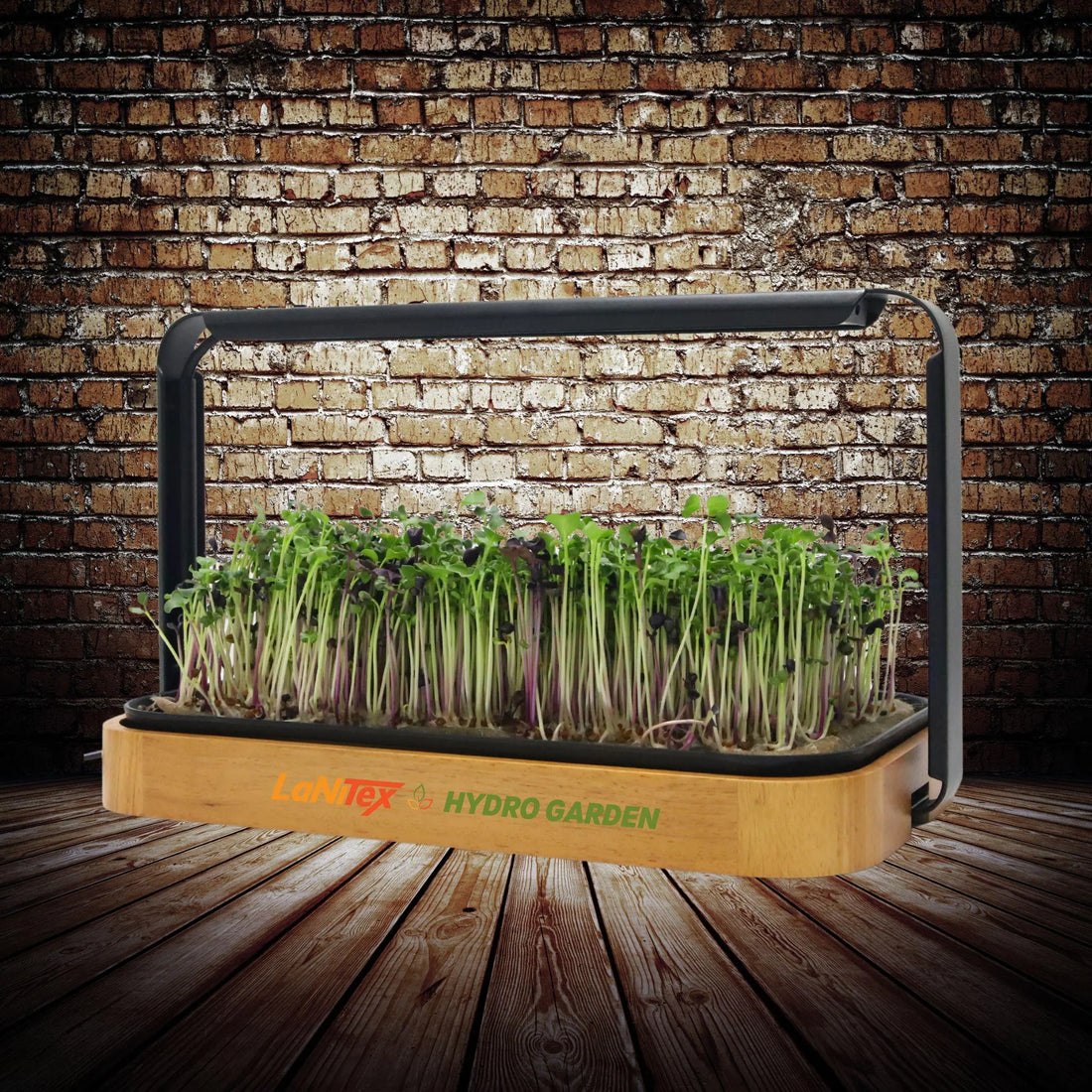
- Same Smart Microgreen Kit, two style options: Black Metal at $129 or Wooden at $189. Both run the same LED, integrated water tray, and reusable lid system; the difference is the tray aesthetic.
| At a glance | Detail |
|---|---|
| Species | Brassica oleracea (Capitata group, red types) |
| Days to harvest | 7-14 |
| Difficulty | Easy |
| Taste | Mild brassica, slightly sweet |
| Best uses | Slaws, tacos, grain bowls, sandwich garnish |
| Recommended kit | Smart Microgreen Kit (Black Metal $129 or Wooden $189) |
What are red cabbage microgreens?
Red cabbage microgreens, sometimes called purple cabbage microgreens, are the young seedlings of Brassica oleracea (Capitata group, red types), harvested when the first true leaves are still small -- typically 4-7 cm above the medium. They sit between sprouts (which are just germinated seeds rinsed in water) and full baby leaves. Three cultivars dominate the AU seed-supply chain: Red Acre, Mammoth Red Rock, and Ruby Perfection. All three produce nearly identical microgreens, so a beginner can pick whichever the local supplier stocks.
Anthocyanin pigments give the first true leaves their vivid deep purple-red colour during the light phase. That is the look chefs pay for. Compared with the mature red cabbage head, which takes 70-100 days to form, microgreens deliver concentrated flavour and visual punch in roughly a tenth of the time.
The variety is forgiving: no pre-soaking, modest light needs, and a blackout phase short enough to fit a weekend kitchen project.

Why grow red cabbage microgreens at home?
Growing red cabbage microgreens at home turns a $5 supermarket punnet, typically 30-50 g and 3-5 days old by retail, into a fresh-cut, sub-$1 garnish on demand. The flavour is brighter and the colour deeper than anything that has spent days on a chiller shelf.
The deep purple-red colour makes them a striking garnish on slaws, tacos, and grain bowls. Plate appeal matters: chefs use red cabbage microgreens precisely because no other common microgreen delivers that intensity of natural pigment.
Red cabbage microgreens contain anthocyanins (the pigment family responsible for their purple-red colour) and glucosinolates (a brassica compound family present in cabbage-family greens). A peer-reviewed microgreens nutrition analysis (Xiao et al., 2012) ranked red cabbage among the most nutrient-dense microgreens it tested, and one of the richest in vitamin C. The same study found that microgreens generally carry several times the vitamin and carotenoid concentration of their mature counterparts by weight. Microgreen nutrition research is still emerging, so this guide on red cabbage microgreens nutrition sticks to what is factually documented, not health claims.
Across Australia, 16 per cent were apartments in the 2021 Census, and a kitchen-bench microgreen growing kit fits where a vegetable patch never could. The mild, slightly sweet flavour also makes red cabbage microgreens easier to introduce to kids than spicier brassicas like mustard.
What I have learned about growing red cabbage microgreens from research
Honest disclosure: red cabbage microgreens were not part of the LaNiTex Smart Microgreen Kit pre-launch validation crop list personally tested in Sippy Downs (Sunshine Coast, QLD 4556) before stocking the kit. Radish, broccoli, and sunflower were the three calibration crops. The guidance below combines established Brassica oleracea microgreen growing protocols, published nutrient-density data (anthocyanin and glucosinolate factual content only, no medical claims), Penn State Extension's brassica microgreen academic baseline, and The Seed Collection AU's red cabbage cultivar specs. Local results may vary by climate zone; the troubleshooting section names the mould, light, and colour-development pitfalls most likely to bite AU growers in Brisbane humidity versus Melbourne winter.
Get a fresh grow guide like this every fortnight
Join the LaNiTex Hydro Garden newsletter for practical hydroponic, microgreen and mushroom growing tips for Australian homes. Subscribe to download a free hydroponics starter guide (PDF) and get 10% off your first order.
Join the newsletter →Growing red cabbage microgreens in the Australian climate
Climate makes a real difference for a brassica that needs a long-ish blackout phase. The table below covers the five main AU climate zones with practical settings for the Smart Microgreen Kit indoors.
| AU climate zone | Indoor target temp | Mould risk | Days to harvest | Watering notes |
|---|---|---|---|---|
| Brisbane / SE QLD humid summer | 18-24 deg C; keep below 28 deg C | HIGH (airflow priority) | 8-10 days, slower | Mist sparingly; bottom water; small fan |
| Sydney / coastal NSW | 18-24 deg C year-round | MODERATE | 7-10 days | Standard mist plus bottom water |
| Melbourne / Adelaide temperate | 18-22 deg C winter minimum | MODERATE indoor | 9-12 days winter / 7-10 summer | Standard |
| Perth dry | 18-24 deg C | LOW | 7-10 days | Mist more often (drier air) |
| Hobart cool | 16-20 deg C | LOW | 12-14 days | Wait longer; ensure 12-16 hours light |
Same Smart Microgreen Kit, choose your style: microgreen growing kit (Black Metal) or wooden microgreen kit. Both run the same LED lighting, integrated water tray, and reusable lid system; the difference is the tray aesthetic.

Fresh microgreens on your kitchen bench in 7–14 days — the self-watering tank and full-spectrum LED do the daily work. You supply the seeds.
Start your first tray →Personally tested at home on the Sunshine Coast before listing.
Kit-aware step-by-step: growing red cabbage microgreens in the Smart Microgreen Kit
Whether you go with the Black Metal Style at $129 or the Wooden Style at $189, the Smart Microgreen Kit handles the LED lighting, integrated water tray, and reusable lid. The protocol below draws on established microgreen-growing guidance, Penn State Extension, and The Seed Collection AU.
1. Choose your kit style (Black Metal $129 or Wooden $189)
Both kits are functionally identical. Pick by kitchen aesthetic: brushed black metal frame for a modern bench, or warm wood for a Hamptons or Scandi kitchen. The same LED, water tray, and reusable lid sit inside either.
2. Source quality red cabbage microgreen seeds
You need clean, microgreen-grade seed. Five AU suppliers cover the country:
- The Seed Collection (Red Acre, Mammoth Red Rock, Ruby Perfection)
- Mr Fothergill's via Bunnings (Red Drumhead, mass-retail)
- Eden Seeds (certified organic Red Express)
- Greenharvest (Sunshine Coast supplier with bonus local provenance)
- Seedmart (microgreen-specific product pages)
LaNiTex does not sell seeds. The 10-pack of Germinating Growing Mats at $14.90 is the consumable that pairs with both kits.
3. Skip the soak
Red cabbage seeds do not need pre-soaking. Some larger brassica seeds benefit from a 4-6 hour soak; red cabbage is small enough to skip it. Move straight to sowing.
4. Sow and cover
Spread 10-15 g of seed evenly across one germination mat in the kit tray. The goal is a single layer with light gaps, not a carpet. Mist the surface, place the reusable lid for the blackout phase, and slot the tray into the kit.
5. Blackout 3-5 days
Keep the tray covered and dark at 18-24 deg C for 3-5 days. Red cabbage seed germinates across a wide band, roughly 8-30 deg C, sprouting fastest toward the warmer end; the kit's steady 18-24 deg C blackout still gives even, reliable emergence. This is a slightly longer blackout than mustard's 2-3 days because red cabbage develops the early purple pigment in the dark before the light phase intensifies it. Check daily and lift the lid for 30 seconds to refresh airflow.
6. Light phase: 12-16 hours daily for 4-6 days
Remove the cover once seedlings reach roughly 2 cm. Position the kit under the integrated LED for 12-16 hours daily. Purple intensifies quickly under good light; pale colour usually means insufficient light, not a seed problem. Bottom-water instead of misting once seedlings are up.
7. Harvest at 7-14 days
When the first true leaves are open and seedlings are 4-7 cm tall, cut with clean scissors just above the medium. From a single sowing, one kit tray typically yields well over ten times the sown seed weight in fresh microgreens -- roughly 150-200 g per flush, several times the 30-50 g of a supermarket punnet. Rinse, dry on paper towel, and store airtight in the fridge for 7-10 days. The mat is single-use per flush.
Common problems and how to fix them
Things go wrong less often than first-time growers expect, but the four below cover most red cabbage microgreens mould prevention issues and growth complaints.
Mould (the first thing to watch)
Mould is the first thing to watch with brassica microgreens, especially through a Brisbane humid summer. Improve airflow with a small fan, lift the lid for 30 seconds daily during blackout, bottom-water once seedlings are up, and ensure the tray drains. White fuzz at the seed-coat layer in the first two days is sometimes root hairs; if it spreads, restart with a fresh mat.
Pale or weak purple colour
Almost always insufficient light. Move the kit closer to the LED or extend the light phase toward 16 hours. Purple is anthocyanin; anthocyanin development needs light.
Leggy growth (stretched stems)
Tall, thin stems usually mean the tray was kept dark too long or placed too far from the light. Aim for blackout 3-5 days maximum, then bright light immediately.
Uneven germination
Patchy emergence is almost always a sowing issue: too dense, too sparse, or clumped. Aim for 10-15 g per tray spread evenly. A teaspoon and a steady hand beats throwing the packet on.
For a Smart Microgreen Kit, the integrated lid and bottom-watering tray prevent most beginner moisture mistakes; the rest is just light.
Using red cabbage microgreens in the kitchen
The mild brassica flavour and vivid colour make red cabbage microgreens recipes easy to slot into everyday cooking.

- Slaws with sesame, ginger, and rice vinegar. Mix just before serving so colour stays bright.
- Tacos and grain bowls as a finishing garnish on black beans, rice, or roasted veg.
- Sandwiches and wraps as a fresh layer with avocado or hummus.
- Egg dishes scrambled, omelette, or shakshuka, scattered on top after plating.
Where to buy red cabbage microgreen seeds in Australia
Use this neutral list, in alphabetical order, for red cabbage microgreens seeds across Australia:
- Eden Seeds -- certified organic Red Express, postal delivery nationwide.
- Greenharvest -- Sunshine Coast based, sub-tropical specialist.
- Mr Fothergill's at Bunnings -- mass-retail Red Drumhead packets, in-store.
- The Seed Collection -- Red Acre, Mammoth Red Rock, Ruby Perfection.
- Seedmart -- microgreen-specific product pages and bulk packs.
Ready to grow red cabbage microgreens at home?
Same Smart Microgreen Kit, choose your style: Black Metal Style at $129 or Wooden Style at $189. Both run the same LED, integrated water tray, and reusable lid system; the difference is the tray aesthetic.
And grab a 10-pack of microgreen growing mats at $14.90 to keep growing for months without buying new substrate.
Email your first red cabbage flush photo to office@lanitexhydrogarden.com.au. That, in seven to fourteen days, is how to grow red cabbage microgreens at home, the LaNiTex way.
Want to compare other easy-to-grow microgreens? Read the complete guide to growing microgreens at home in Australia and the microgreen varieties grown in Australia chooser. For sibling brassicas, see how to grow broccoli microgreens, radish microgreens for fast wins, kale microgreens (a darker brassica cousin), rocket microgreens (peppery brassica), and mustard microgreens (spicy brassica). Sunflower microgreens for fast wins round out the cluster.

Keep a tray going every fortnight — these soil-free germinating mats drop straight into your kit for the next sowing, with no mess to clean up.
Stock up on mats →Personally tested at home on the Sunshine Coast before listing.
The full range
Find the microgreen kit that suits your kitchen


Supported in Australia - every model tested before listing.
FAQ
What are red cabbage microgreens?
Red cabbage microgreens are the young seedlings of Brassica oleracea (Capitata group, red types), harvested when the first true leaves are still small. They have a mild brassica flavour, slightly sweet finish, and a deep purple-red colour that stands out in salads and bowls. They are different from sprouts because they are grown in a tray or medium, not just rinsed in water.
How do you grow red cabbage microgreens at home in Australia?
Use a shallow tray with drainage, fill it with seed-starting mix, coco coir, or a growing mat, then sow red cabbage seeds evenly across the surface. Mist well, cover for germination, and keep the tray in a warm spot with gentle airflow. Once sprouted, remove the cover and move them to bright indirect light. Harvest in about 7-14 days.
What do red cabbage microgreens taste like?
Red cabbage microgreens taste mild, fresh, and slightly sweet, with a gentle brassica flavour that is much less pungent than mustard. The texture is crisp and delicate, which makes them easy to use raw. Their flavour suits slaws, tacos, sandwiches, rice bowls, and Asian-style dishes where you want colour without overpowering the plate.
How long do red cabbage microgreens take to harvest?
Red cabbage microgreens are usually ready in 7-14 days, depending on temperature, light, and growing method. Many growers cut them once the stems are strong and the leaves are open but still tender. In warm indoor conditions, they can move quickly, while cooler rooms may add a few extra days.
What nutrients are red cabbage microgreens known for?
Red cabbage microgreens are valued for their nutrient density, especially their red anthocyanins and naturally occurring glucosinolates. They also contain vitamins and minerals found in brassica greens, and their vivid colour is a visual sign of plant pigments that are often associated with high phytonutrient content. This makes them a strong example of a nutrient-rich garnish or salad topper.
What are the most common problems when growing red cabbage microgreens?
The most common problems are mould, uneven germination, and weak, leggy growth. Mould is usually reduced by good drainage, bottom watering after germination, and steady airflow. Uneven growth often comes from overcrowding or poor seed spread. Leggy stems usually mean the tray needs more light after sprouting.
What are the best ways to use red cabbage microgreens in food?
Red cabbage microgreens work best as a raw garnish or finishing ingredient. Their colour adds instant contrast to slaws, tacos, noodle bowls, sandwiches, grain bowls, and salads. They also suit Asian-style dishes because their mild flavour complements soy, sesame, ginger, and vinegar-based dressings without dominating them.
Where can I buy red cabbage seeds in Australia?
In Australia, red cabbage seeds are commonly sold by online seed retailers, garden centres, and microgreen suppliers. Choose seeds clearly labelled for edible sprouting or microgreen use, and check that the packet is fresh and suitable for indoor growing. If you want a simple start, a microgreen growing kit plus growing mats can make setup easier.
Explore other microgreen varieties
Grown Red Cabbage once? These pair naturally with the same Smart Microgreen Kit & Germinating Growing Mats.
More brassica greens
Easy to start with
Colour & plating
→ Browse all 22 microgreen varieties | → Microgreens growing guide
About the writer
Laszlo Bulatko founded LaNiTex Hydro Garden on one belief: growing your own fresh food at home shouldn't need a backyard, a green thumb, or a science degree — a sunny apartment windowsill is enough. From its base on the Sunshine Coast, LaNiTex makes that easy and affordable — hydroponic grow boxes, a benchtop Mini Grow Pot, and the Smart Microgreen Kit — alongside the Term-Grow Enrolment programme in Queensland primary school classrooms. He set up LaNiTex in December 2024 and personally tested every product at home before it went in the catalogue, bringing 15 years of brand-building from the Hungarian fishing-tackle trade. Read Laszlo's story on the About Laszlo founder page. ABN 47 682 768 967.
Sources
- Australian Bureau of Statistics, Housing Census 2021 -- "16 per cent were apartments" out of 10.85 million private dwellings.
- Sustainable Gardening Australia, The Pros and Cons of Hydroponic Growing -- "Farms utilizing hydroponics use up to 90 percent less water" (published 2019-08-31).
- The Seed Collection AU -- Red Acre, Mammoth Red Rock, and Ruby Perfection red cabbage cultivars.
- Xiao, Z., Lester, G.E., Luo, Y., & Wang, Q. (2012). "Assessment of Vitamin and Carotenoid Concentrations of Emerging Food Products: Edible Microgreens." Journal of Agricultural and Food Chemistry, 60(31), 7644-7651 -- red cabbage among the most nutrient-dense of 25 microgreens tested.