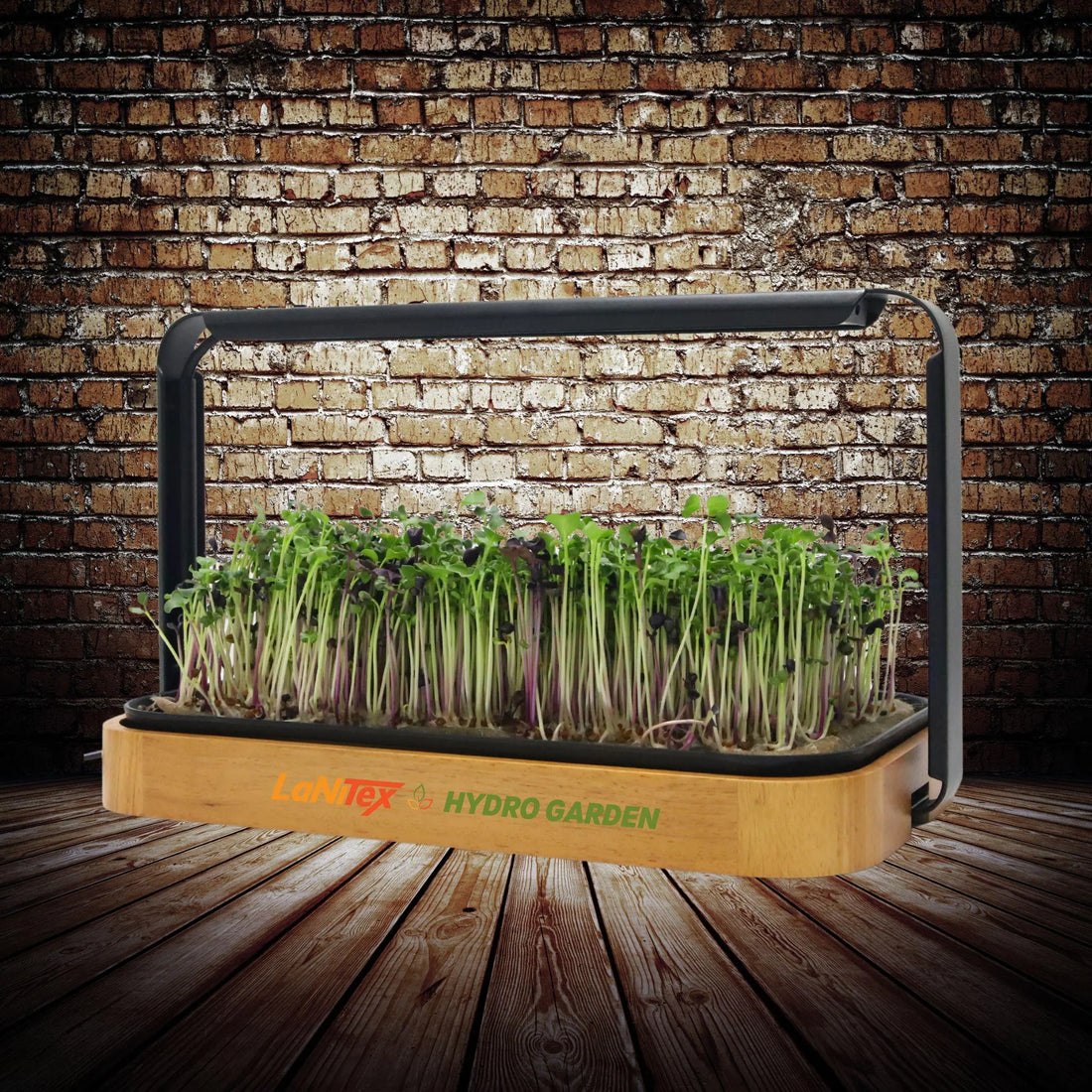

Bull's Blood beetroot microgreens are the deep-magenta cue that turns a $5 supermarket punnet into a $25 restaurant-plate flourish, ready at home in 10 to 18 days (up to 25 if held longer). Detroit beetroot, sown next to it, contributes a green-leaf pink-stem contrast that no single-variety guide bothers to describe.
Quick answer: Beetroot microgreens are young Beta vulgaris seedlings harvested at first true leaves, 10 to 18 days from sow (up to 25 if held longer), with magenta or pink stems and earthy-sweet flavour. Pre-soak the seeds 4 to 12 hours (each beetroot seed is a cluster of 2-4 true seeds), sow 20 to 30 grams per 1020 tray, weighted blackout 4 to 6 days, then light. Grow Bull's Blood for deep magenta drama; grow Detroit for green-pink garden-fresh contrast. Combine both for canapes, cocktails, grazing boards.
Key takeaways:
- Beetroot microgreens take 10 to 18 days from sow to harvest (up to 25 if held longer or in cool conditions) - medium difficulty, second-tier microgreen.
- Pre-soak 4 to 12 hours in room-temperature water is strongly recommended - each beetroot seed is a dried cluster of 2-4 true seeds.
- Bull's Blood gives deep magenta to burgundy stems and leaves; Detroit gives green leaves with pink to red stems - combine in one tray for magenta plus green plus pink contrast.
- Supermarket beetroot microgreen punnets cost $5+ for 50g at Coles or Woolworths; the home flush in a Smart Microgreen Kit costs about $1.50 for 200-300g - roughly 90 percent cheaper per gram.
- Damping off and mould are real risks during the 4 to 6 day blackout - airflow, bottom-watering and lower sowing density prevent them.
At a glance:
| Attribute | Detail |
|---|---|
| Botanical name | Beta vulgaris (Amaranthaceae family) |
| Days to harvest | 10-18 days typical, up to 25 if held |
| Difficulty | Medium - pre-soak required, uneven germination normal |
| Taste | Earthy and slightly sweet, tender stems with magenta or pink colour |
| Best uses | Canapes, cocktails, grazing boards, salads, garnish |
| Recommended kit | microgreen growing kit (Black Metal) or wooden microgreen kit |
What are beetroot microgreens?
Beetroot microgreens are young Beta vulgaris seedlings harvested when they show their first true leaves, 10 to 18 days from sowing (up to 25 if held longer). You cut the whole top growth - stems and leaves - rather than waiting weeks or months for a bulb to form. Concentrated colour, earthy-sweet flavour, tender crunch.

Botanically, beetroot sits in the Amaranthaceae family alongside amaranth, quinoa, spinach and chard. That family connection matters for two reasons: the seed structure (a hard multi-germ cluster shared across the family) and the family's general preference for cool to moderate growing temperatures. Beetroot is not a fast brassica like radish or broccoli; the rhythm is slower, the reward is colour and intensity that fast crops cannot match.
Bull's Blood beetroot microgreens
Bull's Blood is the cultivar grown for visual drama. Stems and leaves develop a deep magenta to burgundy colour, often showing by day 12 to 15 under good light. The Seed Collection and most Australian seed suppliers stock Bull's Blood specifically for microgreen and salad-leaf use.
Detroit beetroot microgreens
Detroit (sometimes called Detroit Dark Red) is the cultivar grown for a fresher garden look. Stems range pink to red; leaves stay green and gather full colour intensity by day 20 to 25. Detroit is slightly milder in flavour than Bull's Blood - both are earthy-sweet, Detroit just dials it down a touch.
Do beetroot microgreens really need pre-soaking? (Yes, and here is why)
Skip the pre-soak and you will fight uneven germination for the next 25 days. That is why pre-soaking is strongly recommended, not just a nice-to-have.
Each beetroot "seed" is actually a dried seed cluster - a fused bundle of 2 to 4 true seeds wrapped in a hard, irregular outer coat. When you sow dry, water cannot penetrate the cluster uniformly. Some seeds inside the cluster get moisture and germinate; others stay dormant for days. The result is a patchy stand that disappoints on harvest day.
The fix is a 4 to 12 hour soak in clean room-temperature water (around 20 degrees Celsius). Room temperature, not warm tap water - heat damages the embryos. Not refrigerated either - too cold slows hydration. Drop the seeds in a small jar or glass, cover with water, leave on the bench. After 4 to 12 hours the seed coat softens, water penetrates the cluster, and you drain and sow on moist medium.
The soak water turns slightly pink-red. That is normal - it is just colour leaching from the outer seed coat, not a sign of seed damage. Drain through a fine sieve, pat the seeds gently with a paper towel, and sow straight onto your prepared tray. Do not let the drained seeds dry out before sowing.
Get a fresh grow guide like this every fortnight
Join the LaNiTex Hydro Garden newsletter for practical hydroponic, microgreen and mushroom growing tips for Australian homes. Subscribe to download a free hydroponics starter guide (PDF) and get 10% off your first order.
Join the newsletter →What I have learned about growing beetroot microgreens from research
Honest disclosure: beetroot microgreens were not part of the LaNiTex Smart Microgreen Kit pre-launch validation crop list personally tested in Sippy Downs (Sunshine Coast, QLD 4556) before stocking the kit - radish, broccoli and sunflower were the three calibration crops. The guidance below combines Microgreen Manager's beetroot grow protocol, Home Microgreens beetroot guide, The Seed Collection's Bull's Blood and Detroit variety knowledge, and AU climate-specific adaptation for the medium-difficulty multi-germ seed cluster crop. Local results may vary by climate zone; the troubleshooting section names the slow-germination, damping-off, leggy-growth, and uneven-emergence pitfalls most likely to bite AU growers in Brisbane warm-humid summer vs Melbourne or Hobart cool winter.
The research-not-first-party framing matters for one reason: trust comes from naming what has not been tested, not from pretending everything has. If you want the fully validated first-microgreen experience, start with the Broccoli Microgreens guide - that crop went through repeated Sippy Downs flushes before the kit was listed. Then come back to beetroot once you have the basic technique under your belt.
Bull's Blood vs Detroit: which beetroot microgreen variety to choose?
Most generic guides treat beetroot as one crop. The two main microgreen cultivars - Bull's Blood and Detroit - look and behave differently enough that variety choice matters more than most growers think.
| Attribute | Bull's Blood | Detroit |
|---|---|---|
| Stem colour | Deep magenta to burgundy | Pink to red |
| Leaf colour | Burgundy-tinged, dark | Green with pink veining |
| Visual impact | Dramatic, single-colour | Garden-fresh, contrast |
| Flavour | Earthy and sweet | Earthy and slightly milder |
| Days to full colour | 12 to 15 | 20 to 25 |
| Sowing density | 20 to 30g per tray | 20 to 30g per tray |
| Pre-soak required | Yes, 4 to 12 hours | Yes, 4 to 12 hours |
| Best plating use | Canapes on white plates, dark cocktails | Grazing boards, light dishes |
Combine both varieties in one tray to get magenta plus green plus pink contrast in a single harvest. Sow them in alternating bands or scatter mixed - the cultivars sprout and mature within a few days of each other, so harvest day works for both. The Seed Collection sells Bull's Blood and Detroit as separate small packets that make this side-by-side approach affordable.
Pick Bull's Blood alone when the goal is single-colour drama on white-plate canapes or a dark cocktail garnish. Pick Detroit alone when grazing boards and softer-tone plating call for a less saturated palette. Pick both when you want flexibility from one tray.

Grow fresh beetroot microgreens on your kitchen bench, any season — the self-watering tank and full-spectrum LED handle the daily light and watering. You supply the seeds.
Start your first tray →Personally tested at home on the Sunshine Coast before listing.
Kit-aware step-by-step: growing 2-variety beetroot microgreens in the Smart Microgreen Kit Black Metal style
This protocol assumes the LaNiTex Smart Microgreen Kit Black Metal Style with its integrated LED, water reservoir and reusable lid. The technique adapts to other shallow-tray setups, but the timing assumes the kit's ambient conditions on a kitchen bench.
1. Pre-soak 4 to 12 hours
Combine 10 to 15 grams of Bull's Blood plus 10 to 15 grams of Detroit beetroot seeds - or use 20 to 30 grams of a single variety per tray. Cover with clean room-temperature water, leave 4 to 12 hours. Drain and pat gently.
2. Prepare the kit tray
Lay a fresh germinating growing mat into the kit tray, or fill with 2 to 3 cm of moist coco coir or fine potting mix. Pre-wet evenly with bottom water before sowing. Firm and level the surface - uneven medium causes uneven germination.
3. Sow at 20 to 30 grams combined
Spread the drained pre-soaked seeds evenly across the tray surface. Press gently with the back of a clean spoon for good seed-to-medium contact. Sow density matters: 20 to 30 grams is the combined-variety target. Under-sow and the harvest looks thin; over-sow above 30 grams and you create a moisture trap that risks damping off during the long blackout.
4. Weighted blackout 4 to 6 days
Place the kit lid on top and add 2 to 4 kilograms of weight - a few books on top of the lid works. The weight forces the seeds into firm contact with the medium and pushes the emerging roots down rather than letting them lift off. Keep dark 4 to 6 days. Lift the lid briefly every 24 hours from day 3 onwards if you are in Brisbane or the Sunshine Coast humid summer - that small airflow window prevents the mould bloom that ends most QLD beetroot attempts.
"Day fourteen the first true leaves unfurl and the magenta stems show their full colour. Patience pays in pigment."
5. Light phase 7 to 14 days
When seedlings push the lid up around day 4 to 6, remove the weight and lid. Place the kit where the integrated LED runs 10 to 14 hours per day. Bright indirect window light alongside the LED helps, but avoid direct afternoon sun in Queensland summer - beetroot stems wilt fast under hard sunlight.
6. Bottom-water from the reservoir
Fill the kit's integrated water reservoir from below. The wicking mat draws moisture up through the substrate. Bottom-watering keeps leaves dry and prevents the mould that misting causes on long-blackout crops. According to Sustainable Gardening Australia, "Farms utilizing hydroponics use up to 90 percent less water" than soil growing - the kit's bottom-water reservoir captures that advantage on the kitchen bench. Refill the reservoir when it runs low, usually every 2 to 3 days.
7. Harvest 10 to 18 days (up to 25 if held)
Cut at 3 to 7 centimetres above the medium with sharp scissors when first true leaves appear and the stems show full colour. Bull's Blood typically reaches deep magenta colour at day 12 to 15. Detroit gathers fuller pink-stem colour by day 20 to 25. Combined tray: harvest by day 18 to 20 for the best of both. Rinse harvested microgreens under cool water, dry gently with a salad spinner or paper towel, and store in a sealed container in the fridge for 5 to 7 days.
Ready to grow beetroot microgreens? Same Smart Microgreen Kit - choose your style: Black Metal $129 for the modern kitchen, or Wooden $189 for the warmer look. Australia-wide same-week shipping from Sippy Downs, Sunshine Coast.
Why are beetroot microgreens slow and uneven to germinate? (Honest medium-difficulty framing)
Day 5, day 7, day 10 and only half the tray is up. That is normal for beetroot. It is not your kit, not bad seed and not poor technique - beetroot is naturally slower and more irregular than fast brassicas like radish (which sprouts uniformly in 3 to 5 days). Patience is the cost of the colour and flavour reward.
Five common causes of slow uneven germination, each with a fix:
- No pre-soak. Hard seed coat plus multi-germ cluster botany means dry sowing produces a patchy stand. Fix: pre-soak 4 to 12 hours every time for even germination.
- Uneven surface moisture. Top of medium dries while underneath stays wet. Fix: bottom-water before sowing, sow on a level surface, lift the lid only briefly during blackout.
- Insufficient weight during blackout. Seeds need firm medium contact to anchor and push roots down. Fix: 2 to 4 kg pressure during the 4 to 6 day blackout - a few books on the kit lid works.
- Cool room temperatures. Below 18 degrees Celsius slows beetroot germination further. Fix: keep the kit between 18 and 22 degrees Celsius - kitchen bench away from cold draughts works in most AU climates.
- Old seed. Beetroot seed loses germination vigour after 2 to 3 years in the packet. Fix: buy fresh-dated seed from The Seed Collection, Mr Fothergill's or another AU supplier with stock rotation.
The honest medium-difficulty rating sits at Medium, not Easy. Slow uneven germination is the cost of buying into the magenta colour reward. Don't make beetroot your first microgreen attempt; nail the radish or broccoli baseline first, then come back.
Are beetroot microgreens nutritious?
Beetroot microgreens earn their place on the plate for more than colour. Like most microgreens, the young Beta vulgaris seedlings carry a concentrated nutrient profile: research on hydroponically grown microgreens reports they hold high concentrations of minerals - phosphorus, magnesium, calcium, iron, zinc and copper - plus vitamins C, E and K, and notes that "some species of microgreens contain more nutrients than mature edible plant parts".
A peer-reviewed comparison of alfalfa, cabbage, beet and fennel microgreens grown in floating hydroponics found beet microgreens recorded the highest antioxidant capacity of the four species tested (by a narrow margin), alongside measurable vitamin C of around 28 milligrams per 100 grams fresh weight. The deep magenta of Bull's Blood is part of that story: the colour comes from betalain pigments, the betacyanin antioxidants that also give mature beetroot its hue. Detroit's pink-stemmed tops show the same pigment family in a lighter dose.
Keep the framing honest, though: beetroot microgreens are a garnish-quantity food, a flavour-and-colour accent, not a bulk vegetable serving, so treat the nutrition as a bonus on top of the visual payoff rather than a reason to eat them by the bowl.
How to plate beetroot microgreens: canapes, cocktails, grazing boards
The visual garnish angle is what makes beetroot microgreens worth the 10-to-18-day wait (up to 25 if held). A $5 supermarket punnet of plain microgreens looks ordinary. A handful of Bull's Blood scattered over a cream-cheese blini turns the same plate into restaurant work.

Canapes. Deep magenta Bull's Blood crowns smoked salmon plus cream cheese blinis or goats cheese toasts. The dark stems pop against the cream-and-pink colour story and the earthy-sweet flavour cuts the richness.
Grazing boards. Detroit green-pink contrast sits well against pale cheeses (brie, ricotta, fresh chevre) and charcuterie. Scatter a small handful over the soft cheeses or arrange a tuft alongside the prosciutto.
Cocktails. A Bull's Blood stem swizzle in a clear gin-tonic or a vodka-cucumber long drink draws the eye to the deep magenta colour. The stems are tender enough to chew if a guest decides to eat them.
Salads and grain bowls. Scatter Bull's Blood or Detroit over rocket plus quinoa for earthy-sweet contrast. Beetroot microgreens add visual depth to otherwise green salads and work especially well with goat cheese, walnut and orange dressings.
Sandwiches and wraps. Layer beetroot microgreens on rye sandwiches with beetroot-cured salmon and cream cheese. The flavour echoes the cured fish and the colour ties the layers together.
Soups. Deep purple swirl of Bull's Blood on a yellow pumpkin soup. The temperature contrast (cold microgreens, hot soup) keeps the colour and the texture intact.
Smoothies. Bull's Blood adds natural deep colour to fruit smoothies without sugary syrups. A small handful tints a strawberry-banana smoothie a striking magenta.
Of Australia's 10.85 million private dwellings counted in the 2021 Census, 16 per cent were apartments - homes where outdoor beetroot gardens are impractical, and indoor microgreen kits become the year-round colour-and-garnish alternative.
Still on the fence? Same Smart Microgreen Kit - choose your style: Black Metal $129 or Wooden $189. Both ship Australia-wide from Sippy Downs.
Common beetroot microgreen problems and how to fix them
Damping off and mould are the two real beetroot risks during the 4 to 6 day blackout, and they need addressing head-on. The Brisbane and Sunshine Coast humid summer makes airflow management non-negotiable.
Damping off (seedling collapse). Caused by fungal infection at the seedling base. Stems thin out, seedlings fall over, the base looks water-soaked. Prevention: gentle airflow (open window or small fan), bottom-watering only, lower sowing density (10g not 20g), clean trays and tools. Distinguish damping off from harmless white root hairs - root hairs are fine white fuzz on the roots themselves, damping off is collapse at the stem base.
Mould bloom during blackout. Most common in subtropical QLD humid summers. Lift the kit lid briefly every 24 hours from day 3 onwards to release trapped moisture. Reduce sowing density to the lower end (10g). If white or grey fuzzy mould appears on the medium surface, cut affected seedlings out and continue with the rest.
Leggy yellow growth. Stems stretch tall and pale, leaves stay floppy. Cause: insufficient light during the light phase. Fix: turn on the kit's integrated LED for 10 to 14 hours per day, supplement with bright indirect window light, but avoid direct afternoon sun in QLD summer.
Uneven patchy stand. Half the tray up by day 5, the other half still dormant on day 10. Cause: dry sowing (no pre-soak) or uneven medium moisture. Fix: pre-soak every time, level and pre-wet the medium before sowing, weight the blackout.
Clinging seed husks on leaves. Hard outer cluster coat sometimes sticks to the first true leaves. Resist the urge to pick - you will damage the seedlings. A light mist during the light phase helps the husks release naturally as the stems extend.
"The reusable kit lid plus a few books on top beats single-flush plastic trays here - humidity control is the difference between a magenta harvest and a mouldy disappointment."

Restock the soil-free mats your kit runs on — a 10-pack of reusable growing mats, ready for your next beetroot sowing.
Stock up on mats →Personally tested at home on the Sunshine Coast before listing.
Beetroot microgreens FAQ
What are beetroot microgreens?
Beetroot microgreens are young beetroot plants (Beta vulgaris) harvested when they have their first true leaves. They are usually cut 10-18 days after sowing (up to 25 if held longer), depending on temperature and variety. Unlike mature beetroot, you harvest the whole top growth - stems and leaves - rather than waiting for a bulb to form. Known for earthy, slightly sweet flavour and colourful stems from pale pink to deep magenta.
What's the difference between Bull's Blood and Detroit beetroot microgreens?
Bull's Blood beetroot microgreens have deep magenta to burgundy stems and leaves with strong visual impact, ideal for dramatic colour on white plates. Detroit beetroot microgreens have green leaves with pink to red stems for a fresher garden look. Flavour is similar - both earthy and sweet - but Detroit is slightly milder. Combine both in one tray for magenta plus green plus pink contrast.
Why do beetroot microgreens benefit from pre-soaking the seed?
Beetroot seeds have a hard, irregular seed coat, and each seed is actually a dried seed cluster. This causes slow and uneven germination if you sow them dry. A short pre-soak softens the seed coat, allows water to penetrate the cluster, and encourages more seeds to sprout at the same time. Soak 4-12 hours in clean room-temperature water, then drain and sow.
How do I grow beetroot microgreens at home in Australia?
Pre-soak beetroot seed 4-12 hours, then sow densely on moist potting mix in a shallow tray (or use a microgreen kit). Cover with a second tray and a few kilos of weight to help seeds anchor and push roots down. Keep dark 4-6 days, checking moisture. Once seedlings push up the cover, move to bright light and bottom-water. Harvest at 10-18 days when stems are coloured (up to 25 if held longer).
What do beetroot microgreens taste like and how can I use them?
Beetroot microgreens have an earthy, slightly sweet flavour similar to beetroot leaves or spinach with a beetroot note. Stems are tender with pleasant crunch when young. Use them sprinkled over salads and grain bowls, layered in sandwiches and wraps, scattered over soups and risottos, as colourful garnish on canapes and grazing boards, or added to smoothies for colour. Bull's Blood gives deeper magenta; Detroit adds green and pink contrast.
Why are my beetroot microgreens slow or uneven to germinate?
Beetroot is naturally slower and more irregular than quick crops like radish. Common reasons: hard seed coat with multi-germ clusters needing hydration, no pre-soak (seeds stall when sown dry), inconsistent moisture (top dries out), insufficient weight (seeds do not make good medium contact), or cool temperatures. To improve consistency: pre-soak, firm and level medium, apply weight, keep evenly moist during the first week.
How can I prevent damping off and mould in beetroot microgreens?
Damping off causes seedlings to collapse at the base from fungal infection. To reduce risk: provide gentle airflow (open window or small fan), water from below rather than misting over the top, ensure trays drain freely (tip out excess water from outer tray), avoid sowing too thickly (overcrowding traps humidity), start with clean trays and tools. Distinguish harmless white root hairs (fine fuzz on roots) from fuzzy grey surface mould.
Where can I buy beetroot microgreen seeds and what about kits?
In Australia, beetroot microgreen seeds are widely available from seed companies that specialise in microgreens, general garden centres and nurseries, and online retailers stocking Bull's Blood and Detroit beetroot varieties. Look for varieties labelled for sprouting or microgreens, untreated or organically grown seed, and clear variety names. For setup, use standard shallow nursery trays with drainage and potting mix, or a purpose-designed microgreen kit with reusable trays and growing mats.
Where to buy beetroot microgreen seeds in Australia
LaNiTex sells the Smart Microgreen Kit and the Germinating Growing Mat 10-pack, not seeds. Source Bull's Blood and Detroit beetroot microgreen seeds from these AU suppliers:
- The Seed Collection (theseedcollection.com.au) - Bull's Blood and Detroit microgreen seeds with detailed variety notes. Reliable AU supplier with rotation-fresh stock.
- Mr Fothergill's (mrfothergills.com.au, also stocked at Bunnings) - Mass-retail beetroot seed packets. Not microgreen-specific but works for the technique.
- Eden Seeds (edenseeds.com.au) - Certified organic beetroot seeds, AU-based.
- Greenharvest (greenharvest.com.au) - Sub-tropical specialist supplier based in QLD; beetroot varieties suited to humid climate growing.
- Seedmart (seedmart.com.au) - Microgreen-specific seed range, larger pack sizes for regular growers.
Buy small packets of both Bull's Blood and Detroit from one supplier first; you only need 20 to 30 grams per tray, so a 100g packet of each lasts months. Rotate two or three suppliers across your first few flushes - different sources produce slightly different germination rates, and finding the supplier that suits your climate zone and water type is worth the experimentation.
Explore other microgreen varieties
Grown Beetroot once? These pair naturally with the same Smart Microgreen Kit & Germinating Growing Mats.
More colourful greens
Easy to start with
Colour & plating
→ Browse all 22 microgreen varieties | → Microgreens growing guide
About the writer
For Laszlo Bulatko, LaNiTex Hydro Garden is as much a mission as a business: helping everyday Australian families grow their own fresh food at home, even without a backyard. From its base on the Sunshine Coast, LaNiTex makes that easy and affordable — hydroponic grow boxes, a benchtop Mini Grow Pot, and the Smart Microgreen Kit — alongside the Term-Grow Enrolment programme in Queensland primary school classrooms. He set up LaNiTex in December 2024 and personally tested every product at home before it went in the catalogue, bringing 15 years of brand-building from the Hungarian fishing-tackle trade. Read more on the About Laszlo founder page. ABN 47 682 768 967.
The full range
Find the microgreen kit that suits your kitchen


Supported in Australia - every model tested before listing.
Sources
- Sustainable Gardening Australia - Pros and Cons of Hydroponic Growing - Australian not-for-profit horticultural authority. Quoted: "Farms utilizing hydroponics use up to 90 percent less water"
- Australian Bureau of Statistics - Housing Census 2021 - Australian Government statistical authority. Quoted: "16 per cent were apartments"
- Microgreen Manager - Growing Beet Microgreens - International microgreen authority site. Beetroot grow protocol, pre-soak duration and weighted-blackout technique cross-reference.
- Home Microgreens - Beet Microgreens Grow Guide - Microgreen technique authority. Multi-germ seed cluster botany and damping-off prevention cross-reference.
- Fabek Uher et al. (2023) - Alfalfa, Cabbage, Beet and Fennel Microgreens in Floating Hydroponics, Plants (Basel) - Peer-reviewed open-access study. Quoted: beet microgreens recorded the highest antioxidant capacity of the four species tested; ascorbic acid about 28 mg per 100 g fresh weight; "some species of microgreens contain more nutrients than mature edible plant parts".