
Supermarket microgreen punnets cost AUD $4-7 for 50 grams and arrive limp within three days of purchase, already past peak flavour. A home tray rewrites that maths in under two weeks.
Quick answer: To grow mustard microgreens in Australia, sow Brassica juncea or Sinapis alba seeds densely on a hydrated growing mat or seed-raising mix, keep dark for 2-3 days, then move to bright light and bottom-water gently until harvest at 5-10 cm tall in 7-14 days.
Key takeaways
- Mustard microgreens harvest in 7-14 days at 5-10 cm tall.
- Wasabi-like heat peaks at the true-leaf stage and softens after.
- Bottom-watering plus good airflow prevents mould, the number-one failure mode.
- The Smart Microgreen Kit (Black Metal $129 or Wooden $189) automates the blackout, light cycle and watering reservoir.
At-a-glance summary
| Field | Detail |
|---|---|
| Botanical names | Brassica juncea (Indian / brown / Red Garnet / Ruby Streaks) and Sinapis alba (white / yellow mustard) |
| Days to harvest | 7-14 days (germinates in 2-3) |
| Harvest height | 5-10 cm tall, at the first true-leaf stage |
| Yield per tray | Several generous handfuls a sowing in good conditions (mustard can run about 14x the seed weight; roughly 140 g from 10 g of seed on a full 10 by 20 inch tray, varying with cultivar and setup) |
| Difficulty | Easy. Good for first-time microgreen growers |
| Best for | Sushi rolls, poke bowls, sangas, grilled meats, eggs and salads that need a clean wasabi-like punch |
| Lead kit | microgreen growing kit (Black Metal) $129 or wooden microgreen kit $189 |
| Pillar guide | Growing microgreens at home in Australia |
How to grow mustard microgreens in Australia comes down to four things: fresh seed, a forgiving tray, three days in the dark, and ten days of bright light. The rest is just airflow.
What are mustard microgreens?
Mustard microgreens are the young seedlings of Brassica juncea and Sinapis alba, harvested at 5-10 cm tall in 7-14 days. They sit between sprouts (eaten with the seed and root) and baby leaves (harvested at four to six true leaves) on the leafy-green ladder.

The two species cover almost every cultivar an Australian grower will find on a seed packet. Brassica juncea is the Indian / brown mustard family that produces Red Garnet (purple-tinged stems) and Ruby Streaks (deep burgundy serrated leaves). Sinapis alba is the white or yellow mustard with a cleaner heat and lighter green colour. Both follow the same growing rhythm. The flavour intensity, leaf shape and colour shift with the cultivar. Beyond those two, a few named cultivars come up often on Australian and overseas seed lists: Mizuna is a mild Japanese mustard that stays gentle even at the salad stage, Wasabina pushes the wasabi-style heat the hardest, and Southern Giant is a fast, full-flavoured green. They all grow on the same blackout, light and bottom-water rhythm.
The seedlings carry the entire mustard plant's flavour profile in a 5-cm stem: punchy, aromatic and noticeably hotter than a salad green. Australian growers describe the heat as wasabi-like, more about the sinus than the tongue. The kick comes from glucosinolates the plant produces as a defence; chewing breaks them down into the volatile compound that hits the back of the nose.
A neat way to think about this: rocket microgreens give peppery heat on the tongue, mustard gives wasabi heat in the nose. Both are Brassica family; the difference is mostly which compound is dominant.
How spicy are mustard microgreens, and do they really taste like wasabi?
Mustard microgreens carry a sharp, mustardy heat that many Australian growers describe as wasabi-like. They are spicier than most salad greens but milder than straight wasabi paste. A small handful gives sushi rolls, poke bowls, burgers or sangas a clean, aromatic punch without overpowering the whole dish.
The heat peaks at the true-leaf stage, around day 7-10, and softens slightly as the leaves mature. Home Microgreens notes that Red Lace Mustard is much milder than other mustards they have grown, which is a useful benchmark: the Brassica juncea purple cultivars (Red Garnet, Ruby Streaks) tend to be milder. The plain green Brassica juncea and the Sinapis alba whites are the heat-forward options.
The wasabi-comparison holds because real wasabi paste, mustard microgreens and horseradish all draw heat from the same isothiocyanate compounds. Supermarket wasabi paste is mostly horseradish dyed green; a handful of fresh mustard microgreens delivers a cleaner version of that nose-hit at home, with extra leafy texture the paste cannot match.
For cooks who hate cooked mustard but love a little kick on raw food, microgreens are the bridge. They taste sharper than cress, milder than horseradish, and brighter than dried mustard powder.
What we have learned about growing mustard microgreens from research
Honest disclosure: mustard microgreens were not part of the LaNiTex Smart Microgreen Kit pre-launch validation crop list personally tested in Sippy Downs (Sunshine Coast, QLD 4556) before stocking the kit. Radish, broccoli and sunflower were the three calibration crops. The guidance below combines Home Microgreens' Brassica juncea growing protocol, Penn State Extension's brassica microgreen academic data, Rachna's Kitchen's home-grower 3-day-blackout method, and The Seed Collection AU's mustard cultivar specs. Local results may vary by climate zone; the troubleshooting section names the mould, light and watering pitfalls most likely to bite AU growers in Brisbane humidity vs Melbourne winter.
What the four research sources agree on:
- Germination window: 2-3 days under a covered blackout.
- Harvest window: 7-14 days, depending on indoor temperature.
- Watering method: bottom water once cotyledons (the first leaves) open.
- Sowing density: dense enough that seeds touch but do not pile.
What they disagree on: how heavily to pre-soak the seeds. Penn State and Rachna's Kitchen recommend no pre-soak for small mustard seeds (the seeds form a mucilaginous gel coat in water that traps the seed in mud). Home Microgreens permits a light mist instead of pre-soak. We have written the step-by-step below using the no-pre-soak method because the gel coat is what feeds mould in 80% of failed home trays.
Get a fresh grow guide like this every fortnight
Join the LaNiTex Hydro Garden newsletter for practical hydroponic, microgreen and mushroom growing tips for Australian homes. Subscribe to download a free hydroponics starter guide (PDF) and get 10% off your first order.
Join the newsletter →Growing mustard microgreens in the Australian climate
Mustard microgreens grow reliably across every Australian climate zone, from Brisbane humidity to Hobart cool, when indoor temperature sits between 20-24 degrees Celsius. The species is forgiving of swings in temperature; what kills trays is humidity stagnation, not heat.
| AU climate zone | Months of concern | Practical adjustment |
|---|---|---|
| Brisbane / SE QLD humid | Nov-Mar | Drop the blackout lid 12 hours earlier than the recipe says. Add a small desk fan on low for 2 hours per day after light phase starts. |
| Sydney coastal temperate | Year-round | Standard protocol works. Run a fan only during pollen-heavy days. |
| Melbourne / Adelaide temperate | May-Aug winter | Move the tray off a cold tile floor onto a warm kitchen bench. Heating pad optional below 18 deg C ambient. |
| Perth dry | Jan-Feb hot | Move the tray away from direct afternoon sun. Bottom-water more often (twice daily in 35+ deg C ambient). |
| Hobart cool | Year-round | Use a heating pad below the tray for the first 2-3 days. Extend the blackout by 12-24 hours. |
So if you grow in Brisbane between November and March, the airflow priority is non-negotiable. Drop the lid 12 hours earlier than a Melbourne grower would, even if the seedlings look shorter. Mould prevention beats height by a wide margin.
The Sunshine Coast sits in a humid-subtropical pocket where indoor mustard trays do well year-round, with the standard caveat about lid removal. Sippy Downs growers (postcode 4556) typically see the first germination peeks on day 2 in summer, day 3 in winter, with harvest at day 9-12 across both seasons.

Fresh microgreens on your kitchen bench in 7–14 days — the self-watering tank and full-spectrum LED do the daily work. You supply the seeds.
Start your first tray →Personally tested at home on the Sunshine Coast before listing.
Step-by-step: growing mustard microgreens in the Smart Microgreen Kit
Step-by-step, mustard microgreens take six actions from seed packet to harvest tray, and the Smart Microgreen Kit automates four of them.
Choose your kit
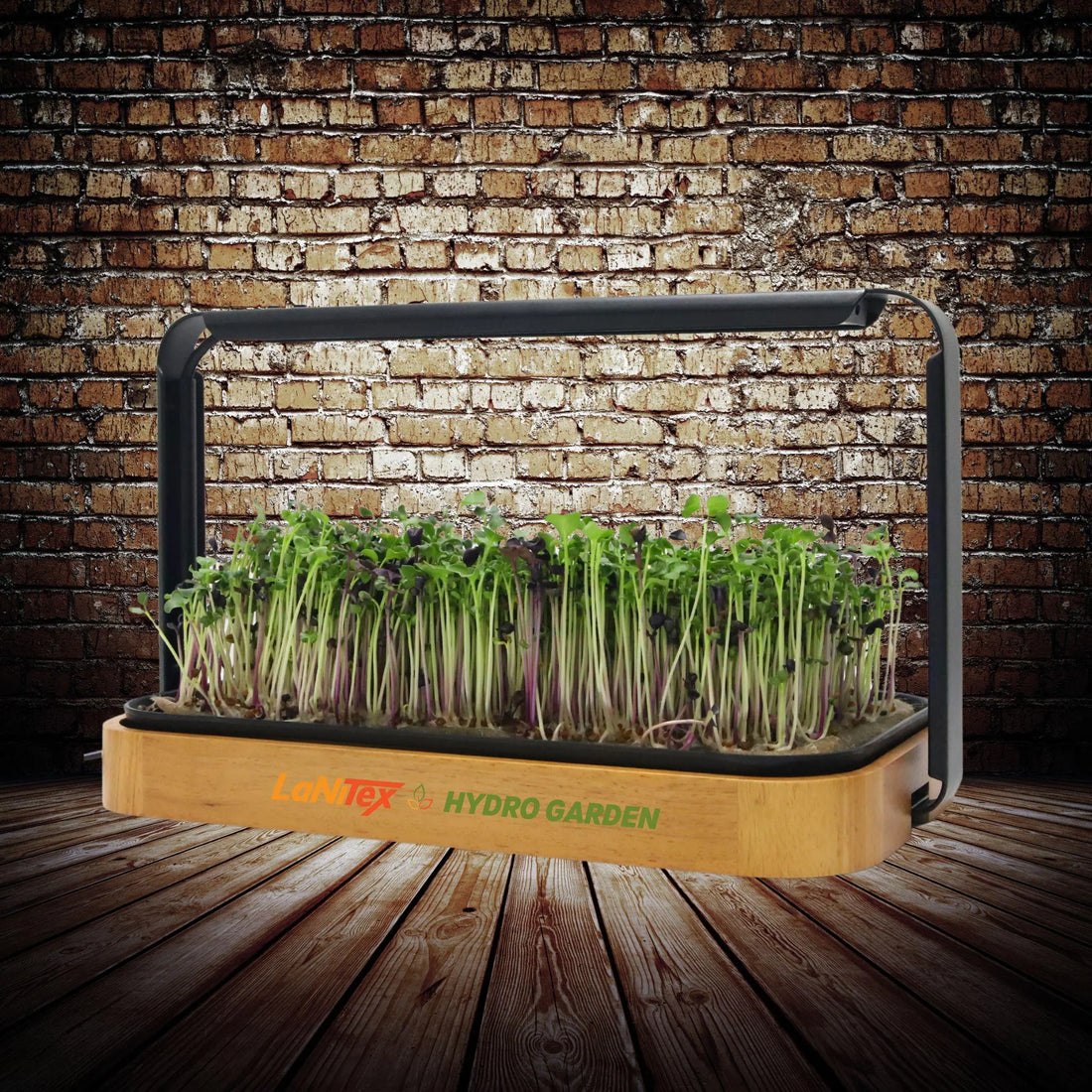
Set up on a kitchen bench out of direct afternoon sun. The Smart Microgreen Kit Black Metal Style at $129 is the industrial minimalist option. The Smart Microgreen Kit Wooden Style at $189 is the warm-finish upgrade for kitchens where the kit is on display. Both run the same automated blackout, light cycle and bottom-watering reservoir.
Ready to start? Same Smart Microgreen Kit, two styles. Choose your finish.
Source quality seed
Buy untreated, organically grown mustard seeds labelled for microgreens. Australian suppliers carry both Brassica juncea (red, green, Ruby Streaks) and Sinapis alba (white / yellow). The Seed Collection in Victoria stocks heirloom, open-pollinated, non-GMO mustard cultivars. Seedmart sells a fast-growing mustard microgreen seed pack with a quoted 7-10 day harvest window. Other reliable AU options include Mr Fothergill's (stocked at Bunnings), Eden Seeds, and Greenharvest (a Sunshine Coast local supplier).
Avoid treated seed sold for paddock cropping. The chemical treatment is not food-grade and the germination rate is calibrated for fields, not trays.
Sow density 15-20 grams per tray
Scatter mustard seeds evenly across a hydrated growing mat or 2 cm of seed-raising mix at 15-20 grams per standard kit tray. The seeds should sit dense enough that adjacent seeds touch but do not pile in clumps. Mist lightly with filtered water so the seed coat starts to absorb moisture. Do not pre-soak.
If you want to extend the kit beyond the trays it ships with, the Germinating Growing Mats 10-pack at $14.90 runs roughly $1.49 per harvest flush across the next 6-12 months.
Blackout 2-3 days
Cover the tray with the kit lid to block all light for 2-3 days. Home Microgreens confirms three days is more than enough time for the seeds to germinate. Check daily for surface moisture; mist gently if the mat looks dry, but do not flood.
The mucilaginous gel coat that forms around wet mustard seeds is what damping-off fungi feed on. A thin film of moisture is good; a puddle is mould bait.
Light phase 12-16 hours per day
Once the seedlings push the lid up (usually day 3), remove the cover and switch on the kit light for 12-16 hours per day. Keep room temperature between 20-24 deg C. The seedlings will straighten and green up over 24-48 hours as chlorophyll catches up.
Bottom-watering daily
Pour filtered water into the tray reservoir, not over the seedlings. Bottom-watering means the roots draw moisture upward through the mat while the leaves stay dry. Dry leaves equals fewer fungal spores landing on damp tissue. This single technique prevents the mucilaginous-seed-coat mould that destroys most home-grown mustard trays.
Harvest at 5-10 cm tall
When the seedlings reach 5-10 cm tall with the first true leaves visible (usually day 7-14), cut at the mat surface with sharp scissors or a microgreen knife. Rinse under cold water, pat dry with a tea towel, and store in a sealed container in the fridge. Use within five days for peak wasabi-heat flavour; the heat fades after day three of storage.
How much will one tray give you? Mustard gives a lot back for the seed: grower yield data records about 140 grams of cut microgreens from 10 grams of seed on a full 10 by 20 inch tray in good conditions, roughly fourteen times the seed weight (actual yield varies with cultivar and setup). The Smart Microgreen Kit tray is a little smaller at 30 by 25 cm, so a 15-20 gram sowing still returns several generous handfuls a flush - enough for a couple of sushi nights and a few sanga lunches a week.
Quick contrast: mustard sits in the medium-fast lane at 7-14 days. Sunflower microgreens hit harvest in 8-12 days but need a 12-hour pre-soak. Broccoli microgreens arrive in 8-12 days with no pre-soak and a milder, sulphur-forward flavour. So the kit does not just save time. It removes the four most common failure modes between sowing and harvest.
Common problems and how to fix them
Mould is the number one reason mustard microgreen trays fail, and it almost always traces back to one of three causes. Here is how to spot each.
Mould prevention
The mucilaginous gel coat that forms around wet mustard seeds traps moisture against the seed. Fuzzy white growth (which is usually root hairs, not mould) appears in 48-72 hours. True mould is greyish, smells musty, and spreads outward from one spot. The fix: drop the blackout lid 12 hours earlier in humid climates, run a fan during the light phase, and never overwater.
Don't tip the lid until day three. Don't pre-soak the seeds. Don't water from the top once true leaves appear.
Leggy growth
If the stems stretch tall and floppy with pale leaves, the seedlings are reaching for light. The fix: shorter blackout (2 days, not 3), brighter light source closer to the tray (the Smart Microgreen Kit positions its LED at the right distance automatically), and 12-16 hours of light per day, not 6.
Uneven germination
If half the tray sprouts and the other half stays bare, the cause is usually uneven seed scatter or a dry patch. The fix: mist evenly during blackout, hand-press dry zones with damp fingertips, and accept that a 90% germination rate is normal for fresh mustard seed (Sinapis alba germination is slightly more uneven than Brassica juncea).
Drying out
If the mat goes crispy and seedlings wilt, the reservoir is empty or the room is too dry. The fix: bottom-water twice daily in dry climates (Perth summer, Hobart winter heating), and check the reservoir level every morning.
If mould has wrecked your last three mustard trays, the integrated humidity lid on the Smart Microgreen Kit closes the airflow plus moisture loop that most cheap kits leave open. Same kit, two styles: Black Metal $129 or Wooden $189.
Mustard microgreens for sushi, poke bowls and sangas - the chef's spicy garnish
Mustard microgreens turn supermarket sushi rolls into restaurant-grade plates with a single garnish. The wasabi-like nose-hit lines up perfectly with raw salmon, raw tuna, soy sauce, pickled ginger and the rice vinegar in the rice. Lay 8-12 sprigs across the top of a sushi roll just before eating. The heat survives the chopstick journey but fades within ninety seconds, so add at the table, not the kitchen.
Poke bowls work the same way: scatter a small pinch of mustard microgreens across the top alongside the seaweed and sesame seeds. The peppery hit cuts through the sweetness of soy-marinated salmon and the fattiness of avocado.
Australian apartment kitchens benefit from this most. The 2021 Census recorded that "apartments comprised 16 percent of all private dwellings counted in Australia's 2021 Census", which means roughly one in six Australian home cooks has limited bench space and zero balcony herbs. A 30 by 25 cm kit tray on a kitchen bench produces enough mustard microgreens for two sushi nights, three sanga lunches and a Saturday brunch egg dish per week.
Other useful pairings: tucked into a smashed-avo toastie, sprinkled over a steak sanga with horseradish cream, stirred through scrambled eggs in the last 30 seconds, or piled on a grilled-fish plate with lemon. The rule of thumb: add them fresh at the end so they stay crisp and aromatic.
Are mustard microgreens actually good for you?
Mustard microgreens are eaten raw at the seedling stage, so the nutrients survive intact rather than cooking out. Like other Brassica seedlings they carry vitamins A, C and K, plus the antioxidant glucosinolates that create the wasabi-style heat - the same compound family does double duty as flavour and as the plant's own defence.
The interesting part is concentration. A 2012 study in the Journal of Agricultural and Food Chemistry that assessed 25 microgreen varieties found that, in general, microgreens carried higher concentrations of vitamins and carotenoids than the mature leaves of the same plants. Mustard was not singled out, but it sits in the Brassica group the study covered, so the same pattern is a reasonable expectation.
One honest caveat: many "mustard microgreen nutrition" tables online are actually copied from mature mustard-green data, which is a different food. Treat any exact per-100-gram figure with suspicion unless it was measured on microgreens specifically. What is not in doubt is the freshness angle - cutting a tray on your own bench skips the days of transport and shelf time that quietly drain vitamin C from supermarket greens.
Where to buy mustard microgreen seeds in Australia
Australian home growers can buy mustard microgreen seeds from five reliable suppliers, each with different organic certifications and cultivar ranges:
- The Seed Collection (VIC) - heirloom, open-pollinated, non-GMO. Carries Brassica juncea (red and green) and Sinapis alba. Their catalogue notes "Vegetable, herb and flower seeds. Heirloom, open pollinated, non GMO, no chemical treatments."
- Seedmart (AU) - mustard microgreen seed product page with the quoted "Mustard microgreens are fast-growing, spicy-flavored seeds ready to harvest in 7-10 days."
- Mr Fothergill's (national) - stocked at most Bunnings and IGA. Reliable germination, conventional packaging.
- Eden Seeds (QLD) - Daintree-grown organic and biodynamic. Smaller cultivar range, higher provenance signal.
- Greenharvest (QLD, Sunshine Coast) - local supplier for Sunshine Coast growers. Stocks both Brassica juncea and Sinapis alba seasonally.
Look for untreated or organically grown seed labelled for microgreens. Avoid paddock-grade treated seed.

Keep a tray going every fortnight — these soil-free germinating mats drop straight into your kit for the next sowing, with no mess to clean up.
Stock up on mats →Personally tested at home on the Sunshine Coast before listing.
The full range
Find the microgreen kit that suits your kitchen


Supported in Australia - every model tested before listing.
Frequently asked questions
What are mustard microgreens?
Mustard microgreens are the young seedlings of mustard plants such as Brassica juncea and Sinapis alba, harvested just after the first true leaves appear. They're grown densely in shallow trays and cut at 5-10 cm tall. These tiny greens pack a sharp, mustard-like heat and are popular for adding flavour and colour to salads, sandwiches and savoury dishes.
How spicy are mustard microgreens and do they taste like wasabi?
Mustard microgreens have a noticeable kick, with a sharp, mustardy heat that many people describe as wasabi-like. They're spicier than most salad greens but milder than straight wasabi paste. A small handful will give sushi, poke bowls, burgers or sangas a clean, aromatic punch without overpowering the whole dish.
How do you grow mustard microgreens at home in Australia?
To grow mustard microgreens at home, fill a shallow tray with moist potting or seed-raising mix, or lay a hydrated growing mat. Scatter mustard seeds evenly, then lightly press them into the surface. Keep the tray covered and dark for 2-3 days while they germinate, then move it to bright light and water gently. Harvest when 5-10 cm tall, usually in 7-14 days.
How many days do mustard microgreens take from sowing to harvest?
Mustard microgreens are quick. In typical Australian indoor conditions they germinate in 2-3 days and are ready to harvest about 7-14 days after sowing, once they're 5-10 cm tall with their first true leaves. Warmer rooms and good light speed things up, while cooler or dim spots will push harvest a few days later.
Do mustard microgreens need soil, or can you grow them on mats?
You can grow mustard microgreens either in a shallow layer of seed-raising mix or on purpose-made growing mats. Soil or coco-based mixes are forgiving and suit beginners. Growing mats keep things cleaner and are ideal in benchtop microgreen kits, as they reduce mess and make it easy to re-sow trays every couple of weeks.
What are common problems when growing mustard microgreens at home?
Common mustard microgreen problems include mould from overwatering, seeds rotting in soggy media, and leggy or floppy stems from low light. To avoid this, use shallow trays with drainage, water lightly from the bottom, keep good airflow, and move seedlings into bright light as soon as they sprout. Harvest promptly once they reach 5-10 cm tall.
How can you use mustard microgreens in cooking?
Mustard microgreens are great anywhere you want gentle heat. Use them as a peppery garnish on sushi, poke bowls and grilled fish, or tuck them into burgers, toasties and sangas for extra bite. They also lift salads, egg dishes and grain bowls. Add them fresh at the end so they stay crisp and aromatic.
Where can you buy mustard microgreen seeds in Australia?
In Australia, mustard microgreen seeds are available from online seed retailers, specialist microgreen suppliers and some garden centres. Look for untreated or organically grown seed labelled for microgreens, such as red or green mustard. Check Aussie-based stores like microgreen seed specialists, general seed companies and hydroponic suppliers for fresh, high-germination stock.
Are mustard microgreens good for you?
Yes - they are a low-kilojoule raw green that carries vitamins A, C and K and the antioxidant glucosinolates behind their wasabi-style heat. Research on microgreens has found many varieties hold higher concentrations of vitamins and carotenoids than the mature plant, and because you cut them fresh on the bench they skip the vitamin loss of supermarket transport. Be wary of online "nutrition tables" that are really mature mustard-green figures.
Do mustard microgreens grow back after cutting?
No. Like almost all microgreens, mustard is a single harvest - once you cut the stems at the mat there is not enough of the seedling left to regrow. Lift and compost the spent mat, then lay a fresh Germinating Growing Mat and re-sow for the next flush, which keeps a benchtop kit producing every couple of weeks.
Explore other microgreen varieties
Grown Mustard once? These pair naturally with the same Smart Microgreen Kit & Germinating Growing Mats.
More brassica greens
Easy to start with
Great in Asian dishes
→ Browse all 22 microgreen varieties | → Microgreens growing guide
About the writer
For Laszlo Bulatko, LaNiTex Hydro Garden is as much a mission as a business: helping everyday Australian families grow their own fresh food at home, even without a backyard. From the Sunshine Coast, he brings smart indoor growing within reach — hydroponic grow boxes, a benchtop Mini Grow Pot, and the Smart Microgreen Kit — and through the Term-Grow Enrolment programme puts grow boxes in Queensland primary school classrooms. He launched LaNiTex in December 2024 and personally tested every product at home before listing it — drawing on 15 years of earlier brand-building in the Hungarian fishing-tackle trade. Read more on the About Laszlo founder page. ABN 47 682 768 967.
Sources
- Sustainable Gardening Australia, "The Pros and Cons of Hydroponic Growing": "Farms utilizing hydroponics use up to 90 percent less water." https://www.sgaonline.org.au/the-pros-and-cons-of-hydroponic-growing/
- Australian Bureau of Statistics, Housing Census 2021 latest release: "Apartments comprised 16 percent of all private dwellings counted in Australia's 2021 Census." https://www.abs.gov.au/statistics/people/housing/housing-census/latest-release
- Home Microgreens, "Growing Mustard Microgreens": "Three days is more than enough time for the seeds to germinate." https://homemicrogreens.com/growing-mustard-microgreens
- The Seed Collection (AU): "Vegetable, herb and flower seeds. Heirloom, open pollinated, non GMO, no chemical treatments." https://www.theseedcollection.com.au/
- Seedmart (AU), Mustard Microgreen Seeds product page: "Mustard microgreens are fast-growing, spicy-flavored seeds ready to harvest in 7-10 days." Seedmart Australia
- Xiao, Z., Lester, G.E., Luo, Y., Wang, Q. (2012), "Assessment of Vitamin and Carotenoid Concentrations of Emerging Food Products: Edible Microgreens", Journal of Agricultural and Food Chemistry: in general, microgreens showed higher vitamin and carotenoid concentrations than their mature leaves. https://pubs.acs.org/doi/10.1021/jf300459b
- Microgreen Manager, Microgreen Yield Guide: mustard yields about 142 g of cut greens per 10 by 20 inch tray from 10 g of seed (about 14x the seed weight). https://microgreenmanager.com/blog/microgreens-yield-cheatsheet