
Coriander outdoors in an Australian summer bolts before you can pick the leaves. Indoors, on a kitchen bench, the same seeds turn into the bright citrusy garnish that survives the heat - if you give them 14 to 21 patient days (occasionally up to 30 in cool climates).
Quick answer: Coriander microgreens are the patience crop of the microgreens family - 14 to 21 days (up to 30 in cool climates) from sow to 5 to 10cm harvest with bright citrusy peppery flavour. Pre-soak or split the seeds, sow 18 to 25 grams per tray, blackout for 4 to 7 days, then light. They are not ideal as a first crop; start with radish or broccoli microgreens, then return to coriander.
Key takeaways:
- Coriander microgreens take 14 to 21 days from sow to harvest (up to 30 in cool climates) - the slowest crop in the LaNiTex Microgreen Cluster.
- Not the right first microgreen: master radish or broccoli first, then return to coriander.
- Pre-soaking or splitting seeds (Coriandrum sativum has paired husks) speeds up germination noticeably - most growers see seedlings emerge 2 to 4 days sooner.
- In Brisbane and Sunshine Coast subtropical humidity, the 4 to 7 day blackout window makes airflow management the single biggest mould-prevention lever.
At a glance:
| Attribute | Detail |
|---|---|
| Botanical name | Coriandrum sativum (Apiaceae family) |
| Days to harvest | 14-21 days typical, up to 30 in cool climates |
| Yield per tray | Up to ~250 g fresh per standard 10x20 tray (varies with sowing density) |
| Difficulty | Medium-Hard - second-tier microgreen |
| Taste | Bright citrusy, slightly peppery - concentrated coriander |
| Best uses | Asian curries, Mexican tacos, Middle Eastern garnish |
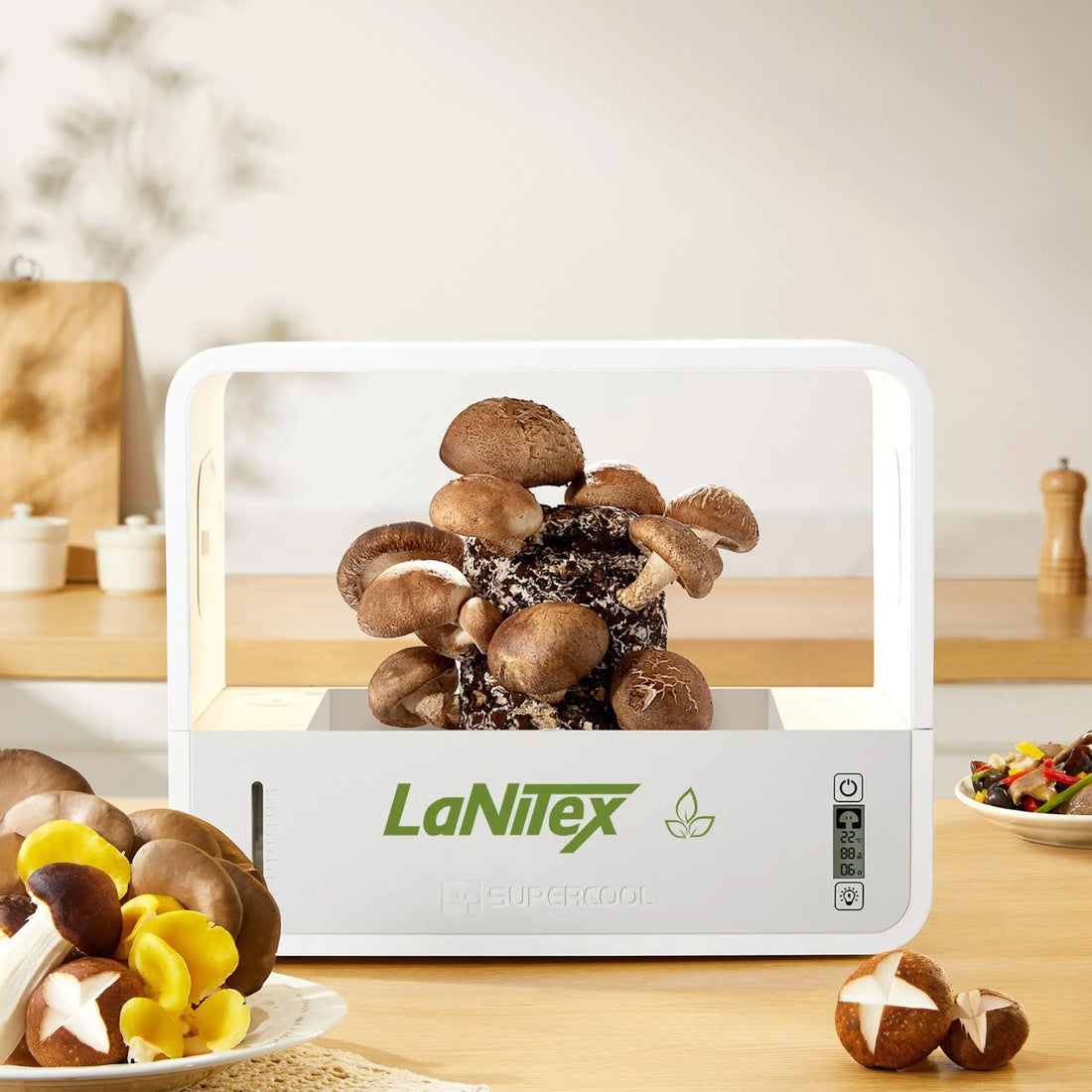
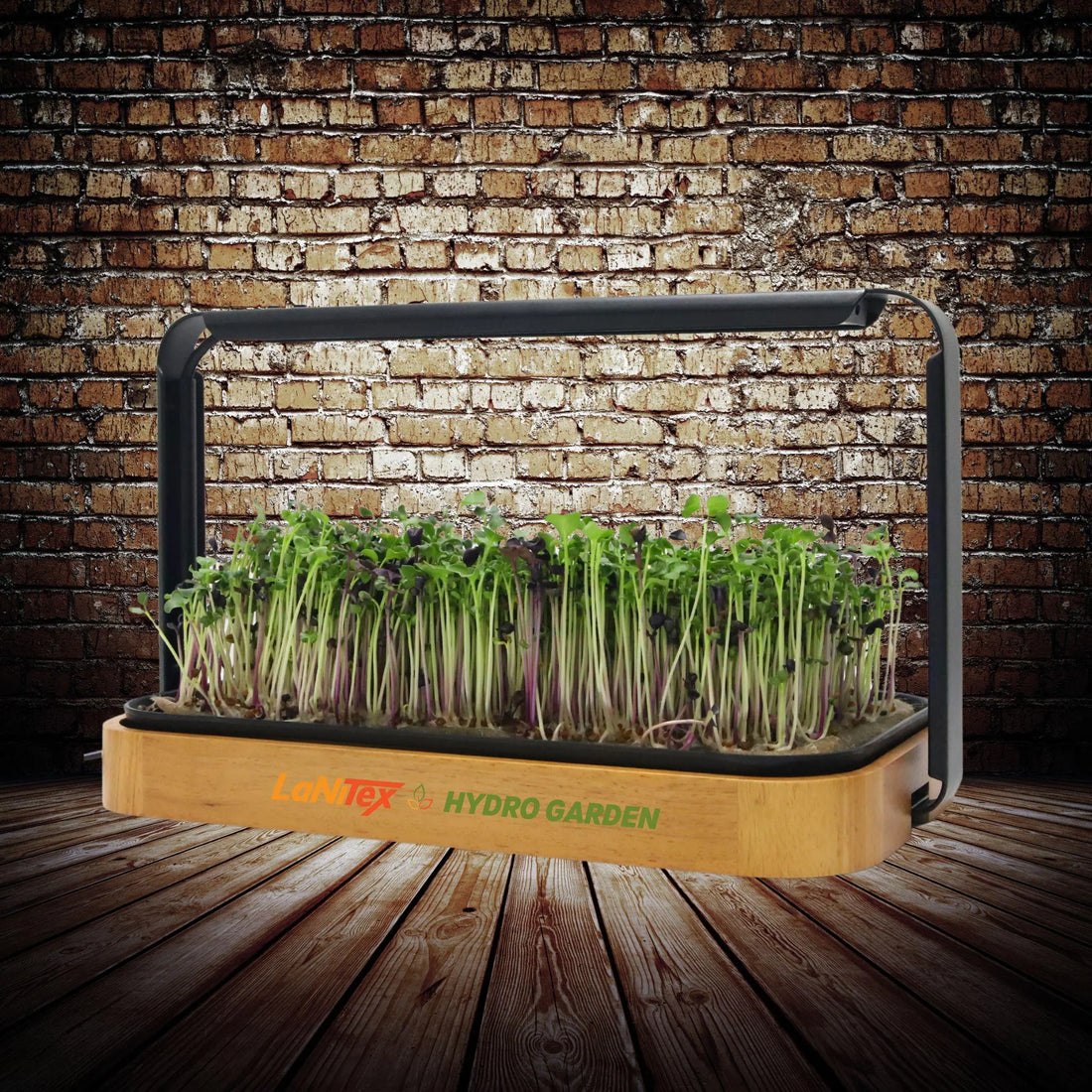
| Recommended kit | microgreen growing kit (Black Metal) or wooden microgreen kit |
What are coriander microgreens?
Coriander microgreens are the young seedlings of Coriandrum sativum, an Apiaceae-family herb harvested at 5 to 10cm tall when the first true leaves appear. This botanical family also covers carrots, celery and parsley - a different plant family from the Brassicaceae siblings (broccoli, radish, mustard) that dominate most microgreen growing guides.
In Australia and the UK, the herb is called coriander. In North America the same plant is called cilantro, so "cilantro microgreens" you might read about in US tutorials refer to the identical crop. The microgreen form concentrates the citrusy peppery flavour of the mature leaves into smaller, more tender seedlings - one good handful flavours a curry the way three sprigs of full-grown coriander would.
Coriander microgreens deserve a careful introduction because their growing cycle differs meaningfully from fast brassicas. Where broccoli or radish microgreens go from seed to harvest in 7 to 10 days, coriander takes 14 to 21, occasionally up to 30 in cool climates. The patience is the price of the flavour intensity - and a fair price once you know what you are paying for.

Why grow coriander microgreens at home?
Outdoor coriander in an Australian summer notoriously bolts. The heat triggers the plant's flowering cycle within weeks, and what should be a leafy harvest turns into a stalky disappointment. The microgreen route bypasses bolting entirely because you harvest at the seedling stage, long before any flowering pressure builds.
Cost compares well too. A 30-gram supermarket punnet of fresh coriander microgreens runs $5 to $8 at Coles or Woolworths - that is $167 to $267 per kilogram. The same 30 grams from your kitchen-bench Smart Microgreen Kit costs about $1.50 once you are past the seed packet. Roughly an 80 percent saving per gram, and the flavour beats the punnet because you cut it minutes before plating, not three to five days before.
There is a space argument as well. Of Australia's 10.85 million private dwellings counted in the 2021 Census, 16 percent are apartments and 13 percent are townhouses - a combined 3.1 million homes where outdoor coriander gardens are impractical, and indoor microgreen kits become the year-round alternative. Apartments do not get easier. Microgreen kits do.
What I've learned about growing coriander microgreens from research
Honest disclosure: coriander microgreens were not part of the LaNiTex Smart Microgreen Kit pre-launch validation crop list personally tested in Sippy Downs (Sunshine Coast, QLD 4556) before stocking the kit - radish, broccoli and sunflower were the three calibration crops. The guidance below combines The Seed Collection AU's coriander grow guide, MP Seeds' split-coriander seed protocol, microgreen tutorial consensus, and Sunshine Coast climate observations. Local results may vary by climate zone; the troubleshooting section names the slow-germination patience, mould-during-long-blackout, and clinging-hull pitfalls most likely to bite AU growers in Brisbane humidity versus Melbourne winter.
That research-not-first-party framing matters for one reason: credibility from honesty. The Fail-Proof brand pillar means LaNiTex would rather name what has not yet been tested than market false ease. If you want the fully validated first-microgreen experience, start with the Broccoli Microgreens guide - that crop has been grown more than fifty times in Sippy Downs since December 2024.
Are coriander microgreens hard to grow?
Coriander microgreens are not ideal for first-time growers. They germinate slowly (7 to 10 days versus radish's 3 to 5), emerge unevenly, and need cooler temperatures than fast brassicas. Most home growers in Australia get better results by starting with radish microgreens or broccoli microgreens, mastering basic technique, then returning to coriander once they have nailed the brassica baseline.
Patience pays.
The honest difficulty rating sits at Medium-Hard. Three things make coriander tougher than the fast brassicas: the 4 to 7 day blackout window holds humidity against the substrate and amplifies mould risk; the paired-husk seed structure means germination is naturally uneven without pre-treatment; and the long stem retains moisture, so overwatering rots seedlings faster than it would on a sturdier crop. Don't make coriander your first microgreen attempt - the disappointment of a patchy stand on day 21 sours new growers on the whole hobby.
Get a fresh grow guide like this every fortnight
Join the LaNiTex Hydro Garden newsletter for practical hydroponic, microgreen and mushroom growing tips for Australian homes. Subscribe to download a free hydroponics starter guide (PDF) and get 10% off your first order.
Join the newsletter →Growing coriander microgreens in the Australian climate
Australia's climate zones vary more than most growing guides admit. Brisbane summer humidity behaves differently from Melbourne winter cold, and Perth dry summer differs again. The 14-to-21-day (up to 30 in cool climates) coriander grow cycle exposes the seedlings to more AU climate variability than fast brassicas - climate guidance matters most for this species in the cluster.
| AU city | Germination window | Blackout duration | Mould risk | Total grow time |
|---|---|---|---|---|
| Brisbane | 7-10 days | 7-9 days | HIGH (humid summer) | 18-24 days |
| Sydney | 7-10 days | 7-10 days | Medium (coastal) | 18-25 days |
| Melbourne | 8-12 days | 8-10 days | Low-Medium | 20-28 days |
| Perth | 6-9 days | 6-8 days | Low (dry) | 14-20 days |
| Hobart | 10-14 days | 9-12 days | Low (cool) | 22-30 days |
The Brisbane and Sunshine Coast subtropical climate is where airflow management becomes non-negotiable. Humidity holds moisture against the substrate longer than the equivalent 2 to 4 day brassica blackout. Good airflow around the kit, not periodic lid-lifting, prevents the mould bloom that ends most QLD coriander attempts. Mist less than you think. Bottom-water always.

Fresh microgreens on your kitchen bench, any season — the self-watering tank and full-spectrum LED do the daily work. You supply the seeds.
Start your first tray →Personally tested at home on the Sunshine Coast before listing.
Step-by-step: growing coriander microgreens in the Smart Microgreen Kit
This protocol assumes the LaNiTex Smart Microgreen Kit with its integrated LED, water reservoir and reusable lid. The technique adapts to other shallow-tray setups, but the timing assumes the kit's ambient conditions on a kitchen bench.
1. Pre-soak or split the coriander seeds
Lightly crush whole coriander seeds with a rolling pin to split the paired husks, or pre-soak them overnight in room-temperature filtered water. MP Seeds' growers' note explains the technique: "In the coriander split which you find in MP Seeds each seed is already divided which gives one germ in each half of the seed." Splitting roughly doubles the seedling count from the paired-husk structure of Coriandrum sativum by releasing both embryos.
2. Prepare the substrate
Lay a fresh germinating growing mat into the Smart Microgreen Kit tray, or fill with 2 to 3cm of fine moist coco coir. Pre-wet the mat or substrate evenly with bottom water before sowing - dry patches at sow time become patchy stands at day 21.
3. Sow seeds at 18-25 grams per tray
Sprinkle 18 to 25 grams of pre-soaked or split coriander seeds evenly across the tray surface (35 to 45 grams if you are using the heavily-split protocol). Coriander sowing density is comparable to fast brassicas at roughly 15 to 25 grams per standard 10-by-20 inch tray; what differs is the longer 4 to 7 day blackout window, which magnifies the mould risk if seeds are crowded. The Seed Collection AU's coriander grow guide recommends sprinkling seeds liberally but evenly - within the 18 to 25 gram window, not above.
4. Cover and blackout for 4-7 days
Place the kit lid or a blackout cover over the tray. Hold the seeds in darkness for 4 to 7 days, roughly twice as long as fast brassicas (which need just 2 to 4 days). The Seed Collection AU's grow guide states that "Seeds should germinate in 7-14 days at temperatures of 18-21 degrees Celsius" - the kit's bench placement away from afternoon sun keeps the substrate in that range. Check daily for moisture; rely on good ambient airflow rather than lifting the lid, which dries seedlings unevenly.
"Day fourteen the first true leaves unfurl - that is when you know the patience paid off." Day fourteen rolls around (or twenty-one, if Hobart's chilly week stretched it), and the wait pays off in concentrated citrusy flavour you cannot buy from a punnet.
5. Move to light for 8-12 days
Once seedlings reach 2 to 3cm tall and stems are firm, remove the cover and place under the Smart Microgreen Kit's integrated LED for 12 to 16 hours per day (or 8 hours minimum on a bright windowsill). Avoid afternoon direct sun in QLD summer; ambient light at indirect strength is enough.
6. Mist and bottom-water
Mist the surface only when the substrate dries on top, and refill the kit's water reservoir from below. Bottom-watering keeps leaves dry and reduces mould risk. Empty the reservoir if water sits stagnant for more than 24 hours; saturated substrate can still trigger damping-off. Don't top-water during the long germination - the long stems retain moisture and rot. According to Sustainable Gardening Australia, hydroponic systems use up to 90 percent less water than soil growing - the kit's bottom-water reservoir captures this advantage on the kitchen bench.
7. Harvest at 5-10cm tall (day 14-21, up to 30 in cool climates)
When seedlings reach 5 to 10cm and the first true leaves appear, harvest by cutting just above the substrate with sharp scissors. Total time from sow to harvest is 14 to 21 days typically, up to 30 in cool climates, depending on temperature and seed quality. A standard 10 by 20 inch tray yields up to around 250 grams of fresh coriander microgreens, depending on how densely you sowed.
8. Rinse, dry, and refrigerate
Rinse only if visibly dirty, then dry thoroughly with a salad spinner or paper towel before sealing, and store in a sealed container in the fridge.
Ready to grow coriander microgreens? Same Smart Microgreen Kit - choose your style: Black Metal $129 for the modern kitchen, or Wooden $189 for the warmer look. Australia-wide same-week shipping from Sippy Downs, Sunshine Coast.
Common problems and how to fix them
Mould is the risk. Coriander's long blackout window is exactly where humid Brisbane summers turn against you. Three problems show up most often, and each has a counter.
Mould bloom during blackout - Most common in subtropical QLD humidity. Rather than lifting the lid (which dries seedlings unevenly), keep the kit in a well-ventilated spot and reduce sowing density to the lower end (around 18 grams). Bottom-water only; never mist heavily during blackout. If white fuzz appears, that's hyphae - cut affected seedlings out and continue.
Uneven or patchy germination - Normal for the species. Coriandrum sativum is a cool-season herb with naturally uneven emergence. Splitting or pre-soaking seeds before sow halves the patchiness. Accept some variance even with pre-treatment; coriander is not a uniform-stand crop like radish.
Clinging seed hulls on leaves - The paired-husk structure means hulls cling to the first leaves longer than on brassicas. Don't pick off clinging hulls; you'll damage the seedlings - let them push off naturally as the stem extends. A gentle daily misting (light, not heavy) during the light phase helps hulls release.
Slow start beginner frustration - Day 5, day 7, day 10 with no visible action under the cover is normal. Resist the temptation to lift and water heavily. The seedlings are there. Patience is the cost of the flavour.
Mould carryover between flushes - Coriander's long blackout window already raises mould pressure, so hygiene between crops matters. Rinse the reusable kit tray in hot water (a splash of white vinegar helps), air-dry it fully, and wash or replace the germinating mat before you resow. Spores left on a tray or mat seed the next flush's bloom, so a clean start is the cheapest mould prevention there is.
"Reusable kits beat the single-flush cheap plastic trays here - humidity control is the difference."
Still on the fence? Same Smart Microgreen Kit - choose your style: Black Metal $129 or Wooden $189. Both ship Australia-wide from Sippy Downs.
How to use coriander microgreens in the kitchen + shelf life
Coriander microgreens taste like fresh coriander leaves but more concentrated: bright, citrusy and slightly peppery. They suit Asian curries, Thai stir-fries, Mexican tacos and salsa, Middle Eastern dips, Vietnamese noodle soups and Indian dals. Scatter them over hot dishes just before serving so the flavour stays bright, or blend into salsa, chutneys and herb oils for a punchy coriander hit that supermarket coriander cannot match.
Harvested coriander microgreens typically last 5 to 8 days in a sealed container in the fridge (up to 10 with careful drying), similar to brassica microgreens like broccoli and radish at 3 to 7 days, because of their sturdier stems and lower moisture content at harvest. The shelf life is part of the value proposition - the long grow cycle is rewarded by a long fridge life.
A simple use: scatter a handful over a finished red lentil dal at the table. The citrusy peppery notes cut through the spice in a way that mature coriander leaves cannot match because the flavour is concentrated into smaller, fresher pieces.
Are coriander microgreens good for you?
Coriander microgreens punch above their size nutritionally. A USDA Agricultural Research Service study of 25 microgreens found that, in general, microgreens carried about five times greater levels of vitamins and carotenoids than their mature plant counterparts - and cilantro (coriander) microgreens recorded the highest carotenoid concentration of all 25 varieties the team measured.
Those carotenoids include beta-carotene (which the body converts to vitamin A) plus lutein and zeaxanthin, the green-yellow pigments concentrated in the young leaves. Coriander microgreens also contribute vitamin C and vitamin K. Because you cut and eat them raw, minutes from the tray, very little of that content is lost to storage or cooking. Treat them as a fresh flavour-and-nutrient garnish scattered over food just before serving rather than a meal in themselves.
Where to buy coriander microgreen seeds in Australia
LaNiTex sells the Smart Microgreen Kit and the Germinating Growing Mat 10-pack, not seeds. Source coriander microgreen seeds from these AU suppliers:
- The Seed Collection - Coriander microgreen seeds and the source grow guide cited above. Reliable AU supplier with detailed variety notes.
- Mr Fothergill's (available at Bunnings) - Mass-retail coriander seed packets. Not microgreen-specific but works for the technique.
- Eden Seeds - Certified organic coriander seeds, AU-based.
- Greenharvest - Sub-tropical specialist supplier based in QLD; coriander varieties suited to humid climate growing.
- Seedmart - Microgreen-specific seed range, larger pack sizes for regular growers.
Rotate two or three suppliers across your first three or four flushes. Different sources produce slightly different germination rates; finding the supplier that suits your climate zone and water type is worth the experimentation.
Two seed forms suit microgreens. Whole coriander seed is the round, paired husk you split yourself; pre-split seed has already been cracked into its two halves, so it sprouts a little faster and more evenly. Most AU suppliers above stock standard whole coriander seed, and Seedmart carries microgreen-specific ranges in larger packs. Variety matters far less for microgreens than for mature coriander: because you harvest at the seedling stage, before any bolting, slow-bolt culinary cultivars and standard coriander behave almost identically, so any culinary coriander seed works for a tray.

Keep a tray going every fortnight — these soil-free germinating mats drop straight into your kit for the next sowing, with no mess to clean up.
Stock up on mats →Personally tested at home on the Sunshine Coast before listing.
Coriander microgreens FAQ
What are coriander microgreens?
Coriander microgreens are the young seedlings of Coriandrum sativum, harvested just after the first true leaves appear. They're grown densely in shallow trays and cut at 5-10cm tall, usually 14-21 days after sowing (up to 30 in cool climates). Compared with full-size coriander, the microgreens have a more concentrated, citrusy flavour and are used as a fresh garnish in many dishes.
Is coriander the same as cilantro when it comes to microgreens?
Yes. In Australia and the UK we say coriander, while in North America the same plant is called cilantro. Both refer to Coriandrum sativum. Coriander microgreens and cilantro microgreens are identical: they're simply the young seedlings of this herb, cut early for their intense flavour and tender texture.
Why are coriander microgreens slower to grow than other microgreens?
Coriander microgreens are slower because Coriandrum sativum is a cool-season herb with naturally longer germination and early growth. Even when seeds are split or pre-soaked, they often take 7-10 days to sprout well and 14-21 days to reach harvest size (up to 30 in cool climates). Fast brassicas like radish or broccoli can be ready in half that time.
How do you grow coriander microgreens at home in Australia?
To grow coriander microgreens at home in Australia, split or lightly crush the seeds, then soak or pre-sprout them. Spread them on a moist growing mat or fine potting mix in a shallow tray. Cover for 4-7 days to encourage germination, then move under bright light. Bottom-water to keep the medium moist, and harvest at 5-10cm tall.
What do coriander microgreens taste like and how can you use them?
Coriander microgreens taste like fresh coriander leaves but more concentrated: bright, citrusy and slightly peppery. They suit Asian, Mexican and Middle Eastern dishes. Scatter them over stir-fries, curries, rice bowls, tacos, noodle soups or omelettes just before serving, or blend into salsa, chutneys and herb oils for a punchy coriander hit.
When are coriander microgreens ready to harvest?
Coriander microgreens are ready to harvest when they reach about 5-10cm tall and show their first set of true leaves, usually 14-21 days after sowing (up to 30 in cool climates) depending on temperature and seed quality. Use scissors to cut them just above the medium, then rinse, dry gently and refrigerate in a sealed container.
What common problems affect coriander microgreens and how can you avoid them?
Common problems include slow or patchy germination, mould in warm humid conditions, and seed hulls clinging to the leaves. Pre-soak or split seeds to speed germination, use good airflow and bottom watering to reduce mould, and keep a light cover on until seedlings push most hulls off. Avoid over-seeding and heavy top watering.
Are coriander microgreens suitable for beginners?
Coriander microgreens aren't ideal as a very first crop. They germinate slowly, can be uneven, and need cooler temperatures than many fast brassica microgreens. Most home growers in Australia get better results by starting with quick varieties like radish or broccoli, then moving on to coriander once they've mastered basic microgreen techniques.
Explore other microgreen varieties
Grown Coriander once? These pair naturally with the same Smart Microgreen Kit & Germinating Growing Mats.
More herb-family greens
Easy to start with
Great in Asian dishes
→ Browse all 22 microgreen varieties | → Microgreens growing guide
About the writer
Laszlo Bulatko started LaNiTex Hydro Garden because he believes every Australian family should be able to grow fresh food at home, even in a small apartment. From the Sunshine Coast he makes smart indoor growing simple and affordable — hydroponic grow boxes, a benchtop Mini Grow Pot, and the Smart Microgreen Kit — and runs the Term-Grow Enrolment programme placing grow boxes in Queensland primary school classrooms. The founder who has run LaNiTex since it launched in December 2024, he personally tested every product at home before listing it — a discipline carried over from 15 years building brands in the Hungarian fishing-tackle market. Full background on the About Laszlo founder page. ABN 47 682 768 967.
The full range
Find the microgreen kit that suits your kitchen


Supported in Australia - every model tested before listing.
Sources
- The Seed Collection AU - Coriander Microgreens Grow Guide - Australian retailer grow guide. Quoted: "Seeds should germinate in 7-14 days at temperatures of 18-21 degrees Celsius."
- Sustainable Gardening Australia - Pros and Cons of Hydroponic Growing - Australian not-for-profit horticultural authority. Quoted: "Farms utilizing hydroponics use up to 90 percent less water"
- MP Seeds - How to Grow Cilantro Coriander Split Microgreens - EU microgreen seed specialist. Quoted: "In the coriander split which you find in MP Seeds each seed is already divided which gives one germ in each half of the seed."
- Australian Bureau of Statistics - Housing Census 2021 - Australian Government statistical authority. Quoted: "70 per cent were separate houses, 13 per cent were townhouses and 16 per cent were apartments."
- USDA Agricultural Research Service - Specialty Greens Pack a Nutritional Punch - US Department of Agriculture research summary (Xiao et al. 2012). Quoted: "microgreens contained considerably higher levels of vitamins and carotenoids - about five times greater - than their mature plant counterparts."
- Microgreens Entrepreneur - Cilantro Microgreens - Commercial microgreen grower guide. Yield reference: a 10x20 tray "should yield you around 250 grams of Cilantro microgreens."