
A single delicate shoot, barely a thumbnail tall, packs more celery aroma than a whole stalk from the supermarket fridge. Apium graveolens at fourteen to twenty-five days delivers a flavour-punch chefs reserve for finishing plates and Bloody Marys.
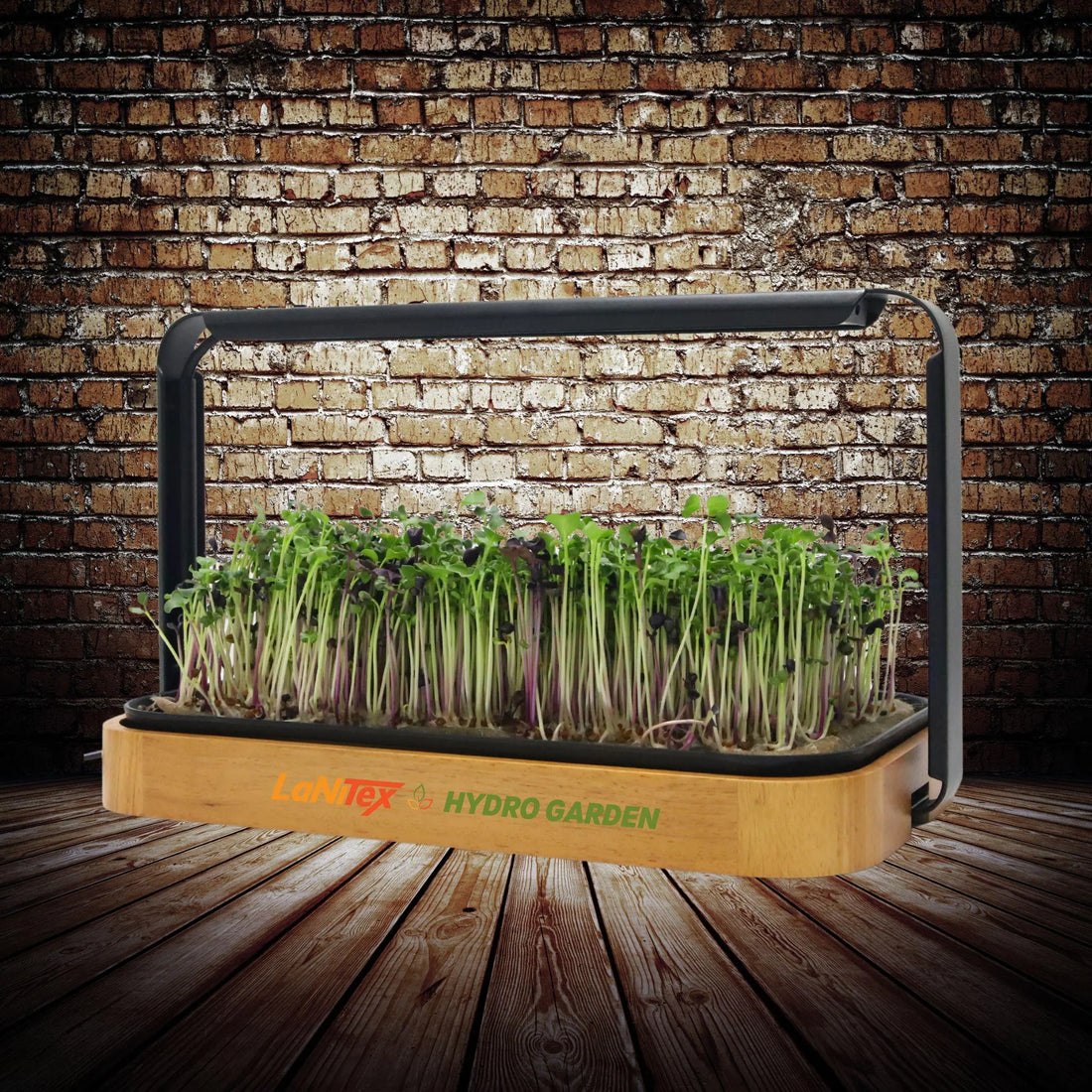
Quick answer: Celery microgreens are young seedlings of Apium graveolens var. dulce (same species as garden celery), harvested 14 to 25 days after sowing at the first true-leaf stage. They carry a stronger, more concentrated celery aroma than mature supermarket stalks because the seedling packs aromatic compounds into a tiny amount of tissue. It is a niche premium crop. Chefs reach for a small pinch as a finishing garnish on plated dishes; cooks scatter it over a hot soup or stew; bartenders perch it on a Bloody Mary rim. Start with the LaNiTex Smart Microgreen Kit (Black Metal at $129 or Wooden at $189) and a 10-pack of germinating mats for $14.90.
At a glance
| Detail | Specification |
|---|---|
| Species | Apium graveolens var. dulce (Apiaceae family) |
| Days to harvest | 14 to 25 days |
| Difficulty | Medium |
| Taste | Strong, concentrated celery |
| Best uses | Chef garnish, Bloody Mary cocktail, soup and stew finishing |
| Recommended kit | LaNiTex Smart Microgreen Kit Black Metal Style ($129) |
Key takeaways
- Concentrated celery flavour at the microgreen stage outpunches the watered-down taste of mature supermarket stalks because aromatic compounds pack into a tiny amount of seedling tissue.
- Celery is the slowest single-variety microgreen in our current kit range, with a 14 to 25 day cycle and a 7 to 14 day apparently-static germination phase before shoots emerge.
- The Bloody Mary cocktail-garnish heritage is unique to celery; within our current microgreen range, no other species carries this craft-cocktail tradition.
- Low yield is the point. A celery tray returns a delicate canopy rather than a thick lawn, which suits chef-grade pinch portions better than market-volume harvests.
- The Apiaceae family pair closes with the coriander microgreens guide (Coriandrum sativum).
What are celery microgreens (and how do they differ from mature celery)?
Celery microgreens are the seedling stage of Apium graveolens var. dulce, the same species as garden celery, harvested at 14 to 25 days when the first true leaves appear above the cotyledons. Shoots reach 3 to 6 cm with fine stems and delicate leaves; they never develop the thick fibrous petioles of a mature celery stalk.
The differences matter for the kitchen. A mature celery stalk runs 30 to 40 cm and stores most of its mass as water held in the petiole, which dilutes the aroma. The microgreen stage concentrates aromatic compounds (apiole, apiin, and sedanolide among them) into a tiny amount of tissue running on seed-stored energy. A small pinch carries the flavour punch of a tablespoon of chopped mature stalk.
Celery sits in the Apiaceae family alongside coriander, parsley, dill, fennel, and carrot. It is the second and final Apiaceae species in our 22-species cluster; our coriander microgreens guide covers the other family member, Coriandrum sativum. Both share the slow, sometimes erratic germination pattern typical of Apiaceae seed and benefit from similar moisture-management discipline.
The chef's signature ingredient: celery microgreens as the small-pinch flavour bomb
Restaurant kitchens treat celery microgreens as a finishing herb, not a bulk ingredient. A small tuft scattered over a plated dish lifts the aroma without overwhelming the protein or sauce. The chef-signature framing matches the natural yield: a single tray returns a delicate canopy that suits service-grade pinch portions, not market-volume bunches.
Concrete applications include seafood (a pinch on grilled scallops, snapper, or crab), roast chicken (the fresh-celery note cuts through richness), and creamy sauces (Bearnaise, Hollandaise, or wine-butter pan reductions). Pair with rich, fatty bases, shellfish, smoked fish, blue cheese, or sour cream.
A note on timing: heat above roughly 60 degrees Celsius wilts the shoot and dulls the volatile aromatics. Add the microgreen at the end of cooking or as a raw garnish, snipped just before plating. Volatile compounds dissipate within minutes of the cut; that is why bagged supermarket microgreens never match a fresh-snipped harvest.
Same Smart Microgreen Kit, choose your style: microgreen growing kit (Black Metal) or wooden microgreen kit. Both run the same LED, water reservoir, and reusable lid; the difference is the tray aesthetic.
My honest disclosure: growing celery microgreens from research, not pre-launch crops
Celery microgreens were not part of the LaNiTex Smart Microgreen Kit pre-launch validation crop list personally tested in Sippy Downs (Sunshine Coast, QLD 4556) before stocking. Radish, broccoli, and sunflower were the three calibration crops on the bench during that pre-listing test. The guidance below draws on the Royal Horticultural Society (RHS) Apium graveolens grow guide, The Seed Collection's Australian Apiaceae context, and peer-source benchmarks for the celery-microgreen cycle, not direct in-house trials.
That honesty matters because celery is the slowest and most uneven-germinating species we cover. The 14 to 25 day cycle and the 7 to 14 day apparently-static phase are verifiable across multiple peer benchmarks. Local results vary by climate zone, humidity, and seed batch freshness. The troubleshooting section names the cycle-length mould risk, slow patchy germination, low yield, and leggy low-light pitfalls most likely to bite Australian growers in a humid Queensland summer or cool southern winter.
Get a fresh grow guide like this every fortnight
Join the LaNiTex Hydro Garden newsletter for practical hydroponic, microgreen and mushroom growing tips for Australian homes. Subscribe to download a free hydroponics starter guide (PDF) and get 10% off your first order.
Join the newsletter →Bloody Mary garnish and cocktail-bar applications: the boutique bartender's secret
The celery-stalk garnish in a Bloody Mary dates back to the 1930s, when a celery rib became both stirring tool and aromatic anchor for the tomato-and-vodka base. The microgreen stage delivers the same aromatic note in a quarter of the volume, with delicate plate-styling that elevates the photographic appeal. For boutique bars, the small-pinch-per-serve economics work: a tray flush garnishes dozens of cocktails over a service.
Four craft-cocktail applications worth naming:
- Bloody Mary -- a small tuft floated on the surface or perched on the rim
- Caesar (the Canadian Bloody Mary variant with Clamato) -- the same aromatic finish, often paired with a celery-salt rim
- Gin and tonic with celery -- fresh shoots replace the stalk garnish on premium G&T menus
- Savoury and dirty martinis -- a small tuft adds herb aroma without altering the spirit profile
Boutique bars value the Instagram appeal of a delicate shoot on a rim. The cocktail tradition is celery-specific cultural heritage; no other microgreen species in our current range can claim it. For the cross-cluster chef-bar parallel, see our onion microgreens guide on Allium concentrated-flavour finishing.
How do celery microgreens grow in Australia?
Celery microgreens are indoor crops in Australia year-round. The Royal Horticultural Society notes that "at least 15 degrees Celsius (59 degrees Fahrenheit) is needed to germinate," which puts most Australian indoor environments in range; aim for roughly 21 to 25 degrees Celsius for the fastest, most even germination. Humidity and airflow matter more than raw temperature.
Climate-zone profile:
- Brisbane -- warm humid summer (75 to 85 percent RH, Dec-Feb) is the highest mould-risk zone; run a fan or air conditioner.
- Sydney -- moderate coastal humidity year-round; a fan on low in summer is wise.
- Melbourne -- temperate; kitchen ambient is usually adequate.
- Perth -- dry low-humidity climate is celery's sweet spot.
- Hobart -- cool low-humidity winters also suit the crop.
The RHS also notes that "celery seeds need light to germinate" and should be sown thinly on the surface. This is a defining quirk of Apium graveolens var. dulce: heavy burial slows germination further or stops it altogether.
For seed supply in Australia, several reputable suppliers stock garden celery seed suitable for microgreen use. The Seed Collection (a self-described "Australian seed retailer" offering "heirloom, open-pollinated, non-GMO seeds with no chemical treatments"), Mr Fothergill's (Bunnings), Eden Seeds (organic-certified), Greenharvest, and Seedmart all carry it. Look for untreated seed labelled for microgreens or baby leaf with fresh batch information; celery seed viability drops noticeably after 18 to 24 months. Stick to Apium graveolens var. dulce. Do not substitute var. rapaceum (celeriac) or var. secalinum (cutting celery).

Grow fresh microgreens on your kitchen bench, any season — the self-watering tank and full-spectrum LED handle the daily watering and light. You supply the seeds.
Start your first tray →Personally tested at home on the Sunshine Coast before listing.
Step-by-step: growing celery microgreens from seed to harvest
The procedure below assumes the LaNiTex Smart Microgreen Kit Black Metal Style. The same steps adapt to any shallow tray with a germinating mat.
- Choose your kit. Set up the Black Metal Style at $129 or the Wooden Style at $189. Both ship with the LED, integrated water reservoir, and reusable lid.
- Source quality seed. Buy untreated Apium graveolens var. dulce from an Australian supplier (see previous section). Check the batch date.
- Soak (optional, 6 to 12 hours). Celery does not require a pre-soak, but a gentle cold-water soak can speed germination by a day or two. Drain thoroughly before sowing.
- Sow at moderate density. Spread 15 to 20 grams of seed evenly across the moistened mat. Surface-sow; do not bury. The RHS recommends sowing thinly because the seed needs light to germinate.
- Cover lightly or use a ventilated dome. Dust a thin layer of vermiculite over the seed, or use a ventilated humidity dome rather than a weighted blackout lid. Weighted lids trap moisture and increase mould risk through celery's slow germination phase.
- Germinate 7 to 14 days. The RHS notes that "germination can be slow (up to three weeks), so patience may be required." Avoid disturbing the tray; celery often looks static for 10 to 14 days before cotyledons emerge.
- Light phase 7 to 14 days. Once most seeds have germinated, remove the dome and expose the tray to the integrated LED (or bright indirect natural light), running the LED about 12 to 14 hours a day. Bottom-water lightly through the reservoir to keep the substrate moist without flooding the surface.
- Harvest at 14 to 25 days. Snip the shoots 1 to 2 cm above the mat with sharp scissors when stems stand upright and the first true leaves have appeared. Expect 3 to 6 cm of canopy. A single tray flush returns a delicate mat rather than a thick lawn; that is the chef-grade yield. Snip the tops rather than cutting right down into the mat, and a celery tray will sometimes push a smaller second flush.
"On a 14 to 25 day cycle in a kit with integrated bottom-watering, celery microgreens reward patience with a delicate canopy ready for service."
Common problems and the Sunshine Coast humidity question
Celery sits on the tray for 14 to 25 days from sowing to harvest. The first seven to fourteen of those days look static; nothing visible happens above the surface while seed coats imbibe water and the radicle pushes down. Combine that long pre-emergent window with a humid Australian summer and the substrate stays wet far longer than the brassicas. Surface fungus that bites a broccoli tray in two days has two weeks to colonise a celery tray.
Two distinct problems share these conditions, and it pays to tell them apart. Surface mould is the grey or blue-green fuzz that spreads across the substrate. Damping-off is the more serious one: a fungal rot that attacks the seedlings themselves, collapsing the thin stems at the base so shoots topple over and do not recover. Celery is unusually prone to damping-off because the seedlings sit wet and crowded through that long seven-to-fourteen-day germination, in the cool, damp, still-air conditions the fungus favours. The reassuring part is that the prevention is identical for both, and it is the same discipline that follows.
Prevention discipline for 75 to 85 percent summer RH:
- Sow at moderate density (15 to 20 grams per tray) with breathing room between seeds.
- Run a fan on low or position the kit near a window for continuous airflow.
- Use a ventilated humidity dome through the long blackout phase, not a weighted lid.
- Bottom-water lightly; let water rise through the mat so shoot tops stay dry.
- Clean tray and substrate thoroughly between flushes; celery trays carry higher cross-contamination risk than fast-cycle crops because dead-seed clusters accumulate over the extended germination phase.
First-timer reassurance: the fine white fuzz that often appears around the seeds in the first week is almost always root hairs, not mould. Root hairs are bright white, form an even halo close to each seed, and vanish when you mist or bottom-water; true mould is grey or blue-green, spreads in irregular patches across the surface, and carries a musty smell.
Other celery-specific issues:
- Slow patchy germination -- normal for celery; bare patches reflect seed-batch variability, not your technique. Sow as evenly as possible and accept some unevenness.
- Leggy seedlings -- usually from leaving the tray under the opaque dome too long. Move to bright indirect light or the integrated LED once most seeds have sprouted.
- Low yield per tray -- botanical, not preventable; celery seed is tiny and plants stay small. Reframe low yield as the feature that drives premium-garnish use.
"The integrated humidity lid prevents the number-one reason cheap kits fail on long-cycle microgreens."
Same Smart Microgreen Kit, choose your style: Black Metal at $129 or Wooden at $189.
Soup, stew, and savoury comfort food: celery microgreens at home
Restaurant-grade chef garnish is the headline use, but celery microgreens earn their place in the home kitchen too. The same small-pinch logic lifts a weeknight soup or weekend roast.
Soup applications worth trying:
- Tomato soup -- fresh celery against the sweet tomato base
- Creamy mushroom or potato-leek soup -- herb-pop against the rich cream
- Clam chowder or seafood chowder -- fresh celery against the cream-and-fish base
- Asian noodle soups, pho, or ramen -- herb-pop on the broth finish
Stew and braise applications:
- Slow-cooked beef stew or braised lamb shanks -- scattered just before serving
- Coq-au-vin or boeuf-bourguignon -- a French-cooking finishing herb that respects the heritage
- Chicken cassoulet or Moroccan tagine -- fresh-celery pop after the slow cook
Savoury-comfort applications include scrambled eggs, omelettes, cheese plates, deviled eggs, and savoury tarts. As with chef plating, add the microgreen at the end; heat dulls the aromatics. For a daily-rotation cooking kit that includes celery alongside four other species, see our microgreen mix guide, or our chive microgreens guide for the parallel slow-cycle herb-garnish workflow.
Are celery microgreens good for you?
Celery microgreens carry the same kinds of nutrients as the mature stalk. Celery is documented as a source of vitamin K, vitamin C, folate, vitamin A, and potassium, along with antioxidant plant compounds such as apigenin and luteolin (USDA FoodData Central). Harvested young at the first true-leaf stage, the seedling concentrates those compounds into a small amount of tissue, the same reason the flavour is so intense. Enjoy a pinch as a fresh, flavour-forward finishing touch rather than a major serve of any single nutrient.
One safety note: celery is a recognised food allergen and must be declared on Australian food labels (Food Standards Australia New Zealand). Anyone with a celery allergy should avoid celery microgreens too, and caterers should flag them on a menu just as they would a celery stalk.
Storing and using your celery microgreen harvest
Celery microgreens are delicate and at their best snipped straight onto the plate, because the volatile aromatics start to fade within minutes of cutting. When you do need to hold a harvest, pat the shoots dry, wrap them loosely in a paper towel inside a sealed container or bag, and keep them in the fridge. Expect one to two days at peak quality, a little longer if the shoots were thoroughly dry when cut. Wash just before use rather than before storage, so they do not go slimy.
Because the kit grows on your benchtop, the simplest storage is no storage at all: snip only what a dish needs and leave the rest of the tray growing for next time.

Restock the refill your kit runs on — 10 soil-free growing mats, ready for your next sowing.
Restock your mats →Personally tested at home on the Sunshine Coast before listing.
Celery microgreen FAQ
What are celery microgreens and how are they different from mature celery?
Celery microgreens are the young seedlings of Apium graveolens var. dulce, harvested at the first true-leaf stage, usually 14 to 25 days after sowing. Unlike mature celery stalks, they are delicate leafy shoots with fine stems. The flavour is noticeably more concentrated and celery-like than supermarket stalks; you need only a small pinch to season dishes. They grow densely in shallow trays or on mats and never form the thick petioles you see in a full-size plant.
Why do celery microgreens have such a strong, concentrated flavour?
Celery microgreens concentrate aromatic compounds in a tiny amount of plant tissue, so each leaf and stem carries an intense celery aroma and flavour. Because they are harvested young, the plant is still running on seed-stored energy and early-growth metabolism, which can lead to a more pungent, compressed taste compared with watered-down mature stalks. When used as a garnish or topping, the microgreen gives a noticeable celery lift to soups, stews, and drinks without needing large volumes of chopped celery.
How do I grow celery microgreens at home in Australia, step by step?
Choose a shallow tray, recycled punnet, or microgreen kit with a mat. Lay the mat (or 1 to 2 cm of fine seed-raising mix) and moisten thoroughly. Sow tiny celery seeds evenly in a single dense layer; do not bury deeply, because celery seed needs light to germinate. Mist evenly damp and cover with a ventilated dome for darkness and humidity. Germinate 7 to 14 days; celery is slow, so keep the medium just moist, not soggy. Once most seeds have sprouted, remove the cover and place in bright indirect light or under the integrated LED. Bottom-water by sitting the tray in a shallow plate. Harvest at 14 to 25 days, when shoots are 3 to 6 cm tall with first true leaves.
Why do celery microgreens have slow and uneven germination, and how can I manage it?
Celery seed is naturally slow and erratic to sprout; some growers describe it as the slowest seed they have worked with for microgreens. The seed can sit apparently unchanged for one to two weeks. Cool temperatures, inconsistent moisture, and old seed all increase delays and patchiness. Manage by using fresh good-quality seed from a reputable Australian supplier, maintaining consistent warmth, keeping the tray evenly moist under a humidity dome (avoid saturation), and refusing to disturb the tray for 10 to 14 days. Accept lower yields per tray than fast species; celery is a premium microgreen, not a bulk crop.
How long do celery microgreens take to harvest, and what yield should I expect?
Celery microgreens take 14 to 25 days from sowing to harvest, slow compared with many other microgreens. They can take 10 to 14 days just to reach a visible seedling stage and are often grown on to roughly three weeks to develop flavour and leaf size. Yield per tray is typically lower than larger faster species. Celery seeds are tiny and the plants stay small at harvest, so even with dense sowing you get a fine delicate mat rather than a thick lawn. Celery is a premium microgreen suited to finishing plates, topping soups, and garnishing drinks rather than to bulk salads.
How can I use celery microgreens in the kitchen?
Celery microgreens carry strong classic celery flavour that works well in concentrated applications. Chef garnish (a small pinch on seafood, roast chicken, potato dishes, or creamy sauces gives a distinctive signature note); soup and stew topping (scatter over soup bowls or slow-cooked stews just before serving for fresh celery aroma without extra chopping); Bloody Mary or savoury cocktail garnish (in place of or alongside celery stalks as a refined garnish); egg dishes and canapes (sprinkle on omelettes, scrambled eggs, pate, savoury tarts, or finger food). You rarely need more than a small tuft per serve.
What are common problems when growing celery microgreens, and how do I avoid them?
Slow or no germination is normal for celery; allow 10 to 14 days or more, maintain warm evenly moist conditions, and avoid letting the tray dry out under cover. Uneven patchy growth is common due to variable germination; sow as evenly as possible, use fresh seed, and maintain consistent moisture and temperature. Mould or fungus is a real risk with slow crops; clean trays, ensure good air circulation once sprouts emerge, avoid over-watering and standing water, and use gentle air movement or reduce sowing density to limit humidity. Yellow or leggy seedlings usually indicate low light or staying under the opaque dome too long; move trays to bright indirect light once most have sprouted.
Where can I buy celery microgreens seeds in Australia?
Celery microgreens remain a niche crop in Australia, so seed may not be stocked at every garden centre. Options include specialist microgreen seed suppliers listing celery specifically for microgreen use, general seed companies offering Apium graveolens var. dulce (choose untreated or organically certified seed suitable for microgreens), and online Australian retailers (often better availability than physical shops). Look for seed labelled for microgreens or baby leaf; untreated or organic seed where possible; and fresh stock with clear batch information for germination reliability. Mr Fothergill's, Eden Seeds, Greenharvest, Seedmart, and The Seed Collection all stock common garden celery seed.
Explore other microgreen varieties
Grown Celery once? These pair naturally with the same Smart Microgreen Kit & Germinating Growing Mats.
More herb-family greens
Easy to start with
Fresh herb garnishes
→ Browse all 22 microgreen varieties | → Microgreens growing guide
About the writer
Laszlo Bulatko founded LaNiTex Hydro Garden on one belief: growing your own fresh food at home shouldn't need a backyard, a green thumb, or a science degree — a sunny apartment windowsill is enough. From its base on the Sunshine Coast, LaNiTex makes that easy and affordable — hydroponic grow boxes, a benchtop Mini Grow Pot, and the Smart Microgreen Kit — alongside the Term-Grow Enrolment programme in Queensland primary school classrooms. The founder who has run LaNiTex since it launched in December 2024, he personally tested every product at home before listing it — a discipline carried over from 15 years building brands in the Hungarian fishing-tackle market. More on the About Laszlo founder page. ABN 47 682 768 967.
The full range
Find the microgreen kit that suits your kitchen


Supported in Australia - every model tested before listing.
Sources
- Royal Horticultural Society (UK), Celery: Grow Your Own -- Apium graveolens germination temperature, slow-germination caveat, surface-sow light requirement.
- The Seed Collection (Australia), theseedcollection.com.au -- Australian heirloom, open-pollinated, non-GMO seed retailer; Apiaceae context.
- CSIRO (Commonwealth Scientific and Industrial Research Organisation) Plant Industry -- Australian agronomy and crop-physiology research baseline for Apium graveolens var. dulce under temperate and subtropical conditions.
- Queensland Department of Agriculture and Fisheries (DAF QLD) -- state-level horticulture advisory for Queensland and Sunshine Coast subtropical climate context.
- Bureau of Meteorology (BoM) Sunshine Coast summer humidity records -- reference for the 75 to 85 percent relative-humidity range cited in the mould-prevention discipline.
- USDA FoodData Central -- celery nutrient profile (vitamin K, vitamin C, folate, vitamin A, potassium) and antioxidant plant compounds (apigenin, luteolin) cited in the nutrition section.
- Food Standards Australia New Zealand (FSANZ) -- celery as a recognised, declarable food allergen on Australian food labels.
- Internal: LaNiTex pillar guide on growing microgreens at home, microgreen varieties sub-pillar, coriander microgreens (Apiaceae family-anchor), onion microgreens, chive microgreens, basil microgreens, best microgreen mix Australia.