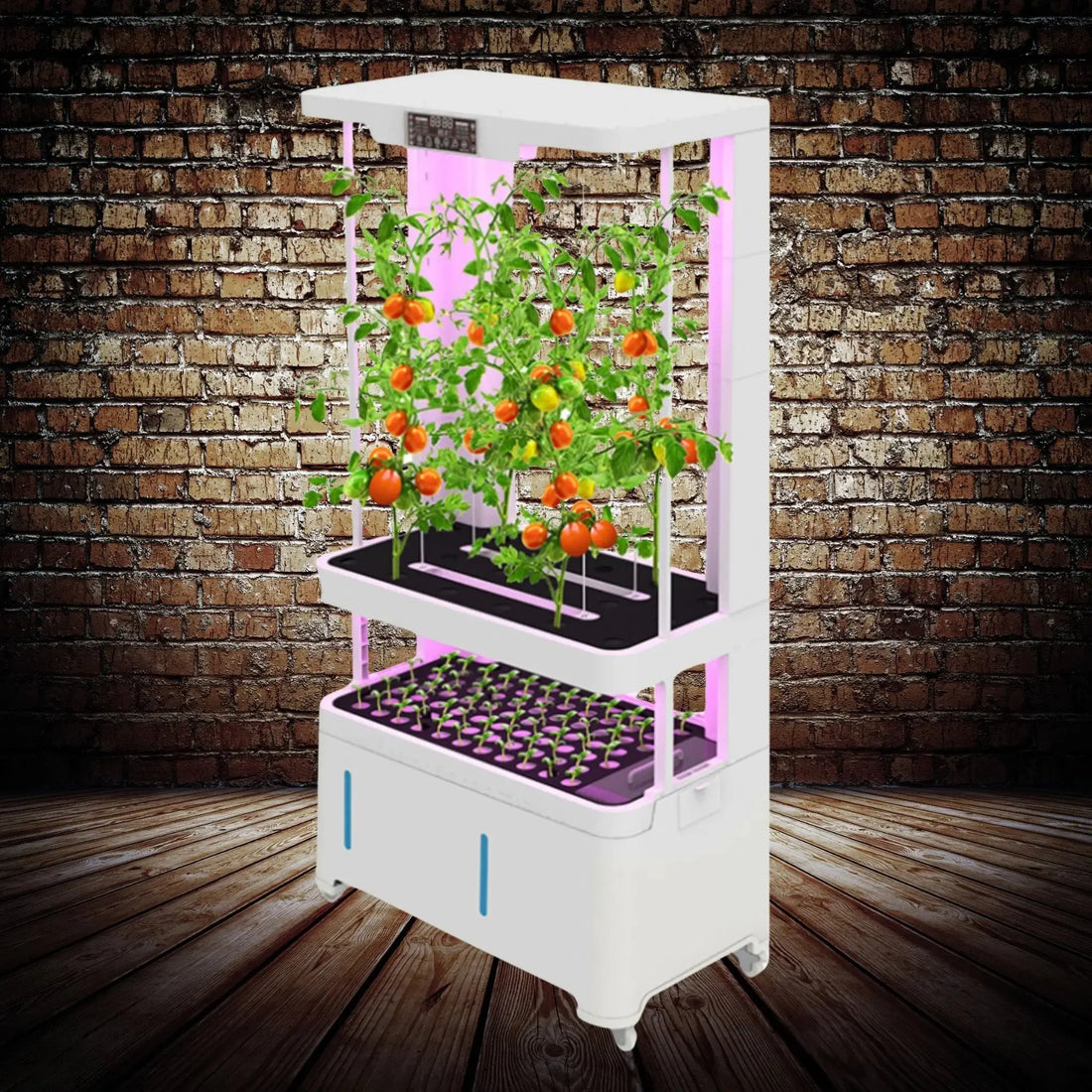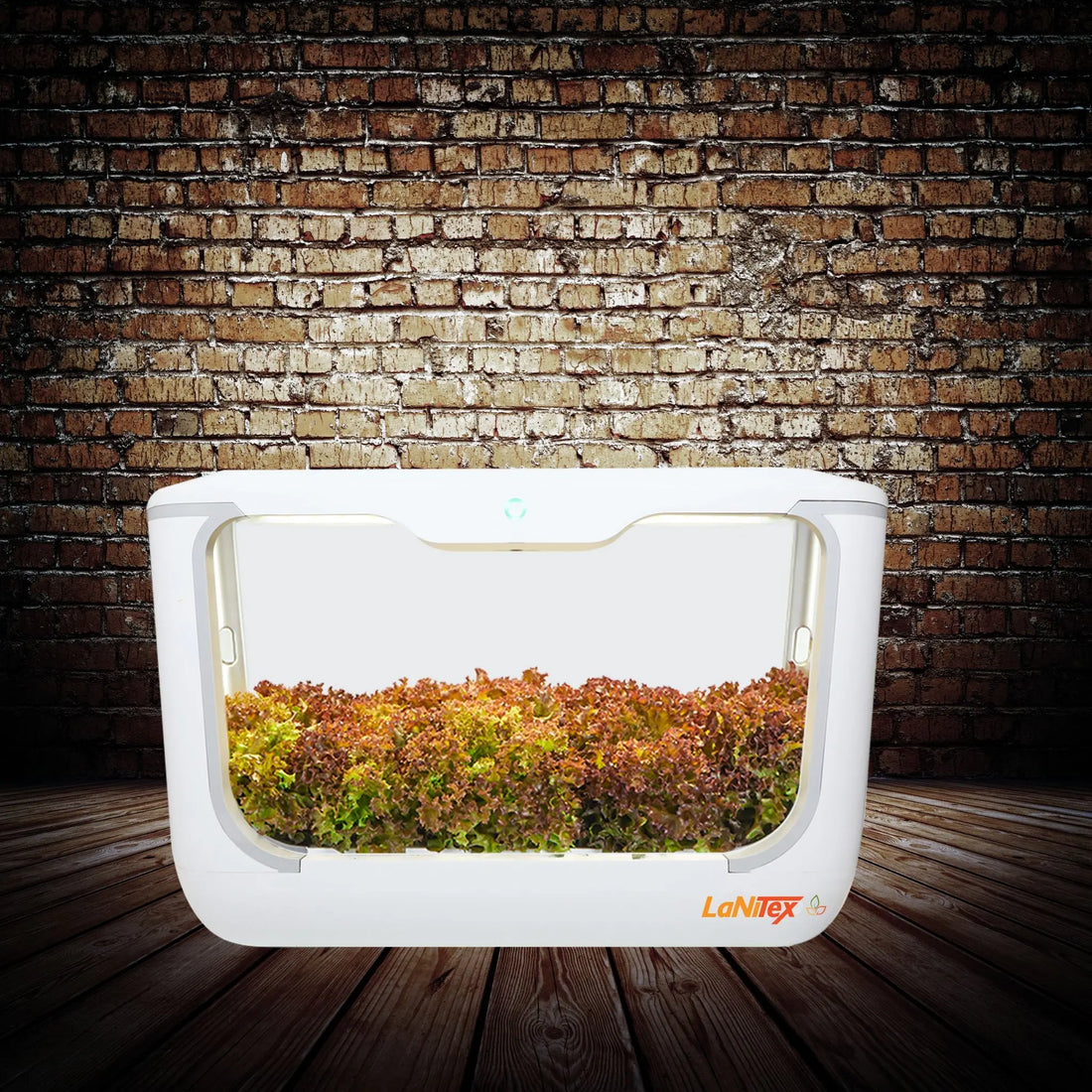

Snip a green-onion-top garnish straight off your kitchen bench, 14 to 21 days from sowing, and replace those wilted $3-5 supermarket spring-onion bunches for roughly $1.49 a flush.
Quick answer: Onion microgreens are young Allium cepa plants harvested 14 to 21 days after sowing, when the grass-like shoots reach 8 to 10 cm tall. They deliver a pronounced, slightly sweet onion flavour, often with signature black seed hulls clinging to the tips. Australian home growers use them as a chef-style green-onion-top garnish across Asian, French, and brunch dishes, sown 12 to 18 grams per tray in a kit-based blackout-then-light cycle.
Onion microgreens sit at the patient-grower end of the microgreen spectrum, a notch slower than chia (8-14 days) and a fair bit slower than radish or sunflower (5-10 days). The longer cycle means more days under humidity management, but the payoff is a concentrated chef-garnish that wholesale microgreen suppliers in Australia commonly report prices in the $40 to $80 per kilogram range. From the LaNiTex Smart Microgreen Kit Black Metal Style on a Sippy Downs kitchen bench in 2026, the grow is straightforward once airflow and sowing density are dialled in. This guide covers Allium cepa botany, onion-vs-chive disambiguation, climate-zone adaptation across Brisbane, Sydney, Melbourne, Perth, and Hobart, a kit-aware seed-to-harvest workflow, mould prevention specific to the long cycle, polka-dot hull aesthetics, three culinary traditions, and an honest neutral list of Australian seed suppliers.
| At a glance | Onion microgreens |
|---|---|
| Species | Allium cepa (Amaryllidaceae onion family) |
| Days to harvest | 14 to 21 days |
| Difficulty | Medium (slow, hull-clingy, light-management matters) |
| Taste | Mild to pronounced concentrated onion, slightly sweet |
| Best uses | Chef garnish, Asian, French, brunch |
| Recommended kit | Smart Microgreen Kit Black Metal Style, $129 |
What are onion microgreens?
Onion microgreens are young Allium cepa plants, harvested when the grass-like green shoots reach 8 to 10 cm tall with their first cotyledons fully open. The species sits in the Amaryllidaceae family, subfamily Allioideae, the same botanical group that gives us mature bulb onions, scallions, bunching onions, and spring onions. At the microgreen stage, all of these names point to the same Allium cepa species, just different cultivar lines.
Onion microgreens are not sprouts. Sprouts germinate in water in the dark and are eaten whole within a few days of soaking. Microgreens grow in or on a medium under light, are cut above the surface line, and are eaten as a leafy garnish or salad accent rather than as a whole germinated seed. The botanical fingerprint that gives onion microgreens their signature look is the hard black testa, the seed coat, which often stays attached to the shoot tip during germination and creates the polka-dot aesthetic many home growers initially mistake for a fault.
Inside the active LaNiTex microgreen cluster, onion is the first and only Amaryllidaceae species published. The forthcoming chive guide will close that family pair, but for now this disambiguation lives entirely in the body below.

Onion microgreens vs chive microgreens: how to tell them apart and which to grow
Onion and chive microgreens look similar in the tray, but they are different species with distinctly different culinary outcomes. Onion microgreens are Allium cepa. Chive microgreens are Allium schoenoprasum. Both grow as grass-like green shoots, both belong to the Amaryllidaceae onion family, and both work as kitchen garnish. The differences matter when you choose which to grow.
In flavour, onion microgreens are more pronounced and slightly sweeter, closer to the green-onion-top end of the bunching-onion spectrum. Chive microgreens are milder, cleaner, more traditionally herb-like, the flavour profile cooks reach for when they want a delicate sprinkle that does not dominate the dish. In texture, onion shoots are often longer, thicker, and tend to keep their black seed hulls attached to the tip, creating the polka-dot look. Chive shoots are finer, cleaner, and shed their hulls more readily.
In plate aesthetic, onion microgreens read as a bold chef-style green-onion-top garnish, the same look a restaurant kitchen achieves by slicing the green tops of bunching onions at a 45-degree angle. Chive microgreens read as a traditional herb sprinkle, the kind you scatter over a baked potato or a bowl of cream-mushroom soup. Choose onion microgreens for restaurant-style plating on grilled fish, Asian noodle bowls, omelettes, and brunch eggs. Choose chive microgreens for cream-based dishes, scrambled eggs, sour-cream toppings, and creamy soups where a milder onion note suits the recipe.
This is the single most common reader confusion around onion microgreens. Skip pelleted seed and stick to untreated raw seed: bunching-onion, scallion, or spring-onion packets for onion microgreens (all Allium cepa), or true chive seed (Allium schoenoprasum) for chives, which is a different species despite the visually similar shoots. Both species use the same kit and method below.
What I have learned about growing onion microgreens from research
Honest disclosure: onion microgreens were not part of the LaNiTex Smart Microgreen Kit pre-launch validation crop list personally tested in Sippy Downs (Sunshine Coast, QLD 4556) before stocking the kit. Radish, broccoli, and sunflower were the three calibration crops chosen for their fast 5-10 day cycles and beginner-friendly profiles. The guidance below combines Epic Gardening onion microgreen growing methodology, Home Microgreens onion-specific cycle notes, Penn State Extension generic microgreen technique guides, The Seed Collection Australian Allium grow guide context, and Australian climate-specific adaptation for this slow-pace Amaryllidaceae onion-family microgreen.
The 14 to 21 day cycle is verifiable across multiple peer-source benchmarks, not a stylistic exaggeration. The clinging seed hulls are an Allium cepa botanical reality grounded in the seed-coat physiology, not a technique failure. Local results may vary by climate zone. The troubleshooting section below names the cycle-length-mould risk, leggy-low-light, clinging-hull-cosmetic, and uneven-germination pitfalls most likely to bite Australian growers in humid Queensland summer versus cooler southern winter.
Patience pays off here.
How to plate restaurant-style green-onion-top garnish at home
The spot-on chef-garnish trick the Sunshine Coast restaurants are using is the slender green top of a bunching onion, thinly sliced at a 45-degree angle and scattered over a finished plate just before service. Onion microgreens deliver the same aesthetic without the 90-day wait for a bulbing onion to mature. Snipped at 8 to 10 cm above the medium and either left whole or cut into 2 to 3 cm batons, they read as the same restaurant-style finish.
The concentrated onion flavour intensifies the garnish compared with diluted-by-water mature green tops. Five plate-styling techniques cover most uses. Scatter pattern works for casual plating: drop a small handful across the dish surface, no formal arrangement. Crown arrangement works for formal plating: cluster the shoots at the centre of the plate, tops upward, creating a small green crown above the protein. Cross-hatch works for steak or grilled fish: lay batons in a loose grid across the protein, the same way a chef finishes a steak with chives. Circular ring works for risotto or curry: arrange shoots in a thin ring around the edge of the bowl. Linear stripe works for sushi or carpaccio: lay batons in a single line down the length of the plate.
Always add the garnish at the very end of cooking. Heat above 60 degrees Celsius wilts the shoots and dulls the fresh onion aroma. The volatile sulphur compounds that give onion microgreens their bright top note dissipate within a few minutes of cutting, so chop or snip just before plating for maximum aroma impact. Don't add them earlier and then leave the plate sitting on the pass.

Want chef-garnish ready on the bench?
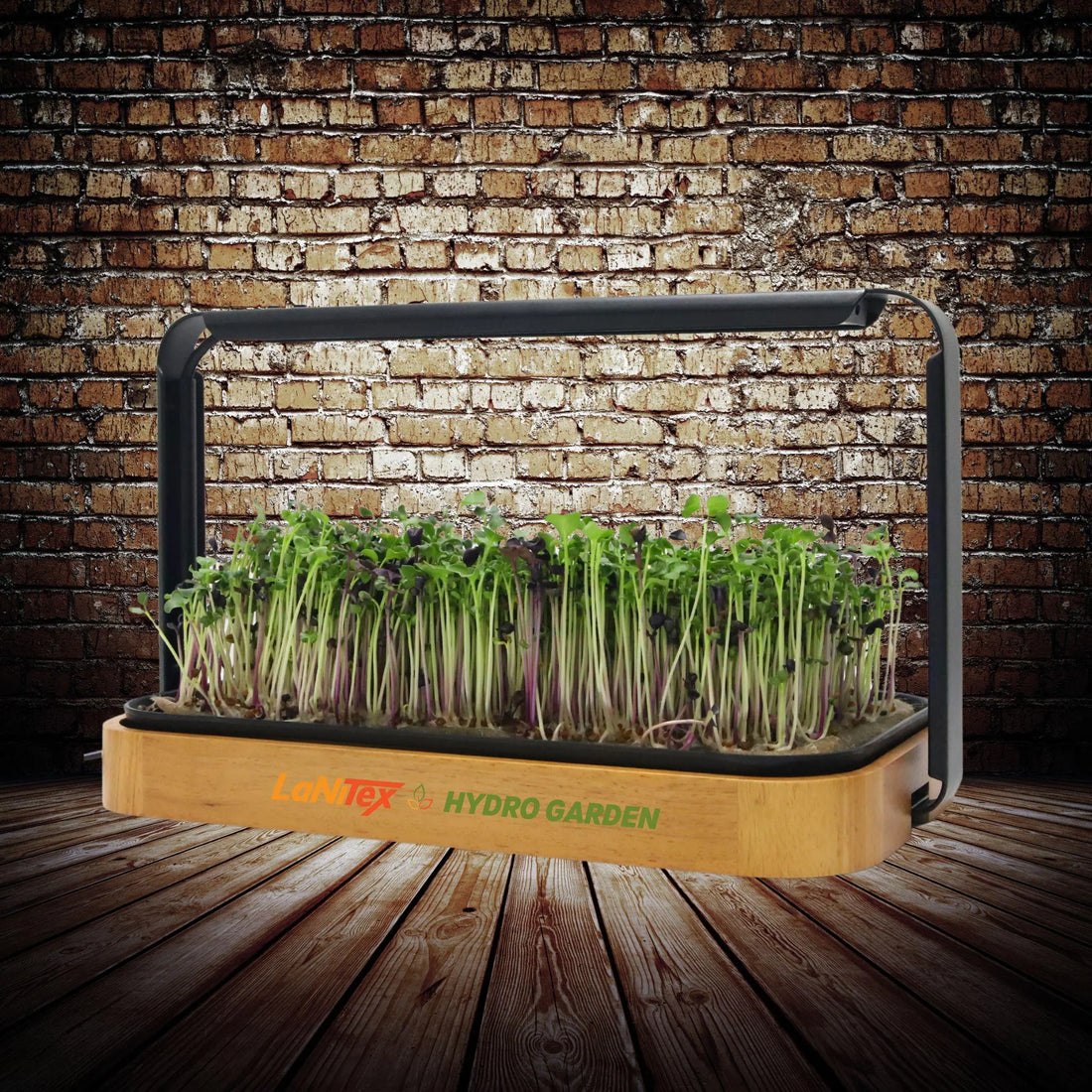
The Smart Microgreen Kit handles the long onion cycle with integrated LED, a bottom-watering tray, and airflow design. Same kit, two styles - pick the one that suits your kitchen:
- microgreen growing kit (Black Metal) for first-time growers and cost-conscious cooks.
- wooden microgreen kit for benches where the tray reads as a feature.
How onion microgreens grow in Australia: climate-zone breakdown
Onion microgreens grow indoors in every Australian capital with a few zone-specific adjustments. The species is moderately temperature-flexible but humidity-sensitive across its long 14 to 21 day cycle, which means the mould-exposure window is wider than for fast-cycle brassicas like radish or broccoli. Indoor temperature between 18 and 22 degrees Celsius is the sweet spot.
Brisbane's warm-humid summer pushes onion microgreen trays firmly indoors with humidity managed below 70 per cent. The 14 to 21 day cycle compounds airborne mould exposure if airflow falters. A small fan running near the tray for several hours a day is cheap insurance. Sydney's coastal climate suits year-round indoor onion microgreen growing without seasonal pause, although peak summer humidity benefits from the same fan approach. Melbourne's temperate spring-autumn windows are the natural sweet spot, with 18 to 22 degrees Celsius ambient indoors and little humidity intervention required. Perth's dry low-humidity climate is the most forgiving for first-time onion growers, with the slow 14 to 21 day cycle becoming less mould-prone in the dry inland air. Hobart's cool-winter rooms slow germination a touch but reduce mould pressure significantly. Sippy Downs on the Sunshine Coast sits between the Brisbane and Sydney profiles, with summer humidity managed indoors and winter conditions close to ideal.
Australian Bureau of Statistics Census 2021 data shows 70 per cent of Australian dwellings are separate houses, 13 per cent townhouses, and 16 per cent apartments. Kitchen-bench grow setups suit the majority of Australian homes, not just the apartment minority. Mr Fothergill's stocks bunching-onion and spring-onion seed at Bunnings stores nationwide. Eden Seeds, Greenharvest, Seedmart, and The Seed Collection round out the supplier list. Untreated raw seed is the rule across all of them.
Step-by-step: growing onion microgreens from seed to harvest
The grow cycle runs across three phases: sowing, blackout, and light. Onion seed does not require pre-soaking, but an optional 4 to 6 hour soak in room-temperature water speeds germination by a day or two for impatient growers.
- Optional soak: soak onion seed 4 to 6 hours in room-temperature water to speed germination (skip if short on time).
- Sow: scatter 12 to 18 grams of untreated onion seed in an even single layer on pre-moistened seed-raising mix, coco coir, or a microgreen mat in a 25 by 25 cm tray, then press lightly.
- Blackout (4 to 7 days): cover with a weighted inverted tray, mist daily, and hold at 18 to 22 degrees Celsius until the shoots lift the lid 1 to 2 cm.
- Light (10 to 14 days): uncover and place under a grow light running 12 to 14 hours per day at 15 to 25 cm, then switch to bottom watering and drain after 30 minutes.
- Harvest (day 14 to 21): cut just above the medium at 8 to 10 cm tall for about 50 to 80 grams per tray, then store refrigerated for 3 to 5 days.
Phase one is sowing. Prepare a shallow tray with drainage holes and a second tray underneath for bottom watering. Use a fine seed-raising mix, coco coir, or a microgreen grow mat suited to the Smart Microgreen Kit insert. Pre-moisten the medium evenly, damp but not soggy. Sow 12 to 18 grams of untreated onion seed per standard 25 by 25 cm tray, scattering for an even single-layer distribution. Press lightly to seat the seeds against the medium. Some growers add a very thin cover of mix or vermiculite over the seed; others surface-sow and use a weighted blackout lid to hold the seeds in contact with the medium. Both methods work for onion.
Phase two is blackout. Cover the tray with a second inverted tray or a blackout lid, weighted gently. The dark plus mild pressure encourages strong taproot anchoring and even germination. Mist the surface daily and check moisture without disturbing the seeds. Keep the tray at 18 to 22 degrees Celsius. The blackout phase runs 4 to 7 days for onion microgreens, longer than the 2 to 4 days typical of brassicas. By day 5 to 7, the shoots will have pushed the cover up by 1 to 2 cm, and the seeds will have visibly germinated.
Phase three is the light phase. Remove the blackout lid and place the tray under a grow light or near a bright window. The Smart Microgreen Kit's integrated LED panel runs 12 to 14 hours per day at a height of about 15 to 25 cm above the canopy. Switch to bottom watering: pour about 250 to 500 ml of water into the outer tray and let the medium wick moisture from below. Drain off any excess after 30 minutes. Bottom watering prevents fungal pressure from wet leaves and stops hulls being pushed into the medium. The light phase runs 10 to 14 days as the shoots stretch from 2 cm to a harvest height of 8 to 10 cm.
Harvest at 14 to 21 days from sowing. Cut just above the medium with sharp scissors. Yield from a single tray runs about 50 to 80 grams of fresh microgreen, enough to garnish 10 to 20 plates. Store in a paper-towel-lined airtight container for 3 to 5 days refrigerated. Don't water from the top during the light phase. It pushes hulls back into the medium and raises mould risk.
Do onion microgreens grow back after cutting?
Yes, partly. Onion microgreens are alliums, and like chives or lawn grass their blades regrow from the base, so a tray can push out a second, smaller flush after the first cut, and sometimes a third. Home Microgreens reports two to three harvests from a single sowing, with each cut yielding less than the one before.
The catch is the long onion cycle: the older a tray gets, the more days it has spent sitting damp, so mould risk climbs with every extra week, and the regrowth comes in slower than it would on a fast brassica. For the cleanest, most reliable chef-garnish, most growers take one strong harvest and resow rather than nursing a tired tray for a thin second cut. If you do chase a second flush, keep the airflow up, bottom water only, and harvest the regrowth promptly once it reaches height.
Common onion microgreen problems and how to fix them
Mould is the number one risk in onion microgreen growing, and the longer 14 to 21 day cycle is the reason. The longer the cycle, the more days the tray spends exposed to airborne mould spores. Onion's clinging seed hulls compound the issue because each hull traps a small pocket of moisture against the shoot. The fix is twofold: airflow plus sowing density. Run a small fan near the tray for 4 to 8 hours per day during the light phase, sow within the 12 to 18 grams per tray range rather than over-sowing, and keep the surface drier between bottom waterings.
Leggy weak seedlings mean insufficient light. Move the grow light closer, 30 to 60 cm above the canopy is the recommended range, and run the LED for 12 to 14 hours per day. The Smart Microgreen Kit's integrated panel handles this automatically, but window-light setups need a supplementary LED in winter months.
Clinging seed hulls are common on Allium cepa. They are not a technique failure. If you want cleaner tips for fine-dining plate-styling, gently brush your hand across the tops 24 to 48 hours pre-harvest. The light disturbance loosens loose hulls. For casual plating or Asian and brunch applications, leave them on. They read as authentic small-batch aesthetic, not industrial product.
Uneven germination usually points to old seed. Onion seed viability drops sharply after 12 to 18 months. Run a germination test: damp paper towel, 10 to 20 seeds, 4 to 7 days, room temperature. If 70 per cent or more germinate, the batch is fresh enough. If under 50 per cent, source fresher seed from a different supplier. Onion seed germinates slower than brassica seed by botanical default, so allow the extra time without panic.
Tired of fighting mould on a single-flush plastic tray?
The Smart Microgreen Kit ships with integrated LED, airflow-friendly base, and bottom-watering tray that keeps moisture off the hull line across the long onion cycle. Same kit, two styles:
- Smart Microgreen Kit Black Metal Style
- Smart Microgreen Kit Wooden Style
Get a fresh grow guide like this every fortnight
Join the LaNiTex Hydro Garden newsletter for practical hydroponic, microgreen and mushroom growing tips for Australian homes. Subscribe to download a free hydroponics starter guide (PDF) and get 10% off your first order.
Join the newsletter →Working with the polka-dot seed hulls
The black hulls cling to the tip of each onion shoot because Allium cepa has a hard outer testa that does not slough off easily during germination. This is a botanical reality, particularly when sowing density is high enough that seeds remain in mutual contact during the blackout phase. Polka-dot hulls are common in commercial onion microgreen trays at high-end restaurant supply houses, and the look is increasingly seen as a feature rather than a fault.
The reframe is straightforward. Polka-dot black tips on a green-shoot field signal authenticity. They read as genuine home-grown small-batch microgreen, the same way visible cookie cracks signal a real hand-baked cookie rather than a factory product. High-end restaurants increasingly source microgreens with hulls intact for the visual signal alone.
When hulls matter for plating depends on the dish. For formal fine-dining plate-styling, brush your hand gently across the tops post-harvest to dislodge loose hulls and present cleaner shoots. For casual plating, Asian noodle bowls, omelettes, grain bowls, and brunch eggs, leave the hulls intact for the polka-dot signature aesthetic. If you want to encourage more hulls to drop pre-harvest, gently mist the canopy and run your hand across the tops 24 to 48 hours pre-cut. Keep humidity consistent during the light phase so hulls dry and detach rather than gel-cling.
LaNiTex's editorial position is that polka-dot hulls are a feature for most home use, and only formal plate-styling warrants the extra hull-management step.
Asian, French, and brunch: onion microgreens across three culinary traditions
Onion microgreens bridge three culinary traditions in a way few other microgreen species do. Asian, French, and brunch cooking all use raw fresh onion at the end of cooking for brightness and texture, and onion microgreens deliver the chef-garnish version of that ingredient across all three.
Asian applications include stir-fry finishing garnish scattered at the end of wok cooking just before serving, dumpling and Chinese-pancake topping, ramen and noodle-soup floating garnish replacing sliced bunching-onion tops, banchan or Korean side-dish accent across mild rice dishes, and sushi or sashimi accompaniment paired with soy and ginger. Five applications, all using onion microgreens raw at the end of cooking. The concentrated onion intensity works particularly well with garlic, ginger, and soy.
French applications include omelette, scrambled eggs, and baked eggs with a gentle onion accent that avoids the chopped-onion sweat. Potato salad finishing benefits from the fresh onion intensity over a creamy base. Cream-based sauces like Bearnaise, Hollandaise, and cream-mushroom finishing love a green-onion-top brightness. Grilled fish and roast meat finishing reads as vibrant green against rich proteins. French onion soup gets a fresh-onion echo of the cooked-base flavour, the kind of restaurant-style plate-finish home cooks rarely manage with supermarket spring onions.
Brunch applications are where onion microgreens shine for parents and home cooks. Scrambled eggs, omelette, and shakshuka all benefit from gentle onion brightness without the bulb pungency that can put kids off. Avocado toast gets a green-onion-top pop on the rich creamy base. Bagel with cream cheese benefits from fresh-onion intensity replacing chopped white onion. Breakfast bowls and grain bowls get chlorophyll plus concentrated onion. Huevos rancheros and breakfast burritos get a fresh top-of-pan finish.
Always add at the end of cooking or raw. Heat above 60 degrees Celsius wilts the shoots. Chop just before serving for the freshest onion aroma. Onion microgreens keep 3 to 5 days refrigerated in a paper-towel-lined airtight container.
Are onion microgreens good for you? An honest nutrition note
Onion microgreens are eaten in small amounts as a garnish, so treat them as a fresh flavour-and-colour boost rather than a major source of nutrition. That said, the research on microgreens as a category is genuinely encouraging. A 2012 University of Maryland and USDA study led by Xiao measured 25 microgreen varieties and found many carried four to forty times more vitamin C, vitamin E, vitamin K, and carotenoids per gram than the mature leaves of the same plant. Onion was not one of the 25 species tested, so the honest position is that the broad microgreen pattern is well evidenced while onion-specific laboratory numbers are still thin.
For alliums specifically, a Penn State microgreen mineral survey singled out scallion (green-onion) microgreens as a good source of calcium and copper among the species it analysed. Because onion microgreens are the same Allium cepa species as bulb onions and spring onions, they carry the same families of plant compounds: vitamin C, flavonoid antioxidants such as quercetin, and the organosulfur compounds that give every onion its aroma and bite. Eating them raw, snipped fresh onto the plate, preserves the heat-sensitive vitamins and volatile sulphur compounds that long cooking drives off.
One honest caveat worth repeating: there is not yet a complete published nutrient profile for onion microgreens specifically, and most "onion microgreen nutrition" tables online are really mature-onion-bulb figures relabelled. Enjoy them as a concentrated, fresh-picked garnish with a plausibly higher nutrient density than the mature bulb, gram for gram, not as a measured supplement.
Where to source onion seeds for microgreens in Australia
Onion seed for microgreen use is widely available across Australian seed suppliers. The basic rule is that bunching onion, scallion, and spring onion seed all work for microgreen use; most are Allium cepa cultivars, and some spring onions are Allium fistulosum (Welsh onion), but both species perform well at the microgreen stage. The seed packets labelled for outdoor bulb, bunching, or spring-onion use grow the same species at the microgreen stage, provided the seed is raw, untreated, without pelleting or fungicide coating, and has high turnover so it is fresh.

Grow your own onion microgreens on the kitchen bench, any season — the self-watering tank and full-spectrum LED handle the daily watering and light. You supply the seeds.
Start your first tray →Personally tested at home on the Sunshine Coast before listing.
Mr Fothergill's stocks bunching-onion and spring-onion seed at Bunnings stores nationwide, the easiest off-the-shelf option for most Australian home growers. Eden Seeds carries Allium cepa cultivars in their organic specialist range, useful for growers wanting certified-organic seed. Greenharvest stocks scallion and bunching onion in their Asian-greens category, suited to the chef-garnish positioning. Seedmart's microgreen-focused range includes onion seed in bulk packs for growers running multiple flushes per month. The Seed Collection lists bunching, spring-onion, and scallion options in its broader Allium category and ships nationwide from Melbourne.
What to avoid: pelleted onion seed, where the coating is designed for outdoor sowing and gums up the flush; treated seed marked with a fungicide colour film; roasted or heated seed that will not germinate; and very old stock, since onion seed viability drops sharply after 12 to 18 months.
To verify a batch is fresh enough for microgreen use, run a germination test. Damp paper towel, 10 to 20 seeds, 4 to 7 days at room temperature. If 70 per cent or more germinate, the batch is usable, though onion seed naturally rates around 70 to 80 per cent on fresh stock and loses viability quickly within 12 to 18 months, so higher is better. If under 50 per cent, source fresher seed elsewhere.
A $4 to $8 packet of bunching-onion seed contains enough seed for 5 to 10 microgreen flushes. Compared with $3 to $5 per supermarket spring-onion bunch as a single use, the cost-per-flush math works strongly in favour of home growing.
LaNiTex Hydro Garden does not sell seed. This list is the neutral Australian supply chain.

Restock the soil-free refill your kit runs on — ten germinating mats, ready for your next onion sowing.
Stock up on mats →Personally tested at home on the Sunshine Coast before listing.
Onion microgreens FAQ
What are onion microgreens, and how are they different from sprouts?
Onion microgreens are young Allium cepa plants harvested when only a few cm tall with first leaves (cotyledons). Grown in shallow medium or mat, under light, cut above the surface. They differ from sprouts: sprouts germinate in water without medium in the dark, microgreens grown in or on medium under light. Sprouts are eaten just after germination; onion microgreens are usually harvested 14 to 21 days after sowing as fine grass-like blades. Use as garnish or herb rather than bulk salad.
How do onion microgreens compare to chive microgreens?
Onion and chive microgreens look similar but differ in four ways. Botanically, onion is Allium cepa and chive is Allium schoenoprasum. In flavour, onion microgreens are more pronounced and slightly sweeter; chive microgreens are milder and herb-like. In texture, both are grass-like and crunchy, but onion microgreens are often longer and finer with many keeping their black seed hulls attached for the polka-dot look. In aesthetic, onion microgreens give a chef-style green-onion-top garnish; chives read as a traditional herb sprinkle. Choose onion for the green-onion effect.
How do you grow onion microgreens at home in Australia?
Prepare a shallow tray with drainage and use seed-raising mix, coco coir, or microgreen mats. Pre-moisten the medium evenly, damp not soggy. Sow onion seeds densely in a single layer at 12 to 18 grams per tray; press lightly. Some growers add a very thin cover of mix. Mist and cover with another tray for darkness and gentle pressure; keep warm at 18 to 22 degrees. After 4 to 7 days when seedlings push up the cover, remove and place under a grow light or near a bright window. Bottom water by sitting the tray in shallow water, then drain. Harvest at 14 to 21 days when shoots reach 8 to 10 cm tall.
How long do onion microgreens take to grow, and why are they considered medium difficulty?
Onion microgreens typically take 14 to 21 days from sowing to harvest. The medium difficulty rating reflects three factors. Germination and growth are slower than radish or broccoli (5 to 10 days). The fine grass-like shoots are more delicate to handle and harvest than thicker brassica leaves. Clinging seed hulls often stay attached to the tips, which is fiddly if you want perfectly clean garnish. If you are comfortable checking moisture regularly and have grown a batch or two of other microgreens before, onion microgreens are very manageable.
What do onion microgreens taste like, and how can you use them in the kitchen?
Onion microgreens have a subtle but distinct onion flavour with a fresh green edge and delicate crunch. The seed hulls themselves are edible, and some growers note a slightly garlicky hint. Use them as chef-style garnish on soups, risottos, grilled fish, and roast vegetables just before serving. Scatter over omelettes, scrambled eggs, and baked eggs instead of sliced spring onion or chives. Use in Asian dishes including stir-fries, fried rice, dumplings, ramen, and noodle soups where they mimic sliced shallot tops. Toss through salads, grain bowls, and poke bowls. Layer on sandwiches, burgers, and wraps. Always add at the end of cooking or raw.
What common problems occur when growing onion microgreens?
Four common problems show up across the long onion cycle. Slow or uneven growth is natural at 14 to 21 days; keep comfortable room temperature, even moisture, and strong light once uncovered. Clinging seed hulls create the polka-dot look; edible but if you want cleaner tips, gently brush your hand over the tops once tall to loosen them, and ensure good humidity plus airflow. Leggy weak seedlings mean insufficient light; move the tray closer to the grow light (30 to 60 cm away) and run 12 to 14 hours per day. Mould and fungus come from overwatering plus poor airflow; bottom water, run a fan, and let the surface dry slightly between waterings.
Where can you buy onion seeds for microgreens in Australia?
Onion seeds suitable for microgreens are widely available in Australia. Look for online seed retailers, with many Australian companies offering onion or scallion seeds specifically labelled for microgreens or sprouting. Local nurseries and garden centres stock packets of Allium cepa, bunching onion, and spring onion varieties that perform well as microgreens. Hydroponic and indoor-growing suppliers carry bulk microgreen seed and accessories. Favour untreated and ideally organic seed; avoid fungicide-treated options. Mr Fothergill's at Bunnings nationwide, Eden Seeds, Greenharvest, Seedmart, and The Seed Collection are reliable starting points.
What kind of setup and equipment work best for onion microgreens at home?
A simple setup is possible, but a dedicated kit makes the process easier and more consistent. Core equipment includes a shallow tray with drainage plus a second tray underneath for bottom watering, a growing medium or mat (fine seed-raising mix, coco coir, or microgreen grow mats), a small grow light above (especially indoors or in apartments) to prevent leggy growth and give more predictable timing, a small fan for airflow to reduce mould risk, and basic tools (a spray bottle for misting and a sharp knife or scissors for harvest). Countertop microgreen kits with integrated trays, lights, and reusable mats are particularly convenient for the kitchen bench or small spaces, especially across the long onion cycle.
Explore other microgreen varieties
Grown Onion once? These pair naturally with the same Smart Microgreen Kit & Germinating Growing Mats.
More allium greens
Easy to start with
Great in Asian dishes
→ Browse all 22 microgreen varieties | → Microgreens growing guide
About the writer
Laszlo Bulatko built LaNiTex Hydro Garden around a simple idea: fresh food you grew yourself should be within reach of every Australian home — flat or house, balcony or kitchen bench. From its base on the Sunshine Coast, LaNiTex makes that easy and affordable — hydroponic grow boxes, a benchtop Mini Grow Pot, and the Smart Microgreen Kit — alongside the Term-Grow Enrolment programme in Queensland primary school classrooms. The founder who has run LaNiTex since it launched in December 2024, he personally tested every product at home before listing it — a discipline carried over from 15 years building brands in the Hungarian fishing-tackle market. Read more on the About Laszlo founder page. ABN 47 682 768 967.
The full range
Find the microgreen kit that suits your kitchen


Supported in Australia - every model tested before listing.
Sources
- Australian Bureau of Statistics Census 2021 Housing data: "70 per cent were separate houses, 13 per cent were townhouses and 16 per cent were apartments." abs.gov.au/statistics/people/housing/housing-census/latest-release
- Sustainable Gardening Australia, The Pros and Cons of Hydroponic Growing: "Farms utilizing hydroponics use up to 90 percent less water." sgaonline.org.au
- Epic Gardening, How to Grow Onion Microgreens: international growing methodology benchmark for the 14 to 21 day cycle.
- Home Microgreens, Onion Microgreens: cross-reference on cycle-length and clinging seed hull aesthetic.
- The Seed Collection (Melbourne, Australia): Allium cepa bunching-onion and spring-onion seed packets stocked in the broader Allium category, used as an Australian seed supplier reference for the microgreen supply chain. theseedcollection.com.au