
Sprinkle a handful of pak choi microgreens over tonight's ramen and the bowl finishes like a chef's garnish. Mild, slightly sweet, ready in eight to fourteen days. Pak choi isn't on most Australian microgreen seed lists, which quietly makes it the bonus brassica for home growers.
Quick answer: Pak choi microgreens (Brassica rapa subsp. chinensis) are the young seedlings of pak choi (bok choy), harvested 8 to 14 days after sowing when stems reach 5 to 8 cm tall. They taste mild, slightly sweet and very tender — a softer version of full-size bok choy. Sow 10 to 15 grams of untreated bok choy seed per tray, blackout for 2 to 3 days, then move under 8 to 12 hours of bright light daily and bottom-water lightly. In Australia, indoor temperatures of 18 to 22 degrees Celsius produce reliable results year-round. Use raw as a fresh topping for ramen, stir-fries, sushi rolls and dumpling platters.
What are pak choi microgreens?
Pak choi microgreens are the young seedlings of Brassica rapa subsp. chinensis, harvested 8 to 14 days after sowing when stems reach 5 to 8 cm tall. They sit in the Brassicaceae family — the mustard family — alongside broccoli microgreens, kale microgreens, rocket microgreens, mustard microgreens and red cabbage microgreens.
Pak choi, pak choy and bok choy all refer to the same species — three common English spellings of the Chinese name 白菜 ("baahk choi" in Cantonese, the dialect most often used in English food writing for this Asian green). Australian seed packets use any of the three. For microgreens, this matters less than the seed-coat condition. Plain, untreated, non-pelleted seed is the only kind that works.
The flavour profile is mild brassica with a slightly sweet finish. Tender white-green leaves on slim white stems. Less peppery than radish microgreens, less sharp than mustard. The fastest brassica microgreen in the Brassicaceae family.
Worth knowing: pak choi microgreens are the same plant as full-size pak choi at the supermarket, just harvested 8 to 14 days from seed instead of 7 to 10 weeks. The cotyledons (first leaves) and slim stem are what you eat. The flavour is gentler than the mature plant, the texture more delicate.
Why grow pak choi microgreens at home?
A 200-gram bunch of bok choy at Coles or Woolworths runs $3 to $5 in 2026, depending on season. The equivalent home flush from the LaNiTex Smart Microgreen Kit costs around $1.50 in seed plus mat amortisation. That's a 50 to 70 percent discount per serving, and the home version is harvested 30 seconds before it hits the bowl.
There are three good reasons to grow them at home. First, the cost gap. Across a 12-month growing year, a regular bok choy buyer spends $156 to $260 on supermarket bunches at roughly one bunch a week. Second, the freshness gap. Supermarket bok choy spends days in transit and on the shelf. Home microgreens go from kit to plate in seconds. Third, the bonus-variety gap. Pak choi isn't on most Australian microgreen seed lists. The Seed Collection's microgreen range doesn't list it specifically. Growing pak choi feels like discovering a chef's bonus brassica.
For families with kids and for hobby chefs chasing the Asian-restaurant-at-home garnish, pak choi delivers on both fronts. Mild enough for fussy eaters, photogenic enough for the dinner-party ramen finish.
There's a nutritional upside, too. Like other brassica microgreens, pak choi microgreens are rich in vitamins, antioxidant compounds and polyphenols while staying low in kilojoules, a nice bonus on top of the cost and freshness wins.
Why pak choi microgreens are the kid-friendly first-microgreen for Australian families
Pak choi microgreens are the mildest brassica microgreen in the LaNiTex range. Measurably less peppery than radish or mustard, and ready in 8 to 14 days. The mild flavour, fast turnaround and chemical-free home grow make them the most kid-friendly first microgreen for Australian families.
Honest disclosure: pak choi microgreens were not part of the LaNiTex Smart Microgreen Kit pre-launch validation crop list personally tested in Sippy Downs (Sunshine Coast, QLD 4556) before stocking the kit. Radish, broccoli and sunflower were the three calibration crops Laszlo tested in his living room before listing the kit on the catalogue. The guidance here combines On The Grow's pak choi microgreen technique notes, Sara Backmo's bok choy grow protocol, smallgreenthings.com.au's AU-focused Asian-greens references, and AU climate-specific adaptation for this mild Brassicaceae cousin of broccoli and kale. Local results may vary by climate zone.
Fair point on the kid-friendly claim though. Pak choi sits in the mildest bracket of the Brassicaceae family. Children who reject the peppery sharpness of radish microgreens or the heat of mustard will often accept pak choi as a salad-style topping. The 8-to-14-day grow window matches a school-holiday weekend-science project. Daily observation is a feature, not a bug. Kids watch the cotyledons (first leaves) emerge on day three and the true leaves open by day eight or nine.
A few kid-friendly serving ideas: a pinch over the rice bowl at dinner, a few sprigs tucked into a sandwich with cheese, a small handful on the side of dumplings with a sweet soy dipping sauce, a finger-food garnish over Saturday-morning eggs.
No worries about complicated soil mixes. The kit handles the substrate. The seeds germinate reliably. The eight-to-fourteen-day window is short enough that a child loses interest only once. That's it.
What is the difference between pak choi and bok choy microgreens?
Pak choi microgreens and bok choy microgreens are the same plant: Brassica rapa subsp. chinensis. The two names are spelling and dialect variants that appear interchangeably on Australian seed packets. Botanically and culinarily, they're identical.
The full taxonomy: kingdom Plantae, family Brassicaceae, genus Brassica, species rapa, subspecies chinensis. Same as full-size pak choi or bok choy at Coles or Woolworths. The only difference is the harvest stage. Microgreens at 8 to 14 days versus mature plants at 7 to 10 weeks.
If a seed packet says "pak choi", "pak choy", "bok choy" or "Asian cabbage", and the seed is plain and untreated, it works for microgreens. Some packets sold as "tatsoi" or "mizuna" are different subspecies (Brassica rapa subsp. narinosa and Brassica rapa subsp. nipposinica respectively). Close relatives, but not the same plant. The flavour and growth habit differ slightly.
Easy mistake: don't buy coated or pelleted seed. The coating, designed for mechanical sowing of mature plants, prevents the close-spaced microgreen germination from working evenly.
How do you grow pak choi microgreens on the Sunshine Coast and across Australian climate zones?
Pak choi microgreens grow reliably indoors across all five major Australian climate zones at 18 to 22 degrees Celsius. The kit handles the temperature window in most homes year-round. The climate-zone variations are about humidity management and seasonal adjustments.
| Climate zone | Representative cities | Pak choi note |
|---|---|---|
| Humid subtropical | Brisbane, Sunshine Coast | 18-22 degC indoor reliable year-round. Airflow fan mandatory in humid summer to prevent surface mould on dense sowings. |
| Temperate coastal | Sydney | Year-round indoor without supplementary heat. Mild conditions favour 8-day harvest. |
| Temperate | Melbourne, Adelaide | Year-round indoor at 18-22 degC. Winter may extend cycle to 12-14 days. |
| Mediterranean dry | Perth | Mist more frequently in dry summer. Bottom watering still primary method. |
| Cool temperate | Hobart | Warm-room placement in winter speeds germination. Pak choi tolerates cooler indoor temperatures better than basil. |
Brisbane summer humidity is the main challenge for densely-sown pak choi trays. A small clip fan from any Australian hardware store, or an open window, handles airflow. Single-layer sowing plus airflow beats heavy carpets every time.
For Sippy Downs specifically, the cloud-diffused morning light from an east-facing window supplements the integrated LED hood through autumn and spring. In summer, the LED hood handles the full light cycle since direct subtropical sun heats the kit too much.
Don't run the misting bottle hard in humid conditions. Wet leaves and warm air feed mould fast. Bottom watering through the reservoir is the safer protocol. The microgreens drink up through the mat without leaf wetting.
Same Smart Microgreen Kit, two styles
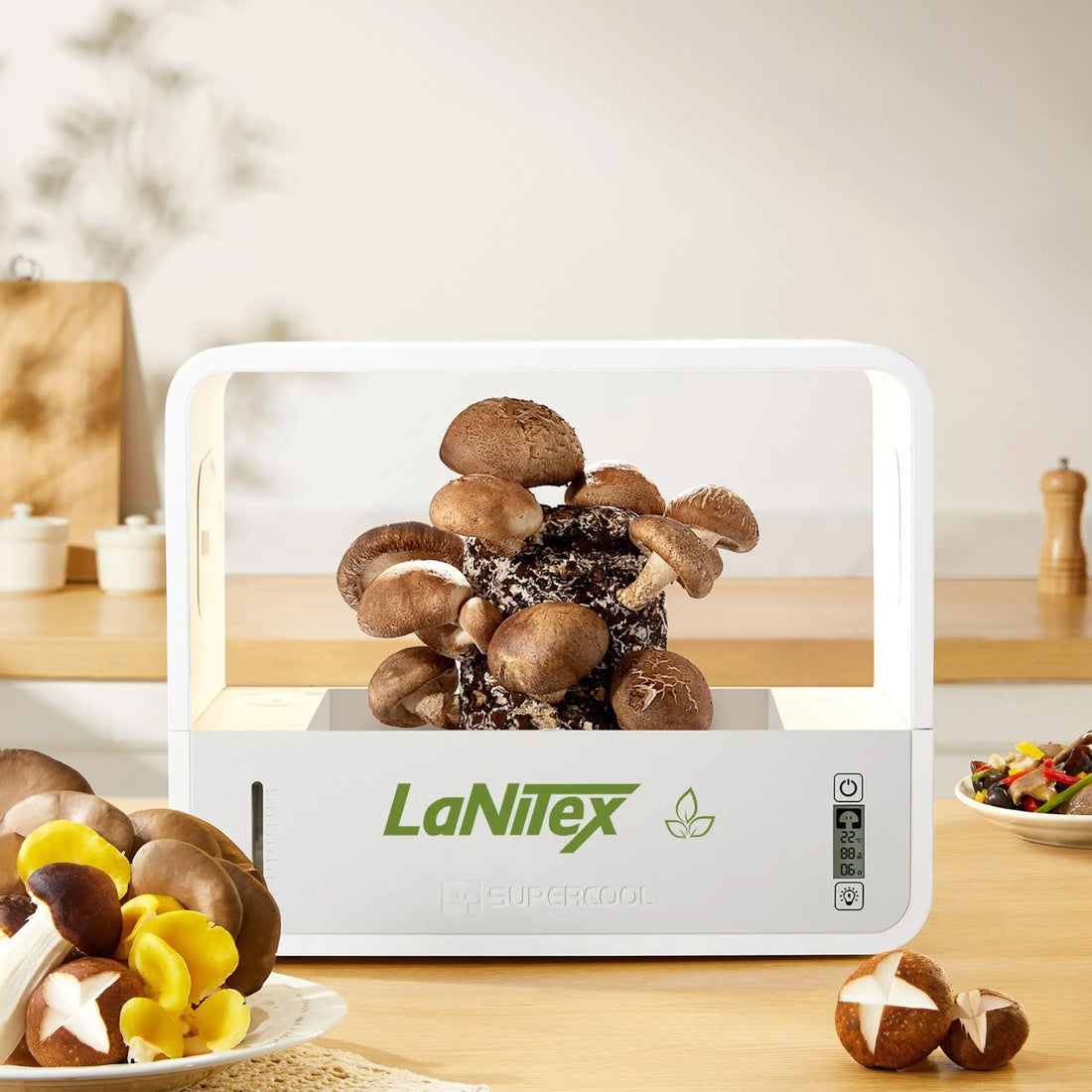
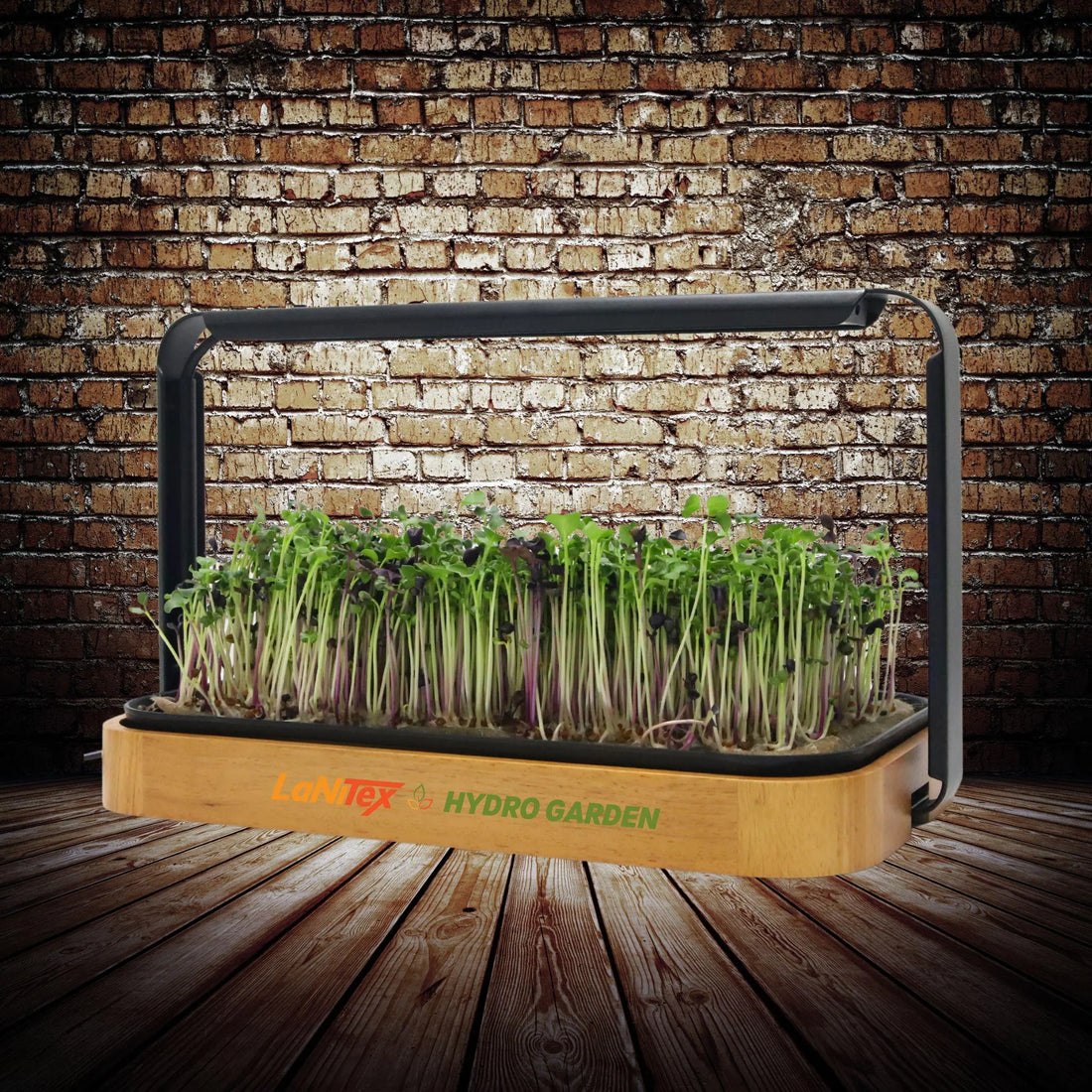
Both styles of the Smart Microgreen Kit grow the same 8-to-14-day pak choi tray. The microgreen growing kit (Black Metal) fits a family kitchen or kid's lunchbox routine. The wooden microgreen kit fits an Asian-restaurant-feature kitchen aesthetic. Same internals, different surround. Not sure which setup suits you? Compare microgreen kits available in Australia.


Fresh microgreens on your kitchen bench in 7–14 days — the self-watering tank and full-spectrum LED do the daily work. You supply the seeds.
Start your first tray →Personally tested at home on the Sunshine Coast before listing.
Kit-aware step-by-step: growing pak choi microgreens in the Smart Microgreen Kit
The 7-step grow cycle for pak choi microgreens in the LaNiTex Smart Microgreen Kit, start to harvest in 8 to 14 days:
- Source untreated bok choy seed from Australian suppliers: Eden Seeds, Mr Fothergill's, Greenharvest or Seedmart. The Seed Collection's microgreen range doesn't list pak choi specifically, but their standard Asian brassica seeds work if not coated or pelleted. Coated seed won't germinate evenly at microgreen density.
- Place the germinating mat in the kit tray. Lay a fresh germinating growing mat flat inside the Smart Microgreen Kit tray. Moisten the mat with clean water until evenly damp but not pooling. Pak choi seed sits directly on the mat. No soil, no substrate, no mess.
- Scatter 10 to 15 grams of seed evenly. Aim for visible spacing between seeds, a single even layer. Avoid heavy carpets that trap moisture and feed mould. Pak choi seed is small but not as fine as basil's. You can see individual seeds when scattered correctly.
- Blackout for 2 to 3 days. Cover the tray with the kit lid or a dark cover and keep at 18 to 22 degrees Celsius. Most seeds germinate by day two and push white root tails through the seed coat by day three.
- Move under light for 8 to 12 hours daily. Once 80 percent of seeds have sprouted, uncover and move under the integrated LED grow light. Position a small clip fan nearby for airflow in humid Brisbane summer conditions. Don't soak the seeds first. Pak choi doesn't need pre-soaking like sunflower or pea.
- Bottom-water from the reservoir. Refill the kit's water reservoir as the microgreens drink it down. The mat wicks moisture up to the roots. Avoid wetting the leaves directly. Wet leaves invite surface mould fast, and a tray won't recover once mould sets in.
- Harvest at 5 to 8 cm in 8 to 14 days. Snip the microgreens with sharp kitchen scissors just above the mat when stems reach 5 to 8 cm tall and the first true leaves have opened. Eat fresh; store leftovers loosely wrapped in the fridge for up to three days.
A tray sown with 10 to 15 grams of seed typically returns roughly 80 to 120 grams of fresh microgreens, around six to eight times the seed weight.
"Pak choi is forgiving. Even a patchy germination still gives you something to harvest. The seeds that did sprout still grow on to 5 to 8 cm. There's no all-or-nothing failure mode like seedling collapse in basil."
The kit-aware step-by-step here was written for the Smart Microgreen Kit specifically. Both kit styles run the same protocol. Black Metal Style $129 for the everyday family kitchen, Wooden Style $189 for the feature-kitchen look. Same eight-to-fourteen-day tray either way.
For a steady supply rather than one big flush, stagger your sowings: start a fresh tray every 5 to 7 days so a new batch is ready just as the last one is harvested. The Germinating Growing Mats 10-pack makes back-to-back trays easy.
Get a fresh grow guide like this every fortnight
Join the LaNiTex Hydro Garden newsletter for practical hydroponic, microgreen and mushroom growing tips for Australian homes. Subscribe to download a free hydroponics starter guide (PDF) and get 10% off your first order.
Join the newsletter →Common pak choi microgreens problems and how to fix them
The four most common pak choi microgreen problems in Australian home grows:
| Problem | Cause | Fix |
|---|---|---|
| Surface mould | Dense sowing + humid air | Single even sowing layer + airflow fan + bottom watering only |
| Leggy pale stems | Insufficient light | Move closer to LED, give 8 to 12 hours daily |
| Patchy germination | Old seed or dry mat | Use fresh untreated seed, keep mat damp through blackout |
| Wilting | Over- or under-watering | Bottom-water lightly, let surface dry between refills |
Mould is the demoralising one. Fluffy white fuzz over your day-seven tray. Caught early, surface fuzz can sometimes be pulled back with better airflow and lower humidity; once it has spread through the tray, though, binning the lot and starting over is the reliable fix. Distinguish mould from damping-off. Damping-off is seedling stem collapse at the base (more common in basil, less so in pak choi). Mould is fluffy surface growth on the medium, fixable by airflow and sowing density.
Worst case: bin one tray, rinse the mat, and start over with fresh seed. Two extra days lost. Eight to fourteen days to the next harvest. The kit is non-toxic and food-safe, and the integrated water reservoir won't leak through to the bench.
"Brisbane summer humidity catches every new grower out. A clip fan from any AU hardware store handles it."
Don't crank the misting up to fight wilting. Wilting is almost always under-watering at the reservoir, not at the leaf. Refill the reservoir and the mat re-wicks moisture to the roots within hours.

How do you use pak choi microgreens in Asian cooking -- ramen, stir-fries, sushi and more?
Pak choi microgreens taste like a milder, gentler version of full-size bok choy. Mild brassica, slightly sweet, very tender. Use them raw as a fresh topping. Heat wilts the texture and dulls the flavour, so always add at serve.
Nine specific Asian cuisine applications:
- Ramen and noodle soups — sprinkle a generous pinch at the moment of serving. The microgreens stay crisp on the broth surface.
- Stir-fries — scatter post-wok, never during cooking. The colour contrast and fresh-green crunch finish the dish.
- Sushi rolls — tuck pak choi microgreens into cucumber and avocado rolls as a milder replacement for shredded cabbage.
- Dumpling and bao platters — garnish the steamer with a small handful of pak choi microgreens beside the dumplings.
- Fried rice — top at the table, never in the pan. The fresh-green finish lifts the heavier rice notes.
- Vietnamese pho — alongside Thai basil and bean sprouts, pak choi adds a milder brassica note than the traditional herbs.
- Korean banchan side — lightly dressed with sesame oil, soy and a touch of rice vinegar.
- Japanese chirashi bowl — scattered over the sashimi and rice as the green-element garnish.
- Kid-friendly sandwich layer — mild flavour kids accept, replacing peppery rocket in cheese or ham sandwiches.
A simple weeknight recipe: cook noodles or rice. Top with a soft-boiled egg. Add a generous pinch of pak choi microgreens. Drizzle with sesame oil and soy. Done in seven minutes.
Storage tip: after harvest, loosely wrap any leftover microgreens in a damp paper towel inside a sealed container. They'll keep crisp for two to three days in the fridge crisper. After that, they wilt.

Restock the refill your kit runs on — 10 soil-free growing mats, ready for your next sowing.
Restock your mats →Personally tested at home on the Sunshine Coast before listing.
Pak choi microgreens FAQ
What are pak choi microgreens?
Pak choi microgreens are the young seedlings of pak choi (bok choy), harvested about 8-14 days after germination. They have tender stems and leaves with a mild brassica flavour that's slightly sweet and very soft. You eat the stems and leaves raw as a garnish or salad ingredient, especially in Asian-style dishes like ramen, stir-fries and rice bowls.
Is there a difference between pak choi and bok choy microgreens?
Pak choi and bok choy microgreens are essentially the same thing. Both come from Brassica rapa subsp. chinensis, but the name changes with spelling and dialect. Seed packets in Australia might use pak choi, bok choy or pak choy. Any plain, untreated seed of this Asian cabbage type will produce very similar microgreens in flavour, colour and growth habit.
How do you grow pak choi microgreens at home in Australia?
To grow pak choi microgreens in Australia, fill a shallow tray or microgreen kit with a fine mix or growing mat, moisten it, then scatter seed fairly densely on top. Keep the tray covered and dark for 2-3 days until most seeds sprout, then move it under bright light. Water from below or mist as needed. Harvest with scissors when 5-8 cm tall, usually within 8-14 days.
How long do pak choi microgreens take to harvest?
Pak choi microgreens are usually ready to harvest 8-14 days after sowing, depending on temperature and light. In warm, bright conditions on the Sunshine Coast, expect the shorter end of that range. Harvest when the plants have opened their first true leaves and reach about 5-8 cm tall, cutting just above the growing medium with a sharp knife or scissors.
What do pak choi microgreens taste like and how can I use them in Asian cooking?
Pak choi microgreens taste like a gentler version of bok choy: mild brassica, slightly sweet and very tender. They're perfect as a fresh topping for ramen, noodle soups and fried rice, sprinkled over stir-fries at serving, tucked into sushi rolls, or added to dumpling platters and bao as a crisp, green garnish. Use them raw so they keep their flavour and texture.
What are common problems when growing pak choi microgreens indoors?
Common problems include mould from overcrowding or poor airflow, leggy pale stems from insufficient light, and wilting from over- or under-watering. In warm Australian climates, heat stress can also cause rapid drying or weak growth. Sow in a single, even layer, use a fan or open window for airflow, give 8-12 hours of bright light daily, and water lightly from below to keep the medium just moist.
Where can I buy pak choi seeds for microgreens in Australia?
In Australia, pak choi or bok choy seed suitable for microgreens is often sold as regular vegetable seed. Look for plain, untreated seed from suppliers such as Eden Seeds, Mr Fothergill's, Greenharvest and Seedmart. The Seed Collection's microgreen range doesn't list pak choi specifically, but their standard Asian brassica seeds can still be used as long as they're not coated or pelleted.
Are pak choi microgreens easy to grow for beginners and kids?
Pak choi microgreens are an easy, fast crop that suits beginners and kids. The seeds germinate reliably, grow well in simple trays or microgreen kits, and are ready in about 8-14 days. Their mild, slightly sweet flavour is less spicy than radish or mustard, making them a good first microgreen for children and anyone new to Asian vegetable flavours.
Are pak choi (bok choy) microgreens good for you?
Yes. Like other brassica microgreens, pak choi microgreens are nutrient-dense: rich in vitamins, antioxidant compounds and polyphenols while staying low in kilojoules. Peer-reviewed research (Xiao et al., 2012) found that many microgreens can carry higher levels of vitamin C, vitamin K, vitamin E and carotenoids than the same vegetable harvested at maturity, and pak choi microgreens specifically contain beta-carotene (provitamin A), vitamin K and plant phenols. This is general information, not dietary advice.
Do I need to rinse pak choi microgreens before eating?
Not necessarily. Grown indoors on a clean germinating mat in the Smart Microgreen Kit, pak choi microgreens never touch soil, so a rinse is optional. If you prefer, give them a quick swirl in cool water and a gentle pat dry just before serving. Avoid soaking, which bruises the tender leaves and shortens their fridge life.
Explore other microgreen varieties
Grown Pak Choi once? These pair naturally with the same Smart Microgreen Kit & Germinating Growing Mats.
More brassica greens
Easy to start with
Great in Asian dishes
→ Browse all 22 microgreen varieties | → Microgreens growing guide
About the writer
Laszlo Bulatko started LaNiTex Hydro Garden because he believes every Australian family should be able to grow fresh food at home, even in a small apartment. From the Sunshine Coast, he brings smart indoor growing within reach — hydroponic grow boxes, a benchtop Mini Grow Pot, and the Smart Microgreen Kit — and through the Term-Grow Enrolment programme puts grow boxes in Queensland primary school classrooms. He launched LaNiTex in December 2024 and personally tested every product at home before listing it — drawing on 15 years of earlier brand-building in the Hungarian fishing-tackle trade. Full background on the About Laszlo founder page.
ABN: 47 682 768 967. Operated by LaNiTex Australia Pty Ltd from Sippy Downs, Sunshine Coast, QLD 4556, Australia. Australian small business.
The full range
Find the microgreen kit that suits your kitchen


Supported in Australia - every model tested before listing.
Sources
- On The Grow -- "Grow Red Pak Choi Microgreens Mini Kratky Tray" (technique reference): "rinse and bottom water through the channel, and after a couple of days you can move them to light to grow them out." Source: onthegrow.net/blogs/microgreens/grow-red-pak-choi-microgreens-mini-kratky-tray
- Sara Backmo -- bok choy grow protocol (microgreen cycle reference): "harvest with scissors when the first true leaves appear." Source: sarabackmo.com
- smallgreenthings.com.au -- Australian Asian-greens microgreen references: "fast-growing brassicas suit the Australian indoor grow window." Source: smallgreenthings.com.au
- Seasol Australia -- bok choy mature-plant botanical reference: "Brassica rapa subsp. chinensis is the Asian cabbage best suited to cool-season planting." Source: seasol.com.au
- Australian Seed Suppliers: Eden Seeds (edenseeds.com.au), Mr Fothergill's (mrfothergills.com.au), Greenharvest (greenharvest.com.au), Seedmart (seedmart.com.au), The Seed Collection (theseedcollection.com.au).
- Bureau of Meteorology -- Australian climate zone reference for indoor grow conditions: "Australia's climate varies across five main zones." Source: bom.gov.au
- LaNiTex Hydro Garden product pages: Smart Microgreen Kit (Black Metal Style $129), Smart Microgreen Kit (Wooden Style $189), Germinating Growing Mat 10-pack ($14.90).
Last updated: 12 June 2026.