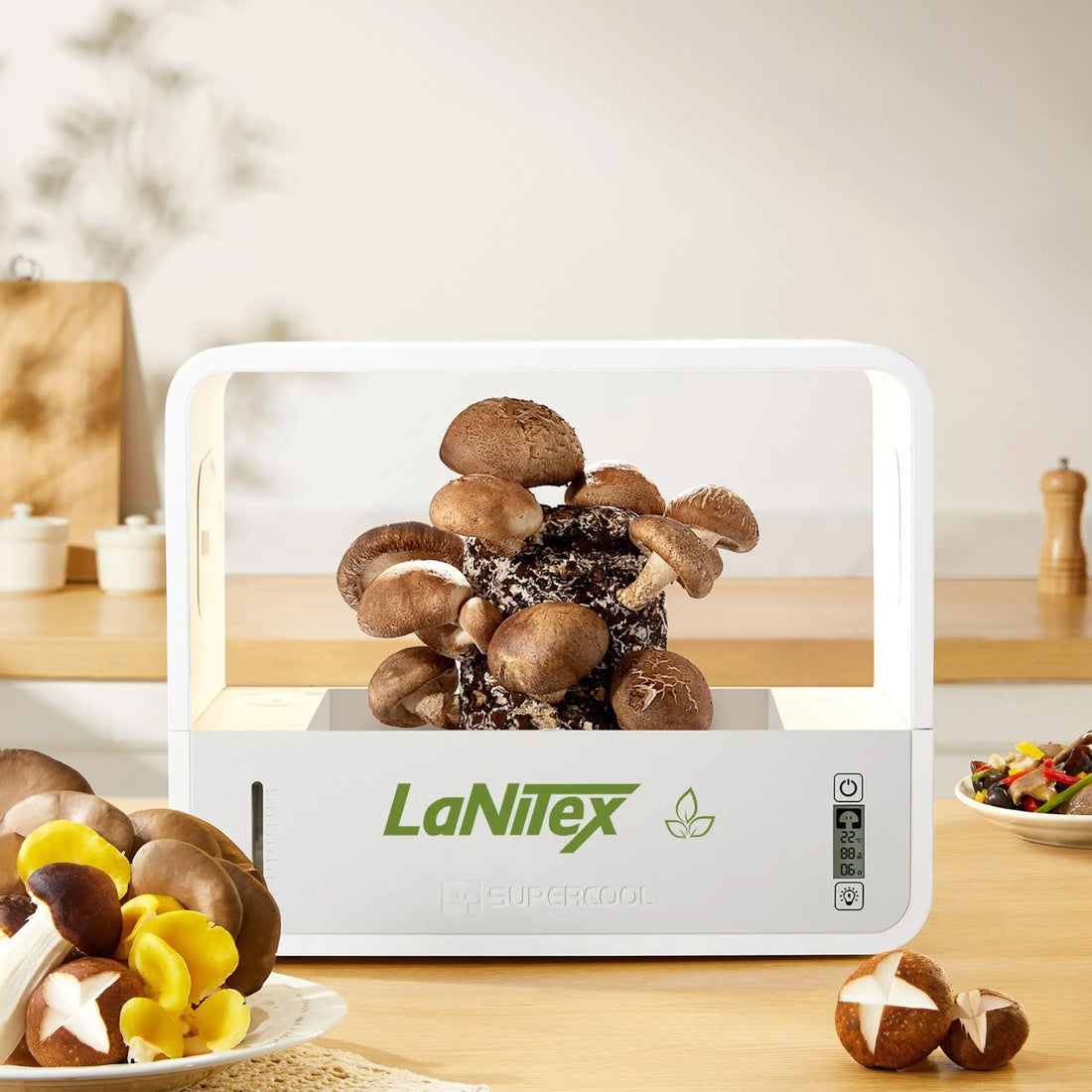

I still remember my first 'Mushroom Box' harvest in my kitchen on the Sunshine Coast. I woke up, and what were just tiny pins the night before had exploded into these beautiful, velvety oyster mushrooms. That 'aha' moment — realising I could grow gourmet food in a tiny corner of my house — is exactly why I started stocking these kits.
A mushroom growing kit is a pre-prepared block or bag of colonised substrate that fruits edible mushrooms at home with minimal setup. The Farmer Magazine reports that "More than 85 per cent of Australian households purchase fresh mushrooms regularly" — but almost none of those households grow their own. That gap is what this guide closes. By the end, you will know which of the four kit types fits your space, your budget, and your time; how to set one up without the rookie errors I made; and what we learned designing the LaNiTex mushroom growing kit after six kitchen flushes across my first autumn on the Coast.
Before the smart kit existed, the before-state was painful: a $40 bag bought on impulse, killed inside a week by tap water and dry indoor air, or a DIY monotub that needed fanning three times a day for three weeks straight. We have watched customers do both. This guide is built to save you that loop.
Growing mushrooms at home in Australia has changed sharply since 2020. Five years ago, bag kits and DIY monotubs were the only options at under $200. Today, sensor-regulated smart boxes compete in the same price band, and the decision has shifted from "which format will fruit reliably" to "which format fits my household routine". The four-kit comparison in this guide reflects April 2026 retail pricing across five Australian suppliers.
Quick answer: the best mushroom growing kit in Australia
There are two honest answers, depending on how often you want to grow. For a one-off, low-cost first try, the best mushroom growing kit in Australia is a blue oyster bag kit ($25–$50) — it fruits in 7 to 14 days and forgives beginner mistakes, but it is spent after one or two flushes. For growing more than once, the best mushroom growing kit in Australia is the reusable LaNiTex Smart Mushroom Growing Box ($219) — a semi-automated kit that holds fruiting humidity and adjustable LED grow light flush after flush, so you reset and grow again instead of binning a single-use block. You set the room temperature; the Box handles the humidity and light that decide whether a flush succeeds.
What is a mushroom growing kit?
A mushroom growing kit is a sealed block of grain and sawdust that has already been inoculated with mushroom mycelium and grown to full colonisation under laboratory conditions. You add moisture, fresh air, and indirect light, and the block fruits within 7 to 14 days. That is the clean definition.
It helps to understand how mushrooms grow in the first place. In nature, a mushroom starts as a microscopic spore that germinates into fine threads called hyphae. Those threads spread into a white, root-like network called mycelium, which feeds on dead wood or other organic matter. When the conditions change, usually a drop in temperature, a lift in humidity, and a bit of fresh air, the mycelium knots itself into tiny pins, and those pins swell into the mushrooms you pick. The mushroom is only the fruit. The real organism is the mycelium hidden down in the substrate. That is also how mushrooms are grown on purpose: a good kit, or the Box, hands you a block where the mycelium has already done the slow colonising work, so you just trigger the fruiting stage and harvest in days instead of starting from a spore.
Australian Mushrooms records that "Commercial mushroom growing in Australian can be traced as far back as 1933, using disused railway tunnels under Sydney." Home kits are a much newer category — they only became widely available in Australia around 2015, driven by the rise of gourmet species like oyster and lion's mane.
The kit format is different from full cultivation. Full cultivation means sourcing spawn, pasteurising or sterilising substrate, inoculating under a flow hood, and waiting three to four weeks for colonisation. A kit collapses that into a finished block. Typical contents: the substrate, a fruiting bag or chamber, a spray bottle, and a one-page instruction sheet. Species sold in Australia skew heavily toward oyster varieties (blue, white, king, pearl), with lion's mane and pioppino rounding out the gourmet range.
Four criteria separate a kit from a full cultivation setup. First, the substrate is already colonised when you open the box — you do not inoculate. Second, the substrate is pasteurised or sterilised at the factory, so contamination risk is lower than DIY. Third, the bag, chamber, or box is designed to hold the right gas exchange rate for fruiting, not for colonisation. Fourth, the instructions assume zero mycology background. A bag kit that follows those four rules will fruit reliably for a first-timer.
Fair point — the terminology across retailers is fuzzy. Retailers call theirs a "grow kit", a "fruiting block", or a "mushroom box". Structurally they are the same product.

The four main types of mushroom growing kits in Australia
Walk into any garden centre or search "mushroom kit Australia" online, and you will find four distinct formats. They suit different growers, different budgets, and different tolerance for daily intervention. The CSIRO has noted that "Premium-quality Asian mushrooms can retail for up to $50 per kilogram" in Australia — that retail premium is what has driven home-grower demand across all four formats over the past five years.
One format you will not find below is the outdoor mushroom growing log, where hardwood logs are inoculated with spawn. It works for species like shiitake, but it is slow (months to over a year to fruit) and weather-dependent, so it sits outside this indoor-kit guide.
1. Bag kit (Spray and Grow)
The common Australian retail format. A pre-inoculated sawdust or straw block sits inside a filter-patch bag. You cut an X in the plastic, mist the opening twice a day, and harvest in 7 to 14 days. Price: $25 to $50. Best for absolute beginners, a one-time gift, or a kitchen demo. Yield per bag typically lands between 300 and 600 grams across 2 to 3 flushes.
Species available: blue oyster, pearl oyster, lion's mane, pink oyster in warmer months. The bag kit form factor has been the dominant Australian retail format since 2018.
One warning from Fungi Ally applies here: "Mushrooms act as sponges, sucking up any liquids they touch." Overmisting is the fastest way to ruin a bag kit. A light mist twice a day on the inside of the bag is the correct dose.
2. DIY monotub
A sealed plastic tub with bore holes in the sides, filled with colonised substrate. You fan it three to five times daily, mist the walls, and manage humidity by eye. Price: $80 to $180 as a kit, or about $40 if you DIY the tub from a 55-litre storage bin and a handful of polyfill bore filters.
Best for the weekend hobbyist who enjoys fiddling. The learning curve is moderate. Three weeks of fanning a tub like a newborn wears thin — that is the honest trade-off for the larger yield of 800 g to 1.5 kg per run. Monotubs suit growers who want to learn cultivation mechanics without committing to lab-grade equipment.
3. Fruiting chamber (shotgun FC)
An acrylic or plastic chamber with a perlite humidification base and passive fresh air exchange through drilled holes. More stable than a monotub, less hands-on than a bag kit. Price: $150 to $300 pre-built, or around $60 DIY. Yield per run: 700 g to 1.2 kg across 2 flushes.
Best for the intermediate grower running multiple flushes. This format favours people who grow a handful of species side by side. The name "shotgun" comes from the drilled-hole pattern on the sides of the chamber — typically 50 to 80 evenly-spaced 6 mm holes that create passive air circulation without a fan.
4. Smart automated grow box
Sensor-regulated humidity, temperature, and fresh air exchange, running on a closed-loop controller. You set the parameters once, then the box cycles humidity and FAE without daily intervention. Price: $200 to $2000. This is the smart mushroom growing kit category. A mushroom growing box like this is the most hands-off format you can buy in Australia. Some Australians search for a "mushroom growing machine" or a "mushroom growing device" — that is the same thing: a sealed unit that runs the climate for you.
Best for the time-poor hobbyist who wants consistent yields without three-times-a-day intervention. The automation is the whole reason the category exists.
Beyond these four, there is a fifth and more advanced option: the all-in-one (AIO) or inoculate-your-own kit. Instead of a ready-to-fruit block, you get a sterile bag of substrate and introduce the spawn or liquid culture yourself, then wait a few weeks for the mycelium to colonise before fruiting. It is more hands-on and carries a little more contamination risk than a ready-colonised bag kit, but it is an inexpensive way to learn the inoculation step that sits behind every other kit.
Two even simpler DIY routes get a lot of attention online. Growing mushrooms from store bought mushrooms, by standing leftover oyster or shiitake stems on damp cardboard or spent coffee grounds, works once in a while, but contamination is common and the yields are tiny. Growing mushrooms in coffee grounds is the same idea with more substrate: oyster mycelium will happily colonise used coffee grounds if you keep them clean, humid and out of direct sun. Both are worth a play on a rainy weekend. For harvests you can actually repeat, a pre-colonised kit or the Box does the risky part for you and takes you straight to fruiting.
Comparison table: four kit types side by side
The four kits compared at a glance — prices verified April 2026 across five Australian retailers.
| Kit type | Price range (AUD) | Time per day | Beginner-friendly (1-5) | Best for | |
|---|---|---|---|---|---|
| Bag kit (Spray and Grow) | $25 – $50 | 1-2 min | 5 | First-time grower, gift, kitchen demo | |
| DIY monotub | $80 – $180 | 10-15 min | 2 | Weekend hobbyist who enjoys fiddling | |
| Fruiting chamber | $150 – $300 | 5-8 min | 3 | Intermediate grower, multi-flush runs | |
| Smart automated grow box | $200 – $2000 | 1 min | 5 | Time-poor household, consistent yields (our pick) |
Winner by use case: beginner = bag kit. Busy household = a smart automated box such as the LaNiTex Smart Mushroom Growing Box. Cost-conscious tinkerer = DIY monotub. Intermediate grower running 3 or more species = fruiting chamber.

How to choose the right kit for your situation
The right mushroom growing kit depends less on the kit itself and more on your weekly schedule and your local climate.
If you have never grown anything
A bag kit. Seven to fourteen days to harvest. Under $50. Low regret if it fails. You will learn what pinning looks like, what a dried-out substrate feels like, and whether the hobby sticks.
If you are a weekend hobbyist who enjoys fiddling
A monotub or a fruiting chamber. Higher yield, steeper learning curve, rewards patience. Plan to be home for a three-week fanning window.
If you are time-poor and want consistent results
A smart automated grow box. Sensor-regulated. Runs while you work. You check it morning and evening, not three times during the day.
If you are in Queensland or subtropical Australia
Climate is the deciding factor here. The Sunshine Coast sits in a mid-autumn band of roughly 24 to 27°C days and 14 to 17°C nights through April and May. That matches the fruiting sweet spot ToshiFarm cites for oyster cultivation: "temperature of 15°C - 25°C" during the fruiting phase.
Humidity is the harder variable. ToshiFarm recommends "Ensure a humidity of 80-90%" during fruiting. That figure is difficult to hit indoors in a Brisbane summer without automation — household air conditioning dries interior spaces to around 40 to 55 per cent relative humidity, and a bag kit will drop its pins in that environment within 48 hours.
Mate, honestly — if you are in Brisbane in January, do not fight it, run a smart box with sealed humidity control. In the autumn and winter window (April to August), the Coast climate does the work for you, and a bag kit performs beautifully on the kitchen bench. In the spring shoulder (September to November), you can still run a bag kit successfully if you set it on a tray with a damp tea towel underneath, which lifts the micro-humidity around the fruiting face by about 10 percentage points.

Get a fresh grow guide like this every fortnight
Join the LaNiTex Hydro Garden newsletter for practical hydroponic, microgreen and mushroom growing tips for Australian homes. Subscribe to download a free hydroponics starter guide (PDF) and get 10% off your first order.
Join the newsletter →Oyster varieties at a glance: which one should you grow?
The table below compares eleven oyster-type varieties that Australian home growers can cultivate, from warm-loving pink oysters to cool-season blues. They all grow with the same basic method, so the real decision is which one suits your room temperature and your taste. Every variety thrives in the reusable Smart Mushroom Growing Box, which manages humidity and adjustable LED lighting while you place it in a spot that naturally sits in the variety's temperature range.
Across all oyster varieties, a healthy block yields roughly 300 to 600 grams over two to three flushes. Yield depends far more on your substrate, freshness, and fruiting conditions than on the variety itself, so choose by climate and flavour first. Source your spawn from a reputable Australian mushroom spawn supplier, then grow it out in the Box.
Most people first picture cultivating oyster mushrooms the old way: on hardwood logs, or growing oyster mushrooms in buckets of pasteurised straw. Commercial oyster mushrooms farming still runs on straw or sawdust blocks. Indoors there is a shortcut. A disposable oyster mushrooms growing kit, or the reusable Smart Mushroom Growing Box, has already done the colonising work for you, so you grow oyster mushrooms straight from a living block rather than starting from scratch. The timing question trips up most beginners, so it is worth being clear about when to harvest oyster mushrooms: pick them while the caps are still curling under, just before they flatten and start dropping spores. That is when both flavour and shelf life are at their best.
| Variety | Botanical name | Climate band | Fruiting temp (°C) | Flavour and texture | Difficulty | Full guide / notes |
|---|---|---|---|---|---|---|
| Blue Oyster | Pleurotus ostreatus var. columbinus | Cool | 10–21 | Rich, savoury, deep umami | Easiest, most forgiving | Full guide → |
| Pearl Oyster | Pleurotus ostreatus | Moderate | 15–27 | Mild, versatile, the classic oyster | Easy | Full guide → |
| Pink Oyster | Pleurotus djamor | Warm | 18–30 | Bold and savoury, ham-like when cooked | Easy, very fast | Full guide → |
| Phoenix Oyster | Pleurotus pulmonarius | Moderate to warm | 18–27 | Mild, slightly sweet, tender | Easy | Full guide → |
| King Oyster | Pleurotus eryngii | Cool | 15–21 | Meaty, scallop-like, thick stems | Intermediate | Full guide → |
| Snow White Oyster | Pleurotus ostreatus (cool strain) | Cool | 15–21 | Delicate, mild, soft white clusters | Easy to moderate | Full guide → |
| Butterscotch Oyster | Pleurotus cornucopiae | Warm | 18–28 | Nutty and mild, firm texture | Easy to moderate | Full guide → |
| Warm White Oyster | Pleurotus ostreatus (warm strain) | Warm | 10–30 | Mild, savoury, white caps | Easy | Folded into this guide: a warm-tolerant white strain you grow like a pearl oyster. |
| Gold Oyster | Pleurotus citrinopileatus | Warm | 16–30 | Delicate, nutty when cooked | Easy to moderate | Folded into this guide: a fast, bright-yellow warm-season variety whose colour softens on cooking. |
| Chocolate Oyster | Pleurotus ostreatus (cool brown strain) | Cool | 10–21 | Robust, deep savoury, brown caps | Easy | Folded into this guide: a cool-season brown strain of the common oyster. |
| Black Pearl King | Pleurotus ostreatus × eryngii (hybrid) | Cool | 15–21 | Meaty and firm, dark caps | Intermediate | Folded into this guide: a king-and-oyster hybrid with thick stems and dark caps. |
The temperatures above are general fruiting bands from our supplier specifications; each full guide gives the optimal sub-range for that variety. Cool-season varieties suit a spare room, a garage, or a southern-state winter. Warm-season varieties suit a heated room or a subtropical Queensland kitchen. The Box handles humidity and light for any of them; you simply choose the room that matches the temperature band, because the Box does not heat or cool the air.
Which oyster should you grow first? A three-question chooser
Answer these three questions and you will land on the right first variety.
- What temperature is the room most of the year? Warm and often above 20°C (subtropical, or a heated room): start with pink or phoenix oyster. Cool and often below 20°C (southern states, or autumn to winter): start with blue oyster. It swings a lot through the year: pearl oyster handles the widest range.
- What flavour are you after? Mild and versatile: pearl or phoenix. Bold and savoury: blue for deep umami, or pink for a ham-like taste when cooked. Meaty and steak-like: king oyster.
- How much fuss do you want? The least: blue oyster forgives the most beginner mistakes. A rewarding challenge: king oyster, with its thick gourmet stems. Something unusual: gold or butterscotch oyster for colour and a nutty edge.
Still unsure? Blue oyster is the best all-round first oyster for most Australian growers. It is fast, forgiving, and tolerant of the temperature swings of a normal home.
Common questions about oyster mushroom varieties
Which oyster mushroom is easiest to grow in Australia? Blue oyster is the easiest oyster for most Australian growers. It fruits across a wide, cool-leaning band of about 10 to 21°C, tolerates lower humidity than fussier species, and pins quickly once it has fresh air and light. Pearl oyster is a close second and handles an even broader range of about 15 to 27°C, which makes it a safe pick if your indoor temperature changes through the year.
What is the difference between blue, pink, and king oyster mushrooms? They differ in species, colour, climate, and texture. Blue oyster (Pleurotus ostreatus var. columbinus) is a cool-season variety with grey-blue caps and a rich, savoury flavour, fruiting best around 10 to 21°C. Pink oyster (Pleurotus djamor) is a warm-climate species with vivid pink, ruffled caps that fruit fast at 18 to 30°C and cook down to a bold, almost ham-like taste. King oyster (Pleurotus eryngii) is different again: a thick, meaty white stem with a small cap, prized for a scallop-like texture, fruiting in cooler conditions around 15 to 21°C.
Can you grow tropical oyster mushrooms in southern Australia? Yes, if you can hold a warm, humid fruiting spot indoors. Warm-climate oysters such as pink and phoenix fruit best between about 18 and 30°C, so in Melbourne, Hobart, or Adelaide you grow them indoors in the warmer months or in a heated room rather than outdoors in winter. A controlled chamber such as the Smart Mushroom Growing Box keeps humidity high and lighting steady while you place it in a room that sits in the right temperature range. Cool-season oysters such as blue and king are the easier choice for southern growers.

Beyond oysters: our complete range of Australian species guides
Oysters are the easiest place to start, but they're only part of the range. If you're scanning a mushroom types list to work out which different mushroom types are actually worth growing, the gourmet mushroom types in Australia below all have their own step-by-step growing guide. These are edible, home-grown species, not wild-foraged or psychoactive types, and several are the Asian mushroom types you already cook with, like shiitake. Inside the Smart Mushroom Growing Box itself, the species the product page lists are the oyster varieties (blue, pink and golden), shiitake, lion's mane and reishi. The oysters, shiitake and lion's mane are good mushroom types to eat fresh and some of the best mushroom types for cooking at home, while reishi is grown for tea and extracts rather than the plate.
- Growing shiitake mushrooms: the most popular gourmet mushroom in Australia, rich and meaty.
- Growing lion's mane mushrooms: a shaggy white gourmet with a seafood-like texture.
- Growing shimeji mushrooms: small clustered brown-beech mushrooms that turn nutty when cooked.
- Growing maitake (hen of the woods): an earthy, frilly mushroom prized by chefs.
- Growing chestnut mushrooms: crunchy-stemmed and firm, a favourite autumn gourmet.
- Growing coral tooth mushrooms: an Australian-native toothed fungus, delicate and seafood-like.
- Growing golden enoki mushrooms: long, slender, cold-season clusters, mild and crisp.
- Growing pioppino mushrooms: the Italian black-poplar mushroom, firm-stemmed and deeply flavoured.
- Growing reishi mushrooms: the woody medicinal Ganoderma, grown for tea and extracts rather than the plate.
New to mushroom growing? Start with a cool-season blue oyster or a shiitake, then branch out as you learn the pinning and fruiting cues.

Grow gourmet oyster and specialty mushrooms on your kitchen bench, any season. The Box runs the humidity, fresh-air cycle and light for you — no daily misting. You supply the fruiting block.
Start growing mushrooms →Ships from the Sunshine Coast, Queensland.
How to grow mushrooms at home: step by step
This walks through a bag kit, which is the simplest entry point. The same principles apply to smart boxes, scaled up.
- Unbox and inspect (day 0, 5 minutes). Check the substrate is uniformly white with mycelium. Green, black, pink, orange, grey, or fuzzy off-colour patches mean contamination — contact the retailer for a replacement before opening.
- Choose location (day 0, 5 minutes). Indirect light. Ambient temperature 18 to 24°C. Away from direct airflow from air conditioning or a heater.
- Cut the X (day 0, 2 minutes). Make a 3 to 5 cm cut across the front face of the bag — not through the filter patch, which keeps providing clean air exchange. Cut it. That is it.
- Mist twice daily (day 1 onwards, 1 minute). A fine spray on the inside of the bag, not a soaking. Fungi Ally is blunt here: "Mushrooms act as sponges, sucking up any liquids they touch." Less water is better than more.
- Watch for pinning (days 3 to 7). Tiny bumps form when humidity, light, and air are right. Oyster mushrooms need a little indirect light to pin — about 12 hours a day is plenty, though some growers run up to 18 (Fungi Ally rates an 18-hour-light, 6-hour-dark cycle as ideal for fruiting).
- Monitor fruiting (days 7 to 14). Mushrooms double in size every 24 hours at peak. Harvest before the caps flatten, which is when shelf life starts to drop.
- Harvest (day 10 to 14). Twist and pull at the base. Do not cut with a knife — leaving a stump invites bacterial rot.
- Rest and re-flush (day 15 onwards). Rehydrate the block by soaking it in cool water for several hours (a few hours up to overnight), drain, give it a short dry rest of a day or two, then resume misting. A standard bag kit produces 2 to 3 flushes this way.
ToshiFarm notes that "It usually takes 3 to 4 weeks from the time of inoculation to the first harvest" for from-spawn cultivation. A kit collapses that window to days because the colonisation work is already done at the factory.
Two setup details bear calling out. Put the kit on a waterproof tray. Oyster mushrooms can drop pale yellow "weeping" liquid as they mature, which stains timber benchtops. A dinner plate or a shallow plastic tray under the bag catches it. Second, keep the kit away from fruit bowls. Ripening fruit releases ethylene gas, which disrupts pinning triggers in some species. A 2-metre separation between the mushroom bag and a banana bowl is enough.
After the harvest: fresh gourmet mushrooms keep best in a paper bag in the fridge for a few days, because a sealed plastic bag traps moisture and they spoil faster. Always cook them through, too; oyster, lion's mane and shiitake are eaten cooked, not raw.
Common beginner mistakes to avoid
I have watched customers make every one of these. Skip the pain.
- Overwatering. Fungi Ally puts it bluntly: "If water is constantly being sprayed or poured onto them they will turn into a soggy puddle." Two light mists a day is the target, not four heavy ones.
- Hitting the substrate with tap water. Chlorine kills young hyphae. Use filtered, boiled-and-cooled, or dechlorinated water. A 24-hour sit in an open jug is enough in Queensland.
- Ignoring air exchange. Fungi Ally stresses frequent fresh-air exchange — aim to refresh the grow-room air roughly every 10 minutes (about six air changes an hour), and more often in a sealed space. CO₂ above about 1,000 PPM during fruiting leads to leggy stems and small caps. In a sealed bag, the filter patch does the work. In a monotub, you fan.
- Chasing a giant first flush. The first flush is usually the largest, and later flushes taper — so don't over-water chasing an even bigger first flush. Harvest it, then rehydrate for a solid second and often third flush.
- Using direct sunlight. Direct sun cooks the substrate surface and dries the caps. Indirect light only. A kitchen bench two metres from a south-facing window works.
- Stopping at one flush. Kits are built for 2 to 3 flushes. Stopping after the first wastes two-thirds of the yield you paid for.
If a kit fails despite this checklist, it is usually a contamination event at the factory, not a grower error. Take a photo and email the retailer the same day — Australian retailers generally replace contaminated blocks within the first 14 days.
One more trap that catches first-timers: harvesting too late. Oyster caps flatten, curl upward, and start dropping spores within 24 to 36 hours of hitting full size. Spore drop stains the surrounding area yellow-brown and drops the flesh quality. Harvest when the caps are still slightly domed, before the edges curl. If you are unsure, harvest early — an underripe oyster is still delicious, and an overripe one is mealy.
Troubleshooting: why isn't my kit fruiting?
Most stalled kits come down to one of three things: moisture, air, or light. Here is how to read the signs and bring a quiet kit back to life.
- Nothing happening, or the block looks dry. The substrate has likely dried out. Lift the block from its box, sit it cut-side-down in a bowl of cool water for several hours (8 to 12 hours if it has dried out completely), drain it well, then resume misting. In a dry or air-conditioned room, add a humidity tent: drape a loose plastic bag punched with a dozen small holes over the kit and mist the inside of the bag each day until pins appear.
- Long, leggy stems with small caps. That is a fresh-air problem, because carbon dioxide is building up around the block. Open a nearby window or move the kit somewhere with gentle air movement, just not in a direct draught.
- Pale, washed-out mushrooms. They need a little more indirect light to colour up. Shift the kit to a brighter spot, still out of direct sun.
One caveat on soaking: delicate species need a far gentler dunk. A lion's mane block should sit in water for only 5 to 15 minutes, because its fine mycelium falls apart if it soaks for hours.
And when a block finally stops producing, you don't have to bin it straight away. Break it up and mix the pieces through fresh pasteurised substrate as a starter for a new grow, then compost whatever is left.
Is it mycelium or mould? How to tell
The most common worry for a first-time grower is a patch of fuzzy growth on the block: is it healthy mycelium, or is it contamination? If you are wondering what healthy mycelium looks like, it is bright white, dense and even, anchored down into the substrate, with a faint fresh-mushroom or earthy smell. That white mycelium fungus knitting through the block is exactly what you want. Mould is the opposite: it usually shows as coloured patches (green, blue-green, black, or slimy pink-orange), sits on the surface rather than gripping the substrate, spreads fast, and often carries a musty or sour smell. One tricky exception is cobweb mould, a wispy grey-white fuzz that looks a little like mycelium but grows loosely above the block and races across it in a day. So the rule on mould vs mycelium is less about colour alone and more about the whole picture: dense, white and anchored is mycelium; wispy, coloured, slimy or fast-spreading is mould, and a bad smell is a warning sign either way. If you see green or black mould, do not eat the mushrooms; photograph the block and contact your supplier for a replacement. This is also where a sealed box earns its keep: the Smart Mushroom Growing Box runs filtered fresh-air exchange and holds steady humidity, which together cut the open-air contamination that catches open bag kits in a humid Queensland summer.
Why we built the LaNiTex Smart Mushroom Growing Box
Six kitchen flushes across my first autumn on the Sunshine Coast taught me the ceiling of manual kits. A bag that thrived in May would dry out in August. A monotub that produced 800 g in winter would strike contamination in February. Sunshine Coast humidity was the research lab. The design brief that came out of those 12 months of testing was simple: build a box that handles every Australian climate swing without asking the grower to be home three times a day.

See the Smart Mushroom Growing Box in action:
The LaNiTex Smart Mushroom Growing Box is what came out the other side. Semi-automated controls, smart humidity monitoring with a real-time display, adjustable LED lighting, automated fresh air exchange with filter cotton. The design philosophy is "plug it in, add your grow kit, press start". Operating range 10 to 30°C, which covers every Australian capital city across every season. SKU LHG-110-10998. Suits shiitake and oyster flushes across the full calendar year.
Adjustable LED lighting handles the day-night cycle, which means you can put the box in a dark cupboard. Automated fresh air exchange replaces daily fanning, which means cleaner conditions and less mould. Smart humidity monitoring with a real-time display means you stop guessing at 80 to 85 per cent — the panel tells you the number, and the box corrects it if it drifts.
What is in the box, and what you source separately
The Box itself includes the chamber, adjustable LED grow light, fan with filter cotton, a humidity sensor with a digital display, an internal misting reservoir, and a transparent lid. What you source separately — from a reputable Australian mushroom spawn supplier — is your spawn (grain or sawdust spawn for your chosen species) and, if you are starting from scratch, your substrate block. LaNiTex sells the Box; the spawn and blocks come from specialist Australian suppliers.
So what is mushroom spawn? It is simply cooked grain or sawdust that has already been colonised with a chosen species' mycelium, sold ready to use and most often supplied as grain spawn in sealed mushroom spawn bags. You break open the bag and mix it through pasteurised substrate, roughly one part spawn to several parts substrate, and the mycelium spreads to colonise the new block. Unopened spawn keeps for several weeks in the fridge, so it pays to buy yours close to when you will use it. For the Box, source oyster mushroom spawn, shiitake mushroom spawn or lion's mane mushroom spawn from a reputable Australian supplier and grow it out from there. We make the machine, not the spawn.
If you are wondering what mushroom growing supplies and equipment you actually need, the list is short. A bag kit is self-contained, so you only add clean water and a spray bottle. For from-spawn growing or a smart box, the core mushroom growing equipment is:
- A colonised substrate block, or your own spawn plus substrate
- A humidity source: a spray bottle for bag kits, or the Box's built-in misting reservoir and sensor
- Fresh-air exchange: opening the bag, or the Box's filtered fan
- Indirect light: a windowsill out of direct sun, or the Box's adjustable LED grow light
- A clean space and basic kitchen hygiene
Grow gourmet at home
Turn a spare corner into a year-round mushroom patch. The Box keeps the humidity, fresh-air exchange and light steady — the controlled conditions gourmet mushrooms need. You supply the fruiting block; it manages the environment.
Start your mushroom grow →Ships from the Sunshine Coast, Queensland.
Frequently Asked Questions
What is the best mushroom species to start with in Australia?
Blue oyster is the most forgiving species for first-time growers. It fruits across a wide temperature band (10 to 24°C), tolerates lower humidity than lion's mane, and pins aggressively within 5 to 7 days of an X-cut. White oyster is a close second but prefers slightly cooler nights. Lion's mane is slower (14 to 21 days to fruit) and needs a stricter 18 to 24°C window. Pink oyster suits warm summers but has a 24-hour shelf life once harvested, which limits its practical use. Start with blue oyster, learn the pinning cue, then branch out to king oyster or lion's mane in your second season.
How long does a mushroom kit take to fruit?
A bag kit fruits 7 to 14 days from the X-cut. A smart box fruits in a similar window once the block is loaded. From-spawn cultivation takes 3 to 4 weeks to the first harvest, per ToshiFarm's cited figure. A kit eliminates the colonisation wait because the substrate ships already colonised. Expect 2 to 3 flushes total from a single block, spaced roughly two weeks apart with rehydration between flushes.
Can you grow mushrooms in Queensland's humidity?
Yes, with a seasonal caveat. April to August is the window where the Sunshine Coast climate does the work for you. December to February, the combination of 30°C+ days and humidity spikes causes mould on bag kits. The solution in summer is either a smart box with sealed humidity control, or pausing and restarting in autumn. Brisbane growers report the same pattern. Do not fight summer — grow against it, or automate through it.
Do mushroom kits keep producing after the first flush?
Yes, with the right rehydration protocol. Soak the spent block in cool water for several hours (a few hours up to overnight), drain fully, give it a short dry rest of a day or two, then resume misting. That dry-rest window is the step beginners skip — without it, the block stays saturated and stalls. A properly rehydrated block produces 2 to 3 flushes, with later flushes smaller than the first but still well worth harvesting.
What is the best mushroom growing kit for beginners in Australia?
For a first-time grower, a blue oyster bag kit is the best mushroom growing kit in Australia. It costs $25 to $50, fruits 7 to 14 days after you cut the bag, and tolerates the temperature and humidity swings of a normal kitchen better than lion's mane or pink oyster. If you want consistent harvests year-round without daily misting, step up to a smart automated mushroom growing box, which monitors humidity and automates fresh air exchange. Start with a bag kit, learn the pinning cue, then decide whether to automate.
Is mushroom growing at home worth it in Australia?
Yes, for most households. Mushroom growing at home turns a $25 to $50 kit into 200 to 600 grams of gourmet oyster mushrooms across two to three flushes. The requirements are modest: indirect light, a spot held between 18 and 24°C, and a light mist twice a day. In a hot, dry Australian summer (December to February), a smart box with sealed humidity control makes home growing far more reliable than an open bag kit.
Where can I buy a mushroom growing kit in Australia?
You can buy a mushroom growing kit in Australia online, with kits shipped Australia-wide, so it does not matter if there is no grower near you. Big-box retailers like Bunnings and Mitre 10 occasionally stock seasonal bag kits, but range and freshness vary, so most growers searching for a mushroom growing kit near me simply order online and have it arrive ready to fruit. Bag kits are also stocked by specialty mushroom suppliers, and smart automated kits like the LaNiTex Smart Mushroom Growing Box ship direct to your door anywhere in the country. Buying online usually gives you a wider species range than a local garden centre carries.
Are mushroom growing kits safe?
Yes. A gourmet mushroom growing kit is safe to use at home. The kits sold for home growing are edible species such as oyster, lion's mane and shiitake, not anything psychoactive, and they pose no risk beyond normal kitchen hygiene. Wash your hands after handling the substrate, and only eat mushrooms grown from a labelled, reputable kit. If a block shows green or black mould instead of white mycelium, do not eat it and contact the supplier for a replacement.
Can you grow morel mushrooms in a kit?
Realistically, no. Morels are one of the hardest mushrooms to cultivate. They form a partly symbiotic (mycorrhizal) relationship with tree roots and need specific outdoor soil, seasonal temperature swings and a lot of patience, so they are not suited to the bag kits, fruiting chambers or smart grow boxes covered in this guide. Outdoor "morel patch" spawn kits exist, but results are unpredictable even for experienced growers. For reliable indoor harvests, start with oyster, lion's mane or shiitake instead.
What is the best reusable mushroom growing kit in Australia?
For growing more than once, the best reusable mushroom growing kit in Australia is the LaNiTex Smart Mushroom Growing Box ($219). Unlike single-use bag kits that are spent after one or two flushes, it is a semi-automated kit that holds fruiting humidity and adjustable LED grow light flush after flush, so you reset and grow again. You set the room temperature; the Box manages the humidity and light that decide a successful flush.
How do mushrooms grow?
Mushrooms grow in two stages. First the vegetative stage: a spore germinates into fine threads called hyphae that spread into a white, root-like web called mycelium, feeding on wood or other organic matter. Then the fruiting stage: when the temperature drops and the humidity and fresh air are right, the mycelium knots into tiny pins that swell into the mushrooms you harvest. The mushroom itself is only the fruit of the fungus, while the mycelium does the real living down in the substrate. A growing kit hands you a block that is already full of mycelium, so you skip straight to the fruiting stage and pick in days.
Sources
- CSIRO — "Sweet opportunity for Australian exotic mushroom growers" (Feb 2023). csiro.au
- Australian Mushrooms — "Australia's Mushroom History". australianmushrooms.com.au
- The Farmer Magazine — "NSW's mushroom industry continues to grow". thefarmermagazine.com.au
- ToshiFarm — "Maintaining suitable humidity and temperature for growing oyster mushrooms". toshifarm.com