
Slice the thick stem into rounds, score it, and sear it, and most people swear they are eating a scallop. That meaty stem is the prize, and it grows fat for one odd reason: a deliberate dose of carbon dioxide.
Quick answer: King oyster mushrooms (Pleurotus eryngii) are a distinct, cool-fruiting species grown for their thick, dense, club-shaped stems rather than their small caps. They fruit best under about 21C, ideally 15 to 18C, with humidity around 85 to 90 per cent, on sterilised supplemented sawdust rather than straw. The trick to a fat stem is high carbon dioxide early, then good fresh air so the cap stays small.
This guide is for: Intermediate growers and gourmet cooks
| At a glance | King oyster (Pleurotus eryngii) |
|---|---|
| Species | Pleurotus eryngii (king oyster, king trumpet, French horn mushroom) |
| Climate | Cool, under about 21C, ideally 15 to 18C for fruiting |
| Fruiting humidity | Around 85 to 90 per cent |
| CO2 and air | High carbon dioxide early for thick stems, then good fresh air so caps open |
| Substrate | Sterilised supplemented hardwood sawdust or Master's Mix, not straw |
| Difficulty | Intermediate |
| Time to first harvest | About 30 to 45 days from inoculation |
Note: the temperature range describes the room the grower provides. A grow box manages humidity, light and fresh air, not temperature.
Key takeaways
- The king oyster is a distinct species, not a colour variant of the common oyster, and the thick edible stem is the part worth growing.
- High carbon dioxide early forces the fat club stem, then fresh air keeps the cap small, which is the opposite of how most oysters are grown.
- It fruits cool, under about 21C with high humidity, and prefers sterilised supplemented sawdust over straw.
- It is an intermediate grow with one or two flushes, the first the most productive, so set expectations a notch above the easy oysters.

What is the king oyster mushroom?
The king oyster mushroom (Pleurotus eryngii) is the largest of the oyster mushrooms and a genuinely distinct species, not a coloured strain of the common oyster. It grows as a long, thick, club-shaped stem topped by a small cap, which is the reverse of the fan-shaped clusters most oysters form. It also goes by king trumpet, French horn, and king brown mushroom, and it is native to the Mediterranean, the Middle East and North Africa.
That species distinction matters when sourcing king oyster mushroom spawn, because the name gets borrowed. The snow white, blue, chocolate and butterscotch oysters are all strains of the common oyster, Pleurotus ostreatus, and behave quite differently. The Black Pearl King is a hybrid, a cross of Pleurotus ostreatus and eryngii, and is often mistaken for the true king oyster. For the dense scallop-like stem this guide is about, the species to ask for is Pleurotus eryngii.
Why grow king oyster mushrooms at home?
The thick stem is the reason. On a king oyster, the dense club-shaped stem is the best part of the mushroom and is fully edible, with a mild, savoury, umami flavour and a firm, meaty texture that holds together through cooking instead of collapsing. Sliced into rounds and seared, it is the celebrated plant-based scallop, which is why chefs pay a premium for it.
Growing it at home changes the maths. An expensive speciality ingredient becomes something you pull off the bench, and king oyster keeps far better than a delicate oyster, so a flush does not have to be cooked the day it is picked. For a cook who already grows the easier varieties, it is the natural step up, and it pairs well with a milder species like a blue oyster grown alongside it.
Growing king oyster mushrooms in Australian climates: the CO2 trick for thick stems
Honest disclosure: king oyster (Pleurotus eryngii) is not yet a species we have fruited on the LaNiTex test bench on the Sunshine Coast - the Smart Mushroom Growing Box and the faster, more forgiving oyster strains came first, and king oyster is one of the fussier oysters to get right. The guidance below is built from cultivation science and grow-guide literature, Australian cool-climate mushroom-growing guidance, and feedback from LaNiTex customers running the Box across QLD, NSW, VIC and TAS. As king oyster lands on our own bench, this guide will refresh with first-hand Sunshine Coast observations.
Growing king oyster mushrooms in Australia comes down to one thing first: temperature. King oyster fruits cool. It wants the air under about 21C, and ideally 15 to 18C, which sets pins reliably; once a room sits much warmer than that, pinning falls away. Across southern Australia, autumn and winter hand growers that range for free, so Melbourne, Hobart, Adelaide and most of Tasmania suit the species through the cooler months. Further north, in Brisbane and on the Coast, the move is to grow indoors in a naturally cool room, which makes a king oyster grow realistic year-round rather than seasonal.
Then comes the part that makes this mushroom unusual. King oyster wants high carbon dioxide early, which forces the thick, dense club stem that is the whole point, and then good fresh-air exchange so the cap opens properly. Get the late-stage air wrong and the result is a long, thin stem with a tiny cap, the classic king oyster fault. The species tolerates more carbon dioxide than the easy oysters, which is exactly why a controllable chamber helps.
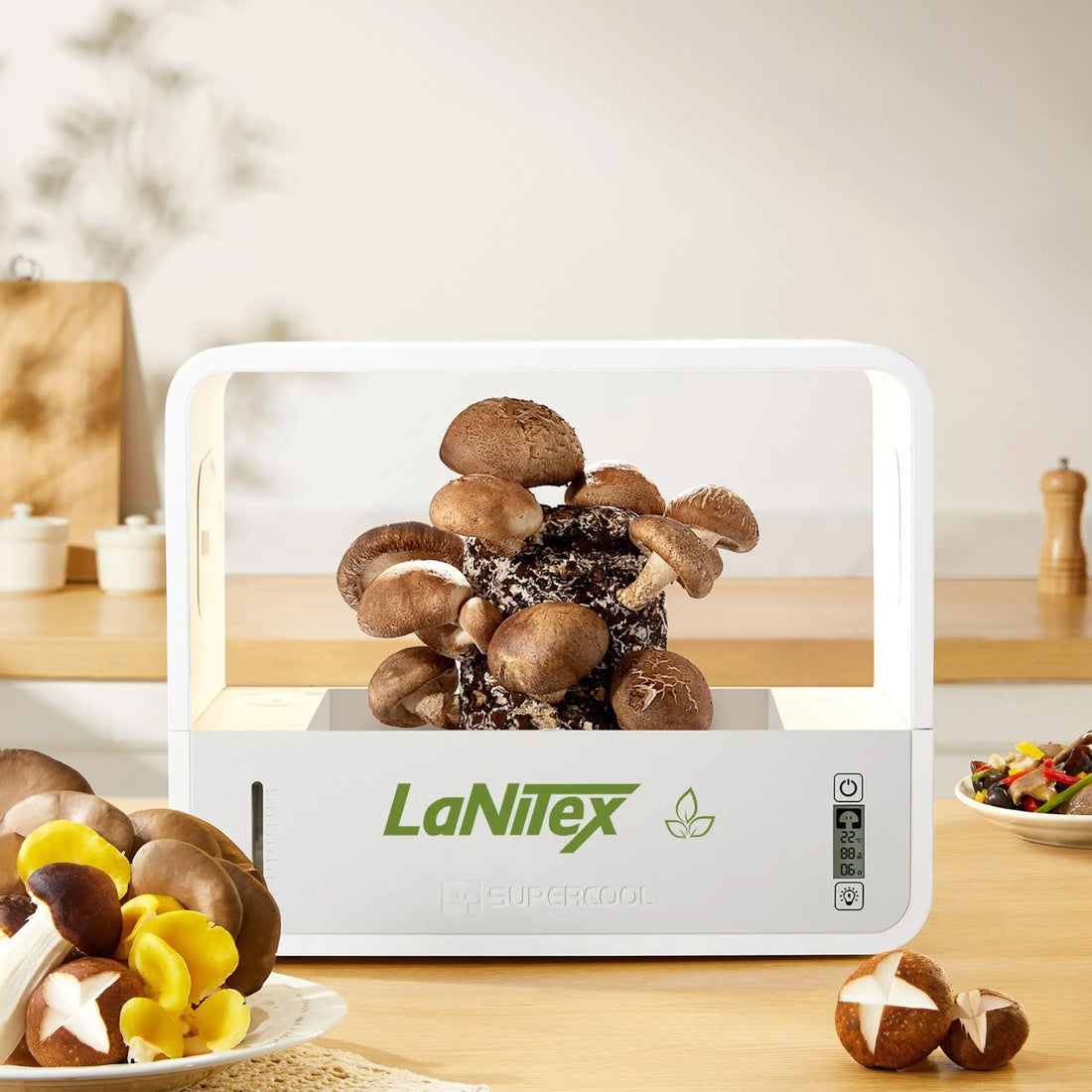
Restaurant kitchens pay a premium for king oyster mushrooms because they are tricky to get right - they need stable humidity and clean air exchange to form properly. The Smart Mushroom Growing Box gives you that same controlled environment on your kitchen bench - a reusable king oyster mushroom grow kit with humidity control, LED lighting and a clear lid so you can watch every stage. Add your spawn, keep it in the right temperature range, and you are growing chef-grade mushrooms at home.

Want hands-off harvests? The Smart Mushroom Growing Box runs the humidity, fresh air and light for you — no daily misting. You supply the fruiting block.
Start growing mushrooms →Ships from the Sunshine Coast, Queensland.
How to grow king oyster mushrooms step by step
The path from spawn to harvest runs about 30 to 45 days, and king oyster gives one or two flushes, with the first by far the most productive. Fewer flushes than the easy oysters is the honest trade-off for those premium thick stems. As a rough guide to the payoff, cultivation studies of king oyster on supplemented sawdust report a biological efficiency - the mushroom yield relative to the dry substrate - of about 45 to 75 per cent, with most of the crop coming in that first flush. No cold shock is needed to trigger fruiting either.
Sourcing your spawn and substrate
You can start one of two ways: from a ready-to-fruit king oyster block that is already colonised and just needs the right conditions to fruit, or from scratch with your own spawn and substrate - either way, steady humidity, airflow and light carry it through fruiting. To build your own, start with healthy Pleurotus eryngii spawn from a reputable Australian mushroom spawn supplier, and confirm it is the true king oyster, not a look-alike hybrid. For substrate, lead with sterilised supplemented hardwood sawdust or a Master's Mix of sawdust with soy hulls, or sawdust with up to around 40 per cent bran. King oyster does not grow well on straw, which gives poor yields. Peer-reviewed cultivation research has found higher yields on sawdust than on rice straw for this species. The high nutrient supplementation means the substrate must be sterilised rather than just pasteurised.
Inoculation
Mix the spawn evenly through the cooled, sterilised substrate with clean hands on a clean surface, working quickly to keep contamination out. The richer substrate that king oyster rewards is also more inviting to mould, so clean technique matters more here than with a forgiving straw oyster.
Colonisation
Keep the inoculated substrate warm and dark while the white mycelium runs through it, around 20 to 24C for two to four weeks. Colonisation is the one warm stage in a king oyster grow, and it runs longer than the easy oysters, so patience is part of the species.
King oyster is grown for the stem, not the cap. Trap carbon dioxide early to build a thick club stem, then open up the air so the cap stays small and the stem stays the star.
Pinning
Move the fully colonised block into fruiting conditions, cool air under about 21C with humidity around 85 to 90 per cent. Here is the staging that defines the species: hold carbon dioxide high at first so the developing pins push into thick stems, then increase fresh air as they grow so the caps open rather than running tall and thin.
Fruiting and harvest
Keep the chamber at 15 to 18C with steady humidity and good airflow as the stems thicken and the small caps form. Harvest when the caps have opened but are still firm, by cutting or twisting the whole mushroom away at the base. The first flush is the big one; a second is possible but lighter, so plan the kitchen around that first harvest.
Get a fresh grow guide like this every fortnight
Join the LaNiTex Hydro Garden newsletter for practical hydroponic, microgreen and mushroom growing tips for Australian homes. Subscribe to download a free hydroponics starter guide (PDF) and get 10% off your first order.
Join the newsletter →Common problems and how to fix them
Most king oyster faults trace back to the same two levers: the carbon dioxide and fresh-air balance, and humidity that will not hold. Fix those and the species behaves.
Long, thin stems and tiny caps
This is the signature king oyster problem, and it means too much carbon dioxide late in fruiting. The early high-carbon-dioxide stage was right; the fix is to bring in more fresh air once the pins are set so the caps can open and the stems firm up instead of stretching.
Pins drying out or aborting
Pins that shrivel or stall usually point to humidity that is too low or swinging. Hold humidity around 85 to 90 per cent through pinning, and avoid letting the surface dry between mists, since young pins lose moisture fast.
Rust-coloured streaks on the stems
Brown or rust-coloured streaking on the stems is usually bacterial blotch, aggravated by warmth, wet surfaces and stale air. Keep the chamber cool, avoid water pooling on the mushrooms, and improve airflow; some growers also run king oyster at lower humidity as the caps firm to keep the surfaces drier.
Slow or failed colonisation
A block that is slow to colonise or shows patchy growth is often too cool, or has lost out to contamination on that rich substrate. Hold the colonisation stage at 20 to 24C, and if mould appears on a sterilised block, the culprit is almost always a gap in sterile technique at inoculation.
Almost every king oyster problem is an environment problem, not a spawn problem. Stabilise the temperature, the humidity and the air, and the same block that was struggling will usually come good on the next attempt.
Most of the problems above trace back to unstable conditions - humidity that swings and air that goes stale. A reusable system removes those variables: the Smart Mushroom Growing Box holds humidity and light steady and keeps the fruiting chamber ventilated, so contamination and dry-out have far less chance to take hold, flush after flush. (Temperature you manage simply by choosing a room in the right range - see above.) Unlike a one-off supermarket kit, it is built to be reset and grown again.

How to cook king oyster mushrooms
Cook the stem first, because the stem is the meal. Sliced into one to two centimetre rounds, scored in a crosshatch and seared in a hot dry pan, the stem becomes the plant-based king oyster scallops the species is famous for, golden and caramelised outside, firm and juicy within. The same dense stem pulls into strips for a pulled-mushroom texture, or roasts whole into a centrepiece. Beyond the scallops, the firm stems take well to a quick stir-fry, thick seared king oyster steaks, air-fryer chips, or a hearty mushroom soup.
The food science is simple: king oyster is low in moisture and dense, so it browns and caramelises with high-heat dry cooking, a sear or a roast, rather than boiling, which leaves it bland and rubbery. Because it holds its texture, it does not weep or collapse the way softer mushrooms do. To store it, keep it unwashed in a breathable container or paper bag in the fridge for several days, and clean it only just before cooking. For more ways to use a flush, the recipe ideas are a good start.
Grow gourmet at home
Grow gourmet king oyster mushrooms on your own kitchen bench — the Box holds the humidity, fresh-air cycle and light steady while you place it somewhere cool. You add the fruiting block.
Grow your own mushrooms →Ships from the Sunshine Coast, Queensland.
King oyster mushroom FAQ
What does king oyster mushroom (Pleurotus eryngii) taste like?
King oyster mushrooms taste mild, savoury and umami, with a firm, meaty texture that holds its shape after cooking rather than going soft. Sliced into rounds and seared, the dense stem is famously scallop-like, browning and caramelising under high dry heat into a golden, juicy centrepiece.
How long do king oyster mushrooms take to grow from inoculation to harvest?
From inoculation to first harvest is usually about 30 to 45 days. The substrate colonises in roughly two to four weeks at 20 to 24C, then one to two weeks of pinning and fruiting follow once cool conditions begin. King oyster gives one or two flushes, with the first the most productive.
What temperature do king oyster mushrooms (Pleurotus eryngii) need to fruit?
King oyster mushrooms fruit best cool, ideally around 15 to 18C, and reliably under about 21C. Pinning drops away once the air sits much above 18 to 21C, so cooler is safer. Alongside temperature, they need high humidity, around 85 to 90 per cent, for pins to set and stems to form well.
Can king oyster mushrooms grow successfully in Australia?
Yes. King oyster mushrooms grow well in Australia wherever fruiting stays under about 21C, which southern regions deliver naturally through autumn and winter. Further north, growing indoors in a humidity-controlled box makes a king oyster grow realistic year-round rather than only in the cooler months.
Can you eat king oyster mushroom stems and why are they so thick?
Yes, king oyster stems are fully edible and are usually the best part of the mushroom, prized for a firm, meaty, scallop-like texture. The stems grow thick because high carbon dioxide early in fruiting concentrates the mushroom's growth into a dense, club-shaped stem with only a small cap on top.
Are king oyster mushrooms easy to grow for beginners?
King oyster mushrooms are a moderate, intermediate grow rather than a beginner quick-win. They need more control than other oysters: cool fruiting temperatures, the staged carbon dioxide and fresh-air technique for thick stems, sterilised supplemented sawdust, and a longer colonisation. They are rewarding, but not the easiest first grow.
How do you store fresh king oyster mushrooms?
Store fresh king oyster mushrooms unwashed in a breathable container or a paper bag in the fridge, where they keep well for several days. Clean them only just before cooking, and avoid sealed plastic, which traps condensation and shortens their life by leaving moisture sitting on the firm stems.
What substrate is best for growing king oyster mushrooms?
The best substrate is sterilised supplemented hardwood sawdust, often a Master's Mix of sawdust with soy hulls or bran. King oyster does not grow well on straw, which produces poor yields. Because the mix is high in nutrients, it must be sterilised rather than just pasteurised to keep contamination out during colonisation.
Are king oyster mushrooms good for you?
Yes. King oyster mushrooms are nutritious and low in kilojoules. Per 100 g fresh they carry around 35 calories and almost no fat, plus roughly 3 grams of plant protein and 2 to 3 grams of fibre, including beta-glucans. They also give you B vitamins such as niacin and riboflavin, some potassium and selenium, and the antioxidant ergothioneine. Exact figures vary with growing conditions, so treat this as general nutrition information rather than dietary advice.
Ready to grow king oyster mushrooms at home?
King oyster is a step up from the easy oysters, and the payoff is a thick, scallop-like stem that turns a home grow into a genuine kitchen event. If a first flush comes up well, the team would genuinely like to see it, so email the LaNiTex crew a photo, or browse the complete Australian mushroom growing guide for choosing a setup.
Related mushroom guides
- Blue oyster mushrooms — a classic easy oyster
- Phoenix oyster mushrooms — a fast warm-season oyster
- Pearl oyster mushrooms — the beginner's oyster
About the author
Laszlo Bulatko is the founder of LaNiTex Hydro Garden, a Sunshine Coast small business making indoor growing simple for Australian households. After fifteen years in sales and brand development, Laszlo now tests every system LaNiTex stocks before it reaches the catalogue - from hydroponic herb gardens to the Smart Mushroom Growing Box - and shares what actually works for growers in Australian conditions.
Sources
- King Oyster Mushrooms: How to Identify, Grow and Cook Them. GroCycle. https://grocycle.com/king-oyster-mushrooms/
- How to Grow King Oyster from Ready-to-Fruit Blocks. Field & Forest Products. https://fieldforest.net/how-to-grow-king-oyster-from-ready-to-fruit-blocks/
- Cultivation of different strains of king oyster mushroom (Pleurotus eryngii) on saw dust and rice straw. Saudi Journal of Biological Sciences, 2010. https://pmc.ncbi.nlm.nih.gov/articles/PMC3730573/