
The caps come up an almost unreal dusky blue, and there is a quiet trick behind it: the cooler the room, the deeper that blue gets. Fewer growers still realise the colour does not last once the mushrooms hit the pan.
Quick answer: Blue oyster mushrooms (Pleurotus ostreatus var. columbinus) are a cool-climate strain of the common oyster mushroom that fruit best at around 10 to 21C, with humidity of 85 to 95 per cent. They are one of the most beginner-friendly mushrooms to grow, colonising in roughly a week and reaching harvest in two to four weeks. The cooler the room, the bluer the young caps.
This guide is for: Beginners
At a glance
| Species | Pleurotus ostreatus var. columbinus (blue oyster mushroom) |
| Climate | Cool, 10 to 21C - the cooler the room, the deeper the blue |
| Fruiting humidity | 85 to 95 per cent |
| Fresh air | Good airflow, CO2 under about 800 ppm |
| Substrate | Pasteurised straw or hardwood sawdust (sugarcane mulch, pine shavings and Master's Mix also work) |
| Difficulty | Beginner-friendly |
| Time to first harvest | About 2 to 4 weeks (colonises in roughly 1 week) |
Note: the temperature range describes the room the grower provides. A grow box manages humidity and light, not temperature.
Key takeaways
- Blue oyster mushrooms are a cool-climate strain of the common oyster mushroom, not a separate species, and the blue is a temperature-driven trait.
- The cooler the room, the bluer the young caps, and the colour fades to grey or beige once cooked, so harvest young if colour matters.
- They are forgiving for beginners, colonising in about a week and reaching harvest in two to four weeks.
- Humidity of 85 to 95 per cent and steady fresh air matter more than climate alone, which is why indoor growing works year-round across Australia.
Honest disclosure: the blue oyster is not yet a strain we have fruited on the LaNiTex test bench on the Sunshine Coast - the Smart Mushroom Growing Box and the faster, warmer oyster strains came first. The guidance below is built from cultivation science, Australian cool-climate oyster-growing guidance, and feedback from LaNiTex customers running the Box across QLD, NSW, VIC and TAS.
What is the blue oyster mushroom?
Blue oyster mushrooms are a cool-climate strain of the common oyster mushroom (Pleurotus ostreatus var. columbinus), recognised by the dusky blue-grey caps that young clusters produce at around 10 to 21C. They are not a separate species. The blue is a temperature-driven trait of the same fungus, which is why the strain is sometimes listed as Pleurotus columbinus.
A pearl or snow-white oyster is the same species grown warmer; the blue oyster is the cool-loving expression, with the colour to match. So the difference between a blue oyster and a pearl oyster is temperature and pigment, not a separate variety. Treat it as a cool-season oyster, keep it cool, and the blue tends to follow.
Why grow blue oyster mushrooms at home?
The first reason is the look. A young blue oyster cluster is one of the most photogenic things a beginner can grow on a kitchen bench. The second is the eating: blue oysters have a mild, savoury, faintly seafood-like flavour that turns nutty when sauteed, best when the caps are picked young.
They are also a confidence-builder. For a first grow, blue oysters are hard to beat - they forgive the small mistakes that sink trickier species, which makes them a sensible start before a shiitake or shimeji grow. On nutrition, a 2025 review in Comprehensive Reviews in Food Science and Food Safety notes that Pleurotus mushrooms "contain key bioactive compounds, including phenolic acids, flavonoids, terpenoids, ergosterol, and polyunsaturated fatty acids" (source).
How do blue oyster mushrooms grow in Australian climates?
Blue oyster mushrooms grow well anywhere the air sits around 10 to 21C during fruiting, and the cooler the room, the deeper the blue. In southern Australia, autumn and winter do this work for free: Melbourne, Hobart and Adelaide regularly drop into that band, so a sheltered indoor spot or a cool garage suits the strain through the cooler months. Further north, in Brisbane and on the Sunshine Coast, the move is to grow indoors or pick a naturally cool room, which makes year-round growing realistic rather than seasonal.
Climate matters, but humidity matters more. Blue oysters need 85 to 95 per cent humidity during fruiting plus steady fresh air, which is harder to hold on a kitchen bench than the right temperature.
In warmer parts of Australia, the task is simply holding that cool band through summer. The cheapest fix is location: grow in the coolest room of the house - a tiled bathroom, a laundry, a south-facing room or an under-house space - rather than a hot kitchen. Growers chasing reliable results through a Queensland summer often repurpose a spare bar fridge or wine fridge as a small fruiting chamber, since both sit naturally in the cool 10 to 21C range, while evaporative cooling helps in dry inland heat. As a rule of thumb, time any outdoor-adjacent grows for autumn through spring, and keep summer grows indoors and cool.
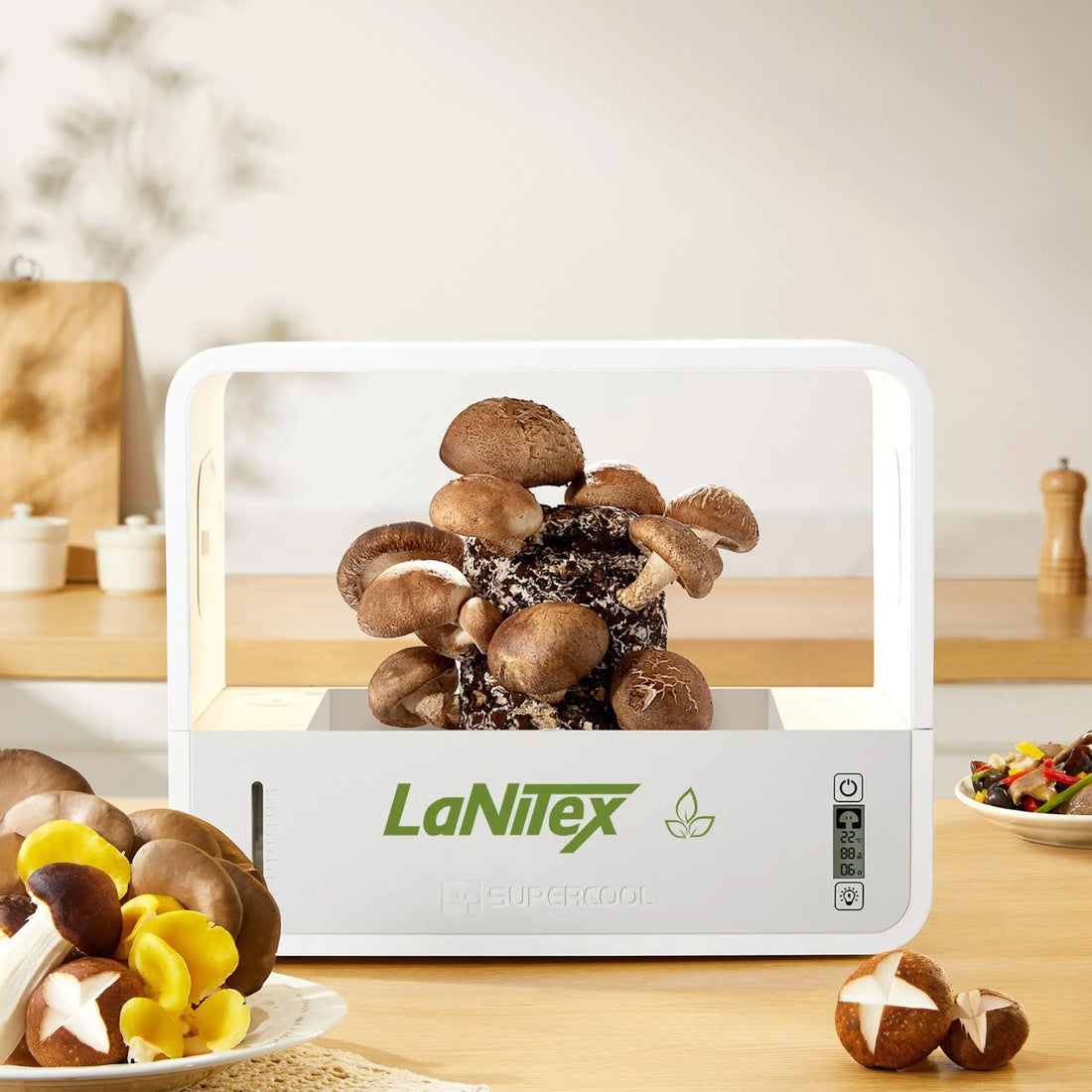
Getting blue oyster mushrooms to fruit comes down to two things: keeping them in the right temperature range (around 10 to 21C - choose a room, cupboard or garage that naturally sits in that band) and holding humidity high and steady at 85 to 95 per cent. The Smart Mushroom Growing Box is a reusable blue oyster mushroom growing kit that takes care of the hard part - its humidity control, LED lighting and clear lid hold the fruiting environment without daily misting or guesswork - while you simply place it somewhere in the right temperature range.
Why are blue oyster mushrooms blue (and why the colour fades when cooked)?
Blue oyster mushrooms are blue because the strain produces blue-grey pigment in the young fruit body, and growers consistently report that cooler conditions deepen the colour. The cooler the room, the bluer the cap. As the cluster matures, the pigment softens, so the most vivid colour sits on young, freshly formed caps.
Here is the part most growers do not expect. That blue does not survive the frying pan - heat turns blue oysters grey, beige or brown, much like other oysters. The dramatic colour is a fresh, raw-state feature, so anyone growing them for the colour should harvest young and show them off before cooking. The exact chemistry is not fully settled in the home-growing literature, but the behaviour is consistent and easy to plan around.


Want hands-off harvests? The Smart Mushroom Growing Box runs the humidity, fresh air and light for you — no daily misting. You supply the fruiting block.
Start growing mushrooms →Ships from the Sunshine Coast, Queensland.
Step-by-step: growing blue oysters from spawn to harvest
The path from spawn to harvest is the same forgiving routine that makes this strain a good first project. A single colonised block usually gives several flushes, so the effort pays off more than once.
The seven steps at a glance:
- Source spawn from a reputable Australian blue oyster supplier.
- Prepare the substrate by pasteurising straw, or use hardwood sawdust.
- Inoculate by mixing the spawn evenly through the cooled substrate.
- Colonise in the dark for about a week, until white mycelium covers the block.
- Pin by moving the colonised block into cool 10 to 21C air at 85 to 95 per cent humidity with fresh air.
- Fruit by holding humidity and airflow steady as the pins grow into clusters.
- Harvest young by twisting the whole cluster away at the base.
Sourcing spawn
Start with healthy blue oyster spawn from a reputable Australian mushroom spawn supplier. Look for a viable, named strain, a supplier who keeps spawn cold in transit, and recent grower reviews.
Preparing the substrate
Pasteurised straw and hardwood sawdust are the two go-to substrates, and straw is the easier first attempt. Pasteurise the straw before packing it into the container. Sugarcane mulch, pine shavings and a supplemented Master's Mix also work.
Inoculation and colonisation
Mix the spawn evenly through the cooled substrate with clean hands on a clean surface, then keep it somewhere dark and stable while the white mycelium spreads through it. Blue oysters colonise quickly, often in around a week, though some setups take two to three weeks to run fully.
A colonised blue oyster block is rarely one-and-done. Most growers get two or three flushes from a single block before it is spent.
Pinning and fruiting
Once the block is fully colonised, move it into fruiting conditions: cool air around 10 to 21C, humidity of 85 to 95 per cent, indirect light and good fresh air. Pins appear within days, then grow into clusters. Stale, high-CO2 air is the usual cause of poor pinning, so keep the air moving.
Harvest
Harvest the cluster young, just before the caps flatten and turn upward, by twisting the whole bunch away at the base. Young caps give the best colour, texture and flavour, and a clean harvest sets up the next flush.
What yield to expect
A healthy colonised block is not a one-flush affair. Most growers report two to four flushes before a block is spent, and the first flush is the largest - often around half to two-thirds of the total - with each later flush smaller than the one before. Flushes usually arrive a week or two apart, so a single block keeps producing over several weeks rather than all at once. The exact amount depends on the substrate, the spawn rate and how well humidity and fresh air are held, but the pattern of a big first flush followed by diminishing returns is consistent across oyster strains.
Get a fresh grow guide like this every fortnight
Join the LaNiTex Hydro Garden newsletter for practical hydroponic, microgreen and mushroom growing tips for Australian homes. Subscribe to download a free hydroponics starter guide (PDF) and get 10% off your first order.
Join the newsletter →Common blue oyster problems and how to fix them
Most first-grow problems trace back to two variables: stale air and humidity that will not hold. Fix those and the rest usually sorts itself out.
Long, thin, leggy stems
Leggy mushrooms with small caps on long stems point to poor fresh air exchange and high CO2. Increase ventilation around the block, and the next flush forms sturdier caps.
The block dries out or stops flushing
A block that stops producing is often drying out. Keep humidity at 85 to 95 per cent and rest the block in humid conditions between flushes. If a block has gone light and dry by the third or fourth flush, rehydrate it: submerge the whole block in cool water for a few hours - up to about twelve at most, since a longer soak invites bacteria - then drain it well so no water pools inside, and return it to fruiting conditions. As a last resort, bury a spent block in a shady garden spot for one final flush.
No pinning after three to four weeks
No pins three to four weeks after fruiting begins usually means air that is too dry, too still or too warm. Lower the temperature toward the cool end of the range, lift the humidity, and add fresh air.
Pale or faded colour
Pale caps usually mean the room is too warm. Cooler conditions deepen the blue, so move the block somewhere cooler and pick the caps young.
Is it contamination, or normal growth?
Beginners often panic at the first sign of something unusual, so it helps to know what is normal. Soft white fuzz on the stems and across the block is almost always aerial mycelium - a healthy part of the fungus - not mould. The blue-grey bruising that appears where blue oyster caps are handled is also natural, and is one of the quirks of this strain rather than a problem.
Real contamination looks and smells different. Green or blue-green powdery patches are usually Trichoderma, the most common mould, and a heavily affected block is best discarded rather than risked near a fresh grow. Slimy, wet, yellow-brown patches with a sour or fishy smell point to bacterial contamination, while a healthy block smells clean and faintly aniseed. Most of it traces back to poor pasteurisation, a low spawn rate, or condensation in stale, warm air, so the prevention rarely changes: clean tools, fresh air, and a block that is never left sitting wet.
Fair warning: that blue does not survive the frying pan, so the only way to enjoy the colour is to pick young and look before you cook.
If this is your first grow, the good news is that blue oyster mushrooms are one of the most forgiving species to start with - and a controlled environment makes them more forgiving still. The Smart Mushroom Growing Box takes the two hardest variables for a beginner - humidity and light - and manages them for you, so your first flush is far more likely to succeed. When it is done, you reset it and grow again, rather than binning a single-use kit.
Grow gourmet at home
Grow gourmet blue oyster mushrooms on your kitchen bench through the cooler months — the Box holds the humidity, fresh-air cycle and light steady while you place it somewhere cool. You add the fruiting block.
Grow your own mushrooms →Ships from the Sunshine Coast, Queensland.
Blue oyster mushroom FAQ
Are blue oyster mushrooms easy to grow for beginners?
Yes. Blue oyster mushrooms are easy for beginners because they colonise quickly, fruit reliably and tolerate a fairly wide range. They are often called very forgiving, though they still need clean technique, humidity above 85 per cent and good fresh air.
What do blue oyster mushrooms taste like?
Blue oyster mushrooms taste mild, savoury and slightly seafood-like, with a tender texture that firms up when cooked. The flavour is more delicate than king oyster or shiitake, turning lightly nutty and meaty when sauteed, especially if the caps are harvested young.
How do you cook and prepare blue oyster mushrooms?
Tear the cluster into strips, keeping the tender caps and upper stems and discarding the tough base; brush off any debris rather than washing them. Sear them in a hot, dry pan first to drive off their moisture, then add oil or butter with garlic or a splash of soy and cook until the edges crisp. They suit stir-fries, pasta, soups and risotto, and are best cooked through rather than eaten raw. The blue tone fades to grey-brown in the pan, so enjoy the colour before it cooks.
How long do blue oyster mushrooms take to grow from inoculation to harvest?
From inoculation to harvest is usually two to four weeks indoors, depending on spawn rate and temperature. Blocks often colonise in about a week, and once fruiting conditions begin, caps are typically ready seven to twelve days after pinning.
What temperature do blue oyster mushrooms need to fruit?
Blue oyster mushrooms fruit best at around 15 to 20C, with broader guidance giving 10 to 21C for cool strains. Fruiting slows outside that band, and steady humidity plus fresh air are needed alongside temperature for good caps.
Can blue oyster mushrooms grow successfully in Australia?
Yes, blue oyster mushrooms grow well in Australia wherever conditions stay in the cool 10 to 21C range, which suits indoor growing across much of the country. They need humidity above 85 per cent while fruiting, so success depends more on indoor conditions than outdoor climate.
Why are blue oyster mushrooms blue, and do they keep their colour when cooked?
Blue oyster mushrooms are blue because the strain produces blue-grey pigment in young fruit, and the colour fades as they mature. They do not keep a strong blue when cooked; heat turns them grey, beige or brown, so harvest young for the best colour.
How do you store fresh blue oyster mushrooms?
Store fresh blue oyster mushrooms in the fridge in a loosely closed paper bag so moisture does not build up. Growing guides suggest anywhere from about three days up to one to two weeks, while drying or freezing extends storage well beyond chilled keeping.
What substrate is best for growing blue oyster mushrooms?
Blue oyster mushrooms grow best on pasteurised straw or hardwood sawdust, which supply the lignocellulose they digest. Straw is the easiest beginner substrate, while sawdust blocks suit more controlled indoor setups, with incubation often around three weeks before fruiting.
Why are my blue oyster mushrooms grey or brown instead of blue?
Warmth is the usual reason. The blue deepens in cool air toward the lower end of the 10 to 21C range and fades as the room warms or the caps age, and strong direct light and strain genetics also play a part. For the bluest caps, keep the room cool and harvest young, since the colour is strongest on fresh, newly formed clusters.
Is the white fuzz on the stems normal, or is it contamination?
Soft white fuzz on the stems and block is usually aerial mycelium, a normal part of healthy growth rather than mould. Contamination instead looks green or blue-green and powdery, which is Trichoderma, or slimy and sour-smelling, which is bacterial. When in doubt, judge it by colour and smell: clean white and faintly aniseed is fine.
How do you store, dry or freeze blue oyster mushrooms?
Keep fresh blue oysters in a loosely closed paper bag in the fridge for up to about a week. To store them longer, slice and dehydrate them until cracker-dry, or saute and then freeze, and both keep for months. The fresh blue colour does not return once the mushrooms are cooked or dried, so enjoy the colour fresh and preserve the rest for the kitchen.
Ready to grow blue oyster mushrooms in Australia?
New to growing mushrooms? Our complete Australian mushroom growing guide covers the basics that apply to every species. A blue oyster grow is a low-stakes, high-reward way into home cultivation: a forgiving species, a vivid cluster on the kitchen bench, and a few flushes from one block. If a first flush comes up well, the team would genuinely like to see it - email the LaNiTex crew a photo, or browse the recipe ideas for what to cook once it is in.
Related mushroom guides
- Pearl oyster mushrooms — the easiest oyster to start with
- Pink oyster mushrooms — a fast, warm-climate oyster
- King oyster mushrooms — the meaty gourmet oyster
About the author
Laszlo Bulatko is the founder of LaNiTex Hydro Garden, a Sunshine Coast small business making indoor growing simple for Australian households. After fifteen years in sales and brand development, Laszlo now tests every system LaNiTex stocks before it reaches the catalogue - from hydroponic herb gardens to the Smart Mushroom Growing Box - and shares what actually works for growers in Australian conditions.
Sources
- Pleurotus Mushrooms in Nutrition and Health: Clinical and Preclinical Insights for Nutraceutical Development. Comprehensive Reviews in Food Science and Food Safety, 2025. https://pmc.ncbi.nlm.nih.gov/articles/PMC12406294/
- Assessing the nutritional quality of Pleurotus ostreatus (oyster mushroom). Frontiers in Nutrition, 2024. https://pmc.ncbi.nlm.nih.gov/articles/PMC10824988/