
Reading time: about 14 minutes
Thinking about growing your own shiitake? In a cool, shaded spot, fresh home-grown caps are well within reach for most Australian households.
Quick answer: You can grow shiitake mushrooms in Australia by inoculating Australian hardwood logs (eucalypt, she-oak or wattle) or a supplemented sawdust block with shiitake spawn, then fruiting them in a cool, shaded, humid spot at around 10-21C. Logs take six months to two years before the first flush; an indoor sawdust block colonises in roughly two to three months, then fruits in about a week once shocked. Shiitake suits autumn, winter and year-round indoor growing across most of temperate Australia.
Key takeaways:
- Shiitake mushrooms (Lentinula edodes) fruit best in cool, shaded conditions around 10-21C, which suits much of southern and high-altitude eastern Australia.
- Two routes work here: slow outdoor logs on Australian hardwoods (six months to two years to first flush) or a faster indoor supplemented sawdust block (weeks once colonised).
- Fruiting is triggered by a cold-water soak and a drop in temperature, so shiitake is a natural fit for a controlled indoor setup.
- You source spawn from a reputable Australian mushroom spawn supplier; the popular cool-climate strain sold here is Lentinula edodes 3782.
- A reusable mushroom growing box handles the humidity and light that decide success, while you choose a room in the right temperature range.
This guide is for: Beginners.
At a glance
- Climate: Cool
- Fruiting temperature: 10-21C (this is the room you provide, not a Box setting)
- Humidity: at least 80%, ideally around 85-95% during fruiting
- CO2: kept low with good fresh-air exchange, below about 1,000 ppm (a vented, lidded chamber)
- Substrate: indoors, supplemented hardwood sawdust block plus wheat bran; outdoors, Australian hardwood logs (eucalypt, she-oak, wattle)
- Difficulty: Intermediate
- Time to harvest: sawdust block roughly two to three months to colonise plus about two weeks browning, then a flush in about a week (three to five flushes); logs six to twelve months to the first flush, productive for four to six years
A note from the bench: we have grown shiitake successfully in the Smart Mushroom Growing Box here on the Sunshine Coast. That first-hand experience sits alongside the wider cultivation science (Ohio State and University of Missouri shiitake extension work, peer-reviewed Lentinula edodes research, and Australian log-growing experience documented by local growers) plus feedback from LaNiTex customers running the Box across Queensland, New South Wales, Victoria and Tasmania.
What is shiitake (Lentinula edodes)?
Shiitake mushrooms are an edible wood-rotting species, Lentinula edodes, traditionally grown on hardwood logs or sawdust blocks and native to East Asia. The mushroom is a white-rot fungus, which means it breaks down the tough lignin in timber and slowly digests the wood as it grows. That one fact drives everything else. Shiitake wants hardwood, it wants time, and it fruits when the weather turns cool and damp.
In the wild, shiitake appears on fallen broadleaf trees after the temperature drops. Home growers copy that lifecycle on a cut log or on a block of supplemented sawdust that mimics the same hardwood food. Research is investigating the mushroom's beta-glucans and other compounds for possible health-related properties, though in Australia shiitake is treated as a gourmet food, not an approved therapeutic product.
Why grow shiitake at home?
The honest reason most people start is taste. Shiitake has a deep, savoury, umami flavour and a meaty texture that dried supermarket caps rarely match. A flush picked an hour ago, sliced into a stir-fry or a bowl of dashi, is a different ingredient entirely.
There is a practical reason too. Fresh shiitake is not cheap, and good caps can be hard to find outside city grocers. Growing shiitake mushrooms at home in Australia turns a premium ingredient into something you walk past on the verandah. The economics stack up, too: growers report that a single inoculated log can crop roughly a kilogram of shiitake a year for about five years, and an indoor block gives three to five flushes, so a modest one-off spawn outlay returns many times its cost in fresh mushrooms. It is also a satisfying first project. Fair enough, mushrooms are not lettuce. But the lifecycle is visible and slow enough to follow, which makes it a rewarding way to learn how fungi work before you try fussier species.
How does shiitake grow in Australian climates?
Shiitake is a cool-climate mushroom, and that shapes where and when it grows here. It fruits best at around 10-21C, so the natural outdoor season across much of temperate Australia is autumn through winter and into early spring. Cooler regions such as the Southern Highlands, the Adelaide Hills, Tasmania and the upland eastern ranges suit it well. The warm, humid subtropics are harder outdoors and lean towards an indoor approach. If you are new to home cultivation, the broader mushroom growing guide covers the basics that apply to every species before you specialise in shiitake.
There are two ways to grow it, and they run on very different clocks. The traditional method is to grow shiitake mushrooms on logs outdoors. Australian growers cut hardwood in late winter and inoculate it. Smooth-barked eucalypts, she-oak and some wattles all work, which makes the question of the best wood for shiitake mushrooms in Australia an easy one to answer locally. Named timbers Australian growers rate include sugar gum, Sydney blue gum, Tasmanian blue gum, ribbon gum and scribbly gum among the eucalypts, plus blackwood (a wattle) and she-oak; use clean, freshly felled logs and avoid dense, oily or rot-resistant timbers such as box, ironbark and turpentine. These shiitake logs sit somewhere shady and moist, get the equivalent of about 25mm of rain a week, and slowly colonise over six to twelve months before the first flush. The payoff for that patience is years of harvests from one stack.

The faster route is a supplemented sawdust block grown indoors. The block colonises in roughly two to three months, browns over a couple of weeks, then fruits in about a week once you trigger it. Indoors you control the two variables that decide success: humidity and clean, moving air. Temperature you handle simply by choosing the room. A spare bathroom, a laundry or a shaded garage that naturally sits in the 10-21C band is ideal.

Where to source shiitake spawn in Australia
LaNiTex sells the growing hardware, not the spawn, so you buy spawn separately from a reputable Australian mushroom spawn supplier. Buy fresh, viable spawn and use it promptly; old spawn colonises slowly and loses out to contamination. For logs you want plug or dowel spawn, which is wooden dowels pre-grown with mycelium that you hammer into drilled holes. For sawdust blocks you want sawdust spawn. Check which strain is on offer, because the popular cool-climate strain sold in Australia is Lentinula edodes 3782. Good suppliers ship cold or quickly to protect the living culture, and a few recent reviews will tell you whether the spawn arrives alive.
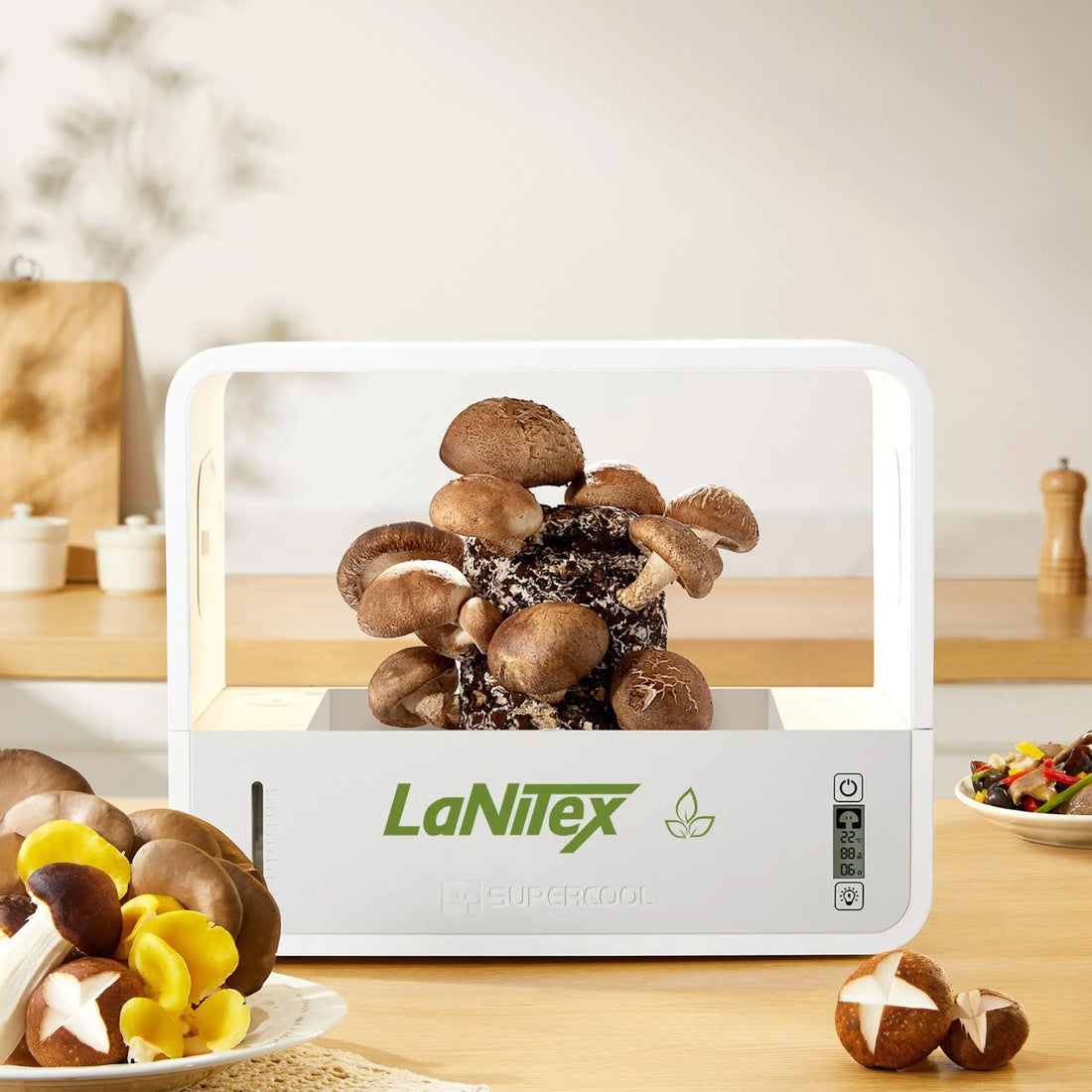
Getting shiitake to fruit comes down to two things: keeping them in the right temperature range (around 10-21C; choose a room, cupboard or garage that naturally sits in that band) and holding humidity high and steady at around 85-95%. The Smart Mushroom Growing Box takes care of the hard part: its humidity control, LED lighting and clear lid hold the fruiting environment without daily misting or guesswork, while you simply place it somewhere in the right temperature range.
Get a fresh grow guide like this every fortnight
Join the LaNiTex Hydro Garden newsletter for practical hydroponic, microgreen and mushroom growing tips for Australian homes. Subscribe to download a free hydroponics starter guide (PDF) and get 10% off your first order.
Join the newsletter →Step-by-step: from spawn to your first flush
The path from spawn to harvest follows the same broad arc whether you choose logs or a block. The timings below come from Ohio State University Extension's shiitake production guidance and match what Australian growers report.
1. Choose and prepare your substrate
For logs, cut freshly felled hardwood about 10-15cm thick and a metre long in late winter, while the wood still holds its sap, and let it rest a week or two so its natural defences fade. For the indoor route, start with a ready supplemented sawdust block, which saves you the sterilising step. For reference, a supplemented block is roughly 80 per cent hardwood sawdust to 20 per cent wheat bran with a little gypsum, hydrated to field capacity (squeeze a handful and only a few drops should run out), though you buy it ready-made rather than mixing your own.
2. Inoculate with spawn
Drill the log in a staggered diamond pattern, tap in plug spawn, and seal each hole with food-grade wax to lock in moisture and keep competitors out. As a rough guide, Australian growers drill roughly 8.5mm holes (a 5/16-inch bit) about 30mm deep and around 15cm apart, dotted all along and around the log. That comes to roughly 30 to 40 plugs in a one-metre log, and the more inoculation points, the faster and more even the colonisation. A sawdust block usually arrives pre-inoculated, so you skip this stage.
3. Let it colonise
This is the long wait. The mycelium spreads through the wood, and as Ohio State University Extension notes, "This process takes six months to two years" for logs. An indoor sawdust block is far quicker, colonising in roughly two to three months before it begins to brown.
4. Wait for browning
Shiitake forms a protective brown skin once colonisation finishes. On a block this browning takes a couple of weeks. Do not rush it; the brown layer signals the block is ready to fruit.
5. Shock it to trigger fruiting
Shiitake fruits when conditions change suddenly. A cold-water soak does it: submerge a log or block in cold water for a day, which mimics a cold autumn rain. Many growers add a physical jolt too: after the soak, they give a log a firm knock with a mallet or a gentle drop onto a hard surface, an old trick that seems to shock it into fruiting. An indoor sawdust block works the same way; a few hours somewhere cold (around 2 to 4C) on top of the soak helps it pin. Fruiting follows the wet, cool seasons in nature, so this soak, jolt and drop in temperature together tell the mushroom it is time.
6. Fruit and harvest
Once pins appear, the mushroom develops quickly. Ohio State University Extension notes that "the shiitake mushroom often matures in two to seven days." Cut each cap when the edge is still slightly curled under, before it flattens out. Indoors a block gives three to five flushes; a log can crop for four to six years, resting between flushes. To coax each new flush, rest the block for about two to six weeks after a harvest so it can recharge, then re-soak it in cool water for around 24 hours to trigger the next round.
Patience is the whole game with logs: you are working on the forest's clock, not yours.

Grow gourmet shiitake and oyster mushrooms indoors, any season. The Box runs the humidity, fresh-air cycle and light for you — no daily misting. You supply the fruiting block.
Start growing mushrooms →Ships from the Sunshine Coast, Queensland.
Shiitake strain 3782 vs 3790: which to grow in Australia
Most Australian shiitake growers meet two strain numbers, 3782 and 3790, and the difference is worth understanding before you buy spawn.
| Strain | Fruiting window | Caps | Public data | Best for |
|---|---|---|---|---|
| Lentinula edodes 3782 | Cool, around 10-20C | Dark, thick, well-scaled below about 18C; lighter and thinner when warmer | Widely documented; listed by most Australian suppliers | The safer first pick for an Australian autumn-winter or indoor grow |
| Lentinula edodes 3790 | Limited public data | Limited public data | A separate commercial production strain; exact traits not well published | Niche or commercial use; 3782 is the easier home choice |
The Lentinula edodes 3782 strain is the cool-fruiting one you will see most often here. It fruits in a roughly 10-20C window and forms dark, thick, well-scaled caps below about 18C, with lighter, thinner caps when it is warmer. That cool preference is exactly why it suits an Australian autumn-winter season and a controlled indoor setup.
Strain 3790 is a separate commercial production strain of the same species. Detailed public data on its exact temperature preferences and cap traits are limited, so it is honest to say the comparison is not clear-cut. What the research does make plain is that strain choice matters more than most beginners expect: Ohio State University Extension found an eleven-fold yield difference between high- and low-producing strains. In practical terms, the strain printed on the spawn label can be the single biggest factor in how much you harvest, ahead of small tweaks to humidity or timing. For a first grow in Australia, and especially for an indoor grow where you want reliable cool-season fruiting, the widely sold shiitake 3782 strain is the safer pick, and it is the one most local suppliers list.
Common shiitake growing problems and how to fix them
Most shiitake setbacks trace back to a handful of causes, and almost all are fixable.
My log or block will not fruit
This is the most common complaint, and the usual fix is a shock. Give the log or block a cold-water soak for a day, then a firm knock with a mallet (or a gentle drop on a hard surface) before you move it somewhere a few degrees cooler, since the jolt plus the cold often does the trick. If a log has never fruited and it is younger than six months, it may simply still be colonising; patience is the answer.
Green mould on the substrate
Patches of green or blue-green powder are usually Trichoderma, a competitor mould that moves in when spawn is weak or air is stale. Improve fresh-air exchange, keep tools and hands clean, and start with fresh, vigorous spawn. Do not seal both ends of a log with wax; the wood needs to breathe.
Caps that crack or dry out
Cracked, leathery caps mean the air is too dry. Lift the humidity during fruiting and avoid a dry draught blowing straight onto the mushrooms. A little surface cracking on cold-grown caps is normal and even prized; severe drying that stunts the cap is not.
Slow colonisation
Cold slows shiitake down. Colonisation runs warmer than fruiting, so if a block is crawling along, a slightly warmer spot will speed the mycelium. Just remember to bring the temperature back down to trigger fruiting later.
Pests on outdoor logs
Outdoor logs can attract company: fruit flies lay in damaged caps and possums will help themselves to a fresh flush. A loose drape of fine insect netting over fruiting logs keeps both off without trapping the humidity the mushrooms need.
Most of the problems above trace back to unstable conditions: humidity that swings and air that goes stale. A reusable system removes those variables: the Smart Mushroom Growing Box holds humidity and light steady and keeps the fruiting chamber ventilated, so contamination and dry-out have far less chance to take hold, flush after flush. (Temperature you manage simply by choosing a room in the right range; see above.) Unlike a one-off supermarket kit, it is built to be reset and grown again.
Shiitake vs oyster mushrooms: which is easier to grow at home?
Shiitake and oyster mushrooms are the two species most Australian beginners start with, and both fruit happily indoors in the same reusable box. The short version: oyster is the easier, faster first grow, while shiitake rewards a little more patience with a deeper, meatier flavour.
| Factor | Shiitake | Oyster |
|---|---|---|
| Difficulty | Intermediate | Easy -- a great first mushroom |
| Time to first harvest (sawdust block) | Two to three months to colonise, then about a week to fruit | Around two to four weeks |
| Substrate | Supplemented hardwood (logs or sawdust block) | Straw or hardwood sawdust |
| Fruiting temperature | Cool, around 10-21C | Adaptable -- many strains fruit across a wide range |
| Flavour and texture | Deep, meaty umami | Mild and delicate |
If this is your first grow, oyster mushrooms are the gentler introduction; once you have the fruiting routine down, shiitake is the natural next step. Both grow in the same Smart Mushroom Growing Box, so you can switch species without buying new equipment.
Cooking and storing your shiitake harvest
A fresh flush is the payoff, and shiitake earns its place in the kitchen. De-stem the caps first (the stems are too tough to eat whole, but they make excellent stock), then slice and stir-fry them, grill the caps whole, or simmer them into soups, braises and a classic dashi stock. Always cook shiitake rather than eating it raw: raw or undercooked caps can cause an itchy skin reaction known as shiitake dermatitis, which thorough cooking prevents. Thicker caps from cool-grown 3782 hold their texture especially well.
To keep fresh shiitake, refrigerate it soon after harvest in a breathable paper bag, not sealed plastic, and use it within several days. For the long term, dry it in a dehydrator or a warm, well-ventilated spot until the caps are hard and light. One nice trick before drying: stand the fresh caps gills-up in the sun for a day, as shiitake (like many mushrooms) develops more vitamin D when its gills are exposed to sunlight. Dried shiitake keeps for months in an airtight jar and rehydrates in warm water in about 20 to 30 minutes for basic softening (thicker caps, or a slow cold-water soak for deeper flavour, take longer), and the dark soaking liquid itself becomes a rich stock. For ideas on what to do with a glut, see the LaNiTex recipes page.
Shiitake grow kit or growing machine: which should you buy in Australia?
If you would rather buy than fell your own logs, you have two options. A shiitake grow kit is usually a one-off, pre-colonised sawdust block that fruits once or twice and is then spent. A growing machine such as the Smart Mushroom Growing Box is reusable: it holds the humidity, light and fresh air for you, and you refill it with a fresh block or spawn from an Australian supplier each time. A kit is the cheapest way to try a single grow; a machine is the better value if you want fresh shiitake on tap, flush after flush, with no single-use waste.
You can, of course, simply buy shiitake. Fresh caps turn up at Woolworths and greengrocers, and a quick "shiitake mushrooms near me" search will find a local stockist -- but shop-bought punnets are pricey and often a few days old, and dried packets cost more again gram for gram. Growing your own, whether from a kit or a reusable machine, gives you fresher, better-tasting shiitake picked the moment you need it.
Growing shiitake in the LaNiTex Smart Mushroom Growing Box
If the six-to-twelve-month log wait sounds like a lot, the indoor route is where a controlled environment pays off. This is also the simplest way to grow shiitake mushrooms indoors in Australia. Shiitake fruits on a trigger -- a cold soak and a humid, stable chamber -- and that is exactly what the indoor sawdust-block method delivers in weeks rather than months.
Without a dedicated box, growers hold that fruiting humidity by hand, standing the block in a loosely tented plastic bag or a tub with a damp towel and misting it once or twice a day. It works, but it is fiddly, easy to forget, and quick to swing too wet or too dry. The Smart Mushroom Growing Box is built around the two variables beginners find hardest to hold steady: humidity and light. It maintains fruiting humidity, provides the LED light that helps caps colour and form, and keeps the chamber ventilated so stale air and contamination have less chance to take hold. Temperature stays in your hands (you place the Box in a room that sits in the 10-21C range), but the daily misting and guesswork disappear. Because it is reusable, one block after another fruits in the same chamber, so unlike a single-use supermarket kit you reset it and grow again. The Box ships Australia-wide.
Grow gourmet at home
Turn a shaded corner into a year-round shiitake bench. The Box holds the humidity, fresh-air exchange and light steady — the controlled conditions shiitake needs to fruit. You choose a cool room and supply the block.
Start your mushroom grow →Ships from the Sunshine Coast, Queensland.
FAQ
What is shiitake mushroom (Lentinula edodes)?
Shiitake is an edible wood-rotting mushroom species, Lentinula edodes, traditionally grown on hardwood logs or sawdust blocks and native to East Asia. It is a white-rot basidiomycete that breaks down lignin in timber and fruits in cool conditions around 10-21C. Research is investigating its beta-glucans and other compounds for potential health-related properties.
How long do shiitake mushrooms take to grow from inoculation to harvest?
Shiitake grown on supplemented sawdust usually needs roughly two to three months (about 6 to 12 weeks) for the spawn run from inoculation to full substrate colonisation, depending on strain and conditions. After colonisation and browning, individual flushes are typically harvested two to seven days after pins appear. Log-based systems generally take longer, often six months to two years before the first harvest, especially in cooler 10-21C climates.
What temperature does shiitake need to fruit?
Shiitake typically fruits in cool conditions between about 10-21C, with cold-weather strains performing best at the lower end of this range. Some commercial 3782 strains list an optimum fruiting window of 10-20C, with darker, thicker caps below 18C. In practice, many growers in temperate regions time fruiting to spring and autumn when ambient temperatures sit near the middle of that range.
Can shiitake mushrooms grow successfully in Australia?
Shiitake mushrooms grow successfully in many Australian regions with cool seasonal temperatures around 10-21C, especially upland or temperate areas where shaded, moist sites are available. Australian suppliers offer Lentinula edodes 3782 spawn with a stated fruiting range that fits local conditions. Using hardwood logs or sawdust substrates under shade with regular watering allows outdoor or protected cropping in much of southern and high-altitude eastern Australia.
What is the difference between the 3782 and 3790 shiitake strains?
Lentinula edodes 3782 is described as a cool-fruiting strain with a 10-20C fruiting window, forming dark, thick, well-scaled caps below 18C and lighter, thinner caps at warmer temperatures. Both 3782 and 3790 are commercial shiitake strains of the same species, but 3790 is generally treated as a separate production isolate with different yield and morphology characteristics. Detailed public data on 3790's exact temperature and cap traits are limited.
What does research say about the health benefits of shiitake mushroom?
Research is investigating shiitake's beta-glucans, eritadenine and polysaccharide-rich extracts for possible effects on immune function, cholesterol metabolism and other biological markers. Traditional use in East Asia spans several hundred years as a valued food and tonic fungus. In Australia, shiitake is regarded as a gourmet ingredient rather than an approved therapeutic product under TGA regulations, so these remain areas of ongoing study rather than proven health claims.
What does shiitake taste like and how do you cook it?
Shiitake has a rich, savoury umami flavour with a meaty texture, especially in thicker caps from cool-fruiting strains such as 3782. Fresh mushrooms are commonly sliced and stir-fried, grilled, or added to soups and braises. Dried shiitake is rehydrated in warm water in about 20-30 minutes for basic softening (thicker caps or a slow cold-water soak take longer), with both the caps and the soaking liquid used to intensify stock and sauce flavour.
Can you eat shiitake mushrooms raw, and are they safe to eat?
Shiitake are not poisonous, but they should not be eaten raw or undercooked. Raw shiitake can trigger shiitake (flagellate) dermatitis, an itchy whip-like skin rash, and may cause stomach upset such as nausea or diarrhoea. Cooking thoroughly breaks down lentinan, the heat-sensitive compound responsible, so always pan-fry, grill or simmer shiitake until fully cooked; prepared that way, they are safe and enjoyable for most people.
How do you store and dry shiitake mushrooms after harvest?
Fresh shiitake is best refrigerated soon after harvest and used within several days, stored in a breathable paper bag to avoid condensation. For long-term storage, caps are typically dried in a dehydrator or well-ventilated warm space until they feel hard and light. Properly dried shiitake is then sealed in an airtight container and kept in a cool, dark place for several months.
Related mushroom guides
- Shimeji mushrooms — another gourmet wood-lover
- Golden enoki mushrooms — a clustered gourmet grown the same way
- Chestnut mushrooms — a nutty gourmet for the same indoor setup
About the writer
About the author
Laszlo Bulatko is the founder of LaNiTex Hydro Garden, a Sunshine Coast small business making indoor growing simple for Australian households. After fifteen years in sales and brand development, Laszlo now tests every system LaNiTex stocks before it reaches the catalogue -- from hydroponic herb gardens to the Smart Mushroom Growing Box -- and shares what actually works for growers in Australian conditions.
Sources
- Song, X., et al. (2025), Cultivation methods and biology of Lentinula edodes, Applied Microbiology and Biotechnology (peer-reviewed review). On colonisation maturity, the synthetic log shows "reddish-brown brown film, tumor-shaped nodules or softness to touch."
- Ohio State University Extension (Ohioline), Shiitake Mushroom Production: Steps to Cultivation and Considerations for Production (F-0039). "This process takes six months to two years." / "the shiitake mushroom often matures in two to seven days" / "Fruiting occurs primarily in the wet, cool seasons (spring and autumn)."
- University of Missouri Center for Agroforestry, "Growing Shiitake in an Agroforestry Practice." "Shiitake mushrooms fruit best in cooler conditions, typically requiring temperatures between 55-75 degrees F" (about 13-24C).
Last updated: 4 June 2026