
The long, pale-white bundle of enoki in the supermarket fridge and the short, golden mushroom a home grower harvests are the same species, grown differently. Golden enoki is also the coldest mushroom in the LaNiTex range.
Quick answer: Golden enoki is the wild, golden-brown form of Flammulina filiformis (still commonly listed as Flammulina velutipes). It fruits cold at around 10-16C and needs a genuine cold-shock to pin, which makes it the coldest, most demanding species in the cluster. It is the same species as the white supermarket enoki, grown with more light and better airflow instead of high carbon dioxide and darkness.
Key takeaways:
- Golden enoki and white supermarket enoki are the same mushroom grown under different conditions: high CO2 plus darkness gives long white stems, while more light plus airflow gives the short golden form.
- It is the coldest species LaNiTex covers, fruiting at around 10-16C and needing a cold-shock of roughly 7-13C to trigger pinning.
- Cool-climate southern cities suit it naturally in autumn and winter; warmer regions need an actively provided cool room.
- It grows on supplemented hardwood sawdust (Master's Mix), traditionally by the jar or bottle method, and takes about 5-8 weeks from inoculation to first harvest.
- Enoki should always be cooked, never eaten raw, and home-grown enoki is a fresh, reassuring choice.
At a glance
| Field | Detail |
|---|---|
| Species | Flammulina filiformis (often listed Flammulina velutipes) |
| Climate | Cool to cold, the coldest species in the cluster |
| Fruiting temperature | Around 10-16C (room provided by the grower), cold-shock about 7-13C to pin |
| Humidity | 85-95% |
| Substrate | Supplemented hardwood sawdust / Master's Mix |
| Difficulty | Intermediate |
| Time to first harvest | About 5-8 weeks |
What is golden enoki, and how does it differ from white supermarket enoki?

Golden enoki is the wild-type, golden-brown form of Flammulina filiformis, a gourmet mushroom with slender stems and small caps. Most Australians only ever meet its pale cousin: the long, white, thin-stemmed bundle sold in plastic at the grocer. The surprise for many growers is that these two are the same edible species, simply grown in opposite ways.
The mechanism behind the difference is light and air. White supermarket enoki is grown in high carbon dioxide and near-darkness, which stretches the stems long and thin, keeps the caps tiny, and suppresses colour, while the same culture grown with more light and better fresh-air exchange gives the shorter, thicker, golden form with fuller flavour. In other words, golden enoki and white enoki are not different species at all: they are Flammulina filiformis (often listed Flammulina velutipes) grown two different ways, and the grower chooses which form appears by managing carbon dioxide and light. That single fact is the most useful thing to understand about this mushroom, and it is also why a controllable indoor environment matters so much, because holding steady humidity and dialling fresh-air exchange and light is exactly what decides the colour, the stem length and the flavour of the harvest.
So when people search for golden enoki vs white enoki, the honest answer is that they are looking at one mushroom in two outfits.
The naming can confuse first-time spawn buyers too. Cultivated Asian enoki is now usually classified as Flammulina filiformis, but it is very commonly still listed and sold as Flammulina velutipes, the European velvet shank mushroom. You will also see it called the golden needle mushroom or enokitake mushroom. When you buy spawn, treat all of these names as the same mushroom.
One brief safety note before the how-to. Flammulina does grow wild in cooler parts of the world, but wild identification needs real expertise and there are toxic look-alikes. The sensible path for home growers is cultivated spawn of a known strain, never a wild collection.
Why grow golden enoki at home?
Freshness, mostly. The golden, wild-type form is rarely sold fresh in Australian shops, which stock the blanched white bundles instead, so growing your own is often the only way to get it on the plate. The golden form is mild, slightly nutty and pleasantly crisp, and it holds its texture well when cooked briefly.
Enoki is a staple of Asian cooking: stir-fries, miso and clear soups, hotpot, and ramen all lean on its delicate stems and gentle flavour. Learning how to grow enoki mushrooms at home gives a cook a steady supply of a hard-to-buy ingredient, harvested minutes before it hits the pan. For anyone hunting fresh enoki mushroom Australia-wide, the shops stock the white form well, but the golden form is the one worth growing yourself.
Then there is the grow itself. Watching a block knit solid white with mycelium, then chilling it and waiting on those first pins, scratches an itch that the easy oysters never quite reach. If you are looking at this as one of several species to try, it sits alongside the LaNiTex guides on how to grow shiitake mushrooms in Australia and how to grow shimeji mushrooms in Australia as another Asian gourmet option.
How does golden enoki grow in Australian climates?
Honest disclosure (intro only, the rest of this guide stays third-person): golden enoki (Flammulina filiformis) isn't yet a species we've fruited on the LaNiTex test bench on the Sunshine Coast. The Smart Mushroom Growing Box and the faster, warmer, more forgiving oyster strains came first, and golden enoki is the coldest, most cold-shock-fussy species in our range. The guidance below is built from cultivation science and grow-guide literature (North Spore, GroCycle), Australian cool-climate mushroom-growing guidance, and feedback from LaNiTex customers running the Box across QLD, NSW, VIC and TAS. As golden enoki lands on our own bench, this guide will refresh with first-hand Sunshine Coast observations.
Golden enoki is the coldest species in the cluster. It fruits best at around 10-16C, and the make-or-break step is a genuine cold-shock, a colder shift of roughly 7-13C, to trigger pinning. Colonisation happens earlier and warmer, at about 18-25C. That cold requirement shapes where and when it grows across Australia.
In cool-temperate zones such as Melbourne, Hobart and Canberra, many homes naturally sit in the fruiting band through autumn and winter, so this is the easiest place and season to grow it. In temperate cities like Sydney, Adelaide and Perth, the shoulder seasons work well, while summer usually calls for a cool spare room, a garage or indoor cooling. In subtropical regions, including Brisbane and the Sunshine Coast, it is best treated as a winter-only project, or run year-round with active cooling. In tropical Darwin, ambient temperatures are simply too warm, so it becomes a special project that needs a dedicated cool space or fridge-temperature cold-shock.
Be clear-eyed about the difficulty. This is not a warm-climate grow and not a beginner quick-win. A skipped or half-hearted cold-shock is the classic reason a block refuses to pin. The reward for the extra care is a fresh, gourmet mushroom you cannot easily buy in Queensland or anywhere else in the country.
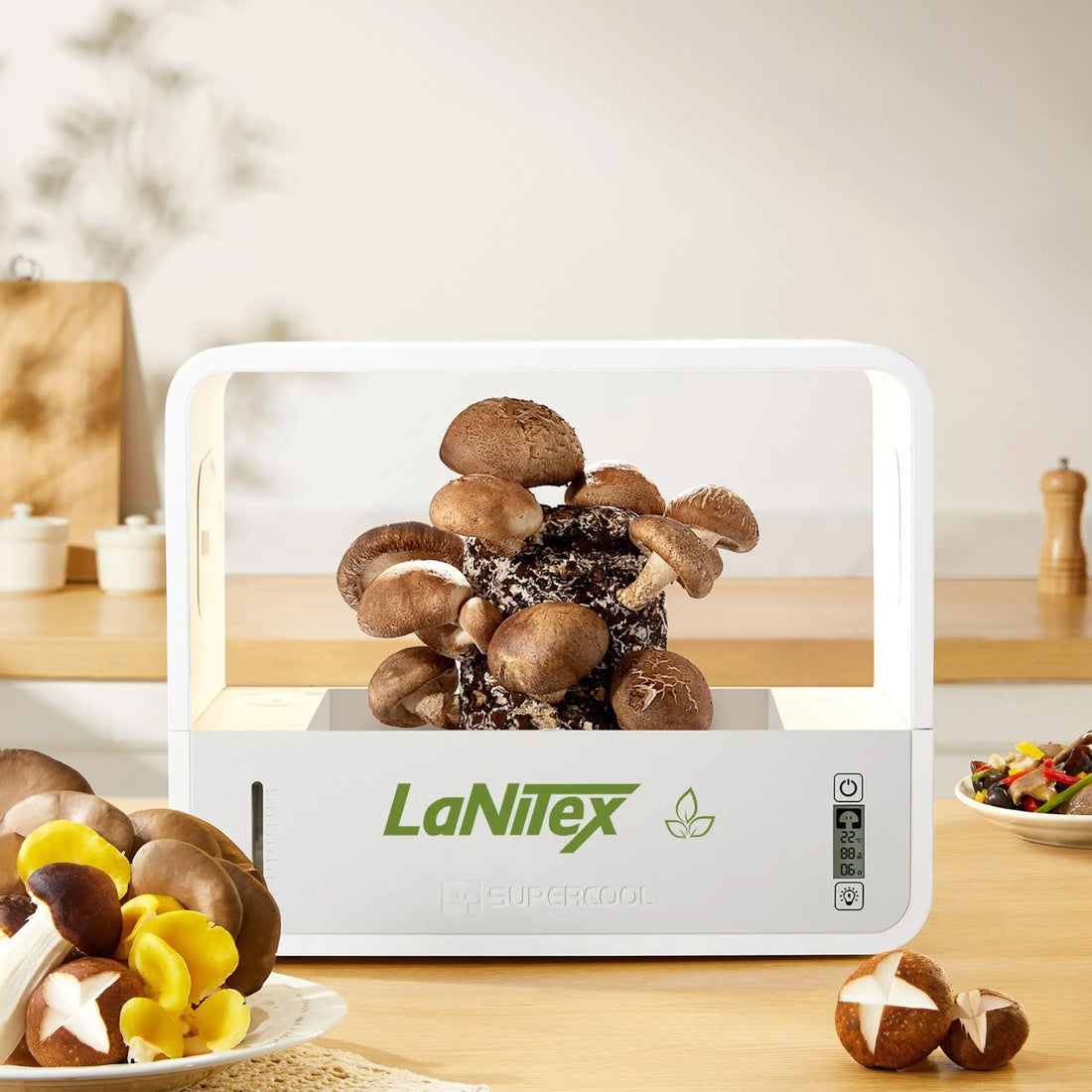
Getting golden enoki mushrooms to fruit comes down to two things: keeping them in the right temperature range (around 10-16C (keep it cold, the coldest species in the range), choose a room, cupboard or garage that naturally sits in that band) and holding humidity high and steady at 85-95%. The Smart Mushroom Growing Box takes care of the hard part, its humidity control, LED lighting and clear lid hold the fruiting environment without daily misting or guesswork, while you simply place it somewhere in the right temperature range.

Want hands-off harvests? The Smart Mushroom Growing Box runs the humidity, fresh air and light for you — no daily misting. You supply the fruiting block.
Start growing mushrooms →Ships from the Sunshine Coast, Queensland.
Step-by-step: growing golden enoki from spawn to harvest
This is the centrepiece of the grow. Golden enoki rewards patience and clean technique more than most species, and the cold-shock stage is what separates a flushing block from a stubborn one.
- Source viable golden enoki spawn and supplemented hardwood sawdust (Master's Mix) substrate.
- Mix the spawn through the cooled, sterilised substrate and seal the jar, bottle or block.
- Colonise at 18-25C in the dark for two to four weeks, until the substrate is fully white.
- Cold-shock to roughly 7-13C to trigger pinning. This is the make-or-break step.
- Pin over one to two weeks, managing carbon dioxide and light to choose the golden or white form.
- Fruit at 85-95% humidity and harvest by cutting at the base once the stems reach a usable length.
Sourcing spawn and the right substrate
Start with viable, contamination-free spawn from a reputable Australian mushroom spawn supplier. Look for grain or sawdust enoki mushroom spawn of the correct species, shipped cold and backed by reviews. Buying an enoki mushroom growing kit is the simplest entry point, but growers who want the golden form and multiple flushes usually move to bulk spawn and their own substrate.
Golden enoki performs best on supplemented hardwood sawdust, a Master's Mix style blend of hardwood sawdust with added bran for nutrition. It is traditionally grown by the jar or bottle method, the classic commercial enoki technique, as well as in blocks. The substrate is sterilised rather than just pasteurised, because the bran supplementation feeds contaminants as readily as it feeds the mushroom. LaNiTex sells the growing equipment, not spawn or substrate, so these are supplies you source separately.
Inoculation
Working in the cleanest space you can manage, mix the spawn evenly through the cooled, sterilised substrate, then seal it into its jar, bottle or block. Even distribution speeds colonisation and gives contaminants less room to establish.
Colonisation
Hold the inoculated substrate at around 18-25C in the dark while the mycelium spreads. Over roughly two to four weeks it knits the substrate into a solid white mass. This warm stage is straightforward and is the easy part of the grow.
Cold-shock, the make-or-break step
Once the block is fully colonised, drop the temperature sharply to deliver the cold-shock, a colder shift to roughly 7-13C. This signals the mushroom that the cold season has arrived and it is time to fruit. Skipping or softening this step is the most common reason a healthy block never pins.
Pinning, where you choose golden or white
After the cold-shock, small pins appear over about one to two weeks. This is where the carbon dioxide and light dial decides the form. Hold high carbon dioxide (commercial growers push it to roughly 3,000 to 5,000 ppm) and very low light for the long, pale, supermarket-style stems, or give more fresh-air exchange to bring the carbon dioxide down, plus a little more light, for the shorter, golden, fuller-flavoured form most home growers are after.
Fruiting and harvest
Keep humidity high at 85-95% through fruiting and let the cluster develop over a further week or two. Harvest the whole clump by cutting at the base when the stems have reached a usable length and the caps are still firm. A block will often give more than one flush, so rest it and keep conditions stable for a second round. As a rough guide, growers report around two to three flushes from a single block, with the first flush the largest, often in the order of 400 to 600 grams for a standard block, and each later flush smaller than the one before.
All up, expect about 5-8 weeks from inoculation to first harvest, with timings shifting depending on strain, substrate, temperature, humidity and airflow.
Get a fresh grow guide like this every fortnight
Join the LaNiTex Hydro Garden newsletter for practical hydroponic, microgreen and mushroom growing tips for Australian homes. Subscribe to download a free hydroponics starter guide (PDF) and get 10% off your first order.
Join the newsletter →Common problems and how to fix them
Most golden enoki troubles trace back to either a weak cold-shock or unstable fruiting conditions. Here are the faults growers hit most.
The block will not pin
A block that refuses to pin almost always had a cold-shock that was too mild or too short. Move the fully colonised block somewhere genuinely cold, into the 7-13C range, for a clear cold period, then return it to fruiting conditions. Patience through a proper cold spell usually breaks the deadlock.
Long thin stems when you wanted short golden ones
Long, pale, thin stems are the carbon dioxide and light balance at work: carbon dioxide is high and light is low, which is the supermarket recipe. For the golden form, increase fresh-air exchange and give a little more light, and accept that golden enoki is naturally shorter and thicker than the blanched product.
Contamination during colonisation
Green or black mould at the warm colonisation stage points to a sterility gap, often under-sterilised substrate or a rushed inoculation. Discard heavily contaminated blocks, tighten your clean technique, and make sure supplemented sawdust is properly sterilised rather than only pasteurised.
Browning or sliminess in storage
Soft, slimy or browning stems after harvest usually mean trapped moisture. Store enoki in a paper bag or loosely wrapped in the fridge rather than sealed tightly in plastic, which holds condensation against the mushrooms.
Most of the problems above trace back to unstable conditions, humidity that swings and air that goes stale. A reusable system removes those variables: the Smart Mushroom Growing Box holds humidity and light steady and keeps the fruiting chamber ventilated, so contamination and dry-out have far less chance to take hold, flush after flush. (Temperature you manage simply by choosing a room in the right range, see above.) Unlike a one-off supermarket kit, it is built to be reset and grown again.
How to use golden enoki in cooking, and a food-safety note

Golden enoki is best cooked briefly, a couple of minutes, and added near the end of cooking so the thin stems stay firm. It shines in stir-fries, miso and clear soups, hotpot, and ramen, where its mild, slightly nutty flavour and crisp texture lift the dish without overpowering it. Nutritionally it is a light choice: low in kilojoules, mostly water, and a source of B-group vitamins such as niacin along with a little dietary fibre. For more ideas across the LaNiTex range, see the recipes page.
There is one food-safety point worth stating plainly: enoki should be cooked, not eaten raw. This pairs with the freshness case for growing your own.
Imported, packaged enoki has been subject to Listeria monocytogenes recalls in Australia, and Food Standards Australia New Zealand (FSANZ) advises that contamination can occur during growing, harvesting, processing and packing without changing how the mushrooms look or smell. FSANZ states plainly that "Consumers are advised to not eat any enoki mushrooms raw" and that cooking enoki thoroughly will kill Listeria. For any recalled product, the advice is direct: "Recalled product should not be eaten."
None of this means imported enoki is inherently dangerous, and there is no need for alarm. The practical takeaway is simple: home-grown enoki travels a short, clean path from your own substrate to your own pan, and always cooking it adds a reliable safety step. That combination is what makes growing your own a fresh and reassuring choice.
Store fresh golden enoki in a paper bag or loosely wrapped in the fridge for several days, and avoid sealing it tightly in plastic, which traps condensation and softens the stems.
Grow gourmet at home
Grow gourmet golden enoki mushrooms on your own kitchen bench — the Box holds the humidity, fresh-air cycle and light steady while you place it somewhere cool. You add the fruiting block.
Grow your own mushrooms →Ships from the Sunshine Coast, Queensland.
Golden enoki FAQ
What is golden enoki mushroom (Flammulina velutipes)?
Golden enoki is the wild-type form of Flammulina velutipes, a gourmet edible mushroom with slender stems, small caps, and a golden-brown to brown cap colour. It is also known as velvet shank or golden needle mushroom, and it grows on dead or dying hardwood in cool conditions. In cultivation, it is grown for its long stems and mild flavour, not for medicinal use.
How long do golden enoki mushrooms take to grow from inoculation to harvest?
Golden enoki takes about 5 to 8 weeks from inoculation to first harvest under controlled growing conditions. A typical cycle includes 2 to 4 weeks for substrate colonisation, about 1 to 2 weeks after cold shock for pinning, and another 1 to 2 weeks to reach harvest size. Timings vary with strain, substrate, temperature, humidity, and fresh air exchange.
What temperature does golden enoki need to fruit?
Golden enoki fruits best at 10 to 16C, with many growers using 13 to 18C for fruiting once the block has colonised. Pinning is triggered by a colder shift, commonly a cold shock around 7 to 13C. Warm incubation is separate from fruiting, usually around 18 to 25C before the cooling step.
Can golden enoki mushrooms grow successfully in Australia?
Golden enoki grows successfully in Australia in cool indoor setups or cool-climate spaces where fruiting stays near 10 to 16C and humidity remains high, around 85% to 95%. Australia's climate suits it best in winter, or in a cool grow area the grower provides, because the fruiting stage needs cooler conditions than normal room temperature. It is a home-growable saprotroph rather than a specialist outdoor crop.
What is the difference between golden enoki and the white enoki sold in supermarkets?
Golden enoki is the natural wild-type form of Flammulina velutipes, while supermarket white enoki is usually cultivated under high carbon dioxide and low light that suppress colour and stretch the stems long and thin. Golden enoki has brown to golden caps and thicker, shorter stems, while cultivated enoki is typically white with very long, thin stems and tiny caps. They are the same edible species, grown and managed quite differently.
Are golden enoki mushrooms easy to grow at home?
Golden enoki is an intermediate grow rather than a beginner one. The colonisation stage is straightforward, but the fruiting stage needs careful environmental control: cool fruiting temperatures of 10 to 16C, humidity above 85%, and a colder shift to trigger pinning. It is more demanding than oyster mushrooms because it responds strongly to air exchange, light, and moisture, so set expectations for a fussier, slower grow.
What does golden enoki taste like and how do you cook it?
Golden enoki tastes mild, slightly nutty, and crisp, with thin stems that hold texture when cooked. It suits stir-fries, soups, hotpots, and noodle dishes, and is usually cooked briefly, a couple of minutes, so the stems stay firm. Add it near the end of cooking. Enoki should be cooked rather than eaten raw, as cooking improves flavour, texture and safety.
How do you store fresh golden enoki mushrooms?
Fresh golden enoki stores best in the fridge in a paper bag or loosely wrapped, where it keeps for several days. Paper allows airflow and reduces moisture build-up, which slows spoilage. Avoid sealing it tightly in plastic, because trapped condensation softens the stems and shortens shelf life. Keep the mushrooms dry until you are ready to cook them.
Are golden enoki mushrooms good for you?
Yes, golden enoki are a light, nutritious food. Per 100g raw they provide only about 155 kilojoules (37 calories) and are roughly 88% water, with around 2.6g of plant protein and 2.7g of dietary fibre. They also supply B-group vitamins, notably niacin, along with potassium. This is general food information, not medical advice.
How do you prepare golden enoki mushrooms for cooking?
Golden enoki needs very little preparation. The woody root base where the stems join should be trimmed off, about two to three centimetres, and the cluster separated into smaller bundles, rinsed briefly and patted dry. It is best added near the end of cooking, as it needs only two to three minutes, and should always be cooked thoroughly rather than eaten raw.
Ready to grow golden enoki at home?
If you are choosing your first species, golden enoki is a step up in difficulty, so weigh it against the easier options in Mushroom Growing Kit: The Complete Australian Guide. A reusable mushroom growing kit or mushroom growing box also takes the guesswork out of the fussy humidity this cold-loving species needs. Whichever species you grow, the path is the same: clean spawn, the right substrate, and a stable fruiting environment. Get the cold-shock right, and golden enoki rewards the effort with a fresh, golden harvest few Australian kitchens ever see.
Related mushroom guides
- Shimeji mushrooms — a similar clustered gourmet
- Shiitake mushrooms — the classic gourmet wood-lover
About the author
Laszlo Bulatko is the founder of LaNiTex Hydro Garden, a Sunshine Coast small business making indoor growing simple for Australian households. After fifteen years in sales and brand development, Laszlo now tests every system LaNiTex stocks before it reaches the catalogue, from hydroponic herb gardens to the Smart Mushroom Growing Box, and shares what actually works for growers in Australian conditions.
Sources
- Food Standards Australia New Zealand (FSANZ), "Listeria monocytogenes and imported fresh enoki mushrooms": https://www.foodstandards.gov.au/consumer/prevention-of-foodborne-illness/listeria-monocytogenes-and-imported-fresh-enoki-mushrooms