
When a Brisbane summer pushes the laundry past 27C and the pearl oysters stall, one warm-loving oyster keeps right on fruiting. That is the phoenix.
Quick answer: The phoenix oyster mushroom (Pleurotus pulmonarius) is a warm-tolerant "summer oyster" that fruits best at 18-24C, tolerates up to about 27C, and crops in roughly 6-9 days from pinning. Source spawn from a reputable Australian supplier, grow it on pasteurised barley straw or hardwood sawdust at 85%+ humidity, and it is one of the most beginner-friendly oysters you can grow at home.
At a glance
- Species: Pleurotus pulmonarius (phoenix oyster, summer oyster)
- Climate band: warm-tolerant - fruits when cooler oysters quit
- Fruiting temperature: 18-27C (best 18-24C)
- Humidity: 85%+ relative humidity
- Substrate: pasteurised barley straw, sugarcane mulch, hardwood sawdust, supplemented sawdust (Master's Mix), or recycled coffee grounds
- Difficulty: Beginner-friendly
Key takeaways
- Phoenix oysters are the warm-season oyster, fruiting at 18-24C and tolerating heat up to about 27C that stalls pearl and blue oysters.
- From pinning to harvest takes about 6-9 days, and the pins can double in size daily, so this is one of the fastest oysters to crop.
- The names Summer Chocolate, Tan, Italian, Indian and lung oyster all describe the same species, Pleurotus pulmonarius.
- A reusable growing box manages the humidity and light; the grower picks a room in the right temperature range, because the Box does not control temperature.
What is the phoenix oyster mushroom?
Phoenix oyster mushrooms are a warm-climate oyster species, Pleurotus pulmonarius, that grows in fan-shaped clusters with pale tan to light-brown caps and noticeably longer stems than the common pearl oyster. The species name pulmonarius means "relating to the lungs", a nod to the lung-like shape of the caps. Caps typically reach 5 to 15 cm across, sitting on stems that grow longer in warm, low-airflow conditions. The flesh is firm when young and tender once cooked, with the mild, faintly sweet flavour that makes oyster mushrooms such an easy gateway into home cultivation.
What sets the phoenix apart is heat tolerance. Where most cultivated oysters prefer cool rooms, this one fruits happily through the warm half of the year. That single trait shapes everything else about growing it, from when you start a block to which Australian climates suit it best.
Phoenix oyster aliases: same mushroom, many names
The phoenix oyster is sold under a confusing pile of names, and every one of them is the same species. Summer Chocolate oyster, Tan oyster, Italian oyster, Indian oyster and lung oyster are all Pleurotus pulmonarius. Australian retailers in particular tend to split it across listings: one shop sells a "Summer Chocolate Oyster" kit while another lists a "Tan Oyster", and both grow into the same pale-capped, warm-loving mushroom. If you are comparing spawn or kits and the botanical name reads Pleurotus pulmonarius, you are looking at a phoenix oyster, whatever the label says on the front.
Phoenix oyster vs pearl oyster: which is which
Phoenix and pearl oysters are the two most commonly confused oysters, and the difference comes down to temperature and timing. Phoenix oysters (Pleurotus pulmonarius) prefer warmer fruiting temperatures around 18-24C and crop fast, often 6-9 days from pin to harvest, with paler tan to light-brown caps and longer stems. Pearl oysters (usually Pleurotus ostreatus) prefer cooler 10-20C conditions, form denser clusters, and show grey to blue-grey caps with a firmer bite. The practical takeaway for an Australian grower: run phoenix oysters through the warm months and pearl oysters through the cool ones, and you have a fruiting oyster on the bench almost year-round.
| Feature | Phoenix oyster (Pleurotus pulmonarius) | Pearl oyster (Pleurotus ostreatus) |
|---|---|---|
| Fruiting temperature | 18-24C (warm; tolerates ~27C) | 10-20C (cool) |
| Pin-to-harvest | 6-9 days (fast) | Slower |
| Cap colour | Pale tan to light-brown | Grey to blue-grey |
| Stems / cluster | Longer stems | Shorter, denser clusters |
| Texture | Tender | Firmer bite |
| Best Australian season | Warm months | Cool months |

Why grow phoenix oysters at home?
The phoenix oyster earns its place on the bench for three plain reasons: it tastes good, it grows fast, and it forgives mistakes. The flavour is mild and slightly sweet, with a gentle umami note that turns nutty and rich once the caps hit a hot pan. The speed is the real hook, though. A flush that goes from tiny pins to harvest in under a fortnight gives a beginner the fast feedback that keeps the hobby fun, rather than the slow slog some gourmet species demand.
There is also the supply angle. Fresh oyster mushrooms wilt within days and rarely turn up in good condition at the supermarket, so growing your own is often the only way to cook with them at peak quality. For a warm-climate grower, the phoenix has one more advantage that no other oyster matches: it is the summer oyster, the variety that keeps producing when the heat has shut everything else down.
Get a fresh grow guide like this every fortnight
Join the LaNiTex Hydro Garden newsletter for practical hydroponic, microgreen and mushroom growing tips for Australian homes. Subscribe to download a free hydroponics starter guide (PDF) and get 10% off your first order.
Join the newsletter →How do phoenix oysters grow in Australia?
Phoenix oysters suit a large slice of Australia because they fruit in the warm half of the year, when cooler oysters refuse to pin. They fruit best at 18-24C and tolerate up to about 27C, which maps neatly onto Australian conditions. In subtropical and tropical zones such as Brisbane, coastal Queensland and Darwin, the warm, humid stretch from spring through autumn is prime phoenix season, and a shaded laundry, bathroom or patio holds the humidity these mushrooms want. In temperate cities like Sydney, Melbourne and Hobart, phoenix oysters work well indoors across the warmer months, while the cool of winter is better handed to a pearl oyster.
Here is the honest part. The LaNiTex testing team has not yet grown phoenix oysters on our own bench at Sippy Downs on the Sunshine Coast. The guidance in this guide draws on established cultivation science, the grow data published by Australian spawn suppliers, peer-reviewed research on Pleurotus pulmonarius, and the feedback we have gathered from LaNiTex customers growing oysters across Queensland, New South Wales, Victoria and Tasmania. When we run phoenix oysters through our own test cycle, we will update this guide with first-hand numbers. Until then, every figure here is sourced rather than measured by us, and we would rather say so plainly.
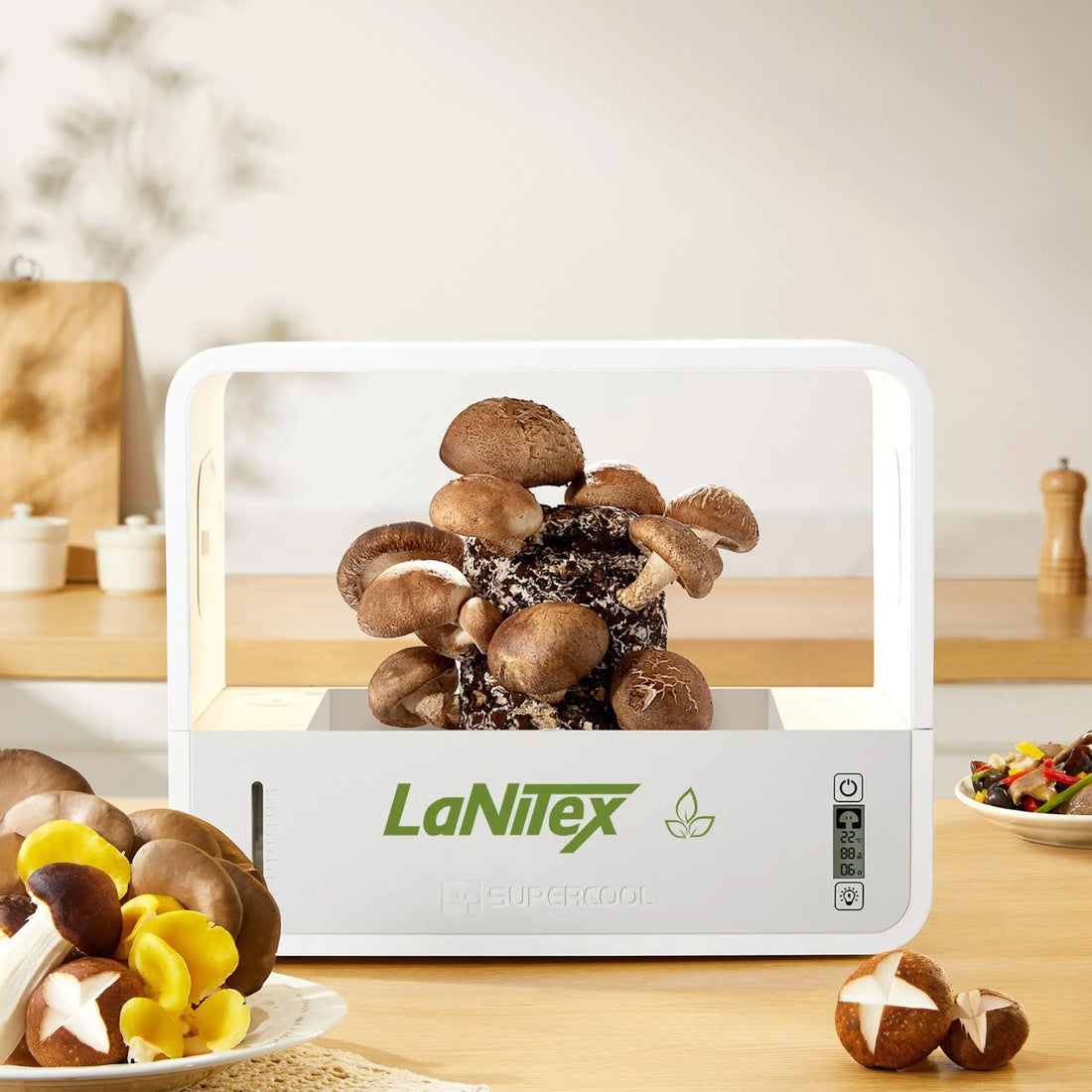
Getting phoenix oysters to fruit comes down to two things: keeping them in the right temperature range (around 18-27C - choose a room, cupboard or garage that naturally sits in that band) and holding humidity high and steady at 85%+. The Smart Mushroom Growing Box takes care of the hard part. Its humidity control, LED lighting and clear lid hold the fruiting environment without daily misting or guesswork, while you simply place it somewhere in the right temperature range. For the bigger picture on choosing and running a kit, see our complete Australian guide to mushroom growing kits.

Want hands-off harvests? The Smart Mushroom Growing Box runs the humidity, fresh air and light for you — no daily misting. You supply the fruiting block.
Start growing mushrooms →Ships from the Sunshine Coast, Queensland.
Step-by-step: growing phoenix oysters from spawn to harvest
Growing phoenix oysters follows the same path as any oyster: source spawn, prepare and inoculate a substrate, let the mycelium colonise, then trigger fruiting and harvest. The whole cycle runs about 14-21 days from inoculation to first harvest, which is fast for a gourmet mushroom. Here is how each stage works.
Sourcing phoenix oyster spawn in Australia
Start with viable, fresh phoenix oyster mushroom spawn from a reputable Australian mushroom spawn supplier. Search "phoenix oyster mushroom grow kit" or "phoenix oyster spawn" and you will find several Australian options, though quality and freshness vary. When you compare suppliers, check three things: that the spawn is recently produced and stored cold, that the species is listed by its botanical name Pleurotus pulmonarius rather than a marketing label alone, and that the supplier has genuine reviews from Australian growers. Grain spawn suits most home setups and colonises quickly. One logistics note worth knowing: some suppliers cannot ship live cultures into Western Australia or Tasmania because of quarantine rules, so check the shipping terms before you order if you are growing in those states. LaNiTex stocks the growing equipment rather than spawn, so you are free to choose whichever Australian supplier serves your area best.
Preparing the substrate
Phoenix oysters grow very well on pasteurised barley straw, sugarcane mulch and hardwood sawdust, all easy to find in Australia. Many home growers run 100% chopped straw for simplicity, while others use a supplemented blend such as roughly 70% hardwood sawdust with 30% bran, often called a Master's Mix, to push nutrition and yield higher. For a low-cost, sustainable option, phoenix oysters also take readily to used coffee grounds, fresh within a day of brewing and mixed with a little pasteurised straw or cardboard, which is a tidy way to turn kitchen waste into food. Whichever material you choose, you supply the substrate yourself, and it must be pasteurised or sterilised first to knock back competing moulds before the mushroom mycelium takes hold. Moisture content matters just as much as the material: the substrate should be damp but never dripping. The quick check is the squeeze test, where a handful squeezed in your fist clumps together and releases only a few drops of water. Too wet invites bacterial rot, while too dry leaves the mycelium struggling to run. Peer-reviewed work backs the value of getting the substrate right: a 2019 study in AMB Express on optimising agro-residues for Pleurotus pulmonarius found that a tuned substrate blend lifted yield meaningfully, reporting that "The biological efficiency was 15.2% greater than that of the control" (see Sources). Phoenix oysters also fruit on inoculated hardwood logs, including suitable eucalypt and Melaleuca species, which can keep producing for several years once colonised.
Inoculating and colonising
Mix your spawn evenly through the cooled, pasteurised substrate, working in a clean space to limit contamination, then pack it into a bag, bucket or block. Keep the colonising block warm, around 24-27C, and out of direct light. Over roughly 8-14 days the white mycelium spreads through the substrate until the whole block turns firm and white. Phoenix oysters colonise faster than many cool-climate oysters, which is part of why they suit impatient first-time growers.
Pinning, fruiting and harvest
Once the block is fully colonised, drop the temperature into the 18-24C fruiting range, lift humidity to 85%+, add fresh air and a little light, and small mushroom pins appear within a few days. From pinning, phoenix oysters race to harvest in about 6-9 days, and the pins can roughly double in size each day near the end, so check them daily. Harvest by twisting the whole cluster away just before the cap edges flatten out, which is when flavour and shelf life peak. Yields scale with block size, so larger commercial blocks produce more; for a typical home-sized block, Australian suppliers report around 300-500g across multiple flushes, with a second and sometimes third flush following a week or two after a quick rest and rehydration. Do not leave a flush too long chasing size: overripe caps drop spores, go soft, and store poorly.
An outdoor option: growing phoenix oysters on logs
Phoenix oysters are one of the more adaptable oysters for outdoor log culture, and Australian growers fruit them on a wider range of timbers than most species tolerate, including fresh-cut eucalypt and Melaleuca (tea-tree) and even some pines, a softwood most oysters refuse. Pick a recently felled, healthy log about 1 to 1.2 m long and 10 to 20 cm thick with the bark still firmly attached, and inoculate within a couple of weeks of cutting, before other fungi move in. Drill a grid of holes, tap in plug or sawdust spawn, and seal each hole with cheese wax or beeswax to lock the moisture in. Logs are the patient grower's route: they take roughly 6 to 18 months to colonise, then fruit each warm season for 3 to 7 years. It is far slower than an indoor block, but once a log is colonised it is close to maintenance-free.
Common phoenix oyster problems and how to fix them
Most phoenix oyster problems trace back to one of three things: stale air, swinging humidity, or contamination, and each has a clear fix. Because phoenix oysters tolerate heat, growers sometimes assume they tolerate everything, but the warm conditions they love also suit mould, so clean technique still matters.
Long stems and small caps
Long, leggy stems topped with tiny caps mean too little fresh air and not enough light. Mushrooms stretch toward air exchange and a light source, so a sealed container with stagnant air produces stalks instead of caps. Increase fresh-air exchange, give the block indirect light for several hours a day, and the next flush forms fatter, better-shaped caps.
No second flush
When a block crops once then sits quiet, it has usually dried out or run low on accessible food. After the first harvest, pick off any leftover stem bases and scraps of old mushroom, which rot and invite mould if they are left on the block. Then rehydrate it by soaking briefly or misting heavily, and return it to fruiting humidity. A healthy phoenix block typically has a second flush in it, and sometimes a third, as long as it has not dried hard or been overtaken by mould.
Green or blue mould
Patches of green or blue-green mould are a contamination, usually Trichoderma, and warm Australian conditions speed it up. Small spots can sometimes be cut away early, but a block heavily colonised by mould is best bagged and binned to protect your other grows. Prevention beats cure here: pasteurise the substrate properly, work clean, and do not let the colonising block overheat.
Block drying out in dry summer air
In a dry Australian summer, especially inland or in an air-conditioned room, a block can dehydrate before it finishes fruiting, leaving cracked, stalled pins. Steady humidity is the answer, which is exactly the variable a controlled fruiting chamber is built to hold.
If this is your first grow, the good news is that phoenix oyster mushrooms are one of the most forgiving species to start with, and a controlled environment makes them more forgiving still. The Smart Mushroom Growing Box takes the two hardest variables for a beginner, humidity and light, and manages them for you, so your first flush is far more likely to succeed. When it is done, you reset it and grow again, rather than binning a single-use kit.
Cooking and storing phoenix oysters
Phoenix oysters cook like other oyster mushrooms and reward high, dry heat. Torn into pieces and seared in a hot pan or roasted at 180-200C, the caps lose their water, brown at the edges, and develop a rich, nutty depth that suits stir-fries, pasta, soups and a simple side of garlic-and-butter oysters. They take on flavour well, so a splash of soy or a handful of herbs goes a long way. Cook them through rather than serving them raw, as with all cultivated oysters.

For storage, keep fresh phoenix oysters unwashed in a sealed container in the fridge at around 2-4C, with a sheet of paper towel inside to soak up excess moisture. Stored this way they hold good quality for about 7-14 days, though the texture and flavour are best in the first week. Skip washing them before storage, because surface water speeds up spoilage and shortens shelf life. If you have a glut from a big flush, oyster mushrooms also dry and freeze well for later cooking.
Grow gourmet at home
Grow gourmet oyster mushrooms on your own bench, right through the warm months. The Box holds the humidity, fresh-air cycle and light steady, so you skip the daily misting and guesswork. You supply the fruiting block.
Grow your own mushrooms →Ships from the Sunshine Coast, Queensland.
Phoenix oyster mushroom FAQ
What does phoenix oyster mushroom (Pleurotus pulmonarius) taste like?
Phoenix oyster mushrooms have a mild, slightly sweet flavour with a gentle earthy, umami character similar to other oyster mushrooms. Their texture is tender yet pleasantly chewy, especially in the 3-5 mm thick caps. When cooked at 180-200C in a pan or oven, they develop a richer, nutty depth that works well in stir-fries and soups.
How long do phoenix oyster mushrooms take to grow from inoculation to harvest?
Phoenix oyster mushrooms typically reach harvest 6-9 days after pinning in a home grow kit under good conditions, making them one of the faster oyster varieties. From initial inoculation of blocks or bags, total time is often around 14-21 days including 8-14 days of incubation at 24-27C and 6-9 days of fruiting at 18-24C.
What temperature do phoenix oyster mushrooms (Pleurotus pulmonarius) need to fruit?
Phoenix oyster mushrooms fruit best between 18-24C, fitting well into a moderate 15-27C home-growing climate. Sources list ideal fruiting ranges from 14-24C to 18-27C, with strong performance around 18-24C for reliable pinning and good cap formation. Temperatures above 27-30C often reduce yield and quality, while long periods below 10C slow or halt fruiting.
Can phoenix oyster mushrooms grow successfully in Australia?
Phoenix oyster mushrooms grow successfully in many Australian regions because they handle fruiting temperatures around 14-24C and tolerate warmer conditions up to about 27C. Australian growers use them on logs of eucalypts, pines and other local timbers, as well as on straw and sawdust substrates. Their adaptability to 6-18 month log colonisation periods matches varied Australian seasonal patterns.
What is the difference between phoenix oyster and pearl oyster mushrooms?
Phoenix oyster mushrooms (Pleurotus pulmonarius) prefer slightly warmer fruiting temperatures, around 18-24C, and are known for fast 6-9 day cropping from pin to harvest. Pearl oysters (commonly Pleurotus ostreatus) often prefer cooler 10-20C ranges and can form denser clusters. Phoenix oysters frequently show paler or tan to chocolate-brown caps with softer edges, whereas pearl oysters more often have grey to blue-grey caps and a firmer texture.
Are phoenix oyster mushrooms easy to grow for beginners?
Phoenix oyster mushrooms are considered easy to grow, with fast fruiting in about 6-9 days from pinning and forgiving temperature needs around 18-24C. Australian suppliers describe them as resilient, warm-tolerant oysters suited to simple bucket, bag or kit methods. Their ability to colonise straw, sawdust and mulch substrates, plus strong flushes with basic daily misting, suits beginners learning sterile technique and fruiting conditions.
How do you store fresh phoenix oyster mushrooms?
Fresh phoenix oyster mushrooms store best in a sealed container in the refrigerator at around 2-4C with paper towel to absorb excess moisture. Under these conditions, they generally hold good quality for 7-14 days, though texture and flavour are usually best in the first week. Avoid washing before storage, as extra surface water accelerates spoilage and shortens shelf life.
What substrate is best for growing phoenix oyster mushrooms?
Phoenix oyster mushrooms grow very well on pasteurised barley straw, hardwood sawdust and sugarcane mulch, all commonly available in Australia. Growers often use 100% chopped straw or blends such as 70% hardwood sawdust with 30% bran or similar supplements to boost nutrition. They also perform on inoculated logs of suitable timbers, with 3-7 years of potential fruiting once colonised.
Ready to grow phoenix oysters at home?
Related mushroom guides
- Pearl oyster mushrooms — the beginner's oyster
- Pink oyster mushrooms — a colourful warm-climate oyster
- Blue oyster mushrooms — a cool-tolerant oyster
Sources
- Sun, L. et al. (2019). "Optimization of agro-residues as substrates for Pleurotus pulmonarius production." AMB Express, Springer. https://pmc.ncbi.nlm.nih.gov/articles/PMC6856248/