
The classic grey oyster is the one most home growers start with, and for good reason: it colonises fast, forgives mistakes, and rewards a first-time grower with a full flush in about a month.
Quick answer
Quick answer: A pearl oyster mushroom (Pleurotus ostreatus) is the common grey oyster, and one of the easiest gourmet mushrooms to grow at home in Australia. Pearl oyster mushrooms fruit best when the room around them sits at 12 to 18 C, with humidity at 85 percent or higher and a bit of fresh air. From spawn to first harvest takes roughly three to five weeks. For beginners, pearls are a forgiving place to start.
At a glance
Climate:               Moderate
Fruiting temp:         best 12-18 C (largest, darkest caps); workable up to ~24-27 C in AU homes (smaller, paler)
Fruiting humidity:     85% or higher
CO2:                   under 1,000 ppm (fresh air)
Substrates:            pasteurised straw, sugarcane mulch, hardwood sawdust, Master's Mix
Difficulty:            Beginner-friendly
Time to first harvest: about 3-5 weeks
Key takeaways
- Pearl oysters are a beginner mushroom: fast to colonise, hard to kill, and grown indoors year-round across most of Australia.
- Aim for a room at 12 to 18 C for the best caps. Pearls still fruit up to about 24 to 27 C in a warm home, just smaller and paler.
- Keep humidity at 85 percent or higher and give the block fresh air, or you get long stems and tiny caps.
- One bag usually gives about three flushes, with the first crop ready roughly three to five weeks after you start.
- Buy spawn from a reputable Australian supplier, never import it, and always cook pearl oysters before eating.
By Laszlo Bulatko | Published 01 June 2026 | Reading time: about 11 minutes | Last updated: 04 June 2026

What is a pearl oyster mushroom?
A pearl oyster mushroom is the common grey oyster, known to science as Pleurotus ostreatus. It grows in shelving, fan-shaped clusters on a short off-centre stem, with caps ranging from soft grey to off-white. The flesh is thin, the gills run down the stem, and a healthy cluster smells faintly of aniseed. Cooler conditions give darker, thicker caps; warmer conditions give paler, faster ones.
This species is the workhorse of home mushroom growing. It colonises many substrates quickly, fruits in small indoor spaces, and tolerates beginner mistakes, which is why a pearl oyster mushroom grow kit is one of the most common starting points and why pearls fill so many bag tutorials. For a wider view of home-grown mushrooms, see our complete Australian guide to mushroom growing kits.
Harvest timing comes down to the cap edge. Pick a cluster when the caps have widened but the edges are still rolled slightly under, just before they flatten and drop spores. Wait too long and the caps thin out and dust everything below them in white spore.
Pearl versus other oyster strains
"Oyster mushroom" covers several species and strains, and they are easy to mix up. Telling them apart matters, because each one fruits at a different temperature.
- Pearl (Pleurotus ostreatus) is the standard grey oyster, happiest in cool-to-mild rooms.
- Warm White is a warm-weather strain of the same species, paler and suited to hotter months.
- Blue oyster (P. ostreatus var. columbinus) leans cooler and carries a bluish-grey tint on young caps.
- Pink oyster (P. djamor) is a tropical species that wants real warmth and turns bright pink.
- King oyster (P. eryngii) forms thick, meaty stems and prefers cooler fruiting.
- Black Pearl is a king-by-pearl hybrid grown for firm texture.
For most Australian beginners, the plain grey pearl is the sensible first choice. It is widely sold, fruits across a useful temperature band, and behaves predictably, which is exactly why a pearl oyster mushroom kit for beginners almost always uses this strain.
Get a fresh grow guide like this every fortnight
Join the LaNiTex Hydro Garden newsletter for practical hydroponic, microgreen and mushroom growing tips for Australian homes. Subscribe to download a free hydroponics starter guide (PDF) and get 10% off your first order.
Join the newsletter →Why grow pearl oysters at home?
Home-grown pearl oysters give you fresh mushrooms for a fraction of the shop price, picked minutes before they hit the pan. Supermarket oysters wilt within days and cost a fair bit per punnet, while a single bag at home keeps cropping for weeks. That is the practical case for growing your own.
There is a food angle too. Pearl oysters are a genuine source of protein: research in the journal Mycobiology measured protein in oyster mushroom fruiting bodies at 19.52 to 29.70 percent of dry weight, depending on the substrate. They also carry dietary fibre, B vitamins and beta-glucans. We keep this to food facts, not health claims.
The taste earns its keep. Pearls have a mild, savoury flavour with a faint seafood or aniseed note, and a firm, chewy texture that holds up to a hard sear. They soak up oil, butter and sauce, so a splash of soy or a pinch of salt lifts a whole pan. Two close cousins grow the same way if you want to branch out: shiitake mushrooms and shimeji mushrooms.
How do pearl oysters grow in Australian climates?
Pearl oyster mushroom Australia conditions are mostly favourable: across temperate and subtropical regions, a sheltered indoor spot fruits pearls for much of the year. The trick is matching the fruiting stage to a room in the right temperature band, the one variable beginners most often get wrong.
Here is the resolved temperature picture. Pearl oysters form their best caps, the largest, darkest and thickest, when the room sits at 12 to 18 C. They still fruit in warmer Australian homes, up to roughly 24 to 27 C, but above 18 C the mushrooms come faster, smaller and paler. Cooler is better for quality; warmer is workable for speed. That temperature describes the room you put the block in, not a machine setting.
This table maps the main Australian climate zones to a sensible fruiting approach.
| Climate zone | Example cities | Best fruiting months | Approach |
|---|---|---|---|
| Tropical | Darwin, Cairns | Cooler dry season (May-Aug) | Fruit indoors in the coolest room; warm strains suit the wet season |
| Subtropical | Brisbane, coastal NSW | Autumn to spring (Mar-Oct) | Ambient indoors most of the year; avoid peak summer heat |
| Temperate | Sydney, Melbourne, Adelaide, Perth | Most of the year | Ambient indoors; very reliable in spring and autumn |
| Cool-temperate | Hobart, Canberra, Tasmanian highlands | Spring, summer, autumn | Ambient indoors; a warm corner helps in deep winter |
This is where the right equipment earns its place, and where honesty matters. As a Sunshine Coast business, we have tested the Smart Mushroom Growing Box across our range, but the founder has not yet run a pearl oyster crop on the Sippy Downs test bench. The guidance here comes from published cultivation science and the experience of Australian growers, not a first-hand pearl harvest.
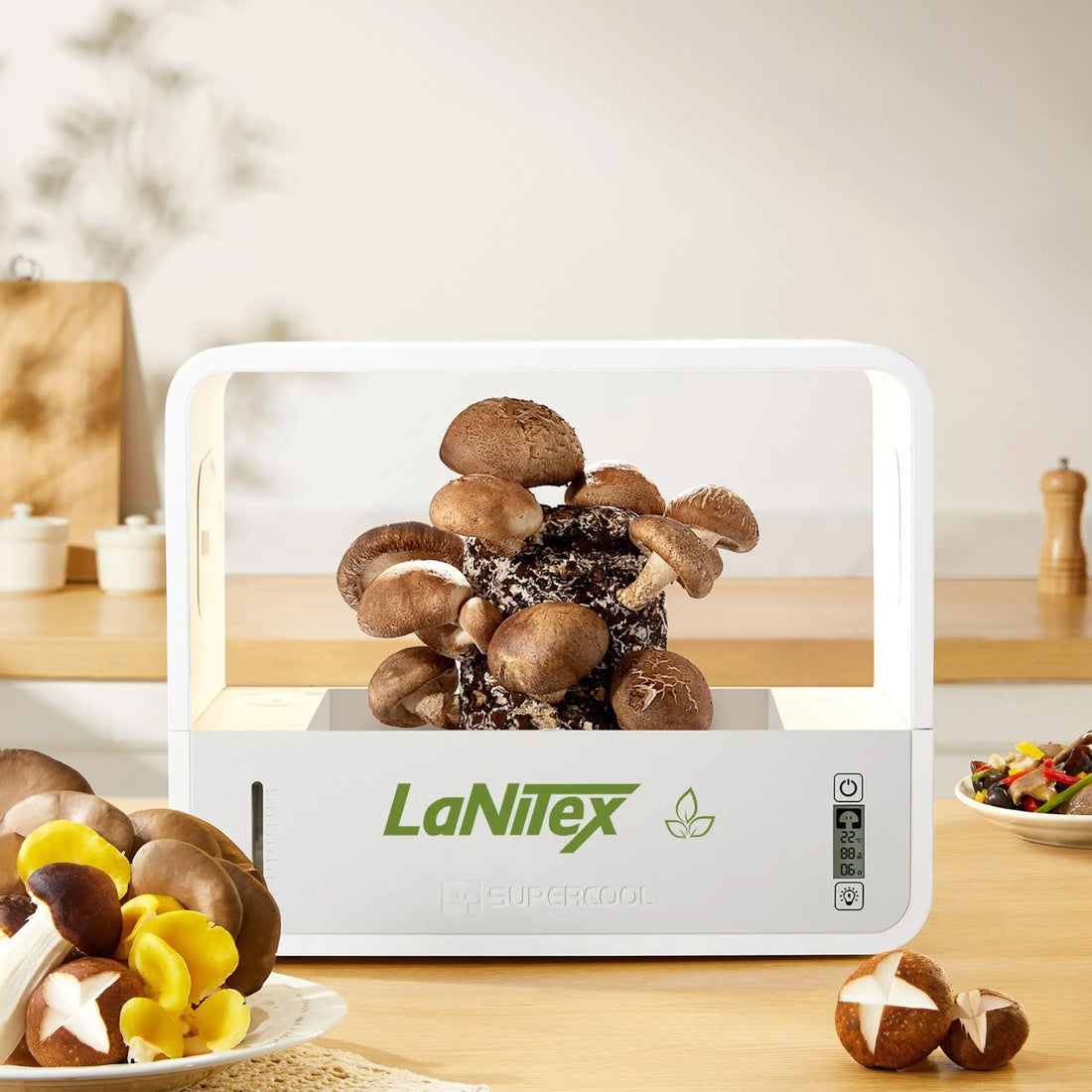
What the Box handles is the part beginners struggle with. It holds humidity steady, runs a full-spectrum LED, and pulls in fresh air through a ventilated lid, so you are not misting by hand or guessing at air exchange. It does not heat or cool. You provide the temperature by choosing the room; the Box provides the stable, humid, well-lit chamber that pearls need to fruit cleanly.
Getting pearl oyster mushrooms to fruit comes down to two things: keeping them in the right temperature range (around 15-24C (with best caps at 12-18C) - choose a room, cupboard or garage that naturally sits in that band) and holding humidity high and steady at 85% or higher. The Smart Mushroom Growing Box takes care of the hard part - its humidity control, LED lighting and clear lid hold the fruiting environment without daily misting or guesswork - while you simply place it somewhere in the right temperature range.

Want hands-off harvests? The Smart Mushroom Growing Box runs the humidity, fresh air and light for you — no daily misting. You supply the fruiting block.
Start growing mushrooms →Ships from the Sunshine Coast, Queensland.
Step by step: from spawn to harvest
Knowing how to grow pearl oyster mushrooms indoors in Australia is really just following seven stages in order and keeping things clean. This sequence is the core of every pearl oyster mushroom growing guide and every pearl oyster mushroom cultivation guide Australia, whether you work from a bag, a bucket, or a Box.
Spawn run
Start with grain spawn: cooked grain already colonised with pearl oyster mycelium. Pearl oyster mushroom spawn is the living seed of the grow, so its quality matters more than anything else you buy. Look for firm, white, sweet-smelling grain with no green or grey patches.
Substrate prep
The best substrate for pearl oyster mushrooms is pasteurised wheat or barley straw, though pearls are not fussy. Sugarcane mulch, eucalypt or other hardwood sawdust, a bran-boosted Master's Mix, and spent coffee grounds all work. Pasteurise straw in hot water at about 65 to 75 C for an hour, then drain to a damp-not-dripping squeeze. One caveat on the richer mixes: straw and sugarcane mulch only need pasteurising, but a bran-boosted Master's Mix is far more nutritious and contaminates easily, so it needs full sterilising - for example in a pressure cooker - rather than a hot-water soak. Avoid resinous softwoods like pine.
Coffee grounds are free and nutritious, but they spoil fast in a warm, humid Australian kitchen. Mix them with straw or sawdust rather than using 100 percent coffee, pasteurise the blend, and use them fresh the same day.
Inoculation
Mix spawn through the cooled, drained substrate at roughly one part spawn to five parts substrate. Work with clean hands and clean surfaces. Pack the mix into a filter-patch grow bag or a bucket with a few small holes.
Colonisation
Now the mycelium spreads. Keep the sealed block dark and roughly room temperature while white threads knit through the substrate. In oyster trials, full colonisation has been recorded in around 13 to 18 days. Do not open the bag yet, and do not panic at faint bread-like smells, which are normal.
Pinning
When the block is solid white, it is ready to fruit. Expose it to fresh air and light: cut a slit or open the top, move it into 85 percent or higher humidity, and give it indirect daylight. Tiny pin-sized mushrooms appear within a few days. Fresh air becomes critical here.
Fruiting
Pins swell into clusters fast, often doubling each day. Hold humidity high, keep CO2 under about 1,000 ppm with regular fresh air, and keep the room in that 12 to 18 C sweet spot. Too little air or humidity is what produces long stems and small caps.
Harvest
Twist or cut the whole cluster away when the caps have widened but the edges are still curled slightly under. A single bag typically gives about three flushes. According to cultivation research in the journal Mycobiology, oyster blocks where "three flushes were harvested" reached a first harvest in roughly 22 to 29 days at a biological efficiency of about 150 to 238 percent - the weight of fresh mushrooms as a percentage of the dry substrate - which worked out to roughly 1.1 to 2 kg per bag across the three flushes.
To coax out those later flushes, rest the block for a few days after the first harvest, then soak it in cool water for several hours or overnight to rehydrate it and return it to the same fruiting conditions. A second flush usually follows in about one to two weeks, and a block often keeps cropping over several weeks before it is spent. Trim away any leftover stem bases between flushes so they do not rot and invite mould. When a block finally stops fruiting, the spent substrate is not waste - break it into the compost or dig it through the garden as a free soil conditioner.
Clean hands at inoculation do more for your harvest than any gadget. Contamination is the one thing that ends a grow before it starts.
Sourcing pearl spawn in Australia
Buy pearl oyster spawn from a reputable Australian mushroom spawn supplier. Look for viable, clearly dated grain spawn, a species range, cold-chain shipping in warmer months, and genuine reviews. Never import spawn into Australia: it is a biosecurity risk and a quarantine breach. If a block goes badly contaminated, bag it and bin it, or hot-compost it well away from the kitchen. Never dump spent or mouldy blocks in waterways or bushland.
Common pearl oyster problems and how to fix them
Most pearl oyster problems trace back to air, humidity, or hygiene, and most are fixable. This table covers the issues beginners hit most often.
| Symptom | Likely cause | Fix |
|---|---|---|
| Long stems, tiny caps | Too much CO2, not enough fresh air | Increase ventilation; move to a brighter, airier spot |
| Dry, cracked cap edges | Humidity too low | Raise humidity to 85% or higher; mist the air, not the mushrooms |
| Green dust or patches on the block | Trichoderma mould contamination | Discard the block; improve hygiene and pasteurisation next time |
| Sour smell, slimy or sticky surface | Bacterial contamination, often too wet | Discard; drain substrate better and keep surfaces clean |
| No pins after weeks of white block | Not enough fresh air or light at pinning | Open the block; add indirect light and air exchange |
A word on safety. Cultivated pearl oysters grown from known spawn are safe to eat once cooked. Discard any block that is heavily mouldy or smells foul, and never eat unknown mushrooms fruiting on a contaminated block. Harvest before the caps drop heavy spore, and keep the area ventilated, since dense spore clouds can irritate sensitive airways. A minority of people develop an allergy or hay-fever-like reaction to repeated spore exposure, so it pays to harvest before heavy spore drop, keep the room ventilated, and wear a simple dust mask at harvest if you are sensitive or growing in any volume.
If this is your first grow, the good news is that pearl oyster mushrooms are one of the most forgiving species to start with - and a controlled environment makes them more forgiving still. The Smart Mushroom Growing Box takes the two hardest variables for a beginner - humidity and light - and manages them for you, so your first flush is far more likely to succeed. When it is done, you reset it and grow again, rather than binning a single-use kit.
A pearl oyster grown from clean spawn in clean conditions is safe to eat once cooked. A foul-smelling or heavily mouldy block is not. When in doubt, bin it.

Cooking and storing pearl oysters
Always cook pearl oyster mushrooms; they are not eaten raw. A hard sear or saute of 5 to 10 minutes firms the texture, drives off excess water, and concentrates the savoury flavour. Pearls drink up oil, butter, and sauce, so go easy on the fat at the start and season near the end. They suit a hot pan, a stir-fry, or a tear-and-roast tray more than a gentle simmer.
Store fresh pearls in the fridge, where they keep for about 7 to 14 days. Keep them in a paper bag or a container lined with paper towel, not sealed wet in plastic. Trapped condensation turns oysters slimy within a couple of days, so let them breathe and keep them dry. For longer storage, pearls dry well: slice them, dry them in a dehydrator or a low oven until they are cracker-dry and snap cleanly, then keep them in an airtight jar for months and rehydrate the slices in warm water for fifteen to twenty minutes before cooking.
Grow gourmet at home
Grow gourmet pearl oyster mushrooms on your own kitchen bench — the Box holds the humidity, fresh-air cycle and light steady while you place it somewhere cool. You add the fruiting block.
Grow your own mushrooms →Ships from the Sunshine Coast, Queensland.
Pearl oyster mushroom FAQ
What does pearl oyster mushroom (Pleurotus ostreatus) taste like?
Pearl oyster mushrooms have a mild, savoury flavour often described as delicately umami, with a subtle anise or seafood-like note when sauteed for 5 to 10 minutes. Their texture is firm yet tender, and the caps stay pleasantly chewy rather than slimy when cooked. They readily absorb sauces, oils and seasonings, so even 1 to 2 percent salt or soy in a dish noticeably boosts their flavour.
How long do pearl oyster mushrooms take to grow from inoculation to harvest?
Pearl oyster mushrooms typically need about three to five weeks from inoculation to first harvest on fast substrates like straw or coffee grounds. Home growers often see visible mycelium within the first week, pinning within two to three weeks, and harvestable clusters two to three days after pins form. Cultivation research on oyster blocks records a first harvest in roughly 22 to 29 days under good conditions.
What temperature do pearl oyster mushrooms (Pleurotus ostreatus) need to fruit?
Pearl oyster mushrooms form their best caps when the room around them sits at 12 to 18 C. They still fruit in warmer Australian homes, up to about 24 to 27 C, but above 18 C the mushrooms grow faster, smaller and paler. The temperature is set by the room you choose, not by the growing equipment, so pick a spot that naturally sits in the right band.
Can pearl oyster mushrooms grow successfully in Australia?
Pearl oyster mushrooms grow very successfully in Australia, where home growers use bags, buckets and Boxes across temperate and subtropical regions. The country's moderate climate and easy access to straw and hardwood suit this species well. In tropical zones, fruit them in the coolest room or favour warm-weather strains during the wet season.
What is the difference between pearl oyster mushrooms and other oyster varieties?
Pearl oyster mushrooms (Pleurotus ostreatus) are a temperate, grey-to-off-white type that fruits best around 12 to 18 C. Pink and yellow oysters prefer warmer conditions and show bright cap colours, while blue oyster strains favour cooler temperatures. Pearls are the standard oyster for Australian grow-bags and kits, whereas king oysters (P. eryngii) form thick stems and prefer cooler fruiting.
Are pearl oyster mushrooms easy to grow for beginners?
Pearl oyster mushrooms are considered one of the easiest species for beginners, needing only basic hygiene, hydration and ventilation. Simple bag, bucket or Box methods using pasteurised straw, sawdust or coffee grounds work well. Their fast colonisation, forgiving temperature band and reliable flushes in small indoor spaces make them a popular starter mushroom.
How do you store fresh pearl oyster mushrooms?
Fresh pearl oyster mushrooms store best in the fridge in a paper bag or a container lined with paper towel. Kept cool and protected from drying airflows, they last about 7 to 14 days. Avoid sealing them wet in airtight plastic, as trapped condensation encourages sliminess and spoilage within a couple of days.
What substrate is best for growing pearl oyster mushrooms?
Pearl oyster mushrooms grow vigorously on pasteurised straw, hardwood sawdust, sugarcane mulch, or mixes that include paper and spent coffee grounds. Straw is the easy starter substrate; a bran-boosted hardwood Master's Mix gives denser fruiting. Whatever you choose, pasteurise it and keep it damp but not dripping for strong colonisation.
Ready to grow pearl oysters at home?
Related mushroom guides
- Blue oyster mushrooms — a cool-tolerant oyster
- Pink oyster mushrooms — a vivid warm-climate oyster
- Phoenix oyster mushrooms — a fast warm-season oyster
About the author
Laszlo Bulatko is the founder of LaNiTex Hydro Garden, a Sunshine Coast small business making indoor growing simple for Australian households. After fifteen years in sales and brand development, Laszlo now tests every system LaNiTex stocks before it reaches the catalogue - from hydroponic herb gardens to the Smart Mushroom Growing Box - and shares what actually works for growers in Australian conditions.
Sources
- Mycobiology (2024). Growth and yield of Pleurotus ostreatus on mixed substrates, recording that "three flushes were harvested", with colonisation around 13 to 18 days, first harvest around 22 to 29 days, and a biological efficiency of about 150 to 238 percent (roughly 1.1 to 2 kg of fresh mushrooms per bag). https://pmc.ncbi.nlm.nih.gov/articles/PMC11749117/
- Mycobiology (2015). Nutritional and cropping study of Pleurotus species, noting that "temperature was maintained at 24C and kept at related humidity about 90% or above", and that "Protein of mushrooms PO ... ranged between 19.52~29.70%" on a dry weight basis. https://pmc.ncbi.nlm.nih.gov/articles/PMC4731647/