
Reading time: about 10 minutes
The coral tooth mushroom grows as a white, repeatedly branched body covered in soft hanging spines, and much of the "Australian lion's mane" sold here is really this native species under another name.
Quick answer: Coral tooth mushroom (Hericium coralloides) is an edible, white, coral-like native fungus that fruits best in a cool room around 12-20C with humidity near 85-95%. It takes roughly four to eight weeks from inoculation to the first harvest, and a home block gives several flushes.
Key takeaways:
- Coral tooth mushroom (Hericium coralloides) fruits best in a cool 12-20C room with high humidity around 85-95%, which suits an indoor grow across much of Australia.
- It is the native branched Hericium, so a lot of what people call "Australian lion's mane" is actually coral tooth, not the imported pom-pom lion's mane (Hericium erinaceus). Check the scientific name.
- The delicate teeth brown and dry quickly in low humidity or under direct airflow, so steady moisture and gentle, indirect fresh air are the make-or-break.
- Growers report roughly 200 to 400 grams per home block over two to three flushes, with a seafood-like, crab or lobster flavour.
- You source spawn from a reputable Australian mushroom spawn supplier; LaNiTex supplies the reusable hardware, not the spawn.
This guide is for: Intermediate growers.
At a glance
- Species: Hericium coralloides (also sold as snowflake mushroom or comb tooth mushroom)
- Climate: Cool, 12-20C (this is the room you provide, not a Box setting)
- Humidity: 85-95%
- Substrate: Supplemented hardwood sawdust or a Master's Mix block, sterilised
- Difficulty: Intermediate (the fine teeth are fussier than oysters)
- Time to first harvest: about four to eight weeks
- Yield: roughly 200-400 g over two to three flushes

What is coral tooth mushroom?
Coral tooth mushroom is an edible saprobic fungus that forms a white, repeatedly branched body with rows of soft hanging spines, looking much like a piece of sea coral. A single cluster runs roughly 7 to 35 cm across. It grows on dead hardwood, digesting the lignin and cellulose in the timber, which is why cultivators grow it on hardwood sawdust rather than straw.
The species sits in the genus Hericium, the same toothed-mushroom group as lion's mane. Its spines hang under many long branches and stay under about 1 cm long, which is the quickest way to tell it apart from lion's mane. Wild and home-grown specimens are bright white when fresh, then drift to creamy-white, buff, or a yellowish tan as they age. That colour shift matters in the kitchen, since the firm white stage is the one worth eating.
Australian growers and suppliers also sell it as the snowflake mushroom, while the names comb tooth mushroom and coral fungus turn up in older guides. They all point to the same fungus, Hericium coralloides.
Why grow coral tooth at home?
Coral tooth is rare on shop shelves, so growing your own is often the only way to cook with it fresh. Growers describe the flavour as delicate and seafood-like, frequently compared to crab or lobster, with a tender texture when the mushroom is young. For a home cook chasing something beyond the supermarket button mushroom, that is the draw.
There is a second pull for the wellness-curious crowd. Coral tooth is a close native cousin of lion's mane, and a 2025 peer-reviewed paper in the Journal of Fungi looked specifically at domesticating and analysing Hericium coralloides, including its antioxidant compounds. Research is investigating the Hericium group for these bioactive compounds, though the work is early and lion's mane is far better studied than coral tooth. Treat it as a fresh native gourmet mushroom you can grow and identify yourself, not a health product.
The "Australian lion's mane" truth, and growing coral tooth in Australian climates
Here is where the naming gets slippery, and it is worth getting right before you buy spawn. Coral tooth is Hericium coralloides, the branched, coral-like native. True lion's mane is Hericium erinaceus, the imported species that forms a single rounded pom-pom. A lot of the "Australian lion's mane" or "Australian native lion's mane" you see online is actually the native coral tooth, not erinaceus. Both are edible Hericium species, but only erinaceus is the one behind most published lion's mane research. The practical rule is simple. Check the scientific name on any label, kit, or bag of spawn. If it reads Hericium coralloides, that is coral tooth.
On native status, be precise rather than sweeping. Coral tooth occurs in Australia and is also found in other parts of the world, so the species is globally distributed rather than uniquely ours. Australian commercial strains, often branded "snowflake" or triplet falls coral tooth, are typically cloned from wild fruit bodies collected in Otway National Park in Victoria. Coral tooth is openly grown and sold here from that local material, which is what gives it its honest native-provenance story. It is not, on the evidence to hand, a definitively listed federally endemic species, so it is fair to say it is native to and grown in Australia without overclaiming.
Honest disclosure (intro only, the rest of this guide stays third-person): Coral Tooth (Hericium coralloides) isn't yet a species we've fruited on the LaNiTex test bench on the Sunshine Coast. The Smart Mushroom Growing Box and the faster, more forgiving species came first. The guidance below is built from cultivation science and grow-guide literature, Australian educator and native-species pages on the coral-tooth-versus-lion's-mane question, taxonomy references, and feedback from LaNiTex customers running the Box across QLD, NSW, VIC and TAS. As Coral Tooth lands on our own bench, this guide will refresh with first-hand Sunshine Coast observations.
Climate is the next big lever. Coral tooth fruits best in a cool window of about 12-20C, the band Australian suppliers most often quote for the native strains, though some sources cite warmer fruiting up to roughly 24C in milder conditions. Push much past that and it struggles: in a warm room it tends to fruit poorly or abort, and the quality falls away, which is the main reason warm-climate growers move it into a cool indoor room rather than fight the weather. That coral tooth fruiting temperature decides where and how it grows. Southern regions such as Melbourne, Hobart, and much of Victoria and Tasmania suit it outdoors for a long part of the year, especially through autumn and winter. Humid-subtropical Brisbane and tropical Darwin are harder outdoors and call for an indoor grow in a cool room or a spare space that holds that temperature, where a reusable mushroom growing kit earns its place over a one-off block. LaNiTex also has a dedicated lion's mane guide for the imported cousin, if you want to compare the two side by side.
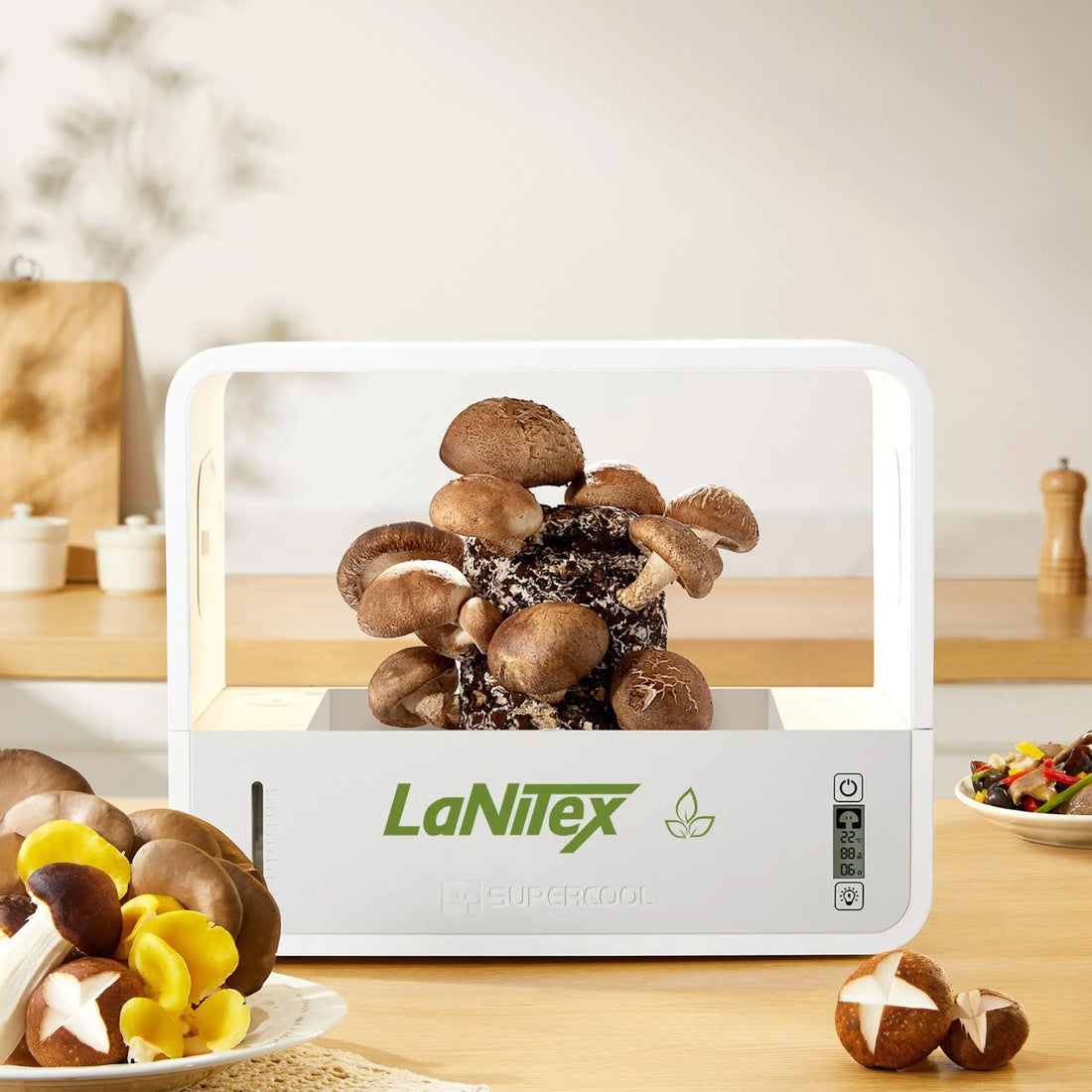
Restaurant kitchens pay a premium for coral tooth mushrooms because they are tricky to get right. They need stable humidity and clean air exchange to form properly. The Smart Mushroom Growing Box gives you that same controlled environment on your kitchen bench: humidity control, LED lighting and a clear lid so you can watch every stage. Add your spawn, keep it in the right temperature range of 12-20C, and you are growing chef-grade mushrooms at home.
One point to be clear on. The Box looks after humidity, LED light and gentle fresh-air exchange, and gives the mushroom a ventilated, lidded chamber. Temperature stays your job. You place the Box in a room that naturally sits in the 12-20C band, and the daily misting falls away. If you are new to home cultivation, the broader complete Australian guide to mushroom growing covers the basics that apply to every species before you specialise in coral tooth.

Want hands-off harvests? The Smart Mushroom Growing Box runs the humidity, fresh air and light for you — no daily misting. You supply the fruiting block.
Start growing mushrooms →Ships from the Sunshine Coast, Queensland.
Step-by-step: from spawn to harvest
Coral tooth follows the same broad arc as other gourmet mushrooms, spawn run through to harvest, but the fine spined fruit body is fussier about air and moisture than a forgiving oyster. If you have grown shiitake or shimeji before, the rhythm will feel familiar, though coral tooth wants cooler conditions and gentler air. The stages below match what the cultivation literature and Australian growers report.
1. Source your spawn
Start with fresh, viable spawn from a reputable Australian mushroom spawn supplier, sold as coral tooth mushroom spawn or snowflake spawn. Some suppliers also sell a ready-inoculated coral tooth mushroom grow kit, though spawn plus your own substrate gives you more control. Old spawn colonises slowly and loses ground to contamination, so buy spawn that arrives quickly and use it promptly. Coral tooth grows from grain or sawdust spawn, which carries the living mycelium into your substrate. A practical note for some states: certain suppliers cannot ship live spawn to Western Australia or Tasmania, so check whether a supplier can ship live spawn to your state before you order.
2. Prepare the substrate
Coral tooth is a wood-lover, so it wants a hardwood-based substrate. The standard recipe is supplemented hardwood sawdust with wheat bran, or a Master's Mix of hardwood sawdust and soy hull. The bran adds the nitrogen the mycelium needs to colonise quickly. The block must be sterilised first, and a ready-made supplemented block saves you that step.
3. Inoculate
Mix the spawn through the sterilised substrate, or inoculate a prepared block, keeping everything as clean as you can. Coral tooth is more sensitive to competitor moulds than oysters, so clean hands, clean tools and fresh spawn matter here.
4. Colonise
Hold the inoculated block while the white mycelium spreads through it, usually around two to three weeks. Colonisation runs a little warmer than fruiting, so a room around 20-24C suits the spreading mycelium; you only move the block into the cool 12-20C band once it is colonised, and that drop into the cool is part of what triggers pinning. This is a room temperature you choose, not a Box setting. Do not panic if the surface does not go fully, evenly white during colonisation, since patchy surface growth is normal for this species as long as the block is firming up. The block is ready to fruit once it feels solid through.
5. Pinning and fruiting
Move the block into fruiting conditions: the cool 12-20C band, humidity at 85-95%, gentle and indirect fresh air, and low, indirect light. Most home blocks are set to fruit from a single cut in the side of the bag rather than the top, and this side-fruiting is the more forgiving option, since it helps the delicate cluster hang and form cleanly. Small white nubs appear first, which are the pins. Over the following weeks these swell into the branched, coral-like cluster. Across colonisation and fruiting, expect roughly four to eight weeks from inoculation to the first harvest, depending on your conditions and strain. Sources vary on the exact timing, so treat it as a range, not a deadline.
If you are fruiting without a controlled chamber, the simplest way to hold that humidity is a loose tent: a clear bag or cover propped over the block with a gap left for airflow, misted as needed. It is fiddlier than a sealed box and you watch it more closely, but it stops the fine teeth drying out between mistings.
6. Harvest
Harvest the whole cluster while it is still white and firm, before the spines start to yellow or dry, since that is the point of best flavour and texture. Remove it cleanly at the base, either cutting flush to the block or twisting the cluster away, and clear any leftover stub or loose sawdust from the hole so that spot can flush again. A well-kept block gives two to three flushes, and growers report a total of roughly 200 to 400 grams from a home block across those flushes. Once a block finally stops flushing it is not waste: break it into a garden bed or compost as a soil conditioner, the way you would a spent oyster or shiitake block.
Harvest coral tooth while it is bright white and firm. Once the teeth tinge yellow, the texture and flavour are already past their best.
Get a fresh grow guide like this every fortnight
Join the LaNiTex Hydro Garden newsletter for practical hydroponic, microgreen and mushroom growing tips for Australian homes. Subscribe to download a free hydroponics starter guide (PDF) and get 10% off your first order.
Join the newsletter →Common problems and how to fix them
Most coral tooth setbacks trace back to a handful of causes, and almost all are fixable once you know the signs.
Teeth yellowing, browning or drying out
This is the make-or-break issue. The fine teeth brown and crisp when humidity drops too low, or when a draught or fan blows straight onto the fruit body. Hold humidity in the 85-95% band and keep the fresh air gentle and indirect, never a direct blast onto the mushroom. Do not let the cluster dry out.
Long, thin, leggy growth
Spindly, stretched growth points to stale, high-carbon-dioxide air and too little fresh-air exchange. Lift the fresh air once the block starts to pin, so the cluster forms a dense, branched body rather than reaching for oxygen.
Contamination or bacterial blotch
Slimy patches or off-colours usually mean wet surfaces and stale air. Keep the air clean and moving, work with clean tools, and avoid oversaturating the surface. Coral tooth wants high humidity, not standing water on the fruit. Warm or swinging temperatures make this worse, since they cause condensation that wets the surface and invites contamination, so a stable, cool room does double duty here.
Slow or no fruiting in a warm room
If a block sits for weeks without pinning, the room is likely too warm. Coral tooth needs that cool 12-20C trigger, so move it to a cooler spot rather than waiting it out in a warm kitchen.
Most of the problems above trace back to unstable conditions, humidity that swings and air that goes stale. A reusable system removes those variables: the Smart Mushroom Growing Box holds humidity and light steady and keeps the fruiting chamber ventilated, so contamination and dry-out have far less chance to take hold, flush after flush. (Temperature you manage simply by choosing a room in the right range, see above.) Unlike a one-off supermarket kit, it is built to be reset and grown again.

Cooking and storing coral tooth
Coral tooth is the seafood of the mushroom world, with a delicate flavour close to crab or lobster and a tender texture that firms up in a hot pan. The technique that gets the best from it is to dry-saute first. Tear or slice the white, firm cluster, then cook it in a dry pan with no oil for a few minutes to drive off its water. Once the moisture has gone, add butter or oil and pan-fry until lightly golden. From there it drops into risotto, pasta, soups and stir-fries, or stands alone as a seafood-style centrepiece. Always cook it while it is white and firm, since the aged, yellowing stage turns stringy.
Storage is simple. Keep fresh coral tooth unwashed in a paper bag in the fridge and use it within a few days, since the open spines lose moisture and discolour quickly. Avoid sealed plastic, which traps moisture and speeds the slide from white to yellow-brown. For longer storage, slice the mushroom and dehydrate it at a low heat until brittle, then store the dried pieces airtight in a cool, dark place. For coral tooth mushroom recipes and ideas on what to do with a flush, see the LaNiTex recipe collection.
Grow gourmet at home
Grow gourmet coral tooth mushrooms on your own kitchen bench — the Box holds the humidity, fresh-air cycle and light steady while you place it somewhere cool. You add the fruiting block.
Grow your own mushrooms →Ships from the Sunshine Coast, Queensland.
Coral tooth mushroom FAQ
What is Coral Tooth mushroom (Hericium coralloides)?
Coral tooth mushroom is an edible saprobic fungus that forms repeatedly branched, white clusters with soft hanging spines that resemble coral, typically 7 to 35 cm wide. It grows on dead hardwood, digesting the lignin and cellulose in the timber. The species sits in the genus Hericium, the same toothed group as lion's mane, and its fruiting bodies discolour to creamy or yellowish tones as they age.
Is Coral Tooth mushroom native to Australia?
Coral tooth mushroom occurs in Australia and is described by Australian growers and suppliers as a native species, while also being found in other parts of the world, so it is globally distributed rather than uniquely Australian. Commercial Australian strains are cloned from wild fruit bodies collected in Otway National Park, Victoria. It is openly grown and sold here, but it is not presented as a definitively listed federally endemic species, so the honest framing is \"native to and grown in Australia\".
How long do Coral Tooth mushrooms take to grow from inoculation to harvest?
Coral tooth blocks usually colonise in about two to three weeks, then fruit over the following weeks once moved into cool, humid conditions. In practice, home growers can expect roughly four to eight weeks from inoculation to the first harvest, depending on substrate, temperature, humidity and strain. Sources vary on exact timings, so treat it as a range rather than a fixed schedule.
What temperature does Coral Tooth need to fruit?
Coral tooth fruits best in a cool range of about 12-20C, which is the band Australian suppliers most often quote for the native strains. Some cultivation sources cite a slightly warmer tolerance up to around 24C in milder conditions. Across that range, holding humidity at 85-95% with gentle fresh air helps keep the teeth white and prevents the drying or yellowing that spoils flavour.
Can you grow Coral Tooth mushrooms in Australia?
Yes. You can grow coral tooth mushrooms in Australia on supplemented hardwood sawdust blocks or hardwood logs using grain spawn from an Australian supplier. Home growers report success indoors with stable humidity around 85-95% and a cool 12-20C fruiting room. Because the species occurs here and locally adapted strains are sold from Victorian wild stock, coral tooth is one of the more straightforward native gourmet mushrooms to source and grow at home.
How is Coral Tooth related to Lion's Mane?
Coral tooth and lion's mane are closely related species in the genus Hericium, both growing white, toothed fruiting bodies on dead hardwood. Coral tooth (Hericium coralloides) is the branched, native species, while true lion's mane (Hericium erinaceus) is the imported single pom-pom. Growers describe them as genetically similar, which is why much \"Australian lion's mane\" on sale is really coral tooth. Research investigating Hericium compounds covers both, though lion's mane is currently far better studied.
What does Coral Tooth taste like and how do you cook it?
Coral tooth has a delicate, seafood-like flavour that growers often compare to crab or lobster, with a tender texture when young. Harvest and cook it while still white and firm. The best method is to dry-saute the torn pieces in a dry pan to drive off water, then pan-fry in butter or oil until lightly golden. It works well in risotto, pasta, soups and stir-fries, and turns stringy if cooked past its firm white stage.
How do you store fresh Coral Tooth mushrooms?
Keep fresh coral tooth unwashed in a paper bag or breathable container in the fridge and use it within a few days, since the open spines lose moisture and discolour quickly. Avoid sealed plastic, which traps moisture and speeds the change from white to yellow-brown. For longer storage, slice the mushroom and dehydrate it at a low heat until brittle, then store the dried pieces airtight in a cool, dark place.
Ready to grow coral tooth at home?
Coral tooth is a rare, seafood-flavoured native mushroom, and growing your own is often the only way to cook with it fresh. If a first flush comes up well, the team would genuinely like to see it, so email the LaNiTex crew a photo, or browse the complete Australian mushroom growing guide for choosing a setup.
Related mushroom guides
- Lion's mane mushrooms — its close toothed-fungus relative
- Reishi mushrooms — another functional species
About the writer
About the author
Laszlo Bulatko is the founder of LaNiTex Hydro Garden, a Sunshine Coast small business making indoor growing simple for Australian households. After fifteen years in sales and brand development, Laszlo now tests every system LaNiTex stocks before it reaches the catalogue, from hydroponic herb gardens to the Smart Mushroom Growing Box, and shares what actually works for growers in Australian conditions.
Sources
- Milkwood, Hericium coralloides (coral tooth) mushrooms. Australian educator describing coral tooth as "native to AU, and lions mane isn't" and "genetically similar" to lion's mane.
- Field & Forest, Hericium: Lion's Mane, Coral Tooth, & Comb Tooth. Notes Coral Tooth spines under 1 cm hanging from many long branches versus the single knot of Lion's Mane, and advises harvesting "best picked before they get yellow".
- Wild Foods & Wilderness, Coral Tooth Mushroom. Morphology and colour: "White when fresh, becoming creamy-white to buff or yellowish-tan as it gets older."
- Zombie Mushrooms, Coral Tooth Fungus (Hericium coralloides). Cultivation conditions: fruiting around 18-24C, humidity 85-95%, colonisation in 2-4 weeks.
- Journal of Fungi, 2025, Domestication, Cultivation and Nutritional Analysis of Hericium coralloides. Peer-reviewed analysis of cultivating the species and its bioactive compounds.
Last updated: 01 June 2026