
Most people meet reishi as a capsule on a health-shop shelf, with no idea where it came from. Growing the conk yourself answers that question, and the species behind it in Australia is not the one the labels name.
Quick answer: You can grow reishi in Australia, but the species to grow is the native Ganoderma steyaertanum, which Australian suppliers stock as spawn; the classic Asian Ganoderma lucidum is biosecurity-regulated rather than freely available for home cultivation here. Source spawn from a reputable Australian supplier, fruit it warm at around 23-25 degrees C on sterilised hardwood sawdust at 85 percent humidity or higher, and expect 8 to 16 weeks from inoculation to your first glossy conk. High CO2 grows antler shapes; more fresh air grows flat caps.
Key takeaways
- The reishi most home growers cultivate in Australia is Ganoderma steyaertanum, a native bracket fungus that local suppliers stock as spawn. The classic Asian Ganoderma lucidum is biosecurity-regulated for live cultivation; its dried form is imported and sold mainly as a supplement.
- Reishi fruits warm and humid: aim for around 23-25 degrees C and 85 percent humidity or higher, on sterilised hardwood sawdust supplemented with 10 to 20 percent bran.
- It is slow. First harvest usually lands 60 to 90 days after inoculation, and a well-run block can yield several flushes over a few months.
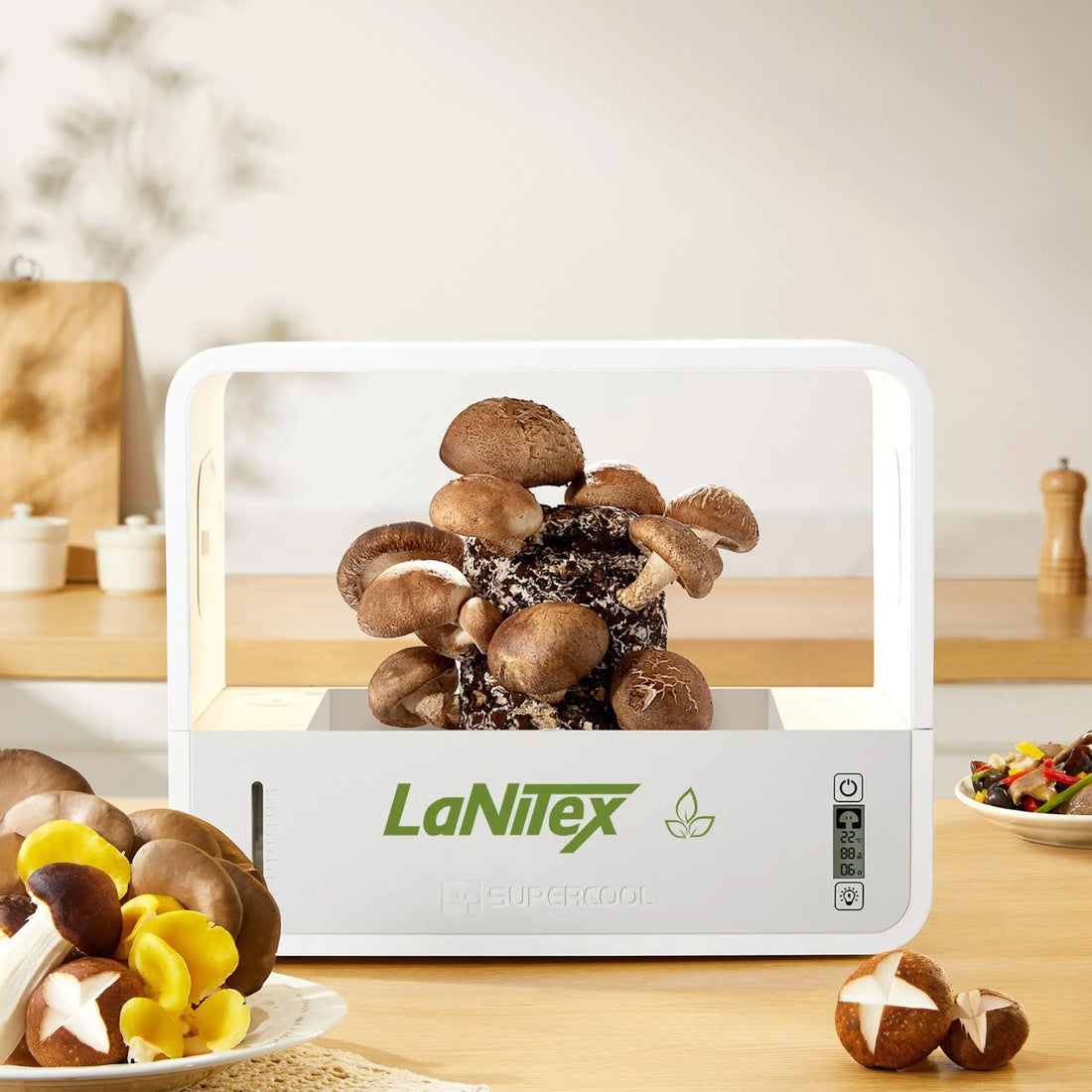
- The Smart Mushroom Growing Box holds the humidity, light and fresh air reishi needs; you choose a room that sits in the right temperature range.
At a glance
| Factor | Reishi (Ganoderma steyaertanum) |
|---|---|
| Species you can grow | Ganoderma steyaertanum (native, stocked by AU suppliers); Ganoderma lucidum biosecurity-regulated for live cultivation |
| Climate band | Warm and humid (subtropical suits it best) |
| Fruiting temperature (room) | About 23-25 degrees C (broad brochure band 18-35 degrees C; flag the high ceiling) |
| Fruiting humidity | 85 percent or higher (about 90 percent at pinning, 85-90 percent as conks form) |
| Substrate | Sterilised hardwood sawdust with 10-20 percent bran, or a Master's Mix |
| Difficulty | Intermediate (slow, but forgiving once colonised) |
| Time to first harvest | About 60-90 days from inoculation; 8-16 weeks all up |
| Yield | A few flushes from one block over several months; a slow, low-yield species grown for provenance and value, not volume |
What is reishi, and which species can you grow in Australia?
Reishi is a wood-loving bracket fungus, a shelf-shaped mushroom that rots hardwood and forms a hard, varnished, often kidney-shaped conk. Where it grows with limited air it instead throws up reddish antler-like columns. It is woody and corky rather than soft, so nobody fries it for dinner. People grow it for tea, extracts and the long traditional-use story behind it. You will see it sold under several names: red reishi, the Chinese ling zhi (sometimes written lingzhi), and simply reishi.
Here is the part most thin product pages skip. The famous reishi of East Asia is Ganoderma lucidum. In Australia it is regulated rather than banned: dried lucidum can be imported and reishi supplements sold under biosecurity and TGA conditions, but importing live lucidum cultures for cultivation requires a biosecurity permit. For live home cultivation, that points growers to the native species instead. What you can grow is the native analogue, Ganoderma steyaertanum, a Queensland bracket fungus sold by Australian suppliers as "native reishi" and regarded locally as a functional analogue. There is also a wild relative, Ganoderma chalceum, found in north-eastern New South Wales, though it is not the one you buy as spawn.
So when this guide says reishi, it means Ganoderma steyaertanum. The two species are both wood-loving, side-fruiting fungi that form varnished conks or high-CO2 antlers, but they differ genetically and in their exact range. Get the species right at the start and the rest of the grow makes sense.
Why grow reishi at home?
Reishi is the wellness mushroom most people buy and fewest people see whole. It sits in the functional group alongside lion's mane and maitake, and it has a long history of traditional use, brewed as a bitter tea or simmered into a decoction rather than eaten as food. Research has investigated its compounds too. A 2016 Cochrane systematic review of Ganoderma lucidum for cancer treatment concluded that the mushroom "could be administered as an alternative adjunct to conventional treatment in consideration of its potential of enhancing tumour response and stimulating host immunity". That is a research-and-traditional-use story, not a health claim, and the FAQ below returns to where the line sits.
The practical reason to grow your own is provenance. A commercial reishi mushroom supplement reaches you as a capsule or powder, often around 60 to 120 dollars a bottle, with little visibility of the species or where it was grown. Many bottles do not even name which Ganoderma species is inside. Grow the conk yourself and you know exactly what went into the jar, you control the drying, and a single block keeps producing for months. Reishi is slow and low-yield, so this is about provenance rather than volume: one colonised block gives a few flushes over its life, enough dried conk for many pots of tea before it is spent. University extension growers report about two flushes from a fruiting block over a season, and an outdoor log can keep fruiting for roughly a year for every inch of its diameter. Reishi rewards patience, not volume. For anyone who already takes reishi, that is a different relationship with the mushroom.
How does reishi grow in Australia?
A note on honesty first. LaNiTex has not yet grown reishi on its Sunshine Coast test bench. The guidance here draws on cultivation science, Australian spawn-supplier data for Ganoderma steyaertanum, university extension research, and the peer-reviewed studies cited in this guide. The Smart Mushroom Growing Box and the faster gourmet species came first; as reishi reaches the bench, this guide will update with first-hand observations.
Reishi is a warm, humid species, which is good news for much of Australia. Australian suppliers list incubation for Ganoderma steyaertanum at around 24 to 27 degrees C, then fruiting at around 23 to 25 degrees C. A supplier brochure gives a broader fruiting band of 18 to 35 degrees C, but treat the high end with caution. The reliable sweet spot is the low-to-mid twenties; sustained heat near the ceiling stresses the grow. Humidity sits high throughout: around 90 percent to trigger pinning, easing to 85 to 90 percent as the conks firm up.
Mapped onto the country, subtropical Queensland and northern New South Wales suit reishi open-ambient through the warmer months, which is one reason a native Queensland species took hold here. In cooler southern states you grow it indoors and pick a warm room, an airing cupboard or a heated space that holds the low twenties. Do not try to fruit reishi in a cold garage over winter in Melbourne or Hobart and expect a conk; the species simply stalls when it is too cold.
Getting reishi mushrooms to fruit comes down to two things: keeping them in the right temperature range (around 23-25 degrees C, so choose a room, cupboard or garage that naturally sits in that band) and holding humidity high and steady at 85 percent or higher. The Smart Mushroom Growing Box takes care of the hard part. Its humidity control, LED lighting and clear lid hold the fruiting environment without daily misting or guesswork, while you simply place it somewhere in the right temperature range.
One fact matters here. The Smart Mushroom Growing Box controls humidity, LED light and fresh-air exchange through its sensor, misting reservoir and ventilated clear lid. It does not control temperature. You provide the warm room; the Box holds the humidity and air that reishi needs while it fruits. For the wider picture on which species suits which setup, the complete Australian mushroom growing guide is the place to start.

Want hands-off harvests? The Smart Mushroom Growing Box runs the humidity, fresh air and light for you — no daily misting. You supply the fruiting block.
Start growing mushrooms →Ships from the Sunshine Coast, Queensland.
Step-by-step: from spawn to harvest
Growing reishi is a slow project measured in months, not a weekend job. Here is the full path from a bag of spawn to a dried conk.
Preparing the substrate
Reishi fruits on sterilised hardwood sawdust, the wood it would rot in the wild. The common recipe is hardwood sawdust supplemented with 10 to 20 percent bran, or a Master's Mix of hardwood sawdust and soy hull. Hydrate it to about 65 percent moisture: squeeze a handful and you want a few drops to run out, not a stream. Then sterilise it, because a slow species like reishi gives contaminants a long window if the substrate is not clean.
Sourcing spawn in Australia
Reishi starts with clean, viable spawn from a reputable Australian mushroom spawn supplier. LaNiTex sells the growing equipment, not spawn, so you source this separately. Confirm the species is listed as Ganoderma steyaertanum, the native reishi that Australian suppliers commonly stock. Because suppliers vary in how they label species, check the botanical name and the listed provenance rather than the marketing name alone. Look for grain spawn that arrives clean and cold, read recent reviews for viability, and check the supplier can ship live cultures to your state, as some quarantine rules restrict what crosses borders.
Inoculation
Mix the spawn into the sterilised substrate in the cleanest conditions you can manage, at roughly 10 to 20 percent spawn by weight. More spawn means a faster, more confident colonisation, which matters for a species this slow. Seal it into its grow bag or container and keep your hands, tools and surfaces clean throughout; this is the stage where contamination most often gets in.
Colonisation
Move the inoculated block somewhere warm and dark, around 24 to 27 degrees C, and leave it alone. White mycelium creeps through the substrate over several weeks, often four to six, sometimes longer. The block firms up and may develop pale lumps as it matures. Resist the urge to open it and check; a fully colonised block fruits far better than one disturbed early.
Pinning and primordia
Once the substrate is fully colonised, introduce the block to its fruiting conditions: the warm low-twenties room, high humidity near 90 percent, light, and fresh air. The mycelium responds by forming primordia, the small reddish-brown buds that become reishi. This is where the Box earns its place, holding the humidity and air steady while the pins form.
Fruiting: antlers or conks
Reishi gives you a choice of shape, and you control it with air. This is the fun part. In high CO2 with limited fresh air, such as a sealed bag, reishi grows tall reddish antler-like columns. With increased fresh air exchange it forms the flat, varnished bracket-shaped conks most people picture. Australian suppliers note exactly this: higher CO2 encourages antlers, more fresh air encourages conks. Antlers do not initially release spores, but if you shift the block to lower CO2 and more airflow, conks often develop on top and begin to drop spores. Temperatures around 23 to 25 degrees C suit both forms.
Reishi also wants light to colour up. Bright enough to read a book by is plenty, and it is what drives the deep, glossy red the conk is prized for; grown too dark, the caps stay pale and washed out. The Box's LED supplies this light directly, so the colour develops without a sunny windowsill.
Harvest
Harvest a conk when its pale, actively growing white edge has narrowed to under a centimetre and the cap has turned firm, glossy and fully coloured. That growing margin is your cue: a wide white rim means it is still bulking up. Cut at the base. Reishi is slow, so expect your first harvest around 60 to 90 days after inoculation, with the whole cycle running 8 to 16 weeks, and a well-managed block giving several flushes over a few months.
Growing reishi outdoors on buried blocks or logs in Australia
If you have a shady, humid corner outdoors, reishi also grows on buried hardwood logs or part-buried colonised blocks during the warm months. In Australia, proven hardwood hosts include eucalypts such as sugar gum (Eucalyptus cladocalyx) and Tasmanian blue gum (Eucalyptus globulus). University extension research notes that the outdoor log method is slower, often taking many months to over a year, but generally produces higher-quality mushrooms. Pick a spot out of direct sun, keep it damp, and let the warm season do the work. It is the low-maintenance route for growers with the patience and the space.
Common problems and how to fix them
Most reishi problems trace back to air, cleanliness or patience. Here are the ones growers hit most.
All antlers, no caps
If your reishi keeps growing tall reddish fingers and never forms a flat cap, the air is too still and the CO2 too high. This is the single most common reishi surprise. The fix is fresh air: open the chamber to more exchange, and the next growth often broadens into proper conks. Many growers deliberately grow antlers, so this is only a problem if caps are what you want.
Pale or washed-out conks
If your conks form but stay pale instead of deepening to that glossy red, they are almost always short on light. Reishi uses light as a cue to colour up, so a block tucked in a dark cupboard makes weak-coloured caps. Give it steady light bright enough to read by, which the Box's LED provides, and the colour follows.
Contamination
Green or black mould, or a sour smell, usually means contamination got in at inoculation or the substrate was not properly sterilised. Because reishi colonises slowly, it gives competing moulds a long head start. Start with clean spawn, work as cleanly as you can, and discard a heavily contaminated block rather than trying to rescue it.
Slow or no fruiting
Reishi is genuinely slow, so first be patient: weeks of nothing visible is normal during colonisation. If a fully colonised block still will not pin, the most likely cause is the room being too cool. Reishi wants the low twenties; a block sitting in a cold space stalls. Move it somewhere warmer and hold the humidity high, and pinning usually follows.
Drying and storage mistakes
The classic mistake is storing reishi that is not fully dry, which invites mould in the jar. Reishi must be dried until the pieces are hard and brittle, not merely leathery, before it goes into storage. Slicing thick conks before drying helps, as covered in the next section.
Most of the problems above trace back to unstable conditions: humidity that swings and air that goes stale. A reusable system removes those variables. The Smart Mushroom Growing Box holds humidity and light steady and keeps the fruiting chamber ventilated, so contamination and dry-out have far less chance to take hold, flush after flush. (Temperature you manage simply by choosing a room in the right range, as covered above.) Unlike a one-off supermarket kit, it is built to be reset and grown again.
How to use and store your reishi harvest

Set your expectations: reishi is not a table mushroom. It is bitter, woody and corky, so you do not slice it into a stir-fry. The traditional preparation is a tea or decoction. Slice 5 to 10 grams of fresh or dried reishi and simmer it in water for at least 60 minutes to draw out its compounds, then strain and drink the liquid. The long simmer is the point; reishi does not give up much in a quick steep.
For storage, dry it properly first. After harvesting firm, glossy conks before heavy spore drop, slice them into 2 to 5 millimetre strips so they dry evenly. Dry the slices in a well-ventilated, low-humidity spot or a food dehydrator at around 40 to 50 degrees C until they are hard and brittle and have lost most of their moisture. Stored airtight in a cool, dark place, dried reishi keeps for up to 12 months, ready for tea or extracts whenever you want it.
Grow gourmet at home
Grow your own reishi conks at home — the Box holds the humidity, fresh air and light steady while you provide a warm room. You add the fruiting block.
Grow your own mushrooms →Ships from the Sunshine Coast, Queensland.
Reishi mushroom FAQ
Can you grow reishi mushrooms (Ganoderma lucidum) in Australia?
Importing live Ganoderma lucidum cultures into Australia is biosecurity-regulated and requires a permit, so home growers typically cultivate the readily available native analogue Ganoderma steyaertanum instead. Dried lucidum and reishi supplements, by contrast, can be imported and sold under biosecurity and TGA conditions. Australian suppliers sell this native reishi as spawn and kits, listing incubation temperatures around 24-27 degrees C and fruiting around 23-25 degrees C, which suit many warm, humid Australian regions between about 18-30 degrees C. Outdoor logs or indoor supplemented sawdust blocks are both used.
Is it legal to grow and consume reishi mushrooms in Australia under TGA regulation?
Reishi (Ganoderma species) is treated in Australia as a food or listed-medicine ingredient, not a controlled drug, so growing and consuming your own mushrooms is generally legal when you are not making therapeutic claims or selling medicine-like products. Importing live Ganoderma lucidum cultures is biosecurity-regulated (a permit is required), while dried lucidum and reishi supplements can be imported and sold under those rules and the TGA; the native Ganoderma steyaertanum is readily available as spawn and kits from Australian suppliers. TGA rules instead regulate commercial reishi supplements and advertising.
What is the difference between Ganoderma lucidum and Ganoderma steyaertanum (Australian native reishi)?
Ganoderma lucidum is the classic reishi species used in East Asia; in Australia, importing its live cultures is biosecurity-regulated, while its dried form is imported and sold as a supplement. Ganoderma steyaertanum is a native Queensland bracket fungus regarded locally as a functional analogue and described as also considered medicinal. Both are wood-loving, side-fruiting species that form varnished conks or high-CO2 antlers, but they differ genetically and in exact morphology and habitat range. Research continues investigating their comparative chemistry.
How long does it take to grow reishi mushrooms from inoculation to harvest?
Reishi grows relatively slowly, typically taking around 8-16 weeks from inoculation to harvest on sawdust or blocks. Australian suppliers list incubation periods of roughly 4-6 weeks for Ganoderma steyaertanum before pinning at 18-24 degrees C, followed by several more weeks for conks to mature at 22-28 degrees C. Many home growers see first harvests around 60-90 days after inoculation, depending on substrate depth, temperature stability, and humidity.
Can you grow your own reishi mushrooms instead of buying capsules or supplements?
Australian home growers routinely cultivate reishi (especially Ganoderma steyaertanum) on sterilised hardwood sawdust supplemented with 10-20 percent bran, using spawn supplied domestically. Kits list ideal fruiting temperatures around 22-28 degrees C, well suited to many warm, humid Australian homes. Once dried, the mushrooms are commonly used in teas or extracts, reflecting traditional use and modern research investigating reishi as a functional ingredient, separate from regulated commercial capsules.
What does fresh reishi mushroom taste like?
Fresh reishi has a distinctly bitter, woody flavour and a tough, corky texture, so it is rarely eaten like a table mushroom. Guides recommend simmering 5-10 g of sliced fresh or dried reishi in water for at least 60 minutes to extract its compounds for tea or decoctions, reflecting traditional preparation methods.
Why is my reishi mushroom growing into antler shapes instead of forming caps?
Reishi forms antler-like columns when grown in high CO2 with limited fresh air exchange, such as sealed bags or tubs. Australian spawn suppliers note that higher CO2 levels encourage antlers, while increased fresh air leads to bracket-like conk caps. Antlers do not initially produce spores, but if the environment shifts to lower CO2 and more airflow, conks often develop on top and begin spore release. Temperatures around 23-25 degrees C still suit both forms.
How do you properly dry reishi mushrooms after harvest for storage?
Reishi is usually dried until pieces are hard and brittle, then stored for up to 12 months in airtight containers in a cool, dark place. After harvesting firm, glossy conks before heavy spore drop, growers typically slice them into 2-5 mm strips and dry them in well-ventilated, low-humidity conditions or a food dehydrator around 40-50 degrees C until moisture loss exceeds about 90 percent. Dried slices are then used for teas or extracts.
What is reishi mushroom good for?
Reishi has a long history of traditional use rather than proven medical benefits. In East Asian medicine it was taken as a tonic and brewed as a bitter tea or decoction for general wellbeing, calm and immune support. Modern research is still investigating its compounds, such as beta-glucans and triterpenes. A 2016 Cochrane review found Ganoderma lucidum may help as an adjunct alongside conventional cancer treatment while concluding more research is needed, and it is not a standalone treatment; randomised trials have not supported reishi for reducing cardiovascular risk. This is general information about traditional use and ongoing research, not medical advice. Most home growers value reishi for provenance: knowing exactly what goes into the tea they brew.
How do you make reishi tea?
Reishi is too woody and bitter to eat, so it is traditionally prepared as a simmered tea or decoction rather than a quick steep. To make reishi tea, slice 5 to 10 grams of dried or fresh reishi, add it to water, and simmer gently for at least 60 minutes to draw out its compounds, then strain and drink the liquid. You can re-simmer the same slices for a second, weaker batch. Home growers brew tea from conks they have dried themselves.
Can you eat or cook with reishi mushrooms?
Reishi is not a culinary mushroom. Unlike oyster or shiitake, it is hard, woody and intensely bitter, so it is not sliced into stir-fries or fried like a table mushroom. Instead it is simmered into a tea or decoction, or processed into powders and extracts, to draw out its compounds. If you grow your own, the usual path is to dry the conks and brew them. There are no standard reishi dinner recipes; think teapot, not frying pan.
Where can you buy reishi in Australia?
Importing live Ganoderma lucidum cultures into Australia is biosecurity-regulated, so it is not a typical over-the-counter spawn purchase. To grow your own, source spawn of the native Ganoderma steyaertanum from a reputable Australian mushroom spawn supplier, then fruit it at home. LaNiTex sells the growing equipment, not spawn or supplements: the Smart Mushroom Growing Box holds the humidity, light and fresh air reishi needs while you provide a warm room. Dried reishi and reishi supplements are sold separately by health-food retailers.
Are reishi mushrooms safe? Side effects and who should avoid them
Reishi is widely consumed as a tea or supplement and is generally well tolerated, but it is not risk-free. Reported side effects include nausea and trouble sleeping, and rare cases of liver injury have been linked mainly to long-term use of powdered reishi products. Reishi may increase the risk of bleeding, so it can interact with blood-thinning (anticoagulant) and antiplatelet medicines, and it may not suit people taking immunosuppressant drugs. Because there is not enough safety data in pregnancy and breastfeeding, those groups are usually advised to avoid it, and health sources suggest stopping reishi at least two weeks before surgery. If you take any medication or have a health condition, check with your doctor first. This is general information, not medical advice.
Ready to grow reishi at home?
Reishi rewards patience and the right species. Get Ganoderma steyaertanum from an Australian supplier, fruit it warm at around 23 to 25 degrees C and humid at 85 percent or higher, give it fresh air for conks, and you can grow reishi mushrooms at home in Australia that go straight from your bench to your teapot.
Have a question about growing reishi in your part of the country? Email us; we read every message. And if you are weighing up which species to start with, the complete Australian mushroom growing guide compares the lot.
Related mushroom guides
- Lion's mane mushrooms — a popular functional mushroom
- Maitake mushrooms — another prized functional species
- King oyster mushrooms — a meaty gourmet species
- Chestnut mushrooms — a nutty gourmet species
- Shimeji mushrooms — a clustered gourmet species
About the writer
About the author
Laszlo Bulatko is the founder of LaNiTex Hydro Garden, a Sunshine Coast small business making indoor growing simple for Australian households. After fifteen years in sales and brand development, Laszlo now tests every system LaNiTex stocks before it reaches the catalogue, from hydroponic herb gardens to the Smart Mushroom Growing Box, and shares what actually works for growers in Australian conditions.
Sources
- Jin X, Ruiz Beguerie J, Sze DM-Y, Chan GCF (2016), Ganoderma lucidum (Reishi mushroom) for cancer treatment, Cochrane Database of Systematic Reviews. A peer-reviewed systematic review, cited here for the research context around reishi compounds, not as evidence of any health benefit or as medical advice.
- University extension research on Ganoderma cultivation methodology (Oregon State University Extension, EM 9364, 2022). Cited for cultivation method only, including sawdust-and-bran block preparation, colonisation timing, and the outdoor log method; the US species names in that source differ from the Australian native Ganoderma steyaertanum described in this guide.
- Australian mushroom spawn-supplier cultivation data for Ganoderma steyaertanum (native reishi), covering incubation and fruiting temperatures, humidity, the CO2-driven antler-versus-conk response, and the legal status of Ganoderma lucidum in Australia.