
This guide is for: Beginners
Here is the seasonal surprise most growing guides miss: there is a pure-white gourmet oyster that crops happily in the cold, just as the rest of the mushroom patch slows down for winter. Hardly anyone explains that it is simply the cool-loving sibling of the warm white oyster.
Quick answer: A snow white oyster mushroom is the cool-season strain of Pleurotus ostreatus that fruits best at 14 to 22C, so in Australia it grows well in the autumn-winter months or in a cool indoor room. It is the same species as the warm white oyster, separated only by the temperature it prefers.
At a glance
Climate:               Cool-season white oyster (the winter-strain Pleurotus ostreatus)
Fruiting temperature:  14-22C (best 15-18C) - the ROOM, not a Box setting
Humidity:              85-95% during fruiting
Substrate:             Pasteurised straw or hardwood sawdust (also sugarcane mulch, paper pellets + coffee grounds)
Time to first harvest: About 3-4 weeks (colonisation 14-21 days, then pins 5-7 days)
Difficulty:            Beginner-friendly (rewards steady humidity + fresh air)
Key takeaways
- Snow white oyster is the cool-season strain of Pleurotus ostreatus; warm white is the same species tuned for heat.
- It fruits best between 14 and 22C, so it suits the cooler Australian months and cooler southern regions.
- The grower picks a room in that temperature band; the equipment holds humidity, light and fresh air, not the temperature.
- First harvest lands in roughly 3 to 4 weeks, and a rested block usually gives a second and third flush.
- Cook it, never eat it raw, and store it loose in the fridge rather than sealed in plastic.
What is a snow white oyster mushroom?
A snow white oyster mushroom is a cool-season strain of Pleurotus ostreatus that produces clusters of pure-white, fan-shaped caps on a short stem. It is prized in the kitchen for a mild, tender bite and a clean white look on the plate. Growers also call it the winter white or snow white strain, and treat it as a cool-season oyster mushroom, because it pins and fruits in cooler conditions that would slow a warm-weather oyster right down.
Snow white is a strain, not a separate species. It is the same Pleurotus ostreatus sold as the common white or pearl oyster, selected over time to crop reliably in the cold. That single fact changes how an Australian grower should treat it: not as an exotic mushroom with special needs, but as a familiar oyster that simply wants a cooler room than its summer cousin.
A note on honesty before going further. LaNiTex hasn't yet fruited the cool snow-white strain on its own Sunshine Coast test bench - this guide draws on cultivation science (including peer-reviewed strain-temperature research), Australian cool-climate oyster-growing guidance, and feedback from LaNiTex customers running the Box across QLD, NSW, VIC and TAS.
Snow white vs warm white oyster: same species, opposite seasons
Snow white and warm white oyster mushrooms are usually sold as the same species, Pleurotus ostreatus, and are best told apart by the temperature they prefer rather than by how they look. Commercial naming isn't fully standardised, so use the temperature preference as your guide. Snow white is the cool strain, fruiting best at roughly 14 to 22C. Warm white is the heat-tolerant strain, happiest around 20 to 30C and growing faster in subtropical or summer conditions. Both throw white caps, which is exactly why the two get muddled on labels and in shops.
| Feature | Snow white oyster | Warm white oyster |
|---|---|---|
| Strain | Cool-season Pleurotus ostreatus | Heat-tolerant Pleurotus ostreatus |
| Best fruiting temp | 14-22C (sweet spot 15-18C) | 20-30C |
| Best AU season | Autumn-winter / cool indoor room | Spring-summer / warm room |
| Cap colour | Pure white | White |
That temperature split is not just a marketing label. A 2017 study in BioResources grew nineteen oyster strains indoors and reported that different Pleurotus ostreatus strains are adapted to lower (winter, around 11C) versus higher (summer, around 26C) cultivation temperatures. In plain terms, the species has cool-season and warm-season versions, and snow white sits at the cool end. Picking the strain that matches the room is the difference between a block that pins on schedule and one that just sits there.
You will also see warm white, pearl and blue oysters sold alongside snow white. They are close relatives, but pearl and warm white lean warmer and blue oyster sits in a moderate band of its own. For a cool Australian winter room, the snow white strain is the one that earns its keep. For more on how the whole oyster family fits together, the complete Australian mushroom growing guide maps the varieties side by side.
Growing snow white oysters in Australian climates
Snow white oysters fruit best between 14 and 22C, with a sweet spot around 15 to 18C and humidity held at 85 to 95 per cent. Because Australia runs its cool season from autumn through winter, the calendar matters as much as the location. Melbourne, Hobart, Adelaide, Canberra and the regional parts of Victoria and Tasmania often sit naturally in that band through the cooler months, so a spare room or garage will do the work on its own.
Warmer zones need a little more thought. Brisbane, Sydney and Perth growers are better off running snow white in winter, or year-round in the coolest indoor spot they have - a tiled bathroom, a room on the shaded side of the house, or a space under the house. Darwin's tropical climate is harder again: expect to use an air-conditioned or actively cooled room rather than relying on the seasons. On the Sunshine Coast and across subtropical Queensland, the practical window is late autumn through winter, or the coolest indoor room at any time of year. A Brisbane grower chasing a midsummer crop will struggle unless the room is genuinely cooled.
One rule sits underneath all of this. The grower chooses the room that holds the right temperature; the equipment does not cool the air. That distinction shapes how the kit fits in.
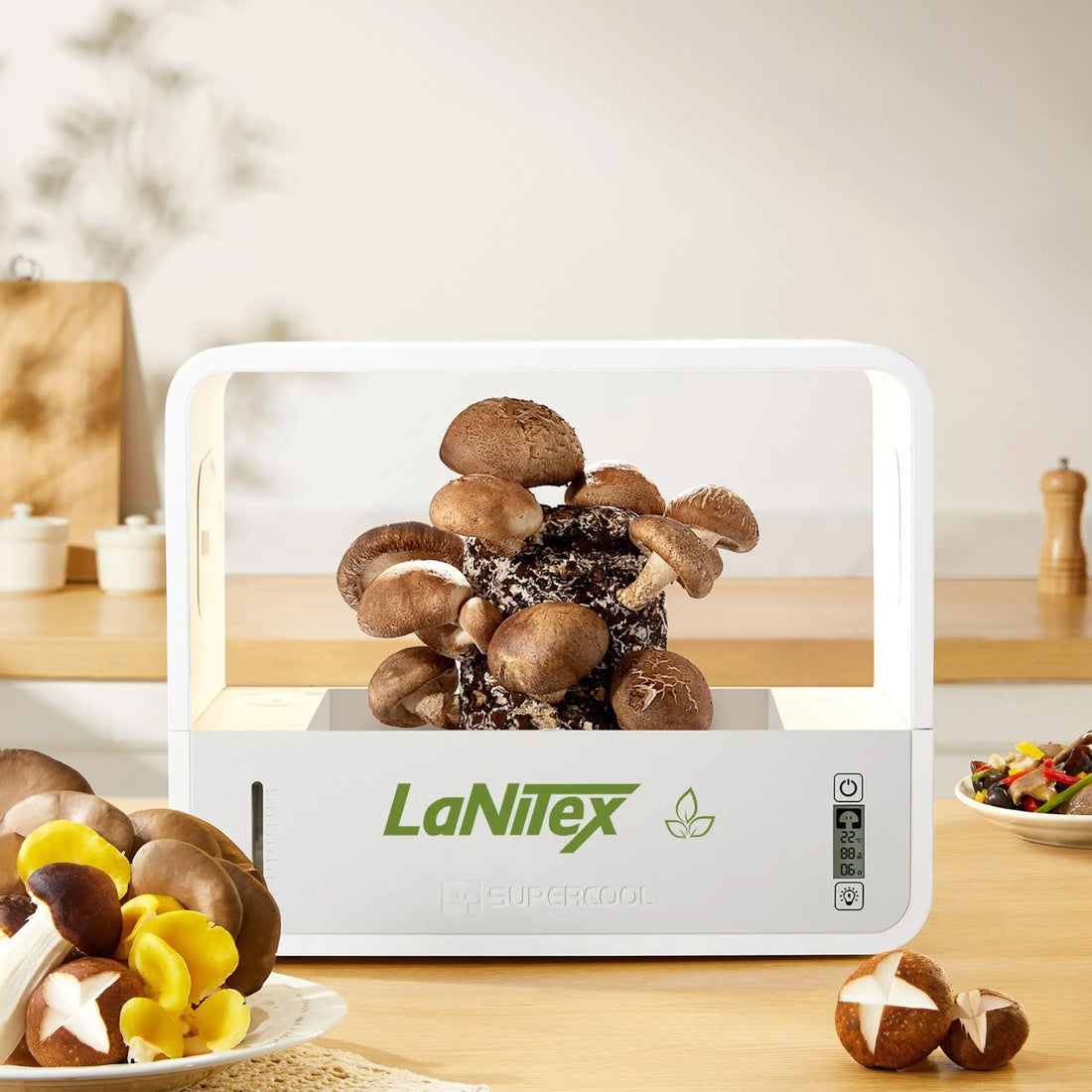
Getting snow white oyster mushrooms to fruit comes down to two things: keeping them in the right temperature range (around 14-22C - choose a room, cupboard or garage that naturally sits in that band) and holding humidity high and steady at 85-95%. The Smart Mushroom Growing Box takes care of the hard part - its humidity control, LED lighting and clear lid take most of the daily misting and guesswork out of fruiting - while you simply place it somewhere in the right temperature range.
Snow white is not the only gourmet mushroom that grows in the same setup. If the room runs warmer, or you simply want variety, shiitake, shimeji and coral tooth are all worth a look as other gourmet mushrooms you can grow in the same Box - each just needs its own substrate and slightly different conditions.

Want hands-off harvests? The Smart Mushroom Growing Box runs the humidity, fresh air and light for you — no daily misting. You supply the fruiting block.
Start growing mushrooms →Ships from the Sunshine Coast, Queensland.
Step-by-step: from spawn to harvest
Sourcing spawn and choosing a substrate
Start with grain spawn from a reputable Australian mushroom spawn supplier, and ask for the cool-season or winter snow white strain specifically so the genetics match the temperature plan. For the substrate, pasteurised wheat or barley straw and hardwood sawdust are the classic choices. Australian growers also do well with sugarcane mulch from the local nursery or hardware store, paper or cardboard pellets, or spent coffee grounds - usually blended into the straw or sawdust rather than used on their own. Any of these works because each is a lignocellulosic material: it holds moisture while leaving air spaces for the mycelium to breathe. Whichever you pick, pasteurise it first to knock back competing moulds and bacteria - the simplest home method is to soak the material in hot water held around 65 to 75C for about an hour, then drain it and let it cool to room temperature before adding the spawn.
Inoculation and colonisation
Mix the spawn evenly through the pasteurised, cooled substrate - aim for roughly 1 part grain spawn to every 5 to 10 parts substrate (about a 10 to 20 per cent spawn rate) - and pack it into your container or grow bag. Keep it somewhere clean and out of direct sun while the white mycelium spreads through the block. Colonisation usually takes about 14 to 21 days, and the block is ready for the next stage once it looks evenly white and firm.

Pinning, fruiting and harvest
Move the colonised block into fruiting conditions: high humidity, fresh air and a little indirect light. Small pins typically appear and reach harvest size in 5 to 7 days at 15 to 21C for this winter strain. Harvest the whole cluster by twisting it free just before the caps flatten right out, while their edges are still slightly downturned. From inoculation to that first harvest is roughly 3 to 4 weeks in most home setups.
Timeline and multiple flushes
Snow white rarely gives just one crop. After the first harvest, rest the block, soak it briefly to rehydrate, and return it to fruiting conditions. A second and often a third flush usually arrive 7 to 14 days after the previous one, as long as humidity stays high and the air stays fresh; many blocks give two or three flushes in total (sometimes four) over several weeks, with each flush usually smaller than the last, before they are spent. As one practical way to picture it: the first flush is the headline, the later flushes are the bonus that a reusable setup is built to capture.
Common problems and how to fix them
Long leggy stems and small caps
Long, pale stems with tiny caps are the classic sign of too little fresh air and a build-up of carbon dioxide around the block. The fix is more air exchange, not more water. Improve ventilation so the mushrooms form short stems and broad caps. Do not seal the block in a closed container to chase humidity, because trapping stale air is what causes the leggy growth in the first place.
Blocks that will not pin
When a fully white block refuses to pin, the usual cause is humidity that is too low or a room that is simply too warm for this cool strain. Raise the humidity toward the 85 to 95 per cent band and check that the room actually sits in the 14 to 22C range. A warm spare room in summer is the most common reason a snow white block stalls.
Drying out and second-flush decline
If caps crack or edges curl and dry, the air is too dry; lift the humidity and keep surfaces visibly moist during pinning. When later flushes shrink, it is normal - each flush draws down the block. A brief re-soak between flushes helps, but yields taper off eventually, and that is the natural end of the block.
Green or black mould and off smells
Snow white mycelium should look clean and white. If the block grows green, blue-green or grey-black fuzzy patches, or starts to smell sour or like ammonia, a competing mould or bacteria has taken hold rather than your mushroom. Do not try to salvage it - bag it and bin it, then start again with a fresh, well-pasteurised substrate and clean hands, because contaminants out-compete the oyster spawn once they are established.
If this is your first grow, the good news is that snow white oyster mushrooms are one of the most forgiving species to start with - and a controlled environment makes them more forgiving still. The Smart Mushroom Growing Box manages humidity and light for you; give it a cool spot with fresh air and your first flush is far more likely to succeed. When it is done, you reset it and grow again, rather than binning a single-use kit.

Get a fresh grow guide like this every fortnight
Join the LaNiTex Hydro Garden newsletter for practical hydroponic, microgreen and mushroom growing tips for Australian homes. Subscribe to download a free hydroponics starter guide (PDF) and get 10% off your first order.
Join the newsletter →How to use snow white oysters in cooking
Snow white oysters have a mild, savoury, lightly umami flavour and a tender-yet-chewy texture that cooks down to something succulent. The pure-white caps look striking on the plate, which makes them a favourite for stir-fries, soups and simple pan-frying. They behave like other oyster mushrooms in the pan: a hot surface and a little patience bring out the best in them. Like other oyster mushrooms, they are also low in kilojoules and a source of fibre, B-group vitamins and beta-glucans.
Oyster mushrooms should be cooked, not eaten raw. To store fresh snow white oysters, keep them in the fridge in a paper-towel-lined container rather than sealed airtight plastic, which traps condensation and turns them slimy. Handled that way, they hold for about 1 to 2 weeks. For a flush bigger than you can eat fresh, snow white oysters also dehydrate, freeze (after a brief pan-fry) or pickle well for longer keeping. For ideas on what to do with a fresh flush, browse the LaNiTex recipes page.
Grow gourmet at home
Grow your own gourmet oyster mushrooms indoors through the cooler months. The Box holds the humidity, fresh-air cycle and light steady — you just pick a cool room and add a fruiting block.
Grow your own mushrooms →Ships from the Sunshine Coast, Queensland.
Snow white oyster mushroom FAQ
What does a snow white oyster mushroom taste like?
Snow white oyster mushrooms have a mild, savoury flavour with a light umami character and a slightly sweet, seafood-like note, much like other Pleurotus ostreatus strains. The texture is tender yet chewy, and the caps cook down to a succulent, meaty bite. They suit stir-fries, soups and pan-frying, and many cooks use them as a plant-based stand-in for lightly flavoured white meat.
How long do snow white oyster mushrooms take to grow from inoculation to harvest?
Snow white oyster mushrooms typically take about 3 to 4 weeks from grain-spawn inoculation of a pasteurised substrate to the first harvest under cool conditions. Once a block is fully colonised, pins usually form and reach harvest size in 5 to 7 days at 15 to 21C for this winter strain. In most home setups, additional flushes appear 7 to 14 days after the first if humidity and fresh air are maintained.
What temperature do snow white oyster mushrooms need to fruit?
Snow white oyster mushrooms fruit best in the cool range of about 14 to 22C, which suits their winter-strain genetics. Australian growers often keep grow blocks between 15 and 21C during pinning and fruiting for reliable flushes and good cap formation. Growth continues a few degrees lower but slows noticeably under about 10C, whereas warmer white strains prefer 20 to 30C conditions.
Can snow white oyster mushrooms grow successfully in Australia?
Yes, snow white oyster mushrooms grow well across many Australian climates when their cool 14 to 22C fruiting range is provided. That happens naturally in southern regions during autumn and winter, and elsewhere by growing in the cooler months or in a cool indoor room. Australian suppliers list this winter strain as a beginner-friendly option for indoor home setups, which keeps it accessible for new growers.
What is the difference between snow white oyster and warm white oyster mushrooms?
Snow white and warm white oyster mushrooms are the same species, Pleurotus ostreatus, separated by temperature rather than appearance. Snow white is the cool strain, fruiting best at about 14 to 22C, and is often called a winter or cold-loving type. Warm white prefers roughly 20 to 30C and grows faster in warmer conditions. Both make white caps, so the season they suit is the real difference.
Are snow white oyster mushrooms easy to grow for beginners?
Yes, snow white oyster mushrooms are considered beginner-friendly, and Australian grow blocks are commonly labelled "Skill level: Beginner". A first flush often appears within 5 to 7 days of starting a colonised block at 15 to 21C, which helps new growers see quick results. The main thing to get right is a cool room (about 14 to 22C) with steady humidity and fresh air - warm, stuffy rooms are where beginners struggle; beyond that, this strain is forgiving of small mistakes.
How do you store fresh snow white oyster mushrooms?
Store fresh snow white oyster mushrooms in the fridge in a container lined with paper towel, which absorbs excess moisture and keeps the caps firm. Handled this way, they generally last about 1 to 2 weeks. Avoid sealing them in airtight plastic without absorbent paper, because trapped condensation encourages sliminess and can cut their shelf life to only a few days.
What substrate is best for growing snow white oyster mushrooms?
Snow white oyster mushrooms grow well on pasteurised straw or hardwood sawdust, matching the wood-loving habit of Pleurotus ostreatus. Australian growers also use sugarcane mulch, paper or cardboard pellets and spent coffee grounds, usually blended with straw or sawdust rather than on their own. The key is a lignocellulosic substrate - straw, paper, cardboard or hardwood - that holds moisture while leaving enough air spaces for the mycelium to colonise.
Ready to grow snow white oysters at home?
Get the strain right and the room right, and snow white oyster mushrooms reward you with a clean white crop through the cooler months when little else is fruiting. Subscribe to the LaNiTex newsletter for 10% off your first order with code NEWSLETTERDISCOUNT10.
Related mushroom guides
- Blue oyster mushrooms — a cool-climate oyster like this one
- Butterscotch oyster mushrooms — a specialty oyster
- Pearl oyster mushrooms — the easiest oyster to start with
Sources
- BioResources (2017), "Assessment of the growth and fruiting of 19 oyster mushroom strains for indoor cultivation on lignocellulosic wastes." https://bioresources.cnr.ncsu.edu/resources/assessment-of-the-growth-and-fruiting-of-19-oyster-mushroom-strains-for-indoor-cultivation-on-lignocellulosic-wastes/