
Firm, crunchy stems and a nutty, velvety cap make the pioppino an Italian-kitchen favourite you can grow fresh at home but almost never find on a shop shelf. It is also one of the easiest gourmet mushrooms to claim in Australia, because barely anyone explains how to grow it here.
Quick answer: Pioppino mushrooms (Cyclocybe aegerita) grow well in Australia's cooler months. Colonise the spawned hardwood substrate at around 21-25C in the dark, then drop the room to about 13-18C with light and fresh air to trigger pinning. Keep humidity at 85-95% and harvest in roughly three to five weeks.
Key takeaways:
- Pioppino is a cool-loving wood mushroom; aim for a fruiting room around 13-18C, not a hot spot.
- Colonise warm (about 21-25C, dark), then move cooler with light and airflow to cue the pins.
- A supplemented hardwood sawdust block is the reliable home substrate; supplemented straw also works well.
- The firm, crunchy stem is as prized as the cap and holds its texture through long cooking.
- Expect two, sometimes three, flushes from one block with a short rest and re-soak between each.
At a glance
| Field | Detail |
|---|---|
| Climate | Cool-moderate; suits southern-Australian autumn and winter |
| Fruiting temp (room) | About 13-18C (workable to roughly 20-21C) |
| Humidity | 85-95% (95-100% during pinning) |
| CO2 and air | Tolerant of higher CO2 (below about 2000 ppm); lower CO2 with 4-8 fresh-air changes per hour gives tighter clusters |
| Substrate | Supplemented hardwood sawdust or Master's Mix; supplemented straw; hardwood logs |
| Difficulty | Beginner-friendly, with consistent humidity the one thing to watch |
| Time to harvest | Roughly three to five weeks from inoculation |
This guide is for: beginner and improving home growers who want a gourmet mushroom that is forgiving to colonise yet rewards a little care at fruiting.
What is a pioppino mushroom (black poplar mushroom)?
A pioppino mushroom is Cyclocybe aegerita, a wood-loving edible species that fruits in tight clusters on decaying hardwoods such as poplar, oak and willow. It carries chestnut-brown caps, usually 2-8 cm across, on long, firm cream-coloured stems, with the whole cluster growing from a shared base.
The naming is where most guides trip up, so here is the clean version. Cyclocybe aegerita is the current accepted name; the species was reclassified from Agrocybe aegerita, and you will still see the older names Agrocybe cylindracea and Pholiota aegerita in supplier listings. Common names include black poplar mushroom, velvet pioppino, piopparello and poplar fieldcap, and some Australian sellers list it as the swordbelt mushroom. One label to avoid is "chestnut mushroom" - that name belongs to a different species (Pholiota adiposa), and using it for pioppino causes real confusion at the spawn shop.
As a clustered wood-lover, pioppino behaves much like other gourmet bracket and cap species: it colonises a block of hardwood, then fruits in a flush of caps when the conditions shift. That habit is what makes it a good fit for an indoor grow at home.
Why grow pioppino mushrooms at home?
The honest payoff is the stem. On most gourmet mushrooms the stem is tough and gets trimmed off; on pioppino the long stem stays firm and crunchy even after cooking, and many cooks prize it as much as the cap. Pair that texture with a nutty, faintly peppery, velvety-capped flavour and you have a mushroom that earns a place in serious cooking.
It is also a mushroom most Australians simply cannot buy fresh. Walk the produce aisle and you will find button, Swiss brown and maybe an oyster punnet, but rarely a pioppino. It turns up only sometimes at specialist grocers and farmers' markets, so growing a block at home is often the only way to get it on the plate when you want it. Nutrition adds to the case: a 2017 study in the Journal of the Science of Food and Agriculture concluded that wild pioppino is "an excellent functional food, by far exceeding that of the Champignon" (the common button mushroom). For a mushroom you grow on your own bench from a single block, that is a strong return on a bit of patience and a cool, humid corner.
How do pioppino mushrooms grow in Australian climates?
For anyone searching "pioppino mushroom Australia", the short version is that climate fit comes down to matching the season to the species. Pioppino is a cool-moderate mushroom. It fruits best in a room sitting around 13-18C, and it will still work towards the warmer end near 20-21C. That band lines up neatly with southern-Australian autumn and winter. Growers in Melbourne, Hobart, Adelaide and regional Victoria and Tasmania often get a natural fruiting window. In warmer Brisbane and Sydney the trick is to run it indoors or wait for the cooler months. Tropical Darwin is an indoor-only, air-conditioned proposition. Up here on the Sunshine Coast, that means pioppino is very much a winter project rather than a summer one.
Here is the part thin guides miss. Pioppino colonises warm and fruits cool. Keep the spawned block at about 21-25C in the dark while the mycelium runs through it, then move it somewhere around 13-18C with light and fresh air to cue pinning. The drop is a gentle nudge, not a hard cold shock - unlike golden enoki or maitake, pioppino does not need a fridge-cold jolt, just a steady move to cooler, brighter, fresher conditions.
Honest disclosure: pioppino isn't yet a species we've fruited on the LaNiTex test bench on the Sunshine Coast - the Smart Mushroom Growing Box and the faster, more forgiving oyster strains came first. The guidance here is built from cultivation science and grow-guide literature, Australian cool-climate growing experience, and feedback from LaNiTex customers running the Box across QLD, NSW, VIC and TAS. As pioppino lands on our own bench, this guide will be updated with first-hand Sunshine Coast observations.
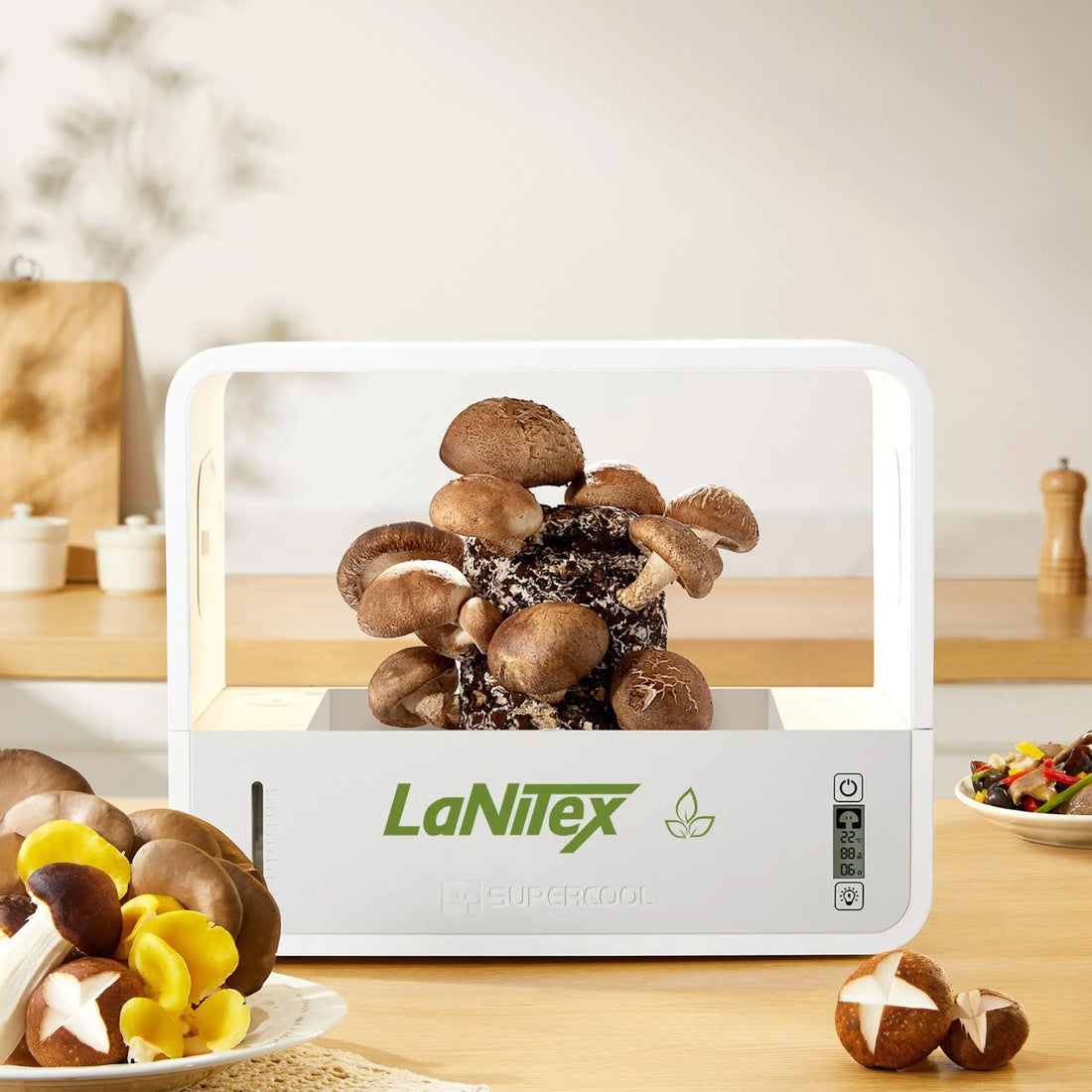
Restaurant kitchens pay a premium for pioppino mushrooms because they are tricky to get right - they need stable humidity and clean air exchange to form properly. The Smart Mushroom Growing Box gives you that same controlled environment on your kitchen bench: humidity control, LED lighting and a clear lid so you can watch every stage. Add your spawn, keep it in the right temperature range, and you are growing chef-grade mushrooms at home.

Want hands-off harvests? The Smart Mushroom Growing Box runs the humidity, fresh air and light for you — no daily misting. You supply the fruiting block.
Start growing mushrooms →Ships from the Sunshine Coast, Queensland.
Step-by-step: from spawn to harvest
The whole grow runs from spawn to a plated cluster in roughly three to five weeks. Work clean at every stage, because the warm colonisation phase is when contamination has its best chance.
Source your spawn
Buy pioppino mushroom spawn (grain or sawdust) from a reputable Australian mushroom spawn supplier. Pioppino is sold under several names, so look for Cyclocybe aegerita, Agrocybe aegerita or "swordbelt" on the label to be sure you have the right species. LaNiTex sells the growing equipment, not spawn, so this step happens elsewhere.
Prepare the substrate
Pioppino is a hardwood lover. A supplemented hardwood sawdust block - hardwood sawdust plus a bran supplement, or a Master's Mix of roughly 50-50 sawdust and soybean hull - hydrated to about 60% moisture is the reliable home choice. Supplemented straw performs strongly too: research has recorded high yields on wheat straw enriched with wheat bran, so it is only plain, unsupplemented straw that underperforms. Sterilise any supplemented substrate before you inoculate it, since the added nutrients also feed mould and bacteria. The simplest route for most home growers is to buy a ready-to-inoculate, pre-sterilised hardwood block; if you prepare your own, pressure-sterilise it first to kill competing moulds.
Inoculate
Mix your spawn through the cooled, sterilised substrate at clean, draught-free conditions, then seal it into your grow container or bag. Even spawn distribution gives faster, more even colonisation. As a rough guide for gourmet mushrooms on supplemented hardwood, home growers commonly run grain spawn at about 1:5 (roughly 20% by weight); leaner rates down to about 1:10 still work but colonise more slowly.
Colonisation (about 21-25C, dark)
Keep the inoculated block warm, around 21-25C, and in the dark while the white mycelium spreads through it. Full colonisation usually takes about two to four weeks. There is no need for light or heavy airflow yet.

Pinning (drop to 13-18C, add light and air)
Once the block is fully colonised, move it to fruiting conditions: about 13-18C, 95-100% humidity, indirect light and good fresh-air exchange. Tiny pins typically appear within a few days, though a cooler month can stretch that out. Low fresh air at this stage is the classic cause of leggy stems and tiny caps, so keep the chamber ventilated.
Fruiting
Hold humidity at 85-95% and keep fresh air moving while the clusters swell. Caps darken to chestnut-brown on top of lengthening cream stems over several days.
Harvest (before the veil tears, twist and pull)
Harvest the whole cluster just before the veil under the caps tears and while the caps are still slightly incurved - that gives the best texture, the longest fridge life and the least spore drop. Twist and pull gently at the base rather than cutting, so you remove the cluster cleanly.
Pioppino rewards patience over force: colonise it warm and dark, then let a cool, bright, well-aired room do the work of calling out the pins.
Get a fresh grow guide like this every fortnight
Join the LaNiTex Hydro Garden newsletter for practical hydroponic, microgreen and mushroom growing tips for Australian homes. Subscribe to download a free hydroponics starter guide (PDF) and get 10% off your first order.
Join the newsletter →Common pioppino problems and how to fix them
Most pioppino troubles trace back to the fruiting environment, and almost all of them are fixable. Work through them one at a time.
Long stems and tiny caps. This is the signature sign of too little fresh air. Carbon dioxide builds up in a closed chamber and the mushroom stretches towards better air. Increase fresh-air exchange and the caps fill out.
The block will not pin. A fully colonised block that just sits there usually needs a clearer signal: nudge the room cooler into the 13-18C band, lift humidity towards 95-100%, and make sure it is getting indirect light. Do not bake it warm hoping to speed things up - pioppino pins on the cool side, not the warm side.
Contamination during colonisation. Green, black or sour-smelling patches at the warm stage mean something got in. Prevention beats cure: sterilise supplemented substrate properly, work in a clean still-air space, and do not open the block more than you must.
A weak second flush. After the first harvest, give the block a short rest of about a week, then re-soak it to rehydrate before fruiting conditions resume. Skipping the rest and soak is the usual reason a second flush disappoints.
Most of the problems above trace back to unstable conditions - humidity that swings and air that goes stale. A reusable system removes those variables: the Smart Mushroom Growing Box holds humidity and light steady and keeps the fruiting chamber ventilated, so contamination and dry-out have far less chance to take hold, flush after flush. (Temperature you manage simply by choosing a room in the right range - see above.) Unlike a one-off supermarket kit, it is built to be reset and grown again.
A stalled block is rarely dead. Nine times out of ten it wants cooler air, more humidity and a little light, not more heat.

How to cook pioppino mushrooms
Pioppino shines in slow, savoury cooking. In Italian kitchens it goes into risotto, pasta, ragu and gentle braises, where the firm stems hold their bite instead of collapsing. In Chinese cooking the same species is known as the tea-tree mushroom (cha shu gu) and lands in stir-fries, soups and hot pots. Either way, that crunchy stem is the point - slice the clusters lengthwise so each piece keeps a bit of stem and cap together.
Cook pioppino before eating it; like most cultivated gourmet mushrooms it is not meant to be eaten raw. A quick saute in butter or oil to brown the edges sets it up nicely, and from there it holds its texture through ten to fifteen minutes in a sauce or braise. For a few ideas to start with, the LaNiTex recipes page is a useful jumping-off point.
To store a fresh flush, keep it in a paper bag or loosely wrapped in the fridge for several days, and avoid sealing it tightly in plastic - trapped condensation softens the clusters and shortens their life.
Grow gourmet at home
Grow gourmet pioppino and other cool-season mushrooms on your own bench. The Box holds the humidity, fresh-air cycle and light steady, so you skip the daily misting and guesswork. You supply the fruiting block.
Grow your own mushrooms →Ships from the Sunshine Coast, Queensland.
Pioppino mushroom FAQ
What is a pioppino mushroom (Cyclocybe aegerita)?
A pioppino mushroom is Cyclocybe aegerita, also known as Agrocybe aegerita or the black poplar mushroom, a wood-loving edible species that fruits in clusters on decaying hardwoods such as poplar and oak. It produces long cream stems topped with small brown caps, typically 2-8 cm wide. It prefers cool conditions around 13-18C for fruiting and is valued for its firm, gourmet texture.
How long do pioppino mushrooms take to grow from inoculation to harvest?
Pioppino mushrooms usually take about two to four weeks to colonise the substrate after inoculation, depending on temperature. Once the block is colonised and moved to fruiting conditions, pins generally appear within a few days, and the mushrooms mature over the following several days. All up, home growers tend to harvest a first flush roughly three to five weeks after inoculation.
What temperature do pioppino mushrooms need to fruit?
Pioppino mushrooms fruit best in cool-moderate conditions, around 13-18C, and will still work towards the warmer end near 20-21C. For pinning they respond well to the cooler part of that band with very high humidity of about 95-100%. Pioppino is a cool-loving species that dislikes hot conditions, so a warm spot is the wrong place for fruiting.
Can pioppino mushrooms grow successfully in Australia?
Yes. Pioppino grows well in cool-moderate conditions around 13-18C with high humidity, which matches the autumn and winter window across much of southern Australia, including Melbourne, Hobart, Adelaide and cooler regional areas. Warmer cities such as Brisbane and Sydney can grow it indoors or in the cooler months. As a hardwood-loving species, it suits a sheltered outdoor log grow or a controlled indoor setup.
What does pioppino mushroom taste like and how do you cook it?
Pioppino has a nutty, faintly peppery flavour and a velvety cap, but its signature is the firm, crunchy stem that stays firm when cooked. Saute it briefly to brown the edges, then it holds its texture through longer dishes such as pasta, risotto, stir-fries, soups and braises. Cook it before eating; it is not meant to be eaten raw.
Are pioppino mushrooms easy to grow for beginners?
Pioppino is beginner-friendly and fairly forgiving. Some growers find it more forgiving than expected, because it tolerates higher carbon dioxide during fruiting than many gourmet species. The one variable it rewards is consistent high humidity for tight clusters, and it prefers a hardwood substrate over plain straw. With clean technique and a cool fruiting spot, it is a confident first or second gourmet grow.
How do you store fresh pioppino mushrooms?
Store fresh pioppino in a paper bag or loosely wrapped in the fridge, and use it within several days for the best texture and flavour. Avoid sealing it tightly in plastic, which traps condensation and softens the clusters. Keeping it cool and lightly covered slows moisture loss without making the surface slimy.
What substrate is best for growing pioppino mushrooms?
Pioppino grows best on hardwood-based substrates, especially sterilised supplemented hardwood sawdust hydrated to around 60% moisture, or a Master's Mix of sawdust and soybean hull. Supplemented straw also performs strongly, so only plain unsupplemented straw is the weaker option. Outdoors, pioppino colonises hardwood logs such as poplar, oak and willow, drilled and plugged with spawn.
Are pioppino mushrooms psychedelic?
No. Pioppino (Cyclocybe aegerita) is a culinary gourmet mushroom with no psychoactive or hallucinogenic effects, grown and eaten purely for the kitchen. It is a long-recognised edible and belongs to a completely different group from the psychedelic species people sometimes confuse it with. Like most cultivated mushrooms it is eaten cooked rather than raw, so always grow from correctly labelled spawn.
What are pioppino mushrooms good for?
Beyond the kitchen, pioppino is a nutritious, low-fat food: a useful source of protein, the dietary fibre (beta-glucans) found in mushroom cell walls, vitamin E, and ergosterol that converts to vitamin D when exposed to light. Laboratory studies are exploring its antioxidant and immune-supporting compounds, though those effects are not yet proven in people. This is general information, not medical advice.
Ready to grow pioppino mushrooms at home?
If you have been hunting for a one-off pioppino mushroom grow kit, this is the more sustainable route: pair your own spawn with a reusable mushroom growing kit you reset for the next species rather than binning after a single flush.
If you grow pioppino as a gourmet project, it pairs naturally with the chestnut mushroom and with the other cool-season gourmet species in the range. For more on those, see the guides to growing shiitake, shimeji and coral tooth mushrooms, or step back to the full mushroom growing guide for the basics that apply to every species.
Grown a cluster you are proud of, or hit a snag worth sharing? Tell us how your pioppino grow went - the next reader learns from it.
Related mushroom guides
- Chestnut mushrooms — a nutty Italian-gourmet cousin
- Shiitake mushrooms — the classic gourmet wood-lover
About the author
Laszlo Bulatko is the founder of LaNiTex Hydro Garden, a Sunshine Coast small business making indoor growing simple for Australian households. After fifteen years in sales and brand development, Laszlo now tests every system LaNiTex stocks before it reaches the catalogue - from hydroponic herb gardens to the Smart Mushroom Growing Box - and shares what actually works for growers in Australian conditions.
Last updated: 04 June 2026
Sources
- Petruccelli V. et al. (2017). "Pioppino mushroom in southern Italy: an undervalued source of nutrients and bioactive compounds." Journal of the Science of Food and Agriculture. https://pubmed.ncbi.nlm.nih.gov/28503801/