
By Laszlo Bulatko, Founder of LaNiTex Hydro Garden — Sunshine Coast hydroponics specialist. Last updated: 19 June 2026.
Kangkong hydroponics in Australia gives you a stir-fry-ready leafy green with first cuts at 30 to 45 days, with up to 90% less water than soil growing (typically 70–90% in well-optimised systems, per Sustainable Gardening Australia). Kangkung, also spelled kangkong, runs hard in NFT and Deep Water Culture between pH 5.5–6.5 and EC 1.5–2.5 mS/cm, and it loves the warm, humid air that Brisbane and the Sunshine Coast get for nine months of the year. If you cook Vietnamese, Filipino, Thai or Indonesian food this is the easiest Asian leafy green to put on tap at home.
From the Sunshine Coast test bench
What is kangkung and why grow it hydroponically in Australia?
Kangkung (Ipomoea aquatica) is a fast-growing semi-aquatic leafy green widely cultivated across South-East Asia. It is also marketed as water spinach or Chinese water spinach — and, less commonly, swamp cabbage, river spinach, Chinese watercress or water convolvulus — though it is not botanically related to true spinach. In Australia, kangkung is in growing demand thanks to the Vietnamese, Filipino, Thai and Indonesian diaspora communities concentrated in Brisbane, Sydney and Melbourne, and supermarket supply is patchy outside Asian grocery hubs.
Hydroponic kangkung solves three Australian problems at once. First, the plant is semi-aquatic, so it thrives on the continuous water and nutrient supply (with high root-zone oxygen) that DWC and NFT systems deliver — DWC submerges the roots, NFT runs a thin nutrient film past them. Second, you escape the soil-borne pests and disease pressure that knocks outdoor kangkung over in a wet QLD summer. Third, a hydroponic setup uses up to 90 percent less water than soil farming, with most well-optimised systems landing in the 70–90% range (Sustainable Gardening Australia), which matters during a southeast Queensland drought year.
Is it legal to grow water spinach in Australia? Yes — it is grown and sold here, and Australian seed suppliers such as Greenharvest and Eden Seeds stock the seed. It is not a prohibited or restricted plant under Queensland's Biosecurity Act 2014. It is, however, a vigorous semi-aquatic plant recognised as an invasive environmental weed in parts of Queensland — it has escaped into Gold Coast waterways — so, like everyone, you carry a general biosecurity obligation to stop it spreading.
The responsible way to grow it is in a contained system: the City of Gold Coast specifically advises growing kang kong for food in containers rather than in or near waterways, and an indoor hydroponic setup keeps every plant fully enclosed, with no path into local creeks, dams or wetlands. (Some overseas guides call water spinach a banned "noxious weed" — that outright ban is a United States rule; in Australia the job is simply to grow it responsibly and contained, not to avoid it.)
Which hydroponic system is best for kangkung in Brisbane and the Sunshine Coast?
Three systems work for kangkung. The right one depends on how much hardware you want to maintain.
| System | Setup cost | Best for | Why it suits AU subtropical |
|---|---|---|---|
| NFT (Nutrient Film Technique) | $$ — mid-tier | Year-round home harvests + Asian-greens cluster | Continuous root oxygenation reduces root rot risk vs poorly aerated systems on humid 60–80% RH days |
| DWC (Deep Water Culture) | $ — entry | First-time growers, single-crop runs | Cheap, forgiving; needs an air pump to stop stagnant-water issues in summer |
| Kratky method | $ — passive | Apartment renters, no electricity | No pump, no plumbing; lower yield ceiling than NFT |
For Brisbane and Sunshine Coast subtropical conditions, NFT wins on three counts: precise water-level control (the V5.2-T NFT system holds depth to 3 mm), strong root oxygenation from the large air-to-water surface area in the channels, and the ability to run kangkung alongside bok choy, spring onions and choy sum in parallel for a full Asian-greens setup. Fair point: DWC is cheaper if you only ever want kangkung.

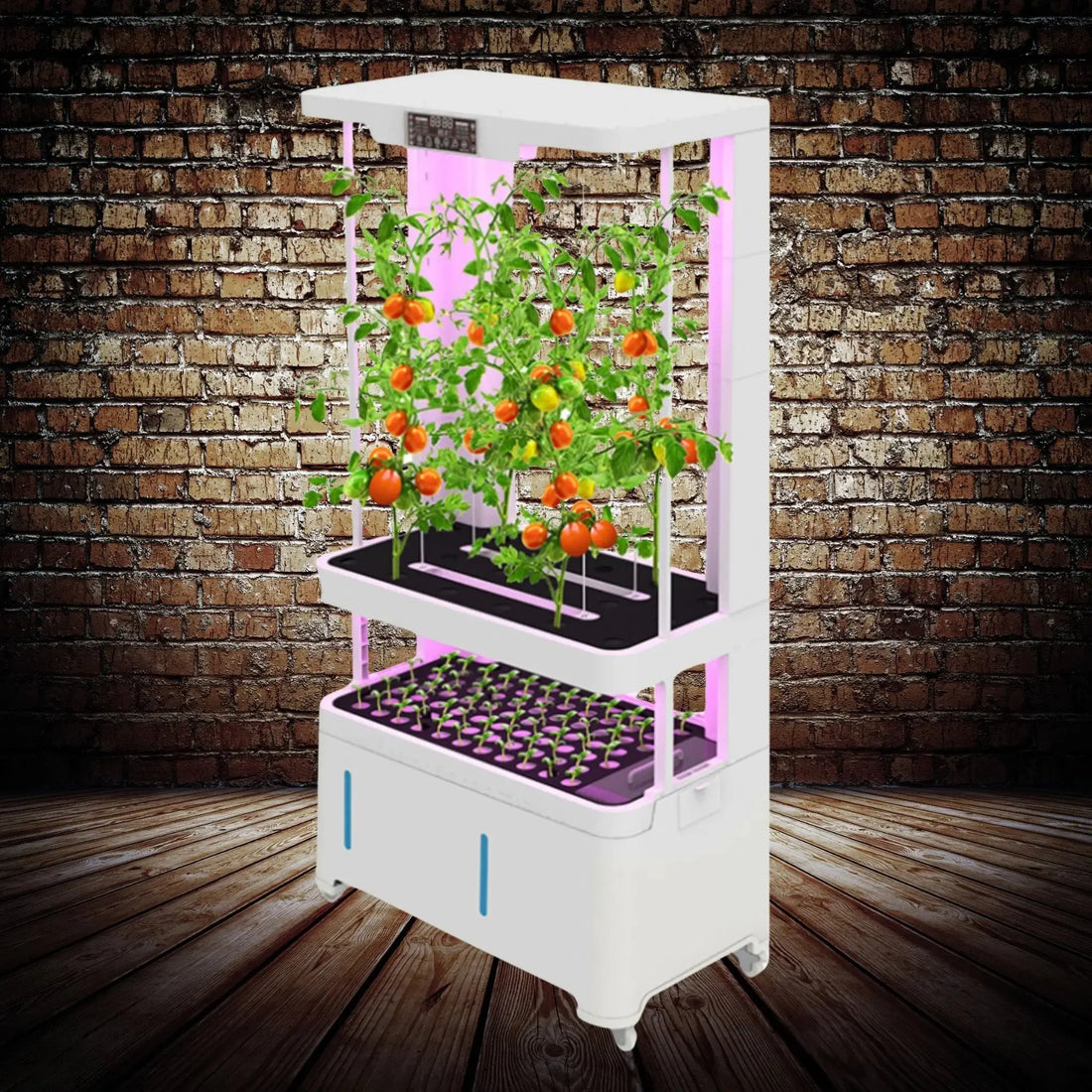
Grow kangkung and the rest of your Asian greens indoors, year-round — the V5.2-T runs a continuous nutrient film with self-watering and full-spectrum LED, the steady, well-oxygenated flow this semi-aquatic green thrives on. You supply the seed.
Start your kangkung setup →Personally tested at home on the Sunshine Coast before listing.
What pH and EC does kangkong hydroponics need?
Hydroponic kangkung is forgiving but not pH-indifferent. Run it in this window:
| Parameter | Target | Notes |
|---|---|---|
| pH | 5.5–6.5 | 5.8–6.0 is the sweet spot for nutrient uptake |
| EC (Electrical Conductivity) | 1.5–2.5 mS/cm | Start low (1.5) for seedlings, build to 2.0 by week three |
| Temperature | 20–30 °C | Matches Brisbane and Sunshine Coast spring-to-autumn ambient |
| Relative humidity | 60–80% | Sub-tropical south-east Queensland natural humidity is in this band |
| Daily light | 12–16 hours full-spectrum LED | Or 6+ hours of strong indirect natural light if windowsill-grown |
Check pH and EC daily for the first fortnight, then twice weekly once the canopy fills out. Hydroponic water spinach pH can drift quickly — often downward in nutrient-imbalanced setups, occasionally upward in nitrate-heavy reservoirs — so don't top up without re-balancing.

Sowing, transplant, and harvest cycle for Australian growers
Kangkung is one of the quickest leafy greens you can put in a hydro setup. Here is the seed-to-cut path most growers run.
- Germination (days 0–4). Drop 2–3 kangkung seeds per rockwool plug or sponge cube, keep moist at 24–28 °C. Most seeds pop within four days. Light is optional until cotyledons show.
- Seedling (days 5–12). Move plugs under LEDs at 12 hours daily (push to 14–16 hours after transplant for the strongest yield). Begin a half-strength nutrient feed (EC 1.0) once the first true leaves appear.
- Transplant (around day 12–14). Move vigorous seedlings into your NFT channels, DWC raft or Kratky reservoir. Roots should be 3–5 cm long.
- Vegetative growth (days 14–30). Bump nutrient to EC 1.8–2.0. Growing water spinach in this phase explodes. Expect up to 2–3 cm of new growth per day in summer.
- First harvest (day 30–45). Cut the top 10–15 cm of each stem, leaving 2–3 nodes for regrowth. Kangkung is cut-and-come-again; expect another full cut every 2–3 weeks for 3–4 months from a single planting. That fast cut-and-come-again regrowth is exactly why kangkong is such a productive leafy green in a small footprint — a single home channel keeps a household in stir-fry greens for a whole season.
Brisbane and Sunshine Coast growers can run kangkung from September through May outdoors; indoor hydro setups run it year-round.
Which kangkung cultivars are worth growing in Australia?
Three cultivars are worth knowing for Australian kitchens, especially if you cook a specific cuisine.
One botanical note first: water spinach comes in two broad forms — an upland (dryland) type with narrower leaves, and an aquatic (wetland) type with broader leaves and hollow, floating stems. Both are Ipomoea aquatica and both grow well hydroponically, but the aquatic type is the one most at home in a constantly wet NFT or DWC channel.
Thai Kangkong (Pak Boong). Hollow stems, broader leaves. Best for stir-fries; holds texture under high heat. Look for it through Asian-grocery seed sections or online Australian seed suppliers.
Chinese Water Spinach (Ong Choy). Narrower leaves, slightly bitter. Common in Cantonese cooking. Plays well with shiso and red malabar spinach for a mixed Asian-greens salad. For a milder, crisper base in that salad, hydroponic butterhead lettuce grows in the very same channel.
Red Stem Kangkong. Firmer stems with a red tinge, slightly sweeter leaf. Excellent for sambal kangkong (the Indonesian/Malaysian chilli-paste stir-fry).
All three handle the same pH/EC envelope. If you cannot decide, Thai is the most beginner-forgiving and the most productive.
Get a fresh grow guide like this every fortnight
Join the LaNiTex Hydro Garden newsletter for practical hydroponic, microgreen and mushroom growing tips for Australian homes. Subscribe to download a free hydroponics starter guide (PDF) and get 10% off your first order.
Join the newsletter →Common kangkung problems and how to avoid them
Kangkung is hardy, but two mistakes kill more plants than anything else.
Don't let the reservoir warm above 28 °C. Warm water holds less dissolved oxygen, and root rot moves fast in stagnant 30 °C tanks. Run a small chiller or shift the reservoir off concrete in a Brisbane February.
Don't drop EC below 1.2 mS/cm during vegetative growth. Prolonged low EC (under 1.2) leads to pale, slow growth within a week or two. Aphids and whiteflies pile onto stressed plants. A common mistake is reaching for pesticide when the real fix is to push nutrient strength back up.
If you see brown root tips: that's classic Pythium root rot. Refresh the nutrient solution, drop temperature, add a beneficial-microbe product, and trim affected roots. Most plants recover within ten days.
Pairing kangkung with other Asian leafy greens for a year-round setup
Kangkung is great solo, but it shines in a year-round Asian-greens rotation. In a V5.2-T NFT system you can run all of these in parallel at the same pH/EC window:
- Bok choy — 30–60 days to mature heads, another stir-fry staple
- Choy sum — flowering Chinese green, harvested for the tender stems
- Shiso — Japanese herb that elevates kangkong stir-fries
- Red malabar spinach — heat-tolerant climbing spinach alternative for Sunshine Coast summers
- Spring onions — an obvious stir-fry pairing, harvested continuously
If you want the full setup running all five in parallel year-round, the V5.2-T is the system we have built for it. For the fundamentals on how hydroponic systems work, see our hydroponic system essentials guide.
Is kangkung good for you? Nutrition at a glance
Kangkung earns its place on the plate as well as in the system. So what is water spinach good for? Its main health benefits come from how nutrient-dense it is for so few kilojoules: per 100 grams, raw water spinach is high in vitamin A and vitamin C, and carries useful iron, calcium and folate (USDA FoodData Central).
| Per 100 g, raw | Amount | Why it matters |
|---|---|---|
| Energy | ~19 kcal | Very low — a light leafy green |
| Vitamin C | ~55 mg | More than a full day's vitamin C for an adult (Australian RDI is 45 mg) |
| Vitamin A | ~315 µg RAE (~6,300 IU) | Supports eye and immune health |
| Calcium | ~77 mg | Bone health |
| Iron | ~1.7 mg | Oxygen transport in the blood |
Because it grows so fast and is cut young, hydroponic kangkung reaches the kitchen within hours of harvest, so little of that vitamin C is lost to days of storage and transport — one quiet advantage of growing it at home instead of buying limp bunches.
From harvest to the plate: storing and cooking kangkung
Kangkung wilts fast — within hours of cutting. Stand the cut stems in a glass of water on the bench like a bunch of flowers, or wrap them loosely in a damp paper towel and keep them in the crisper; either way, use them within two to three days for the best texture.
Always cook kangkung — it is not a salad green. A quick high-heat stir-fry with garlic (the classic kangkong belacan, or a Vietnamese-style garlic stir-fry) takes barely two minutes; the hollow stems stay crisp while the leaves wilt down. Blanching for soups and curries works too. Raw water spinach is best avoided: it is high in oxalic acid, and field- or pond-grown stock can carry waterborne parasites — both of which a proper cook takes care of. Clean hydroponic stock is far lower-risk, but cooking it is a habit worth keeping.

Filled all 18 pods and want more? The V5.2-A Tower steps you up to 72 planting sites in the same floor space — a bigger Asian-greens wall without the sprawl. You supply the seedlings.
Scale up your grow →Personally tested at home on the Sunshine Coast before listing.
The full range
Find the system that fits your space


Supported in Australia - every model tested before listing.
Frequently asked questions about hydroponic kangkung
What is kangkung and how is it different from regular spinach?
Kangkung (Ipomoea aquatica), also called water spinach, ong choy, or kangkong, is a semi-aquatic leafy vegetable native to South-East Asia. Botanically it is unrelated to true spinach (Spinacia oleracea); kangkung is in the morning glory family. It has hollow stems, longer leaves, and a milder taste, and it grows much faster: 30–45 days versus 8–10 weeks for soil-grown spinach.
Can kangkung grow in water without any soil?
Yes, kangkung is semi-aquatic and one of the easiest crops to grow soil-free in Australia. Use NFT, DWC or the Kratky method with pH 5.5–6.5 and EC 1.5–2.5 mS/cm. You can even regrow shop-bought kangkong stems by placing them in a glass of nutrient water for a fortnight before transplanting.
What pH and EC should kangkung be grown at in hydroponics?
Run hydroponic kangkong at pH 5.5–6.5 (5.8 is the sweet spot) and EC 1.5–2.5 mS/cm. Start seedlings at the low end (pH 6.0, EC 1.0–1.2) and build up by week three. Check both daily for the first fortnight, then twice weekly. Top-ups without re-balancing drift the solution fast.
How long does kangkung take to harvest in a hydroponic system in Australia?
First cut at day 30–45 from sowing in Brisbane and Sunshine Coast subtropical conditions. Cut the top 10–15 cm of each stem, leaving 2–3 nodes. Kangkung is cut-and-come-again. Expect another full cut every 2–3 weeks for 3–4 months from a single planting. Indoor setups run year-round; outdoors stop around May in cooler southern climates.
Which hydroponic system is best for kangkung — DWC, NFT, or Kratky?
NFT is the best all-round choice for Australian growers because it gives precise water-level control (3 mm in the V5.2-T system), strong root oxygenation during humid summers, and parallel cropping with siblings like bok choy and choy sum. DWC is cheaper if you only ever grow kangkong. Kratky is the passive entry point — no pump, no electricity, but lower yield.
How do you plant kangkung seeds for hydroponic growing?
Soak seeds overnight, then place 2–3 per rockwool plug, sponge cube or coco coir plug. Keep at 24–28 °C and moist. Most seeds germinate within 3–4 days. Move under LEDs at 12 hours once cotyledons show, transfer to your hydroponic system at day 12–14 when roots are 3–5 cm long. Do not plant water spinach seeds deeper than 5 mm.
Can you grow Chinese water spinach in Brisbane and Sunshine Coast subtropical climate?
Yes, and the subtropical south-east Queensland climate is well-suited for it year-round. Outdoor growers can sow from September to May; indoor hydroponic setups (V5.2-T NFT, DWC, or Kratky) run kangkong twelve months of the year. Summer humidity at 60–80% RH is in the kangkong sweet spot, and the 22–28 °C ambient matches the optimal grow temperature. Indoors, the only adjustment is keeping reservoir water under 28 °C through February.
Where can you buy water spinach seeds in Australia?
Australian seed suppliers such as The Seed Collection, Greenharvest and Eden Seeds stock or list water spinach (kangkung) seed, and Asian grocers often sell viable seed packets too. LaNiTex does not sell seed — we make the V5.2-T hydroponic system you grow it in once your seed arrives.
Is water spinach the same as morning glory?
Not quite. Water spinach (Ipomoea aquatica) belongs to the morning glory family (Convolvulaceae), so it is a relative of the ornamental garden morning glory — but it is a different, edible species grown for its leaves and stems, not the climbing flower. That family link is why you'll occasionally see it called water morning glory.
Sources
External citations
- Sustainable Gardening Australia, The pros and cons of hydroponic growing, water savings up to 90% vs soil cultivation; verified live 18 May 2026.
- USDA FoodData Central, Water spinach (Ipomoea aquatica), raw — nutrient profile; vitamin A, vitamin C, calcium, iron and folate values per 100 g.
- James, A. et al., Phytoremediation Potential of Kangkong (Ipomoea reptans Poir) in Lead-Contaminated Hydroponic Systems, ResearchGate (2024) — peer-reviewed paper on kangkung's nutrient uptake and water-purification capacity. (Note: Ipomoea reptans Poir in the paper title is a regional synonym for the currently accepted scientific name Ipomoea aquatica Forssk.)
Publisher and author entities
- Publisher: LaNiTex Hydro Garden, operated by LaNiTex Australia Pty Ltd (ABN 47 682 768 967), Sunshine Coast, Queensland, Australia. Contact.
- Author: Laszlo Bulatko, Founder. About Laszlo Bulatko · LinkedIn · Wikidata Q138974930.
About the writer
Laszlo Bulatko is the founder of LaNiTex Hydro Garden, an Australian indoor hydroponic systems business he started in December 2024 and runs solo from the Sunshine Coast (Sippy Downs, QLD 4556). He began his career at IBM and Diageo in Hungary, then spent 15 years in sales, marketing and brand development across the Hungarian fishing tackle market, representing Okuma, Mustad, Savage Gear, Prologic, Mad Cat, Penn, JRC, Plano, Abu Garcia and Berkley, and helping establish a 12% market share for the brands he worked with. He now applies the same product-testing discipline to indoor hydroponic kits, microgreens and mushroom growing systems for Australian homes, classrooms and small commercial growers. Every product LaNiTex stocks was personally tested at home before being added to the catalogue. Connect with Laszlo on LinkedIn or the LaNiTex Hydro Garden YouTube channel.
For more on Laszlo's background and current work, visit the About Laszlo Bulatko page.
Take the next step — start your kangkung setup
If you want to grow kangkung alongside bok choy, choy sum, shiso and spring onions year-round in a single NFT system, the V5.2-T Automated NFT Hydroponic System is the system we built for it. Ships from the Sunshine Coast to Brisbane same week, Australia-wide within seven days.
That's it.