
Updated 25 June 2026 | By Laszlo Bulatko, LaNiTex Hydro Garden
Hydroponic celery in Australia is one of the most cost-effective indoor crops for daily juicers, salad makers, and home cooks — fresh, crisp stalks at the rate you actually use them, instead of $40 to $80 a month in supermarket bunches half of which wilt before you finish.
Indoor hydroponic celery grows best in a Nutrient Film Technique (NFT) or Deep Water Culture (DWC) system at pH 6.0-6.5 and EC 1.8-2.4 mS/cm, with 14-16 hours of full-spectrum LED light at 150-300 umol/m2/s and a stable 15-23 degrees Celsius. Expect 120-140 days from seed to a mature plant, then four to six months of continuous harvest. We've tested every system, nutrient, and timing in this guide on our own gear at LaNiTex's Sunshine Coast facility for daily-juicer scenarios before publishing.
Here's what works for growing celery hydroponically in Australia, from system choice through 120-140-day mature harvest.
Why grow celery hydroponically in Australia
Daily celery juicing is a $40-80 monthly habit if you buy bunches at $4-6 from the supermarket. Half of that bunch usually wilts before you finish it. On the Sunshine Coast and across Brisbane, summer humidity makes it worse -- celery loses crispness in 48 hours once cut.
Hydroponic celery solves two problems at once. The first is freshness: you cut what you need and the plant keeps producing for four to six months after maturity. The second is climate. Celery is a cool-season vegetable that becomes stressed and prone to bolting (running to flower) when sustained day-temperatures push into the mid-20s Celsius and above, particularly after heat spikes. Queensland's commercial celery production is concentrated in the cooler months (typically April-September around Brisbane, per DAF QLD), and outside that narrow window summer heat and humidity push outdoor crops toward bolting and disease pressure. Indoor hydroponics removes the seasonal constraint and gives year-round supply in the 15-23 degrees Celsius sweet spot.
That's the practical case. The cost case stacks up too. A LaNiTex Grow Box Tall is a one-off purchase with only a small yearly spend on nutrients, plus a little for power and water. For a daily juicer, it pays for itself inside 7-12 months and gives you year-round supply after that. Less waste, no plastic packaging, fresher juice.

Apium graveolens, the basics
Celery is Apium graveolens in the family Apiaceae, the same family as parsley, carrot, and fennel. The cultivated stalk celery you buy at the supermarket belongs to the Dulce Group. Its botanical origin is the Mediterranean basin, where it grows naturally as a wetland edge plant in cool, damp conditions.
Two facts from that origin story matter for indoor growing. First, celery is a heavy water user -- it evolved with its feet wet. Hydroponics suits its biology directly. Second, it is a cool-season biennial, meaning it stays in vegetative growth (leafy stalks) at 15-23 degrees Celsius and tries to flower if it experiences either a prolonged cold snap below 10 degrees or sustained heat into the mid-20s and above. A well-controlled indoor LED-lit setup keeps temperature inside that 15-23 degrees Celsius range and avoids both triggers.
Wikipedia describes celery's cultivation history clearly: "Celery was first grown as a winter and early spring vegetable." In Mediterranean Europe the season ran "from the beginning of September to late in April." In Australia, that translates to autumn-to-spring outdoors for temperate zones (Victoria, Tasmania, South Australia). Subtropical Queensland gets a much shorter outdoor window in mid-winter only. Indoors, the season is twelve months.
Get a fresh grow guide like this every fortnight
Join the LaNiTex Hydro Garden newsletter for practical hydroponic, microgreen and mushroom growing tips for Australian homes. Subscribe to download a free hydroponics starter guide (PDF) and get 10% off your first order.
Join the newsletter →My experience growing celery on the Sunshine Coast
A book I came across recently completely changed my morning routine. It was about the impact of starting every day with a glass of freshly pressed celery-stalk juice -- and the case for it was compelling enough that I decided to give it a proper run.
The one drawback was logistics: supermarket celery wilts in the fridge within days, and for juicing, freshness is the whole point. That's exactly why it's so satisfying that with the LaNiTex Grow Box Tall I can now grow my own celery any time, right in my living room. No more limp stalks shrivelling in the crisper drawer -- I just cut what I need, and the plant keeps producing.
The setup: NFT vs DWC vs ebb-and-flow
Three system types work for celery. Each has trade-offs.
| System | Best for | Trade-off | LaNiTex fit |
|---|---|---|---|
| Deep Water Culture (DWC) | High water uptake plants, beginner-friendly | Requires good aeration; root rot risk if pump fails | Grow Box Tall (9L reservoir, 15 plants) handles celery's thirst easily |
| Nutrient Film Technique (NFT) | Space-efficient vertical setups | Roots can dry quickly if flow stops; needs constant power | Best when you want apartment-floor footprint |
| Ebb-and-flow | Steady humidity around roots | More moving parts (timer, pump cycle); more complex | Workable but unnecessary at home scale |
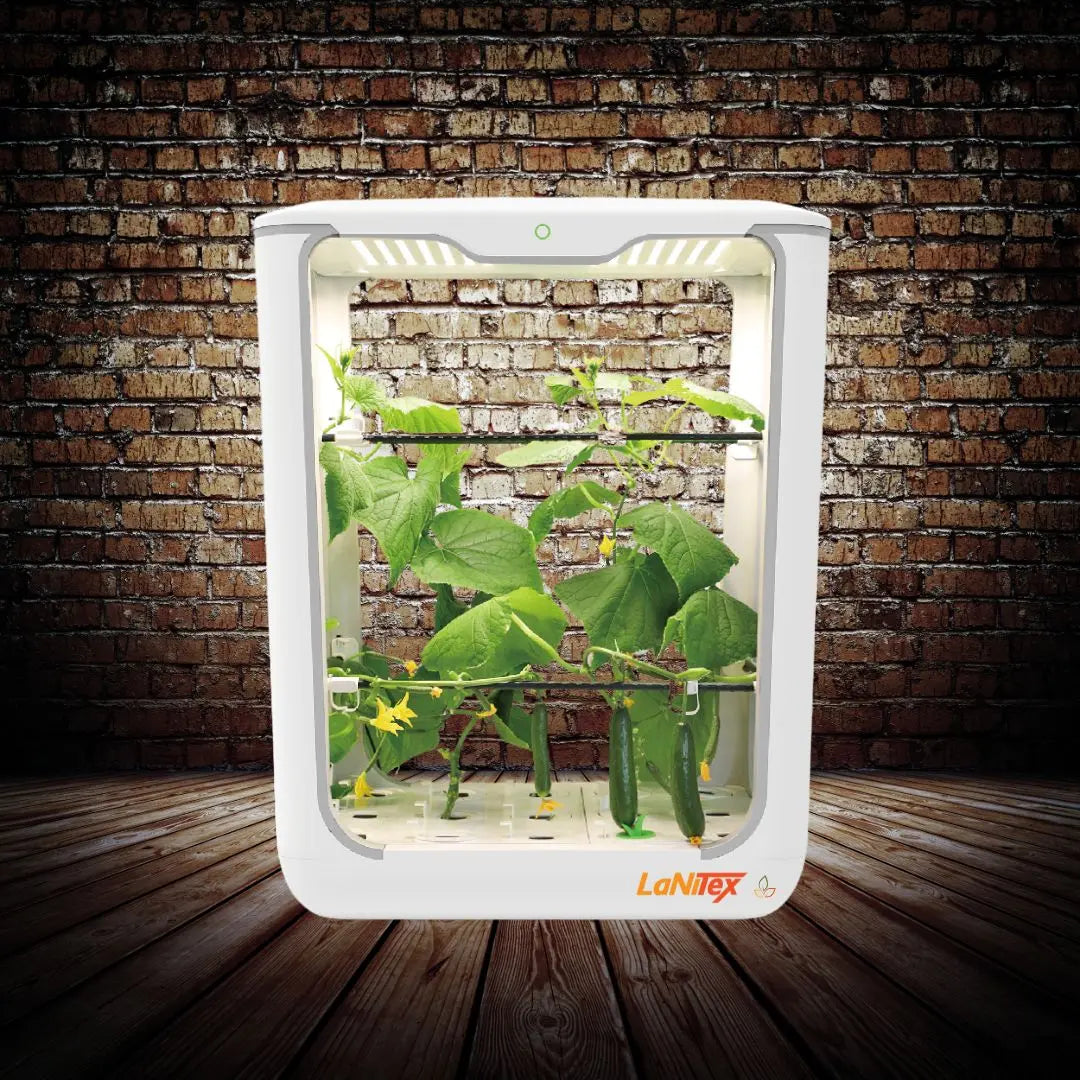
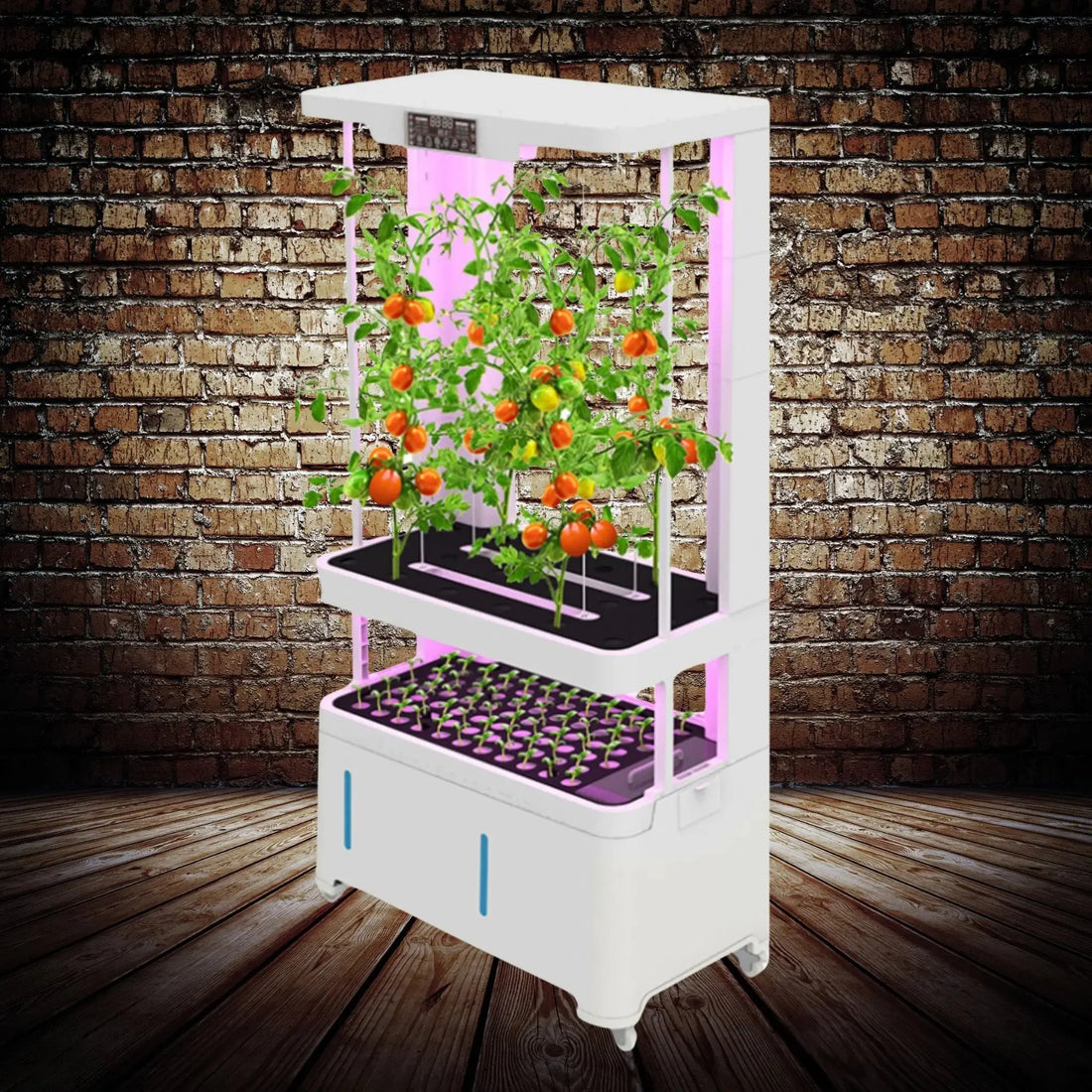
For most home growers on the Sunshine Coast, DWC is the simplest entry. The LaNiTex Grow Box Tall runs a DWC-style reservoir with up to 15 net pots, a 9-litre water capacity, and an LED panel rated up to 90 watts. You can stack up to four units if you want to scale up. At time of writing the Grow Box Tall stock is down to 9 units -- not pushing urgency, just noting it.

Grow your own juicing celery indoors, any season — the Grow Box Tall runs a DWC-style reservoir and full-spectrum LED, the steady water and light this thirsty cool-season crop wants. You transplant the seedlings.
Start your celery grow →Personally tested at home on the Sunshine Coast before listing.
Wikipedia defines NFT as a continuous-flow method where "a very shallow stream of water containing all the dissolved nutrients required for plant growth is recirculated in a thin layer past a bare root mat of plants." DWC works by "suspending the plant roots in a solution of nutrient-rich, oxygenated water." Both are well-suited to celery. The choice mostly comes down to your room layout.
Nutrient and environment ranges
Get these five numbers right and the plant does the rest. Here's the at-a-glance version; the detail follows.
| Parameter | Target for hydroponic celery |
|---|---|
| System | NFT or DWC (ebb-and-flow also works) |
| pH | 6.0-6.5 |
| EC | 1.8-2.4 mS/cm (1.8 as seedlings, ramp to 2.4 at stalk-up) |
| Light (PPFD) | 150-300 umol/m2/s (around 200 is the documented optimum) |
| Light period | 14-16 hours/day, full-spectrum LED |
| Air temperature | 15-23 degrees Celsius (cooler nights around 13 preferred) |
| Water temperature | 18-23 degrees Celsius |
| Humidity | 60-70 percent |
| Germination | 14-21 days |
| Seed to mature plant | 120-140 days |
| Harvest window | Staggered outer-stalk cuts for 4-6 months after maturity |
- pH: 6.0-6.5. Slightly acidic. Test weekly and adjust with pH-up or pH-down solution.
- EC: 1.8-2.4 mS/cm. Run on 1.8 during seedling weeks (first six weeks). Ramp to 2.4 once the stalks start thickening, around week 8-10. Higher EC drives stalk formation; lower EC during early growth prevents salt stress on young roots.
- PPFD: 150-300 umol/m2/s (peer-reviewed studies show around 200 umol/m2/s as the documented optimum for celery, so this range gives you slack). Full-spectrum LED, 12-16 hours per day (14-16 is common practice indoors). Below 150 the stalks tend to go thin and stringy; above 300 generally adds little extra yield.
- Temperature: 15-23 degrees Celsius air with cooler nights preferred (around 13 degrees Celsius); water 18-23 degrees Celsius. Sustained air temperatures in the mid-to-high 20s stress celery and can trigger bolting, especially after heat spikes. Indoor air-conditioning takes care of this on the Sunshine Coast and through Brisbane summers.
- Humidity: 60-70 percent. Lower than 50 risks tip burn; higher than 80 invites fungal issues in recirculating water.
Celery is a heavy feeder, especially for calcium, magnesium, and boron. These three drive stalk wall formation and prevent two of the most common defects: hollow stems (boron deficiency) and tip burn (calcium deficiency). Take care with boron though -- it has a narrow safety margin and over-dosing is toxic, so follow your fertiliser product's directions precisely. Use a hydroponic nutrient formula specifically labelled for leafy or fruiting vegetables, not a generic herb mix. Refresh the nutrient solution every one to two weeks; don't just top up. In small DWC reservoirs through QLD summer heat, monitor pH and EC every 2-3 days and be ready to change solution weekly during peak growth.
I won't pretend I haven't lost a few seedlings to early EC mistakes -- it took a couple of cycles before I trusted the meter and stopped second-guessing.
Cultivar picks for Australia
Three varieties suit Australian hydroponics. The Royal Horticultural Society describes them well.

- Tango -- "Reliable and fast growing. Tolerates less-than-ideal growing conditions and is resistant to bolting." Best beginner pick. Available in Australia through Eden Seeds and Greenpatch Organic Seeds.
- Tall Utah 52-70 -- "A tall variety that produces high yields of thick, crisp, stringless, pale-green stems." Premium juicing cultivar. Stocked by Diggers Club.
- Giant Pascal -- A heritage workhorse, tall stalks, classic celery flavour. Sold through Mr Fothergill's in Australia.
If you're just starting out, get Tango. It is the most forgiving cultivar I've grown. Once you have a few cycles under your belt and want premium juicing stalks, switch to Utah.
Propagation: growing from seed or regrowing celery from a stalk
Two options work.
Seed is the reliable route.
- Use rockwool cubes or peat plugs.
- Sow two to three celery seeds per hole, lightly pressed in (celery seed needs some light to germinate).
- Keep the rockwool moist at 21-24 degrees Celsius.
- Wait 14-21 days for germination -- celery is slow off the blocks.
- Once the seedlings are about 4 cm tall with true leaves, transplant into your net pots.
Yes, you can regrow celery from a cut stalk in water -- it is the fastest shortcut. Sit the bottom 5 cm of a celery bunch (with the base intact) in 1 cm of water in a shallow dish, and put it on a sunny windowsill. Inner new growth appears within a week. Once the new stalks are 5 cm tall, transplant the base into your hydroponic net pot with rockwool packed around it. This supermarket-base clone runs for one full harvest cycle (typically two to three months of stalks) before its energy reserves run out. Then go back to seed for a continuous supply.
Common issues and quick fixes
These six problems cover most of what goes wrong.
- Hollow stem: usually boron deficiency, but also linked to salinity, very rapid growth, and fluctuating moisture. Check EC first, then add a hydroponic boron supplement (or switch to a more complete nutrient brand). Avoid over-dosing boron -- the safety margin is narrow.
- Tip burn (brown leaf edges): calcium deficiency, often combined with low humidity. Boost calcium, raise humidity to 65 percent.
- Bolting (flower stalk shoots up): temperature spike above 25 degrees or a sudden cold snap below 10. Stabilise indoor temperature; once bolted, harvest immediately -- the stalks turn bitter fast.
- Crown rot (mushy base): water sitting in the crown, usually from over-misting or poor air circulation. Reduce humidity, add a small fan.
- Stringy thin stalks: insufficient light (PPFD below 150) or EC too low. Bump both.
- Green algae film (on the reservoir or channels): light reaching the nutrient solution, which lets algae compete with your celery for nutrients and oxygen. Block all light to the reservoir and pipes (a dark lid or foil sleeve), and rinse the reservoir out when you change the solution -- roughly weekly through peak growth.
Harvest: the staggered cut method
Celery takes roughly 120-140 days from seed to a fully mature plant, depending on the cultivar and your growing temperature. From about week 14 you can start a staggered outer-stalk harvest. Cut the outermost stalks at the base, leave the inner heart intact, and the plant keeps producing new stalks from the centre for another 4-6 months.
The RHS notes that "celery can become stringy and too strongly flavoured if it goes short of water." Hydroponic celery never goes short, which is why the texture stays crisp right through to the final harvest.
For juicing, cut stalks ten minutes before you press them. The flavour difference between supermarket celery (cut a week ago, refrigerated, partially dehydrated) and home-grown celery (cut minutes ago, full turgor) is the same difference as between dried herbs and fresh ones. Not subtle.
Want crisp, fresh juicing celery year-round without the wilting supermarket bunches? The LaNiTex Grow Box Tall runs celery start-to-harvest on your kitchen bench.

Growing more than a couple of plants at once? The V5.2-A Tower gives you up to 72 planting sites in the same floor space — a rolling celery crop without the sprawl. You supply the seedlings.
Scale up your grow →Personally tested at home on the Sunshine Coast before listing.
People also ask
If you have a few minutes more, four more questions come up regularly.
How many hours of light does hydroponic celery need indoors?
Fourteen to sixteen hours per day under full-spectrum LED at PPFD 150-300 umol/m2/s. Use a timer; consistency matters more than total hours.
How close should grow lights be to hydroponic celery seedlings?
Start LED panels 30-40 cm above seedlings. Drop to 20-30 cm once true leaves form. The Grow Box Tall has the LED panel fixed at the correct height, so this is automated for you.
Why are my hydroponic celery stalks thin and stringy?
Two likely causes: PPFD below 150 (light too low) or EC below 1.8 during stalk-formation weeks (not enough nutrient for thick stalk walls). Fix one variable at a time and give the plant two weeks to respond.
What can I grow alongside celery in the same hydroponic system?
Celery shares its sweet spot -- pH 6.0-6.5 and EC 1.8-2.4 -- with other cool-season leafy crops, so good companion plants for celery are lettuce, bok choy, parsley, and mint. Pair it with plants that want the same water chemistry and light, and avoid heavy fruiting crops (tomatoes, capsicum) that demand a much higher EC.
The full range
Find the system that fits your space


Supported in Australia - every model tested before listing.
FAQ
What is the best hydroponic system for growing celery at home?
Deep Water Culture (DWC) and Nutrient Film Technique (NFT) both suit celery. DWC handles celery's high water-uptake easily and works well at the LaNiTex Grow Box Tall scale; NFT is more space-efficient for vertical setups. Ebb-and-flow also works but adds complexity.
What EC and pH should I use for hydroponic celery?
Target pH 6.0-6.5 and EC 1.8-2.4 mS/cm for hydroponic celery in Australia. Run on the lower end (1.8) during seedling weeks and ramp to the upper end (2.4) once thick-stalk formation starts around week 8-10.
How long does hydroponic celery take to grow from seed to harvest?
Hydroponic celery takes 120-140 days from seed to mature plant in Australia. You can start outer-stalk staggered harvests from about week 14, and the plant keeps producing for another 4-6 months.
Can I grow celery hydroponically in a hot Australian summer?
Yes. Outdoor celery in subtropical Queensland is limited to the cooler months (typically April-September around Brisbane), and outside that window summer heat and humidity push outdoor crops toward bolting and disease. Indoor hydroponics with climate control keeps celery in the 15-23 degrees Celsius sweet spot year-round, giving you fresh stalks any time.
Which celery varieties grow best in hydroponics in Australia?
Tango (bolt-resistant, fast), Tall Utah 52-70 (thick stringless stalks, high yield), and Giant Pascal (heritage workhorse) all suit Australian hydroponics. Tango is the most forgiving for beginners; Utah for premium juicing stalks.
Sources
- Royal Horticultural Society, "Celery: how to grow your own" -- cultivar descriptions (Tango, Tall Utah 52-70), bolting and harvest guidance.
- Wikipedia, "Celery" -- Apium graveolens botanical classification, Dulce Group, cool-season history.
- Wikipedia, "Hydroponics" -- NFT, DWC, and ebb-and-flow system definitions.
- LaNiTex Hydroponic System Essentials guide -- pillar reference for hydroponic system fundamentals.
For other cool-season hydroponic crops, see our guides on hydroponic spring onions, hydroponic bok choy, and hydroponic beans.
About the writer
Laszlo Bulatko founded LaNiTex Hydro Garden in December 2024. He spent fifteen years in sales, marketing, and brand development in the Hungarian fishing tackle market -- representing brands including Okuma, Mustad, Savage Gear, Berkley, and Abu Garcia -- and helped build 12 percent market share through his earlier company, LaNiTex Kft. His earlier career started at IBM and Diageo in Hungary. The shift to hydroponics came from a simple match of values: home growers want what fishing enthusiasts want -- honest advice and equipment that does what it says.