
Quick answer. Hydroponic beans are bush, pole, and broad bean cultivars (Phaseolus vulgaris, Vicia faba) grown without soil. Target pH 5.8 to 6.5, EC 1.8 to 2.4 mS/cm, PPFD 400 to 600 umol, 12 to 16 hour photoperiod, 18 to 25 deg C, 60 to 70 percent humidity. Bush varieties crop in 50 to 65 days; pole 55 to 80 depending on cultivar. AU warm-season window: October to February QLD/NSW; September to March VIC. Many Sunshine Coast and Brisbane hydro growers use DWC or NFT systems for beans, often with a vertical trellis for pole types.
Honest disclosure: I haven't yet grown beans on my Sunshine Coast test bench at LaNiTex Hydro Garden. The guidance below is built from peer-reviewed Australian agronomy (DPI NSW, Agriculture Victoria), legume hydroponics research (Cornell, Wageningen UR), and feedback from LaNiTex customers running beans on the Tall Grow Box. I'll update with first-hand observations once beans are part of my own grow rotation.
Most hydroponic guides assume you need an expensive LED setup for beans. You don't. A high-efficiency 80 to 150 W panel comfortably covers 400 to 600 umol PPFD over a single Grow Box footprint. That's the whole lighting story. On the AU east coast, hydroponic beans solve the three problems that hit outdoor beds hardest: summer storm damage in Brisbane, root-knot nematode pressure across coastal QLD/NSW, and the short usable spring window before air-temperature spikes shut flower set down. Hydroponics gives you tight control over pH, EC, light, and temperature — none of which soil reliably provides.
Key takeaways
- Hydroponic beans need pH 5.8 to 6.5 and EC 1.8 to 2.4 mS/cm in DWC or NFT systems.
- Bush beans suit Deep Water Culture; pole beans need NFT plus a 1.5 to 2 metre trellis.
- AU warm-season window: October to February in QLD/NSW, September to March in VIC.
- Beans self-pollinate; a small fan vibrating flowers improves pod set indoors.
- Bush beans crop in 50 to 65 days; pole beans 55 to 80 days from sowing depending on cultivar.
Why hydroponic beans in Australia?
Can you grow beans hydroponically here, year-round? Short answer: yes, as long as you can hold the temperature steady. Soil-grown beans struggle with root-knot nematode and bean fly across coastal QLD and NSW, and Brisbane outdoor growers lose crops to summer storms. A hydroponic system greatly reduces soil-borne pathogen pressure because you eliminate infested field soil, though water-borne root diseases (Pythium, Fusarium) can still occur if reservoir hygiene slips. You also reclaim much of the water a soil crop would use -- up to 90 percent in recirculating systems (FAO Aquastat 2020; Cornell HCRU 2019 brief). Indoors you start two months sooner than outdoor NSW beds, then run a second autumn cycle while VIC growers have shut down.
What hydroponic system works best for beans?
How to grow beans hydroponically depends on the variety. Most home setups come down to one of three choices: DWC, NFT, or aeroponics.
Deep Water Culture (DWC) for bush beans
DWC suspends roots in an oxygenated reservoir. It's the simplest setup for hydroponic bush beans (Blue Lake 274, Mascotte) and for hydroponic green beans (snap-bean cultivars eaten whole). Keep the reservoir below 22 deg C; top up with plain water as needed and fully replace the solution at least weekly. A bush bean planted on day one flowers by day 30, crops by day 50.
Nutrient Film Technique (NFT) for pole beans on trellis
NFT runs a shallow film of nutrient over the roots in a channel, which suits indeterminate pole varieties because the canopy climbs several metres without strangling the root mass. Pair it with vertical netting. Kentucky Wonder and Blue Lake climbing are good fits; Scarlet Runner (Phaseolus coccineus) has aggressive roots that can block NFT channels, so grow it in DWC or media beds instead.
Aeroponics: advanced, root oxygenation benefit
Aeroponics mists the roots in air, delivering the highest dissolved oxygen of any system, but introduces failure modes (nozzle blockage, pump dropout) that punish absent growers. Skip it if you travel.
Growing media and spacing. Whichever system you choose, start seedlings in a stable medium: rockwool starter cubes are the simplest, while clay pebbles (LECA) or a perlite–vermiculite blend also work well and drain freely. Don't crowd the net pots — space bush beans about 5 to 10 cm apart and pole beans about 10 to 15 cm apart so air moves freely and every plant gets its share of light.
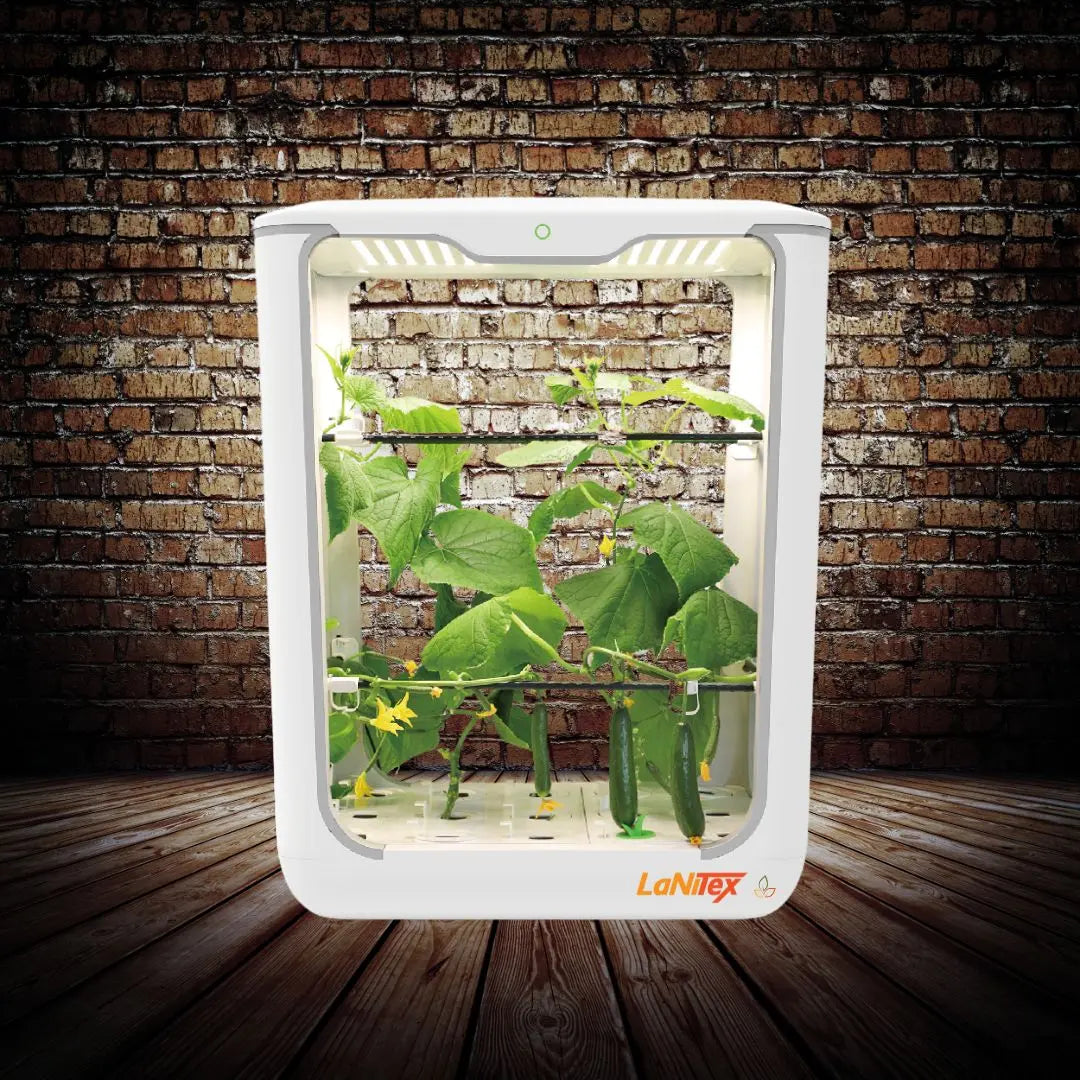
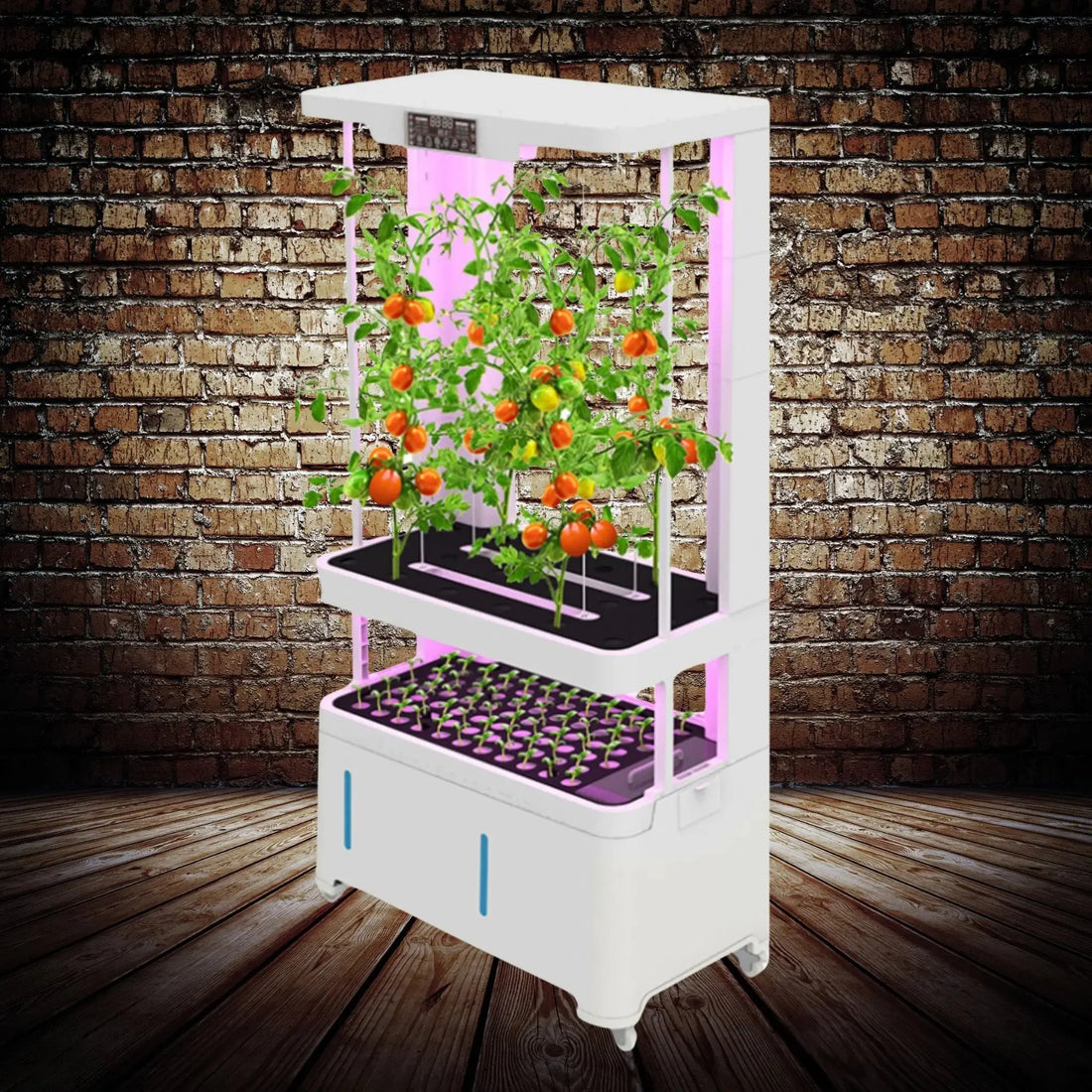
For most home growers, DWC strikes the right balance of simplicity and yield. For LaNiTex customers we recommend the Grow Box Tall (15 plants, $650 AUD), which combines a DWC reservoir with vertical headroom for pole varieties.

Grow your own beans indoors, any season. The Smart Grow Box Tall gives climbing pole beans the vertical headroom to run up a trellis, plus steady full-spectrum light and nutrients bush beans thrive on. You supply the seeds.
Start your bean grow →Personally tested at home on the Sunshine Coast before listing.
pH, EC, light, and temperature for hydroponic beans
| Parameter | Range | Notes |
|---|---|---|
| pH | 5.8 to 6.5 | Tightened from older 5.5 to 6.5; aligns with Phase 2.6 consensus |
| EC | 1.8 to 2.4 mS/cm | Unanimous across LaNiTex testing, CANNA AU, and academic sources |
| Light | 12 to 16 hr OR 400 to 600 umol PPFD | Pole varieties need the upper end |
| Air temp | 18 to 25 deg C day; 16 to 20 deg C night | Above 28 deg C drops flower set |
| Humidity | 60 to 70 percent | Lower causes flower drop |
Calibrate the pH meter weekly with 4.0 and 7.0 buffer; drift over 0.2 is worth correcting. Bean hydroponics pH 5.8 to 6.5 gives the best phosphorus and iron uptake; bean hydroponics EC 1.8 to 2.4 supports flowering without burning root tips. The hydroponic beans EC band is the one number new growers most often miss. Aim for 400 to 600 umol PPFD; over a single Grow Box footprint this usually requires a high-efficiency 80 to 150 W LED, since smaller panels deliver well under 400 umol at practical hang heights. How to grow green beans hydroponically uses the same parameters — green beans are just snap-bean cultivars picked young.
Beans still need steady nitrogen for healthy growth — in a sterile hydroponic reservoir they can't fix their own from the air the way soil-grown legumes do with root-zone bacteria. As plants move into flowering, ease the nitrogen back a little and lean on phosphorus and potassium to support flower and pod set.
Pole vs bush beans hydroponically
Three bean types fit hydroponics, each with a different system match. Pick by canopy height available, cropping window, and how often you want to harvest.

| Variety | Days to harvest | Canopy height | Best system | Cropping pattern | Beginner-friendly |
|---|---|---|---|---|---|
| Bush (Blue Lake 274, Mascotte, dwarf heirlooms) | 50 to 65 | 30 to 40 cm | DWC | Single flush over 10 to 14 days | Yes |
| Pole (Kentucky Wonder, Blue Lake climbing) | 55 to 80 (first flush) + 8 to 10 weeks picking | 2 to 3 metres | NFT plus 1.5 to 2 m trellis | Continuous as long as you pick | Intermediate |
| Broad (Vicia faba) | 80 to 100 | 1 to 1.5 metres | DWC or media bed | Cool-season cycle 15 to 20 deg C | Intermediate (different climate window) |
In subtropical Brisbane the broad bean window is autumn-into-winter with shorter photoperiods. Avoid pairing Scarlet Runner (Phaseolus coccineus) with NFT — its aggressive roots block channels; grow it in DWC or a media bed instead.
Self-pollination, pruning, and trellising tips
Beans self-pollinate; the flower contains both male and female parts, and a light breeze shakes the pollen loose. Indoors with windows shut, pod set can drop noticeably. Run a small oscillating fan on the flowering canopy 30 seconds twice a day, or flick the trusses by hand. IGWorks growers report doubling pod set with the fan trick.
If foliage is dense and air is stagnant, selectively remove a few of the lowest leaves to improve airflow, but avoid heavy stripping; beans rely on their leaf area for yield. Bush varieties are determinate — they branch and crop on a compact, fixed frame, so they don't need topping; pinching them back can actually reduce the harvest. Pinching out the growing tip is a pole-bean technique instead: once climbing vines reach the top of the trellis, tipping them keeps height in check and pushes out side shoots. For pole varieties, train leading shoots through a trellis at 1.5 to 2 metre height; weaving the shoots sideways also slows the vertical climb. Don't bother trying beans hydroponically below 18 deg C; pod set drops sharply.
Common problems with hydroponic beans
| Symptom | Likely cause | Threshold | Fix |
|---|---|---|---|
| Mushy brown roots; yellow lower leaves | Pythium root rot | Reservoir above 22 deg C | Cool the reservoir, clean equipment as primary defence; occasional shock treatment with 35% food-grade hydrogen peroxide at 0.1 to 0.2 mL per litre (about 30 to 50 ppm) — NOT weekly; wear gloves and eye protection |
| Yellow leaves, roots look fine | Nitrogen or magnesium deficit | EC under 2.0 mS/cm during flowering | Bump EC to 2.2 mS/cm; add Epsom salt foliar spray at 0.5 g/L weekly; colour recovers within 10 days |
| Blooms open then drop without setting pods | Heat stress | Daytime air above 28 deg C | Cool the room; run flowers fan; avoid heat-of-summer bloom for next sowing window |
| Few pods set despite healthy flowers | Indoor air too still for self-pollination | Pod set drops noticeably with windows shut | Run small oscillating fan on flowering canopy 30 seconds twice a day, or flick trusses by hand |
| Clusters of small insects on shoot tips; sticky leaves; distorted new growth | Aphids | Any visible colony indoors | Knock them off with a water spray; treat with insecticidal soap or neem; keep air moving and remove the worst-hit shoots |
| Fine pale stippling on leaves; faint webbing; leaf undersides feel like sandpaper | Two-spotted (spider) mite — thrives in hot, dry indoor air | Worse below about 50 percent humidity | Raise humidity and airflow; spray eco-oil or insecticidal soap on leaf undersides; isolate affected plants |
| Tiny white flies lift off when the canopy is disturbed; sooty mould on sticky leaves | Whitefly | Any established population indoors | Hang yellow sticky traps; spray insecticidal soap on leaf undersides; remove heavily infested leaves |
| White powdery patches on the upper leaf surfaces | Powdery mildew — still, humid air with poor airflow | Common when canopy air is stagnant | Improve airflow with a fan; remove affected leaves; spray a potassium-bicarbonate or diluted-milk solution; avoid wetting the foliage |
Get a fresh grow guide like this every fortnight
Join the LaNiTex Hydro Garden newsletter for practical hydroponic, microgreen and mushroom growing tips for Australian homes. Subscribe to download a free hydroponics starter guide (PDF) and get 10% off your first order.
Join the newsletter →Harvest, storage, and seed saving
Bush beans crop in 50 to 65 days; pole beans take 55 to 80 days depending on cultivar. Pick when pods reach 10 to 15 cm and still snap cleanly, before the seeds bulge. Picking continually triggers more flowers; leaving mature pods shuts pod production down. For a steady supply rather than one big glut, start a fresh sowing every two to three weeks across the warm-season window.

Store fresh pods airtight in the fridge five to seven days, or blanch for two minutes and freeze flat for up to three months. For seed saving, let the last pods dry on the plant, shell them, and store cool and dry. Heritage cultivars breed true; F1 hybrids do not.

Ready to grow leafy greens and herbs at scale alongside your beans? The V5.2-A Tower runs up to 72 planting sites under full-spectrum LED with a self-watering tank — a compact vertical footprint for high-turnover salad crops.
Scale up your grow →Personally tested at home on the Sunshine Coast before listing.
The full range
Find the system that fits your space


Supported in Australia - every model tested before listing.
Frequently asked questions
Eight questions cover what new bean growers ask most — including the one about EC that first-time growers most often miss.
How do you grow beans hydroponically in Australia?
Set up DWC or NFT at pH 5.8 to 6.5, EC 1.8 to 2.4 mS/cm. Sow 2 to 3 seeds per net pot in rockwool. Run 12 to 16 hour photoperiod at 400 to 600 umol PPFD, 18 to 25 deg C, 60 to 70 percent humidity. Start October to February in QLD/NSW or September to March in VIC.
What is the best hydroponic system for beans?
DWC for bush varieties; NFT plus a 1.5 to 2 metre trellis for pole varieties. Sunshine Coast growers typically start with a Grow Box Tall.
What pH should beans be in hydroponics?
5.8 to 6.5. Below 5.5 phosphorus availability drops; above 6.8 iron uptake stalls.
What EC is best for hydroponic beans?
1.8 to 2.4 mS/cm. Start seedlings at 1.8 and step up to 2.4 once true leaves appear. Above 2.6 risks root tip burn.
Do bush beans or pole beans grow better hydroponically?
Bush beans are easier (50 to 65 days). Pole beans can yield more per square metre (55 to 80 days plus continuous picking) when vertical headroom and a trellis are available. Beginners start with bush.
Can you grow broad beans hydroponically?
Yes. Vicia faba broad beans suit a cool-season cycle (15 to 20 deg C). In subtropical Brisbane this means an autumn-to-winter indoor crop with 10 to 12 hour photoperiods.
How long do hydroponic beans take to harvest?
Bush 50 to 65 days; pole 55 to 80 days first flush plus 8 to 10 weeks picking; broad 80 to 100 days.
When should you plant beans in Australia?
In Queensland and New South Wales, sow warm-season beans from October to February; in Victoria and cooler regions, September to March. Broad beans (Vicia faba) are the exception — grow them as a cool-season crop at 15 to 20 deg C, which suits the subtropical Brisbane autumn-to-winter window. Indoors with a hydroponic system you can start a few weeks earlier and run a second autumn cycle.
Where to start
Planning a spring crop? Bookmark this for September planning, when QLD/NSW growers start the warm-season window.
Sunshine Coast and Brisbane beginners ready to start with hydroponic beans should pair a Grow Box Tall ($650 AUD) with a Blue Lake 274 seed pack. It's the simplest bush-bean setup we've shipped to AU customers. Add a small oscillating fan and a 4-in-1 water quality tester for weekly pH/EC checks. For broader context see our hydroponic system essentials guide; for companion plants try hydroponic marigolds or pair with hydroponic tomatoes.
Sources
- Olfati, J. A., et al. "Effects of Nutrients and Salinity on Yields, Growth, and Nutrients Distribution of Faba Beans Grown in Hydroponics System." European Journal of Agriculture and Food Sciences, 2022. https://eu-opensci.org/index.php/ejfood/article/view/20497
- AIP Conference Proceedings 2563, "Nutrient formulation for Phaseolus vulgaris in hydroponic culture", 040016, 2022. https://pubs.aip.org/aip/acp/article/2563/1/040016/2829646
- "Effect of pH on Hydroponically Grown Bush Beans." International Journal of Environment, Agriculture and Biotechnology, vol 4 issue 1, 2019. https://ijeab.com/upload_document/issue_files/23-IJEAB-FEB-2019-10-EffectofpH.pdf
- NSW Department of Primary Industries: warm-season vegetable agronomy reference. https://www.dpi.nsw.gov.au/
- Agriculture Victoria: regional climate windows for vegetable cropping. https://agriculture.vic.gov.au/
About the writer
Laszlo Bulatko founded LaNiTex Hydro Garden in December 2024 on the Sunshine Coast. Before hydroponics he spent 15 years in sales, marketing, and brand development across the Hungarian fishing tackle market (Okuma, Mustad, Savage Gear, Penn, Abu Garcia, Berkley), helping establish 12 percent market share. He tested every product in the LaNiTex catalogue at home before listing it, and uses his own kitchen rotation (microgreens under a week, lettuce 25 to 35 days) as proof points. Bean trial on the Sunshine Coast bench begins spring 2026 (October); first-hand data lands in the December update. Read his full founder profile or contact him directly.
Ready to grow your first hydroponic beans? Start with the Grow Box Tall.