
Ever bitten into a winter supermarket tomato and tasted almost nothing? Shop-bought tomatoes travel for weeks and ripen in trucks, not on the vine. There is a better way, and it needs no backyard.
Quick answer: grow hydroponic tomatoes by rooting them in an inert medium like rockwool or coco coir, feeding a nutrient solution at pH 5.5-6.5 and EC 1.1-2.0 mS/cm, and giving the canopy 400-800 umol/m2/s of light for 14-18 hours a day. Indoors, you also hand-pollinate the flowers.
Hydroponic tomatoes are tomatoes grown without soil, their roots fed a controlled nutrient solution instead. For a home grower in Brisbane or on the Sunshine Coast, that means vine-ripe fruit through winter, indoors. There is no garden bed required and no wait for the right season.
I started growing tomatoes hydroponically on the Sunshine Coast because I wanted flavour I could not buy. The pay-off is control: you set the feed, the light and the warmth, so the plant never stalls. It is not the cheapest way to grow a tomato. But few things beat picking a warm cocktail tomato in July.
So what exactly are these soilless tomatoes, and why does the method suit them so well? Start with the plant itself.

What are hydroponic tomatoes?
Basically, hydroponic tomatoes are just ordinary tomato plants (Solanum lycopersicum) grown without soil. The roots sit in an inert medium or a bare channel, and a water-based nutrient solution feeds them directly. The tomato belongs to the nightshade family (Solanaceae) and is a warm-season crop. So it wants plenty of light, a steady feed and real warmth to do well. Its close cousin the hydroponic eggplant is, likewise, another warm-season nightshade you grow the same way.
That is exactly why soilless growing suits it. Can you grow tomatoes hydroponically? Yes - in fact, hydroponic tomato plants often crop earlier and cleaner than the same variety in soil, because food and water go straight to the roots. As a result, you dodge soil-borne disease and grow indoors, out of season.
Of course, not every variety earns its space under lights. On the whole, the best tomatoes to grow hydroponically are compact, heavy croppers. For example, choose truss and cherry tomatoes, cocktail types for flavour, roma for cooking, and beefsteak if you have the height. For that reason, most serious indoor growers pick indeterminate tomatoes for hydroponics, because a vine that keeps growing keeps fruiting for months.
Best growing conditions for hydroponic tomatoes
In general, tomatoes reward precision. Get these numbers right and the plant almost grows itself.
| Parameter | Target range |
|---|---|
| pH | 5.5-6.5 |
| EC (vegetative) | 1.1-2.0 mS/cm |
| EC (fruiting) | 1.8-2.3 mS/cm |
| Light level (PPFD) | 400-800 umol/m2/s |
| Light hours | 14-18h vegetative, easing to 12-16h fruiting |
| Air temperature | 26-28C day / 20-23C night |
| Solution temperature | 18-22C |
| Humidity | 50-60% |
To begin with, keep the nutrient solution at pH 5.5-6.5 so the roots can take up what you feed them. Next, run the electrical conductivity (EC) around 1.1-2.0 mS/cm while the plant is leafy and vegetative. Then lift it to about 1.8-2.3 mS/cm once flowering and fruiting begin. Fruiting tomatoes are heavy feeders, so many growers push it higher on an established plant - watch the plant, not just the meter. In practice, most hydroponic tomato nutrients sold in Australia come as a two-part A and B mix.
Light is the other lever. Likewise, aim for a canopy light level (PPFD) of 400-800 umol/m2/s. Brighter is better inside that band, of course, though tomatoes still need a nightly rest.
Warmth matters too. Tomatoes like air around 26-28C by day and 20-23C at night, with humidity near 50-60 per cent. At the same time, hold the nutrient solution itself at 18-22C and keep it oxygenated with an air stone. After all, warm, still, low-oxygen solution is where root rot starts. For the roots, rockwool and coco coir are the two workhorse media - both are inert and hold moisture and air.
Get a fresh grow guide like this every fortnight
Join the LaNiTex Hydro Garden newsletter for practical hydroponic, microgreen and mushroom growing tips for Australian homes. Subscribe to download a free hydroponics starter guide (PDF) and get 10% off your first order.
Join the newsletter →Starting your tomato seedlings
In either case, tomatoes begin the same way whatever system you choose. Sow seed into a moistened rockwool cube or starter plug and keep it warm, around 22-25C. Then it should sprout in roughly five to ten days. As soon as the first true leaves appear, sit the seedling right under your grow light so it grows stocky rather than leggy and stretched.
White roots will start to poke through the base of the cube. Once the plant is a few centimetres tall, move it into your system. Instead, drop the whole cube into the net pot or channel so you never tease the roots apart. Feed a weaker solution at first, nearer the low end of the EC range. Then build it up as the plant establishes and starts to climb.
My experience growing tomatoes on the Sunshine Coast
Forget the pale supermarket tomatoes you get in winter. Imagine harvesting fragrant, sweet cocktail tomatoes from a professional hydroponic unit in your own kitchen, at any time of the year. In truth, growing a fruiting plant indoors does take more attention and more precise equipment than leafy greens. But the result is worth every bit of the effort. Here are the most important steps to get your own system groaning under the weight of its harvest.
So far, I have grown tomatoes here in two of our own units. For example, in the Grow Box Tall, the extra headroom lets a cocktail vine climb and truss up without constant pruning. In the larger V5.2-T, I ran a couple of plants on the nutrient-film channels. Both worked; in short, the difference was space and how many plants I wanted to look after at once.

Choosing a hydroponic system for tomatoes
So which system should you actually use? For tomatoes at home, three approaches come up again and again. If you are new to soilless growing, our guide to hydroponic system essentials walks through the main types first.
| System | Pump | Cost | Best for |
|---|---|---|---|
| Kratky | None | Low | A single plant; beginners |
| NFT | Yes | Mid | Several tidy plants |
| Drip | Yes | Higher | Precise, commercial-style feeding |
For instance, the Kratky method is the simplest: a sealed tub of nutrient solution, no pump, roots half in liquid and half in air. So it is a cheap way to run a kratky hydroponic tomatoes setup for a single determinate plant. A big indeterminate vine, though, drinks a reservoir dry fast.
NFT (nutrient film technique) runs a thin, constant stream of solution down sloped channels past bare roots. Meanwhile, an NFT system for tomatoes Australian growers like because it is tidy and scales to several plants. But a pump failure on a hot day is unforgiving.
Finally, a drip system feeds each plant through a dripper into rockwool or coco coir. Drip system hydroponic tomatoes get precise, repeatable feeding, which is why most commercial glasshouses use it - it just needs more parts.
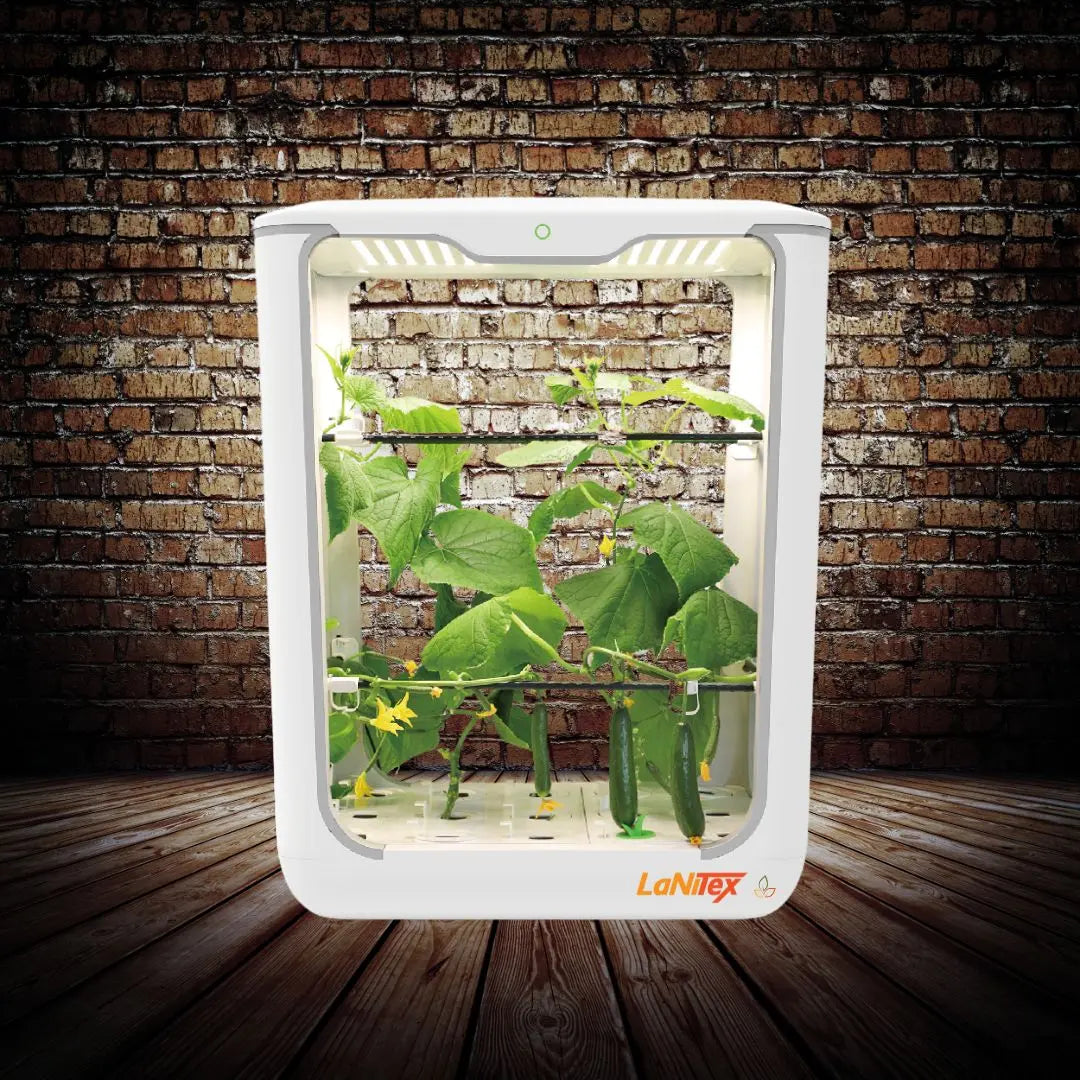
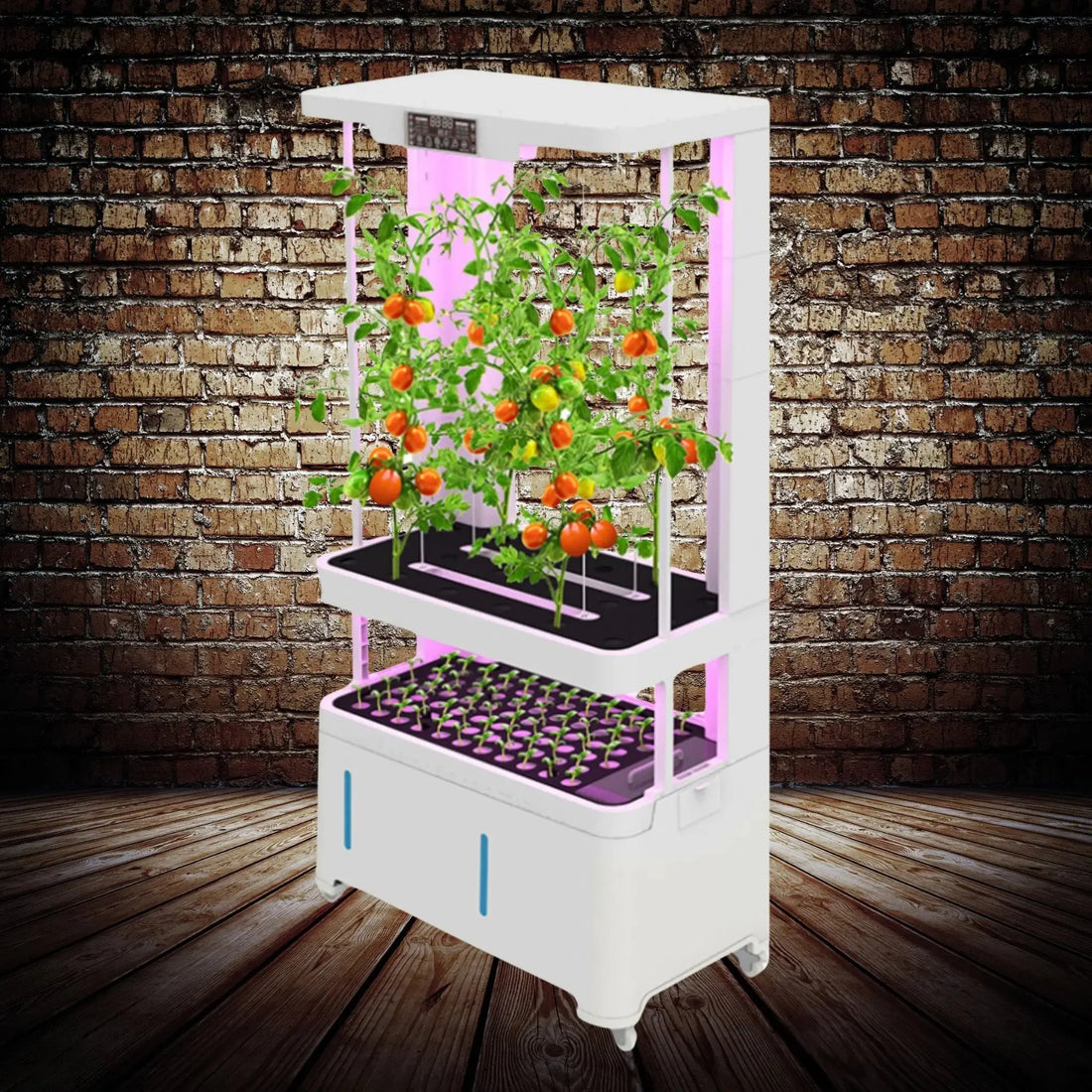
For most home growers who want to grow tomatoes hydroponically indoors, a self-contained unit takes the guesswork out. Our Grow Box Tall is built for this: a taller cabinet with the light, tank and pump matched, so a single vine has room to climb. It is self-watering from its tank, though in practice you still top it up. Step up to the V5.2-T instead for more planting sites and several plants at once.

Grow a full tomato vine indoors without the guesswork. The Grow Box Tall matches the grow light, tank and pump in one taller cabinet and self-waters from its tank between top-ups - you add the seedling and the feed.
Start growing tomatoes →Personally tested at home on the Sunshine Coast before listing.

Pollinating and caring for indoor tomatoes
Here is the step most indoor growers miss. Outdoors, wind and bees shake pollen loose; inside there is neither. So you pollinate by hand. Once flowers open, tap or gently vibrate each truss every day or two - an electric toothbrush against the stem works a treat. No buzzing, no fruit. Our step-by-step hand pollination guide covers the exact routine.

Also, give the plant a daily dark period. Tomatoes are not lettuce. Running lights 24 hours a day stresses them. So aim for roughly 14-18 hours of light in vegetative growth. Ease toward 12-16 hours once fruiting begins, and give a genuine night.
Then prune as you go. An indeterminate vine throws side shoots (laterals) from every leaf joint - pinch most out so the plant feeds fruit, not foliage.
Also, support the vine before it needs it. An indeterminate tomato grows tall and top-heavy once fruit sets, so give it something to lean on early. Run a length of soft string from an overhead bar down to the base and wind the growing stem around it as it climbs, or tie the stem to a stake with soft ties - tomato clips make this quick. Commercial growers "lower and lean", letting the string out and leaning the stem along the row as it lengthens; at home, simply clipping or tying the main stem every 20-30cm stops a heavy truss snapping the plant. The RHS notes that cordon (indeterminate) tomatoes need tall supports and regular side-shoot removal.
Water consistency is the quiet hero. The RHS notes that even moisture helps prevent fruit splitting and blossom-end rot. It also notes that tomatoes want a high-potassium feed once the fruit starts to swell. In a hydroponic system that is easy: keep the tank topped up and the EC steady.
Top the tank up as the plant drinks, but do not just keep topping up forever. As the water level falls the leftover salts concentrate and the balance drifts, so refresh the whole reservoir every one to two weeks: tip the old solution out, give the tank a quick rinse, and mix a fresh batch to your target pH and EC. On a fruiting plant that is drinking hard, change it a little more often.
Common problems
For example, yellowing or curling leaves usually mean the feed is off - too weak, too strong, or a pH drifted out of the 5.5-6.5 band. First, check the meter before you blame the plant.
Similarly, blossom-end rot, the sunken brown patch on the base of the fruit, is a calcium-uptake problem from erratic watering or a swinging EC. Generally, steady feeding fixes most of it.
Pests find indoor tomatoes too. The usual suspects are sap-sucking insects such as whitefly, aphids and two-spotted (red) spider mite, plus fungus gnats whose larvae live in constantly damp media. Check the undersides of the leaves each time you tend the plant; caught early, most of an outbreak wipes or hoses off before it spreads. Even so, good airflow from a small fan and not overwatering the media keep the numbers down.
Disease indoors is mostly about damp, still air. Grey mould (Botrytis) and powdery mildew appear when humidity sits high and the canopy is crowded. So thin the leaves and keep the air moving. Root rot starts in warm, stagnant, low-oxygen solution - the reason that air stone and an 18-22C tank matter. The RHS lists glasshouse whitefly, tomato blight and grey mould among the common tomato problems to watch for.
Timing catches people out too. From seed, a hydroponic tomato takes roughly three to four months to first harvest, so in Queensland you can sow in late autumn or winter for indoor fruit while the shops sell pale, out-of-season ones.
Harvesting and storing your tomatoes
Pick tomatoes when they are fully coloured and give slightly to a gentle squeeze - that is when the flavour peaks. Then twist or snip each fruit off with a little of the stalk still attached. If you need to clear a truss before the plant tires, pick fruit that has just started to colour and let it finish ripening on the kitchen bench; a ripe banana sitting nearby speeds it along.
Also, keep ripe tomatoes at room temperature, not in the fridge - cold flattens the taste and turns the flesh mealy. A well-fed, well-supported indeterminate vine keeps setting new trusses for months. So a single healthy plant can yield several kilograms of fruit across a season, picked a handful at a time.


Want to run several tomato plants at once? The V5.2-T uses nutrient-film channels with more planting sites, so you can grow a row of vines side by side and feed them from one tank.
Grow more tomatoes →Personally tested at home on the Sunshine Coast before listing.
The full range
Find the system that fits your space


Supported in Australia - every model tested before listing.
Frequently asked questions
How do I start growing hydroponic tomatoes at home in Australia?
Start small: one compact, indeterminate cherry or cocktail variety in a self-contained unit or a Kratky tub. Then germinate seed in rockwool, move the seedling into your system, set pH to 5.5-6.5 and EC near 1.2 mS/cm, and give it 14-18 hours of light a day. Finally, in Queensland, sow in autumn or winter to beat the out-of-season tomatoes in the shops.
What EC and pH should I use for hydroponic tomatoes?
First, keep the nutrient solution at pH 5.5-6.5 for the whole crop. Then run EC around 1.1-2.0 mS/cm while the plant is vegetative, and lift it to 1.8-2.3 mS/cm once it flowers and fruits. Tomatoes are heavy feeders, so established plants can take the higher end - adjust to the plant, not just the meter.
How many hours of light do hydroponic tomatoes need under grow lights?
Give hydroponic tomatoes about 14-18 hours of light a day in vegetative growth, easing toward 12-16 hours once fruiting begins, aiming for a canopy PPFD of 400-800 umol/m2/s, then a real dark period. Unlike leafy greens, tomatoes need that nightly rest - running lights 24 hours a day stresses the plant and does not speed up fruiting.
Which tomato varieties grow best in hydroponic systems in Australia?
Compact, heavy croppers do best, such as truss and cherry tomatoes, cocktail varieties for flavour, and roma for cooking. Indeterminate varieties keep fruiting for months, which suits an indoor system; a dwarf determinate type fits a small Kratky tub. Even so, beefsteak works if your unit is tall enough for the fruit weight.
How long do tomatoes take to grow?
Generally, expect roughly three to four months from seed to your first ripe tomato, depending on variety, light and warmth. Cherry and cocktail types come in fastest; large beefsteak fruit takes longer. Hydroponic plants tend to hold that schedule better than garden beds, because steady light, warmth and nutrients keep growth on track — outdoors, cold snaps and irregular watering can stretch the timeline.
What hydroponic system is best for tomatoes - Kratky, NFT or drip?
For one plant with no pump, Kratky is the easiest and cheapest, in fact. NFT suits several tidy plants but is unforgiving if the pump fails. Drip feeding is the most precise and is what commercial glasshouses use. So for most home growers, a self-contained cabinet removes the guesswork.
Why are hydroponic tomatoes grown in a small root zone?
Because the nutrient solution is delivered straight to the roots, a hydroponic tomato does not need a large root system to search for water and food. Growers use a small root zone, such as a rockwool cube or slab, a bag of coco coir or a net pot. A 2019 review of soilless growing in the journal Agronomy notes that a limited root volume supports a comparable, sometimes larger, plant above. The catch is that there is hardly any buffer, so the feed and watering have to stay steady.
Why are my hydroponic tomato leaves yellowing or curling?
Yellowing or curling leaves usually point to the feed: too weak, too strong, or a pH drifted out of 5.5-6.5 that locks out nutrients. First, check your EC and pH meters. Curling can also be heat stress if the canopy runs hotter than about 28C, so improve airflow.
Can you grow tomatoes hydroponically in winter?
Yes. That means growing indoors under lights takes the season out of it, and a hydroponic tomato crops right through winter while the shops sell pale imports. In effect, you control the warmth, light and feed, not the weather. In Queensland, sow in late autumn or winter for fruit through the cold months.
Can tomatoes grow in shade or low light?
Not well - tomatoes are sun-hungry and turn leggy and fruitless in shade. Indoors, a grow light does the sun's job instead: aim for a canopy PPFD of 400-800 umol/m2/s for 14-18 hours a day. Overall, bright, consistent light is what turns the flowers into fruit.
What nutrients or fertiliser do hydroponic tomatoes need?
Use a two-part A and B hydroponic nutrient, not a garden fertiliser. Run EC around 1.1-2.0 mS/cm while the plant is leafy, then lift it to 1.8-2.3 mS/cm once it flowers, when tomatoes want more potassium. Then keep the solution at pH 5.5-6.5 so the roots can take it up.
Can you grow tomatoes in pots, or is a hydroponic system better?
Certainly, you can grow a tomato in a large pot, but it means constant watering and guesswork on feed. A self-contained hydroponic unit holds the light, feed and water steady from one tank, so an indoor vine crops more reliably - especially through winter. Otherwise, for a single plant, a simple Kratky tub is the easiest start.
About the writer
Laszlo Bulatko founded LaNiTex Hydro Garden in December 2024 and grows his hydroponic systems at home on the Sunshine Coast in Queensland. He began his career at IBM and Diageo in Hungary, then spent 15 years in sales, marketing and brand development in the Hungarian fishing-tackle trade, working with brands like Okuma, Mustad, Abu Garcia and Berkley and building them to a 12 per cent market share. His own grows now run from microgreens in under a week to lettuce in 25-35 days, with capsicum and herbs year-round. Through the Term-Grow Enrolment programme he also puts grow boxes into Queensland primary school classrooms. Read more on the about Laszlo Bulatko page.
Sources
- Tomato botany (Solanum lycopersicum, nightshade family Solanaceae, warm-season crop): NC State Extension - Solanum lycopersicum
- Growing conditions, even moisture to prevent splitting and blossom-end rot, high-potassium feeding, cordon supports and side-shoot removal, and common pests and diseases (glasshouse whitefly, tomato blight, grey mould): RHS - Tomatoes
- Limited root volume in soilless culture, a reduced root system for a comparable or larger plant, and little buffer against mistakes: Gruda (2019), Agronomy 9(6), 298
Figures for pH, EC, PPFD, temperature, humidity and yield are general hydroponic guidance ranges - treat them as starting points and adjust to your own plants.