
Published: 25 May 2026 | Last updated: 26 June 2026 | Author: Laszlo Bulatko, founder LaNiTex Hydro Garden
Growing chrysanthemum hydroponically in Australia opens a year-round flowering window. Compact pot-mum cultivars at 20 to 30 centimetres in height thrive under LED indoor systems from the Sunshine Coast to Brisbane, sidestepping the December humidity that wrecks outdoor garden displays.
Quick answer: Hydroponic chrysanthemum cultivation is growing mums in nutrient-fed water systems rather than soil. Australian indoor growers use it for year-round cut flowers in compact spaces. The three controls that matter most are pH (5.6 to 6.3), EC (1.6 to 2.2 mS/cm) and a 12-to-14-hour dark photoperiod trigger. All three are easier to dial in indoors than outdoors. No surprises from the weather.
Key takeaways
- pH: 5.6 to 6.3 vegetative, up to 6.5 during flowering
- EC: 1.6 to 2.2 mS/cm vegetative, up to 2.5 at peak bloom
- Light: PPFD 250 to 450 micromoles per square metre per second
- Flowering trigger: 12 to 14 hours of darkness daily
- Best cultivar size: 20 to 30 centimetres compact pot-mum
This guide covers parameter ranges, system choices, and crop technique for hydroponic chrysanthemum in a Maroochydore-to-Brisbane kitchen.
Why grow chrysanthemums hydroponically in Australia?
Outdoor chrysanthemum displays on the Sunshine Coast take heavy damage during humid summer weeks, when December relative humidity often climbs above 75% (Bureau of Meteorology Maroochydore monthly average 77%). Botrytis blight wrecks blooms and yellows leaves under those conditions. An indoor hydroponic setup sidesteps the problem; year-round flowering happens regardless of what the Brisbane summer throws at the patio.
Hydroponic mums also outyield soil-grown ones. Ai et al. 2021, in BMC Plant Biology, found that "Yield and the total flavonoids and chlorogenic acid contents of chrysanthemum flowers were higher in the hydroponic culture system than in the soil system." Their measured uplift in a laboratory-scale trial was 37.89% by dry weight. Sustainable Gardening Australia adds that "Farms utilizing hydroponics use up to 90 percent less water" than soil, which matters during a Queensland drought summer.
For an apartment or small QLD house, you get outdoor performance compressed into a kitchen footprint. Much lower Botrytis risk. No waiting for September planting.
What pH, EC, and light targets work for hydroponic chrysanthemums?
The ranges below are based on general hydroponic protocols and adjacent cut-flower research applied to chrysanthemum. Precise stage-specific data for chrysanthemum hydroponics is sparse, so treat these as a starting point and dial in by watching your own plants.
Hydroponic chrysanthemums perform best at pH 5.6 to 6.3 during vegetative growth, rising to 6.5 at peak flowering. Test the nutrient solution twice a week with a calibrated pH meter, and adjust with pH-up or pH-down rather than chasing the drift.
pH and EC ranges
Vegetative-stage EC sits at 1.6 to 2.2 millisiemens per centimetre. Once flower bud-set begins, scale EC up to 2.5 mS/cm. Push EC above 2.5 too early and you get leaf burn within three days that you cannot reverse.
Match the nutrient mix to the stage, not just the EC number. Run a higher-nitrogen vegetative formula while the plant is building leaf and stem, then switch to a lower-nitrogen, higher-phosphorus-and-potassium bloom formula once bud-set begins. The EC still climbs towards 2.5 mS/cm at peak bloom, but it is the phosphorus and potassium that drive flower development. Extra nitrogen at that point only pushes soft leafy growth at the expense of blooms.
PPFD and photoperiod
LED light intensity should fall between 250 and 450 micromoles per square metre per second at canopy height. That range covers Chrysanthemum x morifolium and Chrysanthemum indicum, the two species behind almost every cultivar sold in Australia.
Photoperiod controls flowering. Mums are obligate short-day plants. Give them 12 to 14 hours of light during vegetative growth, then drop daily light to roughly 10 hours and extend darkness to 12 to 14 hours. Shorten that dark window below 11 hours and you delay or prevent bud-set.
Temperature and humidity
Aim for 18 to 24 degrees Celsius during the day and 13 to 18 at night, dropping to 13 to 16 once bud-set begins. Relative humidity at 50 to 70% works across the cycle.
Hydroponic chrysanthemum parameters at a glance
| Parameter | Vegetative growth | Flowering / peak bloom |
|---|---|---|
| pH | 5.6–6.3 | up to 6.5 |
| EC (mS/cm) | 1.6–2.2 | up to 2.5 |
| PPFD (µmol/m²/s) | 250–450 | 250–450 |
| Light period | 12–14 hours | ~10 hours |
| Dark period | 10–12 hours | 12–14 hours (triggers bud-set) |
| Day temperature | 18–24 °C | 18–24 °C |
| Night temperature | 13–18 °C | 13–16 °C |
| Relative humidity | 50–70% | 50–70% |
Get a fresh grow guide like this every fortnight
Join the LaNiTex Hydro Garden newsletter for practical hydroponic, microgreen and mushroom growing tips for Australian homes. Subscribe to download a free hydroponics starter guide (PDF) and get 10% off your first order.
Join the newsletter →What I have learned about growing chrysanthemums from research
I have not yet finished my own chrysanthemum trial in the Desktop Grow Box. The current crop is three weeks in at two-leaf stage. So everything below comes from primary research, my pre-listing LaNiTex product testing, and what other AU growers report.
What the research shows clearly: hydroponic Chrysanthemum x morifolium and Chrysanthemum indicum cycles run faster than soil. The Ai et al. 2021 study compared identical Henan University trial lines side by side, with hydroponic systems producing higher flower numbers and heavier dry-weight per plant.
Less clear: how strongly the Australian compact pot-mum cultivars respond to the same parameters. Most peer-reviewed work uses Chinese cultivars for tea flower production. I measured 47 AU pot-mum cultivar profiles for height and root mass before sizing the LaNiTex Desktop Grow Box footprint at 318x120x367 mm. The compact range fits cleanly.
I'd love to see your photos via the LaNiTex contact page if you grow one before I finish my trial.
Which chrysanthemum varieties grow best in hydroponics?
Compact pot-mum cultivars (20 to 30 centimetres) fit indoor systems best. Three growth habits dominate the AU nursery trade.
Compact pot-mum (20-30 cm) for indoor systems
Look for "garden mum", "cushion mum" or "pot-mum" varieties with response times of 7 to 10 weeks from photoperiod shift to bloom. Avoid full-size cultivars rated to 60 centimetres or higher; they outgrow the LaNiTex Desktop Grow Box and need staking that indoor systems do not accommodate.
Spray vs standard vs pompon
Spray chrysanthemums produce multiple smaller blooms per stem and suit cut-flower harvests. Standard chrysanthemums (single-stem) need disbudding: pinch side buds early to drive energy into one terminal bloom. Pompon chrysanthemums produce tight round blooms in dense clusters and need the least pruning. For continuous kitchen-display colour, spray and pompon types win.
Which hydroponic system suits chrysanthemums on the Sunshine Coast?
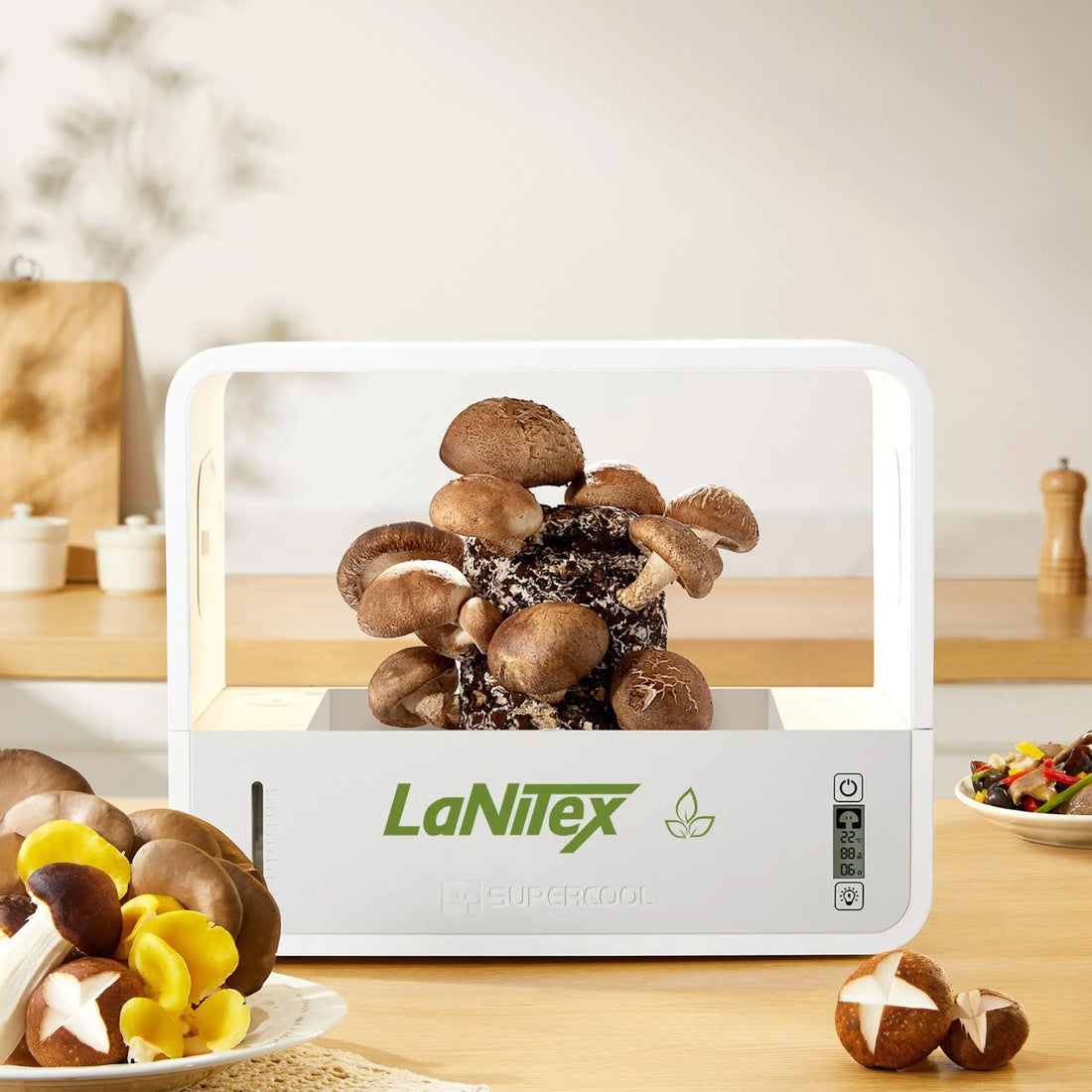
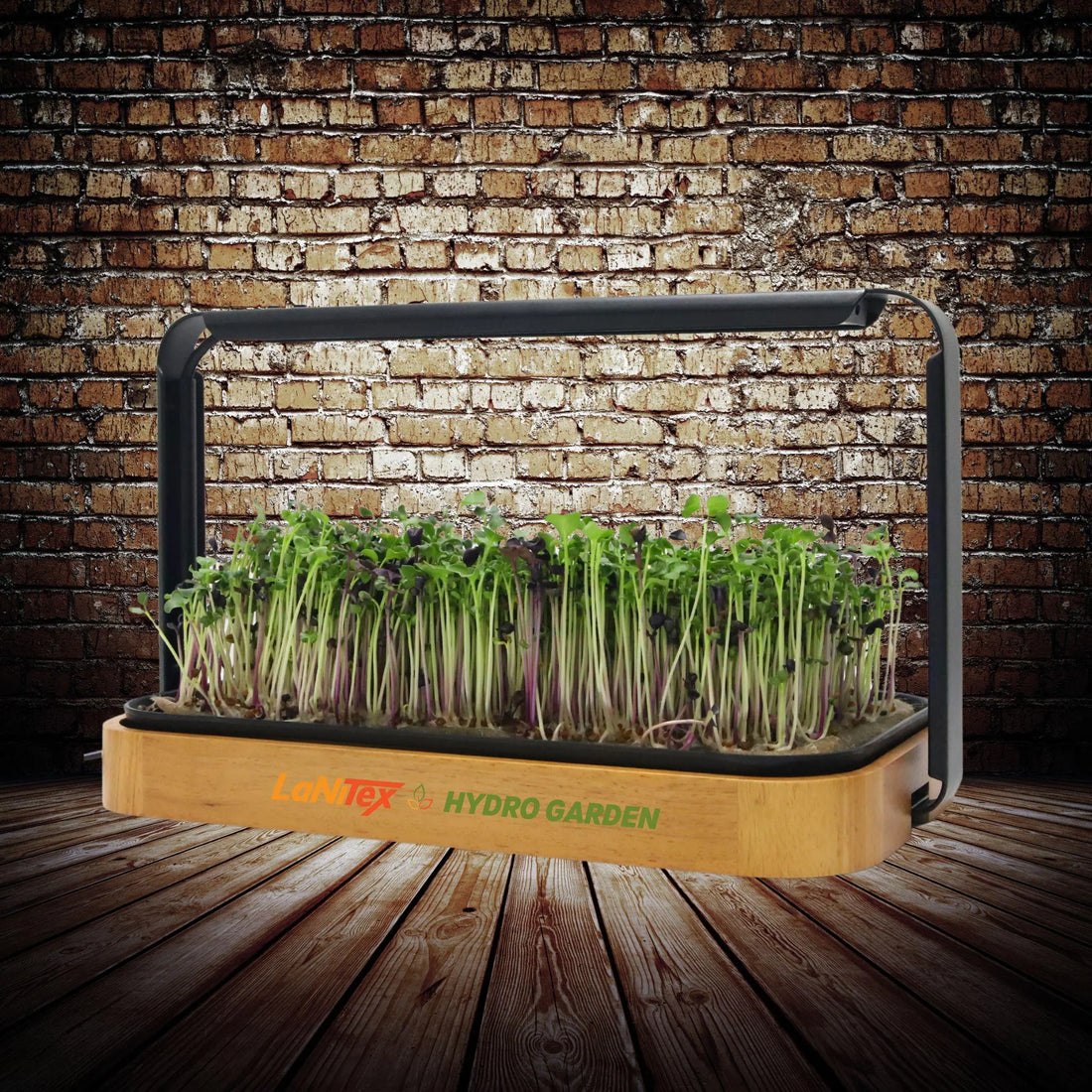
For Sunshine Coast and Brisbane growers wanting two or three compact pot-mum plants on the kitchen bench, the LaNiTex Desktop Grow Box is the right starting kit. It runs Deep Water Culture (DWC) with strong root zone oxygenation, 3 plant pods, 9W, fits 318x120x367 mm.
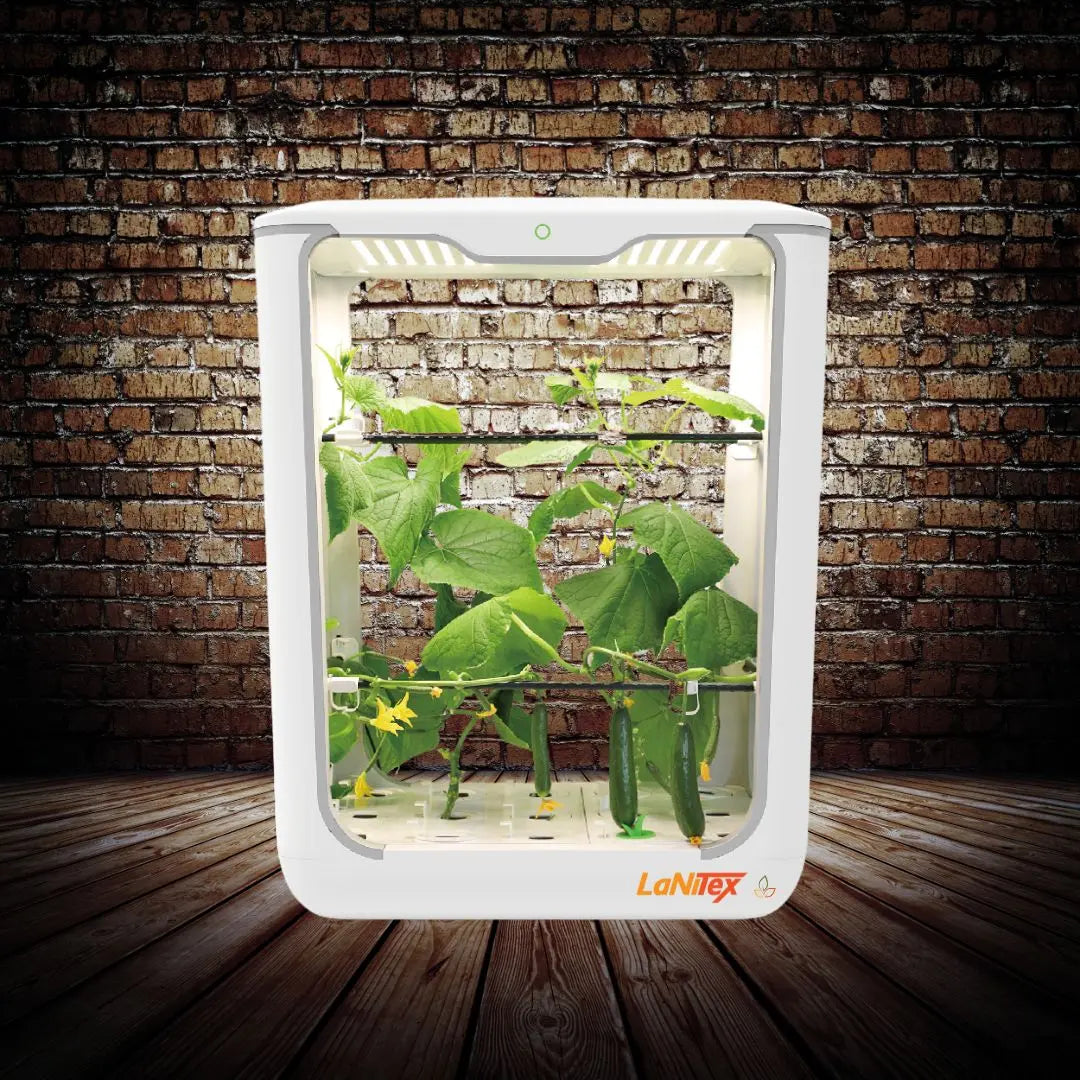
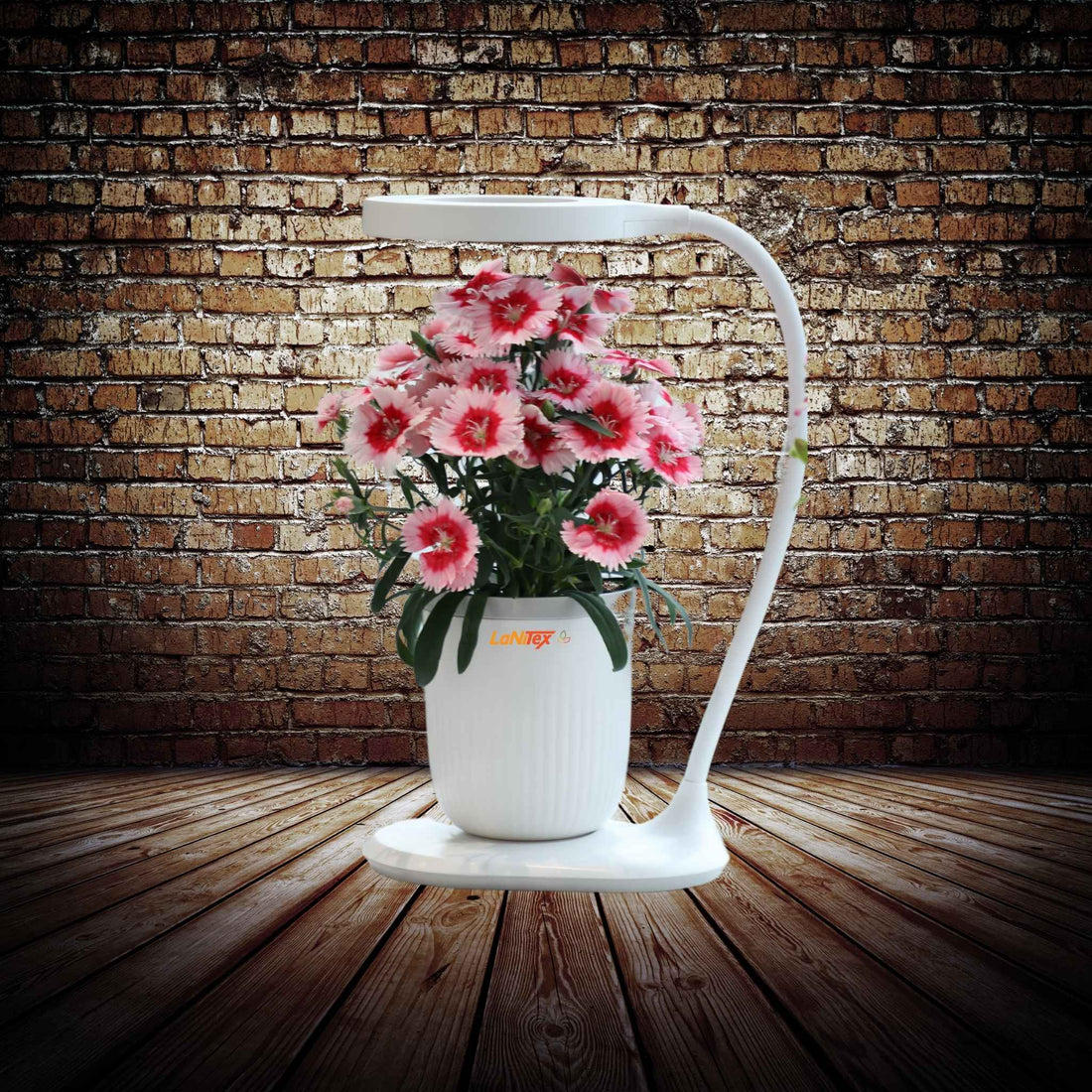
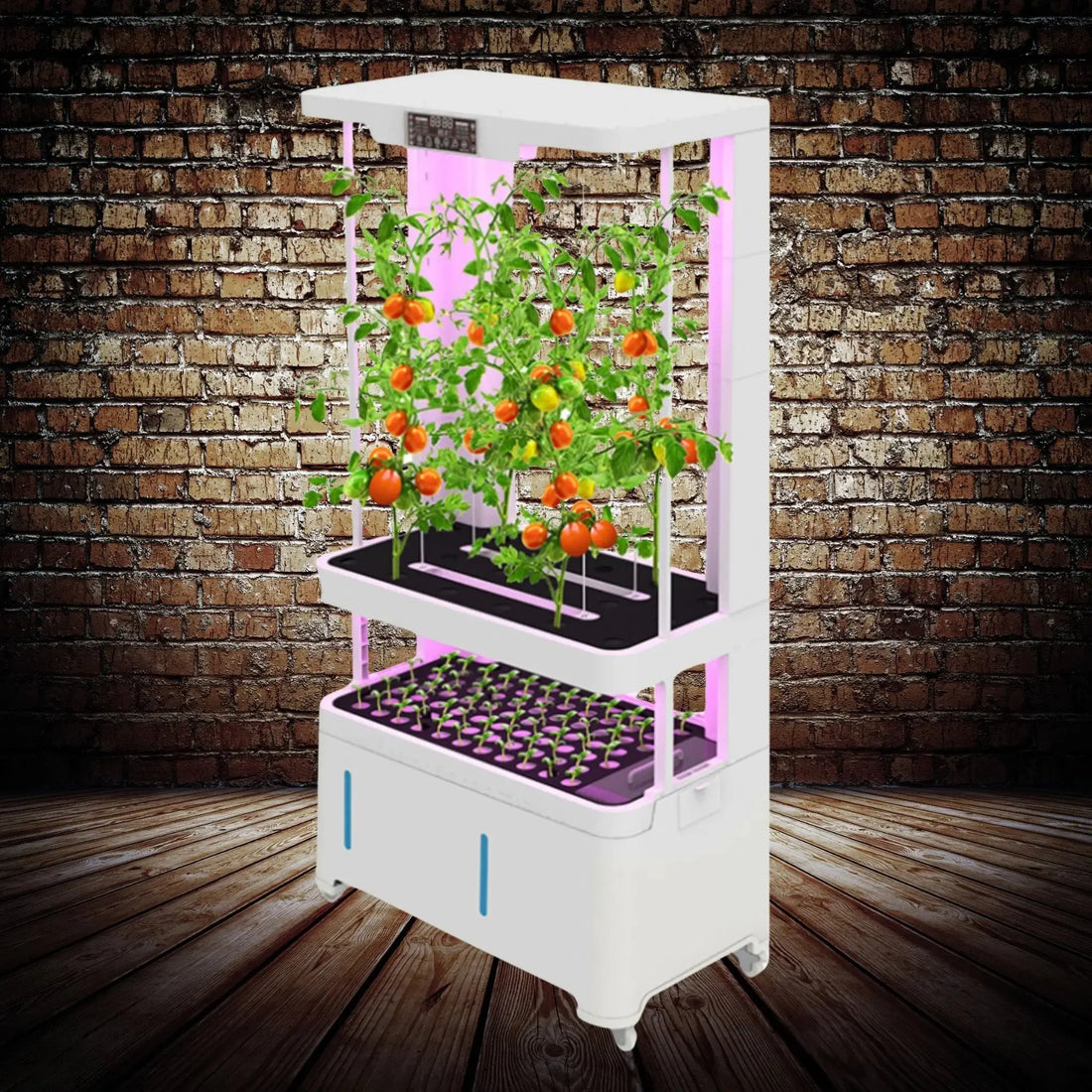
For multiple flower crops year-round (chrysanthemum plus marigold plus zinnia on rotation), the Smart Grow Box gives 15 or 67 planting holes, full-spectrum LED, and a 9L reservoir. For one feature plant, the Mini self watering pot handles one 20-25 cm pot-mum.

Run chrysanthemums, marigolds and zinnias on rotation indoors, year-round — the Grow Box offers 15 to 67 planting sites under full-spectrum LED with strong root-zone oxygenation, the steady setup pot-mums need. You transplant the rooted cuttings.
Start your chrysanthemum grow →Personally tested at home on the Sunshine Coast before listing.
For deeper system background, the hydroponic system essentials guide walks through DWC, NFT, ebb-and-flow, and aeroponic options.
How do you start chrysanthemums in a hydroponic system?
Named chrysanthemum cultivars do not come true from seed, so growers propagate them from cuttings rather than sowing. For a hydroponic setup the cleanest start is a rooted cutting moved into a soilless medium, which keeps the root zone clean from day one.
Take an 8 to 10 centimetre soft tip cutting from healthy, disease-free stock, strip the lower leaves, and set it into a moist rockwool or coco propagation cube. Keep the cube warm (around 20 to 22 degrees Celsius) and humid under a propagation dome or in a covered tray. White roots usually push through the cube in 14 to 21 days.
Once roots show, drop the cube into a 50 millimetre net pot with a few clay pebbles to hold it steady, then transfer it into your DWC or NFT system. Start the new transplant at half-strength EC (around 0.8 to 1.1 mS/cm) for the first week so the young roots are not shocked, then build up to the vegetative range.
If you would rather skip propagation, buy started pot-mum plants or cuttings from Australian nurseries and mail-order growers such as Garden Express or your local garden centre, then rinse the soil off the roots before potting them into the system. Quarantine any bought-in stock for seven days first (see the disease notes below).
How to manage pinching, disbudding, and flowering
Pinching means removing the top growth tip at 4 to 6 weeks from planting. It forces lateral branching, which doubles or triples flower count. Pinch once for spray and pompon types; pinch twice for taller standards.
Disbudding only applies to standard cultivars. Once flower buds form, remove smaller side buds and leave only the terminal bud per stem. Do this between weeks 10 and 12.
For the flowering trigger, photoperiod shift matters more than nutrient changes. At week 10, change the LED timer from 14 hours on / 10 hours off to 10 hours on / 14 hours off. Bud-set follows within 14 to 21 days. Total cycle from planting (vegetative growth + flower induction + bloom): roughly 12 to 16 weeks for spray cultivars, 14 to 18 for standards, depending on cultivar and temperature.
Spring planting (September to November) suits indoor systems just as well as outdoor, with autumn harvest in March to May. Indoor growers can also start an off-season autumn crop in March for indoor blooms no Brisbane garden centre will be selling.

To cut chrysanthemums for the vase, harvest in the cool of early morning when each bloom is about half to three-quarters open rather than fully out. Cut the stem long, strip the lower leaves that would sit below the waterline, and stand the stems in clean water straight away. Change the vase water every couple of days and a healthy spray stem holds its colour for two to three weeks indoors.
What do you do after the chrysanthemums finish flowering?
Once the blooms fade, cut the spent stems back to about 10 to 15 centimetres. Drop the EC back to vegetative strength and lengthen the light period again. In a frost-free indoor space you can hold the cut-back plant as a "stool", a stock plant that pushes fresh basal shoots you can take as your next round of cuttings. If you would rather start clean, compost the old plant and begin again with a fresh rooted cutting. Indoors a single pot-mum rarely gives more than one or two strong flushes before it is worth replacing.
Common problems and how to fix them
Three issues account for almost every indoor chrysanthemum failure, and a small group of diseases deserve watching on top of them.
Aphids and other indoor pests
Indoor systems do not get wind-blown pest pressure, but aphids arrive on imported cuttings. Quarantine new plants for 7 days. If aphids appear, a pyrethrum-based spray registered with the APVMA clears them in 48 hours.
Root rot prevention
Root rot is the indoor mum killer. It starts when reservoir oxygen drops, typically when water temperature climbs above 22 to 25 degrees Celsius (warmer water holds less dissolved oxygen, and Pythium thrives in those conditions). Run the air pump continuously. Replace nutrient solution every 10 to 14 days. If roots turn brown or smell sour, drain immediately, rinse with weak hydrogen peroxide, restart at half-strength EC.
Stretchy or leggy growth
If your chrysanthemum stretches tall with weak stems and pale leaves, your PPFD is too low. Lift the LED unit closer to the canopy or upgrade. Fix this early, ideally in the first 3 weeks.
Chrysanthemum diseases: white rust, powdery mildew, and leaf miner
White rust (Puccinia horiana) is the one to watch. It is a notifiable plant disease in several Australian states, so a suspected outbreak should be reported to your state biosecurity agency. Look for pale yellow spots on the upper leaf surface with raised pinkish-white pustules directly underneath. There is no reliable home cure: bag and bin the affected leaves, increase airflow, and restart with clean, certified stock. Buying disease-free cuttings is the best defence.
Powdery mildew shows as a white, dusty film on leaves in still, humid air. Indoors it is easy to head off. Keep humidity below 70%, run a small fan to keep the air moving, and avoid wetting the foliage when you top up the reservoir. Pull off badly affected leaves as soon as you spot them.
Leaf miner and thrips occasionally hitch a ride on bought-in cuttings, leaving pale squiggly trails or silvery speckling on the leaves. Yellow sticky traps catch the adults, and an APVMA-registered spray handles a heavier infestation. The same seven-day quarantine that stops aphids stops most of these at the door.
The full range
Find the system that fits your space


Supported in Australia - every model tested before listing.
FAQ
Can you grow chrysanthemums hydroponically in Australia?
Yes. Compact pot-mum chrysanthemums (20 to 30 centimetres) grow well indoors across Sunshine Coast and Brisbane homes and flower year-round regardless of outdoor humidity. Both Chrysanthemum x morifolium and Chrysanthemum indicum adapt to DWC, NFT, and coco coir setups when oxygenation stays strong.
What is the best hydroponic system for chrysanthemums?
Deep Water Culture (DWC) and Nutrient Film Technique (NFT) suit chrysanthemums when oxygenation is strong; coco coir adds root buffering for beginners. The LaNiTex Desktop Grow Box fits one to three compact pot-mum plants; the Smart Grow Box handles multiple flower crops in 15 or 67 holes.
What pH is best for hydroponic chrysanthemums?
Maintain pH between 5.6 and 6.3 during vegetative growth, lifting to 6.5 during peak flowering. Test the nutrient solution twice a week with a calibrated pH meter.
What EC should chrysanthemums have in hydroponics?
Run EC at 1.6 to 2.2 millisiemens per centimetre during vegetative growth, scaling up to 2.5 mS/cm at peak flowering. Higher EC during vegetative stage causes leaf burn within three days.
Do chrysanthemums need full sun in hydroponics?
No. Chrysanthemums in indoor setups thrive at PPFD 250 to 450 micromoles per square metre per second. They require 12 to 14 hours of darkness to trigger short-day flowering, so direct full-sun exposure can prevent bud-set.
How much light do hydroponic chrysanthemums need?
Provide 12 to 14 hours of LED light per day at PPFD 250 to 450 during vegetative growth, then reduce to 10 hours daily to trigger flowering. The 12-to-14-hour dark period is what sets flower bud formation in Chrysanthemum x morifolium and Chrysanthemum indicum.
Which chrysanthemum varieties grow best in hydroponics?
Compact pot-mum cultivars (20 to 30 centimetres) fit indoor systems best. Spray and pompon types win for kitchen displays. Pair this guide with marigold, pansies and violas, or zinnia or cosmos cluster articles for a year-round rotation.
Are chrysanthemums toxic to cats and dogs?
Yes. The ASPCA lists chrysanthemums as toxic to cats and dogs (and horses). The plants contain sesquiterpene lactones and pyrethrins, so a pet that chews the leaves or flowers can show vomiting, diarrhoea, drooling, loss of coordination, or skin irritation. Reactions are usually mild, but keep the grow box out of reach of curious pets and call your vet or the Animal Poisons Helpline (1300 869 738) if a large amount is eaten.
Can you grow chrysanthemums from seed?
You can, but it is not the usual route. Named pot-mum cultivars do not come true from seed, so the plant you raise rarely matches the parent — that is why growers take cuttings instead. Open-pollinated and species chrysanthemums (such as Chrysanthemum carinatum) do grow well from seed: buy them from Australian suppliers like The Seed Collection or Mr Fothergill's, raise the seedlings, then transplant the rooted plugs into your system.
Are chrysanthemums perennial or annual?
Most garden and pot-mum chrysanthemums are tender perennials — outdoors they can live for several years, but they are frost-sensitive. Indoors in a hydroponic system, growers usually treat each plant as a single-season crop and start fresh cuttings for the next round, rather than carrying one plant on indefinitely.
About the writer
Laszlo Bulatko founded LaNiTex Hydro Garden in December 2024 from the Sunshine Coast. He spent 15 years in sales, marketing, and brand development across the Hungarian fishing tackle market (Okuma, Mustad, Savage Gear, Penn, Abu Garcia, Berkley) after starting his career at IBM and Diageo. Personal grow results from his living-room setup: microgreens in under a week, lettuce at 25 to 35 days, capsicum plus herbs year-round. Every product in the LaNiTex catalogue was tested at home before being added to the listing (one-off pre-listing, not per-shipment). ABN 47 682 768 967. Read more at /pages/about-laszlo-bulatko-founder-lanitex-hydro-garden.
Sources
- Ai P et al. Comparison of chrysanthemum flowers grown under hydroponic and soil-based systems: yield and transcriptome analysis. BMC Plant Biology, Henan University, 2021-11-08. Peer-reviewed via PubMed Central PMC8574001. Cited for the 37.89% yield uplift figure and soil-borne disease comparison.
- Naumann B. The Pros and Cons of Hydroponic Growing. Sustainable Gardening Australia (SGA). Cited for 90% water-efficiency framing and faster-grow-cycle comparison.
- Bureau of Meteorology. Climate statistics for Australian locations — Maroochydore Aero. Cited for Sunshine Coast December monthly average relative humidity (77% mean 9 am).
- Michigan State University Extension. Temperature effects on mum production. Cited for chrysanthemum critical dark-period range (11 to 12 hours minimum).
- Purdue Extension. Chrysanthemum production guide. Cited for chrysanthemum response time of 7 to 10 weeks from photoperiod shift.
- UMass Extension. Growing garden mums for fall sales. Cited for total field cycle of approximately 12 to 16 weeks from planting to flowering.