
Quick answer: Yes. Hydroponic watermelon and melons grow well in Australia using Dutch bucket, DWC, or drip systems with 15 to 20 litres of substrate or solution volume per plant and daily hand-pollination. Sugar Baby ripens in about 75 to 85 days from germination, roughly 55 to 70 days from transplant under indoor hydroponics.
Key takeaways:
- Hydroponic Sugar Baby ripens in about 75 to 85 days from germination indoors. See varieties.
- Dutch bucket is the most reliable system; standard NFT channels are a poor match for melon root masses. See why NFT fails.
- Target pH 5.8 to 6.0; EC steps from 1.0 to 3.0 mS/cm by growth stage. See pH / EC schedule.
- Indoor flowers need daily hand-pollination; no bees in your laundry. See how to hand-pollinate.
- Train one vine and thin to a few fruits so each melon sizes up and sweetens. See training and thinning.
- Read ripeness by the fruit, not the calendar: a creamy ground spot, a dried tendril, and a dull hollow thump. See harvest signals.
- Sugar Baby and Honey Pearl F1 fit a Sunshine Coast spare-room.
- Hydroponic farming uses up to 90 percent less water than soil (SGA).
This guide is for: intermediate hydroponic growers (you have run lettuce or herbs before).
Contents:
- Can you grow hydroponic watermelon?
- Watermelon hydroponics: what system works best?
- How do you start hydroponic watermelon from seed?
- What pH, EC, and timing should I run for hydroponic watermelon?
- Do I need to hand-pollinate hydroponic watermelon?
- Which hydroponic watermelon variety should I pick for limited space?
- How do you train and thin a hydroponic watermelon vine?
- What problems should I expect with hydroponic watermelon?
- How do you know when a hydroponic watermelon is ripe?
- Glossary of hydroponic watermelon terms
- FAQ
- Sources and references
Hydroponic watermelon means growing Citrullus lanatus in a soilless system with roots in nutrient solution or perlite substrate. Growers in Brisbane and across the Sunshine Coast lose outdoor vines to summer heatwaves and fruit fly. Indoor hydroponics fixes both problems. Done right, a single hydroponic watermelon vine in a Dutch bucket fruits in your spare room with 15 to 20 litres of substrate, a clip fan, and 90-second morning hand-pollination. The same system works for other cucurbit crops. You need the right system and the discipline to hand-pollinate every morning during flowering. If that daily commitment sounds like a lot, a low-growing, self-fertile crop is far more forgiving indoors - our guide to growing day-neutral strawberries on a vertical tower covers a gentler fruiting option.
Can you grow hydroponic watermelon?
Yes. Hydroponic watermelon, cantaloupe, and honeydew grow well indoors or in a covered greenhouse. What matters most is adequate root volume, water, oxygen, and steady feeding, whether the medium is soil or nutrient solution.
Hydroponic watermelon production works in three main system formats. Dutch bucket (Bato bucket) pairs a perlite container with a drip-fed nutrient line. Deep water culture (DWC) suspends the root ball in an oxygenated reservoir. Drip systems on coco coir or rockwool deliver feed on a timer. Standard NFT channels are a poor match for cucurbits. The channel is too narrow for a vining root mass unless heavily oversized.
Watermelon hydroponics: what system works best?
For Australian home growers, Dutch bucket is the most reliable choice. Each bucket holds 11 to 20 litres of substrate, so vines get the root volume to fruit without flopping. The recirculating reservoir cuts daily top-up labour. I recommend at least 15 to 20 litres of substrate or solution per plant as a practical guideline. This matches the upper end of typical Dutch bucket sizes used for vining fruit crops in Australia.
DWC works for a single plant in a 25-litre tub (a footprint that fits the compact Mini Indoor Grow Pot), but oxygen demand jumps as the vine matures. Standard NFT and hobby aeroponics are usually poor matches for melons: root mass can block channels and spray heads can clog unless the system is carefully oversized and maintained.
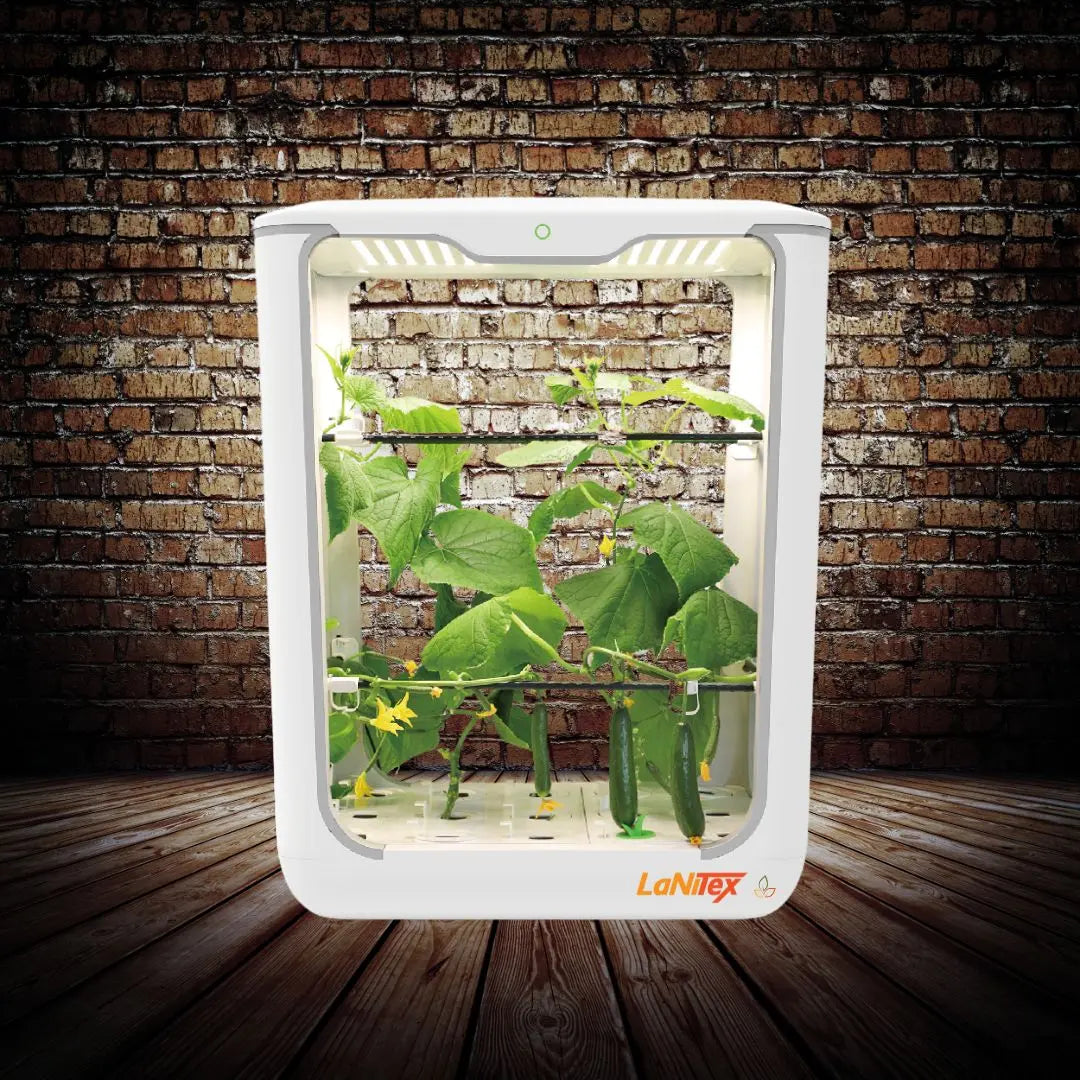
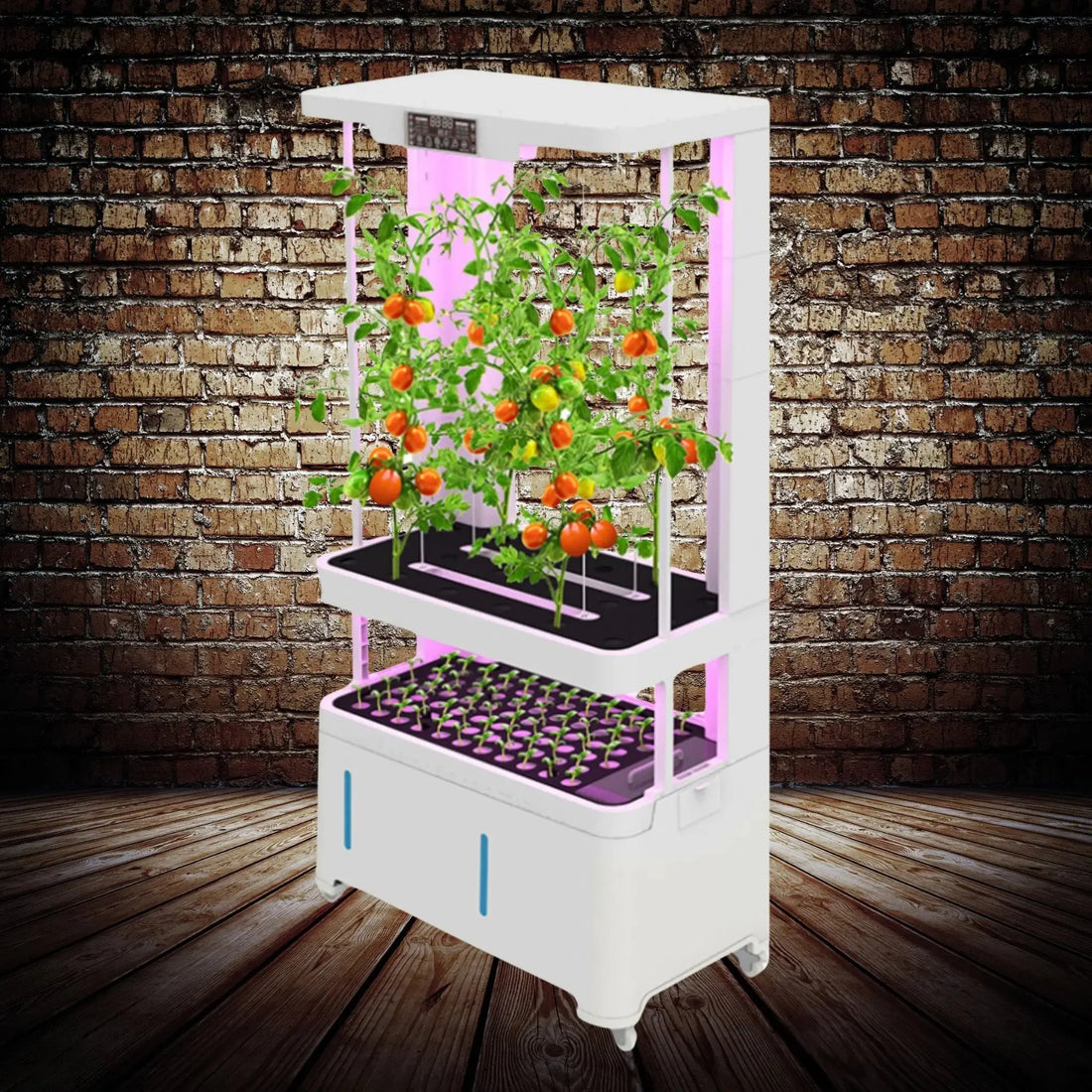
For a packaged indoor setup, the Smart Grow Box Tall is what I run on my own workshop bench: 15 plant slots in a stackable footprint. I train one compact Sugar Baby vine vertically and the unit handles the rest. Sustainable Gardening Australia confirms "farms utilizing hydroponics use up to 90 percent less water" than soil farms (SGA). That matters when Brisbane goes 40 days without rain, and it is one reason Brisbane growers chasing hydroponic melons prefer the indoor route.
From our workshop bench on the Sunshine Coast: I have run hydroponic kits for leafy greens, herbs, and microgreens, but I have not yet completed a full hydroponic watermelon crop. This guide draws from peer-reviewed studies, AU seed-supplier datasheets, and the protected-cucurbit cropping literature. When I run a Sugar Baby trial in the Smart Grow Box Tall, I will update this article with measured numbers. Expected harvest window: Feb 2027.
Laszlo Bulatko, Founder, LaNiTex Hydro Garden, Sippy Downs, Queensland, Australia (postcode 4556). Built 12 percent Hungarian fishing-tackle market share at LaNiTex Kft (2005-2018) before pivoting to hydroponics in 2024. Personally tested every product in the catalogue once before stocking.

Set up a compact melon vine indoors, any season. The Smart Grow Box Tall gives one trained vine vertical headroom plus steady full-spectrum light and nutrients — the controlled conditions this heat-loving cucurbit prefers. You supply the seeds.
Start your melon grow →Personally tested at home on the Sunshine Coast before listing.
How do you start hydroponic watermelon from seed?
Melon seed germinates fast in warmth. Sow into a starter plug, a rockwool cube, or a folded damp paper towel inside a sealed container, and hold the medium at 24 to 30°C. A heat mat helps in a cool spare room. Most watermelon and cantaloupe seed sprouts in about 5 to 10 days; cooler conditions stretch that out and raise the risk of rot.
- Pre-soak (optional): soak the seed in clean water for 20 to 30 minutes to soften the coat.
- Sow shallow: set the seed about 1 cm deep in a moist plug or rockwool cube, pointed end down.
- Cover and warm: keep a humidity dome over the tray at 24 to 30°C until the first shoot appears.
- Vent on sprouting: remove the dome once seedlings emerge so they do not damp off, and give them strong light straight away.
- Transplant: move the seedling into the Dutch bucket or DWC pot at the two to three true-leaf stage, usually two to three weeks after sowing.
Start the nutrient feed light. Run EC 1.0 to 1.5 mS/cm for the first few weeks (see the EC schedule) so tender seedling roots are not burned. Source seed from Australian suppliers such as Mr Fothergill's, Eden Seeds, and Greenpatch Organic, since melon seed sells out by August in subtropical zones.
What pH, EC, and timing should I run for hydroponic watermelon?
pH targets by growth stage
pH is the acidity of your nutrient solution measured on a 0-14 scale. Hydroponic watermelon wants pH 5.5 to 6.5, sweet spot 5.8 to 6.0. Drifting far outside that band triggers nutrient lockout (the progressive availability decline of dissolved minerals), with strongest calcium lockout above pH 7 and magnesium lockout below pH 5.5. Test pH twice daily during fruit set.
EC schedule
EC (electrical conductivity) is the salt concentration of your nutrient solution measured in mS/cm. EC steps up by growth stage:
| Stage | Week | EC (mS/cm) | Nutrient emphasis |
|---|---|---|---|
| Seedling | 1 to 3 | 1.0 to 1.5 | Light feed; strong root development |
| Vegetative | 3 to 6 | 2.0 to 2.5 | Vine extension; more nitrogen |
| Fruit set onward | 6+ | 2.5 to 3.0 | Heavier potassium for sugar loading |
In warm Queensland reservoirs (above 24°C), stay nearer the lower end of each band to reduce salt stress. This matters most if you are growing melons indoors in Queensland and running summer crops without active reservoir chilling.
Air and reservoir temperature
Watermelon is a heat-loving cucurbit. Aim for daytime air temperatures around 24 to 30°C through vegetative growth and fruiting, with nights no colder than about 18°C. Growth stalls below 18°C, and pollen viability drops in sustained heat above 35°C. Keep the nutrient reservoir below about 24°C as well, because warm solution holds less dissolved oxygen and pushes root-zone stress. That is why a shaded or insulated reservoir earns its keep in a Queensland summer.
Timing windows
A Frontiers in Plant Science study on hydroponic melon nutrients found that "plants grown with 50% of required potassium nitrate produced fruits with approximately 53% lower potassium compared to control" (Asaduzzaman et al. 2018). Adequate potassium from fruit set onwards is one important lever for sweetness measured as brix (the sugar-content percentage of fruit juice), alongside light, temperature, and overall plant health.
Timing from germination to ripe fruit is about 75 to 85 days for compact Sugar Baby (roughly 55 to 70 days from transplant under indoor hydroponics), and 85 to 105 days for Charleston Gray. Queensland outdoor windows sit September to April. Indoor hydroponic watermelon production largely sidesteps outdoor seasons if you also manage temperature, humidity, and provide adequate LED light intensity and duration (typically 12 hours per day at sufficient PPFD for fruiting crops). For deeper background on nutrient ratios across crop stages, see our pillar guide on hydroponic system essentials.
Do I need to hand-pollinate hydroponic watermelon?
Yes. Hand-pollination is the manual transfer of pollen from a male flower's stamen to a female flower's stigma using either a small brush or a picked male flower. Melons carry separate male and female flowers on the same vine, and indoor air has no bees. Skip pollination, get empty vines.

When to pollinate
Wait for a sunny morning when flowers open between 6 and 10 am. Female flowers are receptive for one day only; pollen viability drops after midday in warm conditions. One male flower pollinates two to three female flowers.
How to pollinate (step-by-step)
- Identify a freshly opened male flower: slim stalk, no fruit bulge behind the petals.
- Pick the male flower at the stem and peel back the petals to expose the yellow pollen on the central stamen.
- Locate an open female flower: thick stalk, small fruit bulge behind the petals.
- Dab the male stamen against the stigma (the sticky centre) of the female flower, transferring pollen with gentle contact.
- Repeat on two to three females from each male flower, then discard the spent male.
How to confirm pollination worked
You will know it worked within 48 to 72 hours: the female fruit swells visibly and the spent flower drops off cleanly. If the small fruit yellows and aborts instead, pollination failed. Try again on the next female flower. Hand-pollinating takes about 90 seconds per vine, so the daily morning round is the difference between a harvest and zero fruit.
Which hydroponic watermelon variety should I pick for limited space?
Compact varieties save grief in a spare-room setup. Watermelon belongs to Citrullus lanatus; cantaloupe and honeydew belong to Cucumis melo. The two species share overlapping growing requirements but have different fruit profiles. Source seed from Australian suppliers like Mr Fothergill's, Eden Seeds, and Greenpatch Organic; melon seed sells out by August in subtropical zones.
Watermelon varieties (Citrullus lanatus)
| Variety | Type | Days to harvest (from transplant) | Fruit weight (kg) | Vine length (m) | Trellis required? | AU seed supplier |
|---|---|---|---|---|---|---|
| Sugar Baby | Compact watermelon | 75 to 80 | 3 to 5 (up to 6 ideal) | 1.8 to 2.5 | Yes (vertical) | Mr Fothergill's, Eden Seeds |
| Crimson Sweet | Mid-size watermelon | ~85 | 5 to 7 | 2.5 to 4 | Yes (vertical or horizontal) | Mr Fothergill's, Greenpatch Organic |
| Charleston Gray | Long-season watermelon | 85 to 105 (some list 110) | 9 to 14 | 3 to 5 | Skip indoor (needs ground space) | Eden Seeds |
| Jubilee | Long-season watermelon | ~95 | 9 to 13 | 3 to 5 | Skip indoor (needs ground space) | Mr Fothergill's |
Cantaloupe and honeydew varieties (Cucumis melo)
| Variety | Type | Days to harvest (from transplant) | Fruit weight (kg) | Vine length (m) | Trellis required? | AU seed supplier |
|---|---|---|---|---|---|---|
| Honey Pearl F1 | Cantaloupe (US-bred F1) | 74 to 80 | 1 to 2 | 1.5 to 2.2 | Yes (vertical) | Eden Seeds, Greenpatch Organic |
| Honeydew Green Flesh | Honeydew | ~78 | 1 to 2 | 1.8 to 2.5 | Yes (vertical) | Eden Seeds, Mr Fothergill's |
Honey Pearl F1 fits a single Dutch bucket footprint. For an apartment-fit setup, pair Sugar Baby (watermelon) with Honey Pearl F1 (cantaloupe). Both fit a Sunshine Coast spare-room growing height and mature in roughly the same window.
How do you train and thin a hydroponic watermelon vine?
Indoor space is the limit, so train one main vine and keep the fruit count sensible. Run the main stem up a sturdy trellis and pinch off side runners (laterals) once the vine is established, so the plant pours its energy into the leader and its fruit rather than a sprawl of stems. Remove the first one or two female flowers that appear low on the vine; letting the plant bulk up before it sets fruit gives larger, sweeter melons.
Thinning matters as much as feeding. On a single trained vine, keep about two to three watermelons (or four to six cantaloupe, which are smaller) and pinch the rest off while they are tiny. Fewer fruits mean each one sizes up properly and loads more sugar, instead of a vine carrying a crowd of undersized melons. Support every retained fruit in a fabric sling once it reaches tennis-ball size, because a 5 kg watermelon will pull a vine off the trellis without one.

What problems should I expect with hydroponic watermelon?
Three issues cause nearly every hydroponic cucurbit failure:
- Pollination failure: vine grew beautifully but no fruit. Fix: daily morning hand-pollination during flowering.
- Powdery mildew: white dust on leaves; favoured by moderate to high humidity and poor airflow, and unlike most fungi it does not need leaf wetness. Fix: keep relative humidity moderate (around 60 to 65 percent) with a clip fan, and consider a weekly milk-and-water spray (1:9) for early infection, though results are mixed. For severe outbreaks, use a registered fungicide or biological labelled for cucurbits.
- Nutrient lockout: yellowing leaves, stunted fruit, often from pH drift. Fix: test pH twice daily during fruit set.
Sap-sucking pests and blossom-end rot
Indoor cucurbits still attract pests. Watch for aphids, two-spotted spider mites, and whitefly on the undersides of leaves, especially in dry, still air. Knock them back early with a neem-oil or insecticidal-soap spray plus yellow sticky traps; a clip fan and relative humidity at or below 65 percent make the canopy less hospitable. Blossom-end rot, a sunken brown patch on the fruit base, is not a pest but a calcium-uptake problem driven by uneven watering or pH drift, so hold pH 5.8 to 6.0 and keep the feed steady through fruit set.
Why NFT does not work for hydroponic watermelon
NFT (nutrient film technique) is a hydroponic format where a shallow stream of nutrient solution flows over bare roots in a sealed channel. Standard NFT channels are a poor match for vining cucurbits. Root mass blocks a standard channel within four weeks. Downstream plants then starve of oxygen and feed. Dutch bucket or DWC are the safer choice for hydroponic watermelon. Fair point: NFT is excellent for leafy greens. For melons, standard channel sizes simply do not fit a 1.8 to 2.5 metre vining root system. A heavily oversized custom channel (deeper than 80 mm) can work but rarely justifies the build cost over a Dutch bucket array.
System comparison summary
| System | Substrate | Reservoir | Best for | Pitfalls |
|---|---|---|---|---|
| Dutch bucket (Bato bucket) | Perlite or coco coir (11 to 20 L per bucket) | Recirculating, 40 to 200 L for a 4-vine array | 2 or more vines; long crops; vining cucurbits | Bucket weight when wet; tubing leaks if fittings are skimped on |
| Deep water culture (DWC) | Net pot + hydroton (~25 L tub per vine) | Aerated tub; one tub per plant | Single-vine apartment setup | Oxygen demand spikes at fruit set; root rot if airstone fails |
| Drip on coco coir or rockwool | Coco or rockwool slabs/blocks | Recirculating or run-to-waste | Compact Honey Pearl F1 cantaloupe setups | Emitter clogging; substrate replacement after each crop |
| NFT (standard channels) | None (bare roots) | Recirculating film | Leafy greens; NOT cucurbits | Root mass blocks channel; downstream plants starve |
| Hobby aeroponics | None (root chamber) | High-pressure misters | Short-cycle herbs; NOT cucurbits | Nozzle clogging from particulates; pump failure kills vine fast |
Get a fresh grow guide like this every fortnight
Join the LaNiTex Hydro Garden newsletter for practical hydroponic, microgreen and mushroom growing tips for Australian homes. Subscribe to download a free hydroponics starter guide (PDF) and get 10% off your first order.
Join the newsletter →How do you know when a hydroponic watermelon is ripe?
Days-to-harvest is only a guide; read the fruit itself. Four signals tell you a watermelon is ready to cut:
- Ground spot turns creamy yellow: the patch where the fruit rests changes from white to a buttery cream as the sugars peak.
- The nearest tendril dries: the curly tendril on the stem closest to the fruit browns off and shrivels.
- A dull, hollow thump: a ripe melon sounds deep and hollow when tapped, not a high, tight ring.
- Days from pollination: count roughly 35 to 45 days from the morning you hand-pollinated that flower for a compact variety like Sugar Baby.

Cantaloupe reads differently. A ripe rockmelon "slips" from the vine with light pressure, the netting on the skin lifts and coarsens, and the blossom end gives off a sweet, musky aroma. Honeydew stays attached and turns from green-white to a creamy waxy skin. Cut the fruit free with secateurs, leaving a short stub of stem, rather than tearing it off. Hydroponic melons taste best eaten within a few days of harvest, while the brix is at its peak.
Glossary of hydroponic watermelon terms
- Dutch bucket (also Bato bucket)
- A hydroponic format where each plant sits in an 11 to 20 litre container filled with perlite or coco coir; nutrient solution drips in from the top and overflow returns to a shared reservoir via a siphon elbow at the bucket base. The standard format for vining hydroponic watermelon and cucurbits.
- DWC (deep water culture)
- A hydroponic format where the plant sits in a net pot suspended above an aerated reservoir, with bare roots hanging directly in oxygenated nutrient solution. Works for a single hydroponic watermelon vine in a 25-litre tub; needs an airstone running 24/7.
- EC (electrical conductivity)
- The salt concentration of a nutrient solution, measured in millisiemens per centimetre (mS/cm). For melons, EC ranges from 1.0 to 1.5 mS/cm at seedling stage to 2.5 to 3.0 mS/cm at fruit set. Higher EC means more dissolved nutrients per litre.
- NFT (nutrient film technique)
- A hydroponic format where a shallow stream of nutrient solution flows over bare roots in a sealed channel. Standard channels are unsuitable for hydroponic watermelon. The vining root mass blocks the channel within four weeks.
- pH
- The acidity of a nutrient solution measured on a 0-14 scale. For melons, target pH 5.8 to 6.0. Drifting above pH 7 causes calcium lockout; below pH 5.5 causes magnesium lockout.
- Brix
- The sugar-content percentage of fruit juice, measured with a refractometer. A ripe Sugar Baby watermelon hits 9 to 12 brix; a ripe Honey Pearl F1 cantaloupe hits 12 to 14 brix. Holding EC at 2.5 to 3.0 mS/cm during the final 14 days is one lever for the brix peak, alongside light and temperature.
- Hand-pollination
- Manual transfer of pollen from a male flower's stamen to a female flower's stigma using either a small brush or a picked male flower. Required daily for indoor melons because indoor air has no bees.

Ready to grow leafy greens and herbs at scale between melon crops? The V5.2-A Tower runs up to 72 planting sites under full-spectrum LED with a self-watering tank — a vertical footprint for high-turnover salad crops.
Scale up your grow →Personally tested at home on the Sunshine Coast before listing.
Hydroponic watermelon FAQ
Can you grow watermelon hydroponically?
Yes. Watermelon thrives in Dutch bucket, deep water culture, or drip systems indoors. Provide 15 to 20 litres of substrate or solution volume per plant, 12 hours of strong LED light, EC 2.5 to 3.0 mS/cm during fruit set, and daily hand-pollination. Expect ripe Sugar Baby fruit in about 75 to 85 days from germination, roughly 55 to 70 days from transplant under indoor hydroponics.
How long do hydroponic melons take to ripen?
Sugar Baby ripens 75 to 85 days from germination, about 55 to 70 days from transplant under indoor hydroponics. Charleston Gray takes 85 to 105 days. Honey Pearl F1 cantaloupe lands at about 74 to 80 days. From seed, the seedling stage runs roughly 2 to 3 weeks before transplant.
Are hydroponic melons as sweet as soil-grown?
The final-fortnight nutrient profile is one important driver of sweetness, alongside light, temperature, and overall plant health. A Frontiers 2018 study showed cutting potassium nitrate by half reduced fruit potassium by about 53 percent without crashing yield, which means you can control sweetness with your feed schedule. Hold EC at 2.5 to 3.0 mS/cm and manage nitrogen and light in the last 14 days for the brix peak.
What is the best hydroponic system for watermelon?
Dutch bucket. Each bucket holds 11 to 20 litres of perlite or coco coir, supports a vining root system, and uses a small recirculating reservoir. Deep water culture works for a single vine; drip systems work for compact varieties. Standard NFT and hobby aeroponics are usually poor matches for melons because root mass can block channels and nozzles unless the system is heavily oversized.
Do hydroponic watermelons need a trellis?
Yes. Vertical training saves floor space and improves airflow. Use a sturdy trellis or netting attached to the ceiling above the bucket. Each fruit needs a fabric sling -- a cut-up onion bag works -- to support the weight as it ripens; a 5 kg watermelon will pull a vine off the trellis without support.
Can I grow hydroponic melons outdoors in Brisbane?
You can run a Dutch bucket on a covered patio between September and April, but you will fight 35-plus degree summer days, humidity-driven mildew, and Queensland fruit fly. Indoor or shade-house hydroponics gives you steadier results year-round. Coastal Sunshine Coast humidity adds airflow risk; a clip fan is mandatory.
How much water does hydroponic melon farming use?
Sustainable Gardening Australia notes that farms utilizing hydroponics use up to 90 percent less water than traditional farms. A single Sugar Baby vine in Dutch bucket needs roughly 8 to 12 litres of nutrient solution per week at peak fruiting, versus 80 to 100 litres for the equivalent soil plant in Queensland summer.
How do you know when a hydroponic watermelon is ripe?
Read four signals rather than the calendar: the ground spot where the fruit rests turns from white to creamy yellow, the tendril nearest the fruit dries and browns, a tap gives a dull hollow thump, and it has been roughly 35 to 45 days since you hand-pollinated that flower for a compact variety like Sugar Baby. Cantaloupe is different: a ripe rockmelon slips from the vine with light pressure and smells sweet at the blossom end.
What's the difference between a watermelon, rockmelon (cantaloupe) and honeydew, and do they grow the same way?
Watermelon (Citrullus lanatus) is a different species from rockmelon and honeydew, which are both Cucumis melo. Rockmelon, the Australian name for cantaloupe, has netted skin and orange flesh. Honeydew has smooth skin and pale green flesh. Watermelon is larger, with red flesh. All three are vining cucurbits grown the same way hydroponically: a trellis, daily hand-pollination, and the same pH and EC schedule. Watermelon just needs more root volume and a longer season.
Bottom line: Hydroponic watermelon works in Australia if you run Dutch bucket with 15 to 20 litres of perlite per plant, hold pH 5.8 to 6.0, ramp EC from 1.0 to 3.0 mS/cm across the crop, and hand-pollinate every morning during flowering. Sugar Baby is the apartment-fit variety; Honey Pearl F1 covers cantaloupe in the same footprint. Sippy Downs QLD (postcode 4556) averages 72 percent humidity Dec to Feb, so a clip fan is non-negotiable.
The full range
Find the system that fits your space


Supported in Australia - every model tested before listing.
Sources and references
- Asaduzzaman et al. (2018). Frontiers in Plant Science, 9, 1382. DOI: 10.3389/fpls.2018.01382. Effect of nutrient solution composition on melon (external link).
- Sustainable Gardening Australia (SGA). The Pros and Cons of Hydroponic Growing. sgaonline.org.au (external link).
- NSW Department of Primary Industries: Cucurbit IPM and Horticulture guides. dpi.nsw.gov.au (Australian government source; external link).
- Queensland Department of Agriculture and Fisheries (QLD DAF): Protected cropping fact sheets for cucurbits. daf.qld.gov.au (Australian government source; external link).
- Cornell CALS Controlled Environment Agriculture. cornellcea.com (external link).
- University of Connecticut Home Garden, Powdery Mildew of Cucurbits. homegarden.cahnr.uconn.edu (external link).
Related LaNiTex guides: cucamelons, summer squash, winter squash, peppers, eggplant, hydroponic system essentials pillar guide.
About the writer
Laszlo Bulatko founded LaNiTex Hydro Garden in December 2024. He spent 15 years in sales, marketing, and brand development across the Hungarian tackle market. He sold Okuma, Mustad, Savage Gear, and Berkley products and helped LaNiTex Kft hit 12 percent market share. His early career began at IBM and Diageo in Hungary. From Sippy Downs on the Sunshine Coast he ships hydroponic systems Australia-wide. He personally tested every product before adding it to the catalogue. ABN 47 682 768 967. Read his full founder profile.
Last updated: 19 June 2026