
How to Grow Cucumbers Hydroponically in Australia
Supermarket cucumbers wilt within days, and outdoor vines on the Sunshine Coast battle mildew every humid summer. Growing cucumbers indoors sidesteps both problems, and you can pick crisp fruit year-round.
Quick answer: To grow cucumbers hydroponically in Australia, run a parthenocarpic (seedless) variety at pH 5.8 to 6.5 and EC 1.8 to 3.0 mS/cm, give 14 to 16 hours of light at 400 to 700 umol/m2/s, and trellis the vine upward. A warm indoor system fruits in roughly 50 to 70 days from seed.
Cucumbers (Cucumis sativus) are one of the most rewarding crops for indoor hydroponics in Australia, where subtropical humidity leaves outdoor plants prone to disease. A controlled indoor system removes soil pests and gives growers in Brisbane and across the Sunshine Coast a steady supply of fruit.
By Laszlo Bulatko | Updated 8 July 2026
Interest in hydroponic cucumbers in Australia keeps rising because indoor growing solves the two biggest local problems: powdery mildew and unpredictable weather. With tight pH and EC control, a home setup delivers year-round harvests instead of a short summer window. At LaNiTex Hydro Garden we build indoor systems for exactly this kind of grower, and everything below leans on peer-reviewed cucumber research rather than guesswork.
Here is what a first-time indoor grower needs, from botany to harvest.
Key takeaways:
- Hold pH between 5.8 and 6.5 and EC between 1.8 and 3.0 mS/cm; a 4-in-1 water tester keeps both in range.
- Choose a parthenocarpic (seedless) cultivar so you never have to hand pollinate indoors.
- Give 14 to 16 hours of light at 400 to 700 umol/m2/s and trellis the vine as it climbs.
- Expect fruit in about 50 to 70 days, and watch for two-spotted mite and powdery mildew.
What are hydroponic cucumbers?
Hydroponic cucumbers are Cucumis sativus plants grown in nutrient solution instead of soil. The species is a warm-season vining member of the gourd family, and it grows fast: a healthy vine can add several centimetres a day once it is established. Indoors, the roots sit in water, coir, or an inert medium, and you feed them a balanced nutrient mix rather than relying on soil fertility.
The big advantage for Australian growers is control. Outdoor cucumbers here fight humidity, fungal disease, and hungry insects. An indoor system lets you set the light, the temperature, and the feed, so the plant never stalls.
One term worth learning early is parthenocarpic. Parthenocarpic cultivars set fruit without pollination, which means seedless, bitter-free cucumbers and no fiddly hand pollination in a closed room. Most greenhouse and indoor cucumbers sold today are parthenocarpic for exactly this reason. This guide sums up what commercial glasshouse growers have long known about running Cucumis sativus in a hydroponic system.
Best growing conditions for hydroponic cucumbers indoors
Cucumbers are hungry, thirsty plants, so the numbers matter. Keep the nutrient solution at pH 5.8 to 6.5. If it drifts high, add a small dose of pH-down; if it drops low, use pH-up, then re-test after mixing. A cheap 4-in-1 water tester makes this a two-minute job.
Electrical conductivity (EC) tells you how concentrated the feed is. Run 1.8 to 2.2 mS/cm while the plant is young and building leaves. Once it starts fruiting and demand climbs, push toward 2.5 to 3.0 mS/cm. As one review put it, "nutrient solution concentration is a crucial factor that impacts plant growth in hydroponic" systems (Asian Journal of Crop Science, 2023).
Light drives yield. Aim for a 14 to 16 hour photoperiod at a light intensity (PPFD) of 400 to 700 umol/m2/s at the canopy. Below that, vines stretch and fruit sets poorly. On the nutrient side, cucumbers lean heavily on calcium and potassium. Calcium shortfalls show as brown, papery leaf edges and blossom-end problems on the fruit. Low potassium shows as yellowing along older leaf margins. Keep the room between 22C and 28C and the water topped up, and most deficiencies never appear.
Refresh the whole nutrient reservoir every one to two weeks so mineral salts don't build up. Between changes, top up with plain water and re-check EC and pH each time. A fruiting cucumber drinks heavily in warm weather, so check the tank every few days once it starts setting fruit.
What I have learned about growing cucumbers from research
I will be straight with you: I have not yet grown a cucumber crop hydroponically myself. What I have grown at home in my Sunshine Coast kitchen tells me the method holds up. My microgreens are ready in under a week, my lettuce runs 25 to 35 days start to finish, and I keep capsicum and herbs going year-round on the bench. Same principle, bigger plant.
So for cucumbers I lean on the research I trust rather than a story I have not lived. A 2022 study in the Journal of Soil Science and Plant Nutrition found that splitting the nutrient solution improved cucumber growth and productivity. That lines up with the veg-then-fruiting EC step I described above. When customers ask me whether indoor cucumbers are realistic in a Queensland home, my honest answer is yes. But a cucumber vine needs more vertical room and more feed than a tray of greens. That is the whole reason I point people toward a taller cabinet rather than a benchtop unit. I would rather tell you what the evidence shows than dress up guesswork as experience.
Choosing a hydroponic system for cucumbers
Cucumbers are big, thirsty climbers, so the system matters more than it does for leafy greens. Here is how the common options compare for growing cucumbers hydroponically indoors:
| System | How it works | Verdict for cucumbers |
|---|---|---|
| Deep water culture (DWC) | Roots sit in oxygenated water. | Cheap and high-yielding, but a good DWC cucumber system design needs a strong air pump and a sturdy trellis to hold the vine. |
| NFT (nutrient film technique) | A thin film of solution runs past the roots. | Great for greens; workable for cucumbers if the channels are wide and well-fed. |
| Drip-to-waste in coir | Individual plants in coco coir, fed by drippers. | The commercial greenhouse standard and very forgiving for a first-timer. |
| Kratky | A passive, no-pump method. | Kratky cucumbers indoors are possible for a single short-season plant, but the heavy feed demand makes it fiddly. |
| Vertical towers | A stacked vertical planting frame. | Brilliant for leafy greens and herbs, less ideal for a heavy fruiting vine that wants to climb - though low-growing fruit thrives on them, as our guide to growing strawberries hydroponically in Australia shows. |
Whatever system you choose, the growing medium matters. Coco coir is the most forgiving for beginners. Rockwool cubes are the greenhouse standard for propagation. Clay pebbles (LECA) and perlite both drain fast and suit DWC or drip setups. All are inert, so you stay in full control of every nutrient the plant receives.
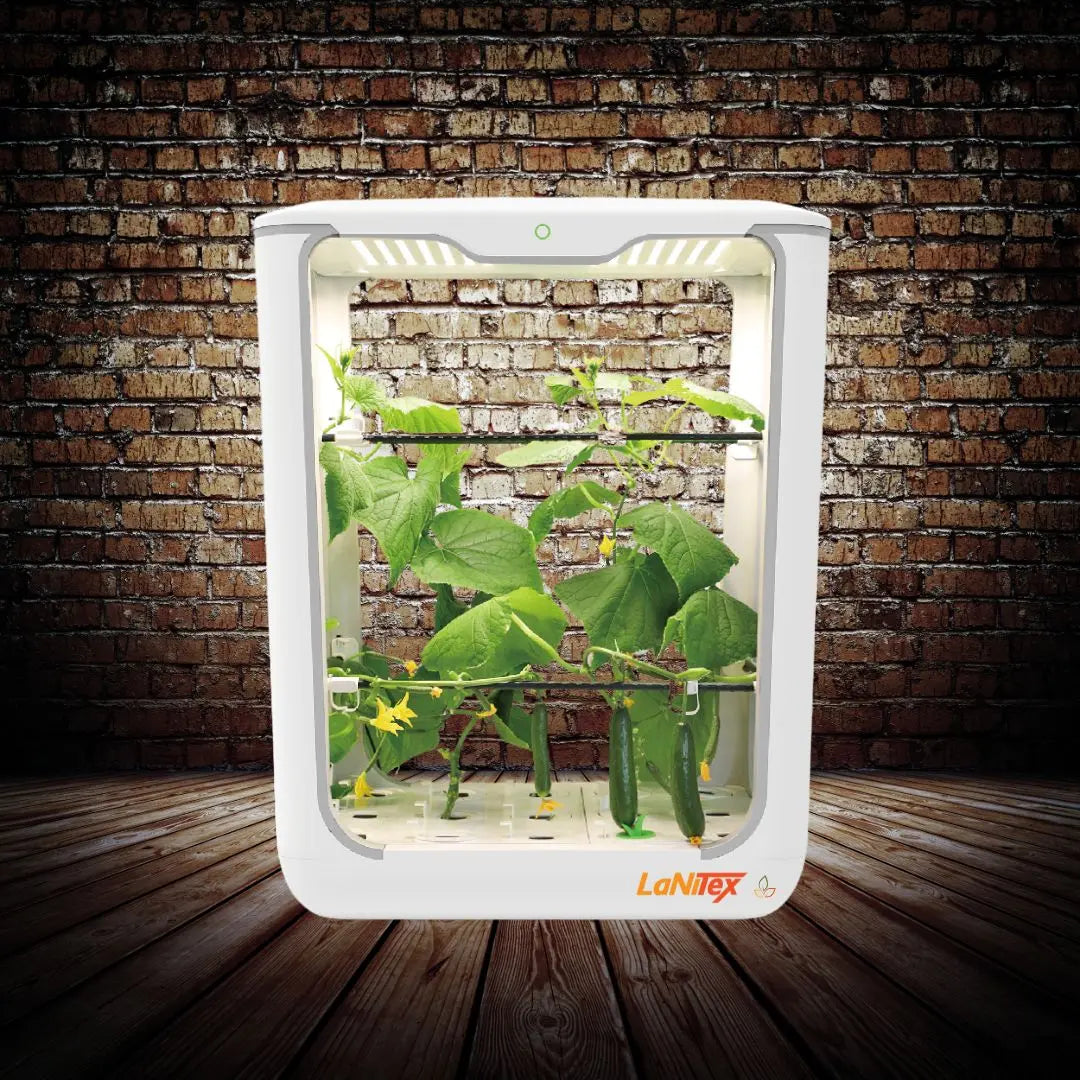
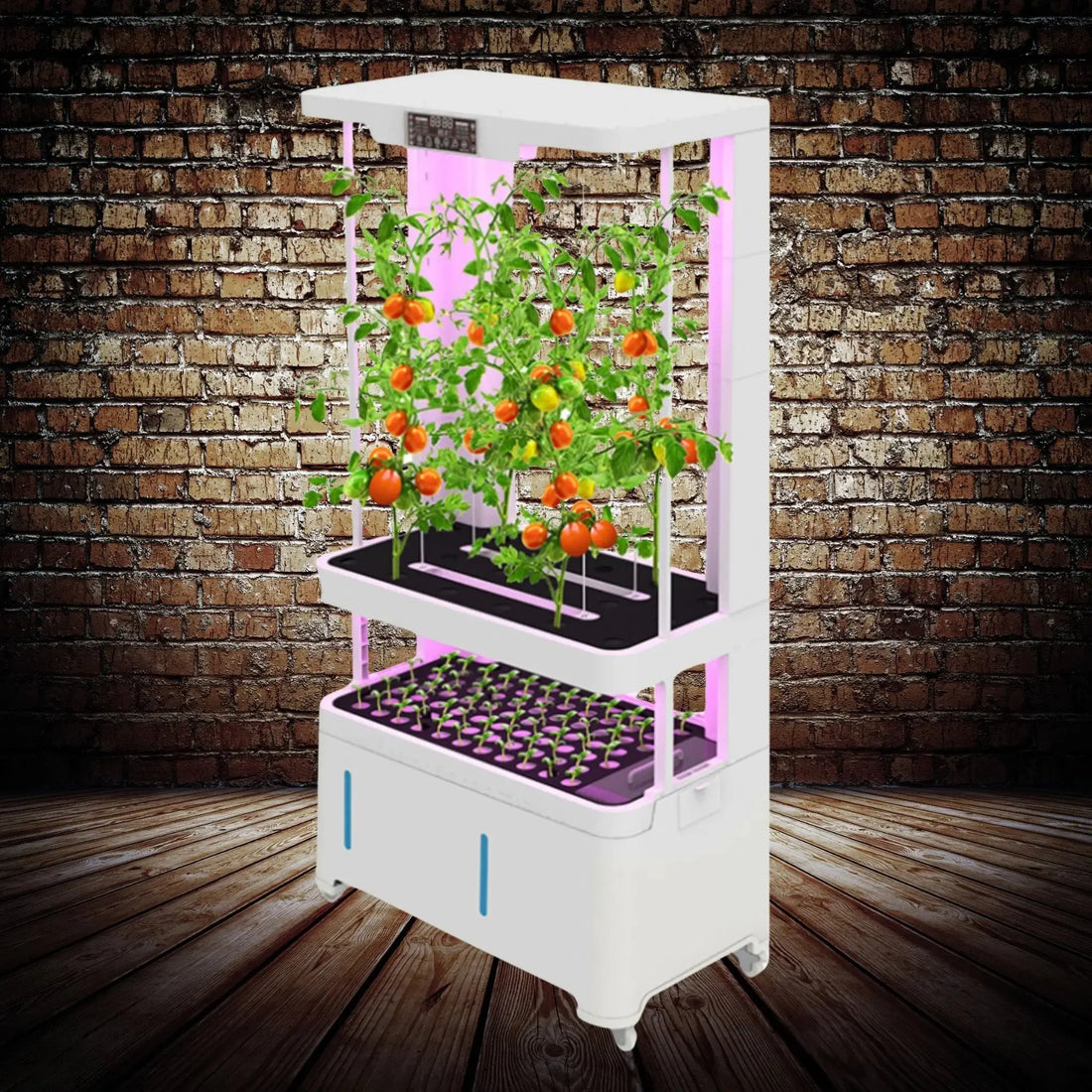
For a home grower, an enclosed grow cabinet solves the two hardest parts at once: it gives the vine vertical space and it automates the water and light. Our Smart Grow Box Tall was designed for exactly this kind of tall, trellised crop.

Crisp indoor cucumbers in about 50 to 70 days - the tall frame lets an indeterminate vine climb while the self-watering tank and full-spectrum LED do the daily work. You supply the seedling.
Start your indoor cucumber patch →Personally tested at home on the Sunshine Coast before listing.
Best cucumber varieties and pollination for indoor systems
Variety choice is where most beginners go wrong. The best cucumber varieties for hydroponics are compact, parthenocarpic types bred for glasshouse and indoor growing. Reliable parthenocarpic (seedless, self-fruiting) names to look for include 'Iznik', 'Mini Munch', 'Gina', and 'Picolino'. These set fruit on the main stem without pollination and stay manageable in a cabinet. A couple of popular home varieties such as 'Lemon' and 'Picklebush' are not parthenocarpic, so grow those only if you are happy to hand pollinate.
It helps to know the main types too. Lebanese cucumbers (sold as qukes) are the compact, thin-skinned favourite in Australian kitchens, and they grow well indoors. Apple and telegraph (continental) types also suit hydroponics. Short pickling cucumbers work if you want fruit for preserving. Whichever type you pick, look for a parthenocarpic F1 version bred for glasshouse growing. Many standard Lebanese, apple, and telegraph seed lines are bee-pollinated, so they will need hand pollination indoors.

You can buy parthenocarpic cucumber seeds in Australia from specialist suppliers such as The Seed Collection, Green Harvest, and Eden Seeds. Avoid old outdoor field varieties for indoor systems; they usually need insect pollination and are more prone to bitterness under stress such as heat, uneven watering, or nutrient swings.
Starting from seed is simple. Sow one seed per rockwool cube or coir plug, keep it at 25 to 28C, and it will sprout in three to seven days. Move each seedling into your system once it has two or three true leaves and a healthy white root poking through the base.

Pollination is the neat part. A true parthenocarpic cultivar needs no help at all - it fruits on its own indoors. If you do grow a non-parthenocarpic type, you will have to hand pollinate. Pick a male flower, which has a thin stem and no baby fruit behind it. Peel back the petals and brush its pollen into each female flower. The female is the one with a tiny cucumber behind the bloom. Do it in the morning when pollen is fresh. For most home growers indoors, though, a parthenocarpic variety removes the job entirely.

Trellising, pests and Australian seasonal timing
A cucumber vine is indeterminate, meaning it keeps growing and fruiting from one long stem. Train it up a single string or trellis, and prune the lowest side-shoots and tendrils so the plant puts energy into fruit rather than sprawl. Any tall, top-heavy fruiting crop needs the same support - the same trick applies to growing eggplant hydroponically or hydroponic tomatoes indoors. Never let the vine flop across the canopy; it shades itself and invites disease.
Pests still find indoor plants. The usual Australian offenders are two-spotted mite, aphids, and thrips, plus powdery mildew in humid rooms. Use integrated pest management (IPM): inspect leaf undersides weekly, wipe or spray early infestations, keep airflow moving, and bring in predatory mites if numbers climb. Don't reach for harsh chemicals in a kitchen; prevention and early action do more.
Timing indoors is flexible, but the warm-season window still guides you. In Queensland, cucumbers naturally run October to February. New South Wales extends a little either side. Victoria, SA, and WA favour November to March. Indoors with lights, you can start any month. Give each plant about 0.3 to 0.4 square metres of space, and a single healthy indoor vine can yield several kilograms of fruit across a season.

Ready to grow more than cucumbers? The 72-plant V5.2-A tower scales your indoor garden up to leafy greens and herbs alongside your fruiting crops, all on one self-watering, full-spectrum setup.
Scale up your indoor garden →Ships from the Sunshine Coast, Queensland.
The full range
Find the system that fits your space


Supported in Australia - every model tested before listing.
Frequently asked questions
What EC and pH do hydroponic cucumbers need in Australia?
Hold the nutrient solution at pH 5.8 to 6.5 and EC 1.8 to 3.0 mS/cm. Keep EC lower (about 1.8 to 2.2) while the plant is young, then raise it toward 3.0 as it fruits and feeds harder. A 4-in-1 water tester lets you check both in under two minutes and correct with a small dose of pH-up or pH-down.
How much light do indoor hydroponic cucumbers need per day?
Give indoor cucumbers 14 to 16 hours of light per day at a PPFD of 400 to 700 umol/m2/s measured at the canopy. Less than that and vines stretch, flowers drop, and fruit sets poorly. A full-spectrum LED on a timer is the simplest way to hit both the hours and the intensity consistently.
Which cucumber varieties are best for small indoor hydroponic systems?
Compact, parthenocarpic (seedless) cultivars are best for small indoor systems. Look for true parthenocarpic F1 names such as 'Iznik', 'Mini Munch', 'Picolino', or 'Gina'. These fruit on the main stem without pollination and stay a manageable size. A few home favourites like 'Lemon' and 'Picklebush' are not parthenocarpic and need pollination to set fruit.
How long do cucumbers take to grow hydroponically from seed to harvest?
A hydroponic cucumber usually runs about 50 to 70 days from seed to first harvest in a warm indoor system, faster than most soil crops. Germination takes 3 to 7 days, flowering starts around week five, and a healthy vine then keeps producing for weeks as you pick regularly.
Can I grow cucumbers in a DWC or Kratky system at home?
Yes. Deep water culture (DWC) works well for cucumbers if you use a strong air pump and a solid trellis for the heavy vine. Kratky, the passive no-pump method, can grow a single short-season plant, but a cucumber's heavy feed and water demand makes it fiddly. Most home growers find an enclosed cabinet easier.
How do I hand pollinate cucumbers in an indoor hydroponic setup?
Only non-parthenocarpic varieties need it. In the morning, pick a male flower (thin stem, no fruit behind it), peel back the petals, and brush its pollen into each female flower (the one with a tiny cucumber behind the bloom). Repeat every couple of days. A parthenocarpic variety skips this step entirely.
Why are my hydroponic cucumber leaves turning yellow or scorched?
Yellowing along older leaf margins usually signals a potassium or nitrogen shortfall, while brown, papery, scorched edges point to calcium deficiency or salts building up from EC that is too high. Re-test pH and EC first, flush if the reading is high, then adjust the feed. Heat stress above 30C can cause similar scorching.
How do cucumbers grow, from seed to fruit?
A cucumber grows fast in four stages. The seed germinates in three to seven days, the vine then climbs and puts out leaves for a few weeks, female flowers appear around week five, and each parthenocarpic (or pollinated) flower swells into fruit you pick about 50 to 70 days from sowing. Pick regularly and the vine keeps producing.
When should you plant cucumbers in Australia?
Indoors under lights you can start cucumbers any month of the year. Outdoors the warm-season window guides timing: Queensland runs October to February, New South Wales a little either side, and Victoria, South Australia, and Western Australia favour November to March. A warm indoor system removes the seasonal limit entirely.
Do hydroponic cucumbers need companion plants?
No. Companion planting helps soil gardens by deterring pests and sharing nutrients, but an indoor hydroponic system already controls both. You feed a measured nutrient solution and manage pests with airflow and weekly inspection, so cucumbers grow well on their own. Skip companions indoors and give each vine its own space and trellis.
About the writer
Laszlo Bulatko founded LaNiTex Hydro Garden in December 2024 with one mission: to help any Australian family grow fresh food at home, even in a small apartment with no backyard and no green thumb. He runs LaNiTex Hydro Garden from the Sunshine Coast, and his catalogue covers hydroponic grow boxes, a benchtop Mini Grow Pot, and the Smart Microgreen Kit. He talks most about the Term-Grow program, which places grow boxes in Queensland primary school classrooms so kids grow real food during term. Before hydroponics, Laszlo spent 15 years in sales and brand development in the Hungarian fishing-tackle market. Every product on the site was personally tested at home before it was listed.
Get a fresh grow guide like this every fortnight
Join the LaNiTex Hydro Garden newsletter for practical hydroponic, microgreen and mushroom growing tips for Australian homes. Subscribe to download a free hydroponics starter guide (PDF) and get 10% off your first order.
Join the newsletter →Sources
- Asian Journal of Crop Science (2023). "Nutrient solution concentration is a crucial factor that impacts plant growth in hydroponic" cucumber systems. https://scialert.net/fulltext/?doi=ajcs.2023.24.30
- Journal of Soil Science and Plant Nutrition / Springer (2022). "Hydroponics with Split Nutrient Solution Improves Cucumber Growth and Productivity." https://link.springer.com/article/10.1007/s42729-022-01056-8