
Trying to choose between LaNiTex's hydroponic systems? This guide compares every active SKU side-by-side — footprint, plant capacity, power draw, Australian price — across four product categories: home grow systems, microgreen + mushroom kits, accessories, and school term-rentals. Every product has been tested at home on the Sunshine Coast across one full growing cycle before stocking.
Methodology. Specifications, prices, and capacity figures are pulled directly from LaNiTex Hydro Garden's Shopify catalogue (verified 16 May 2026). Every product has been tested by Laszlo Bulatko on the Sunshine Coast, Queensland across at least one full growing cycle. Australian prices in AUD, GST included. Ships from the Sunshine Coast same-week to most east-coast addresses.
Indoor hydroponic grow systems — home use
Six systems cover the household price band from a $75 starter pot to a $1,990 72-slot vertical tower. All six are all-in-one hydroponic system kits — reservoir, LED, and controls included, nothing to plumb. The cheapest way in is the $75 Mini Grow Pot; the most popular is the $429 Smart Grow Box. The right choice depends on bench space, ceiling height, and how much you actually eat.
| System | Price (AUD) | Footprint | Plant capacity | Best for |
|---|---|---|---|---|
| Mini Grow Pot Z 2.4 | $75 | 146mm x 178mm | 1 plant | Renters, first-timers, single herb on a kitchen bench |
| Desktop Grow Box | $139 | ~0.1 sq m | 3-5 plants | Desk-side herbs, small microgreens |
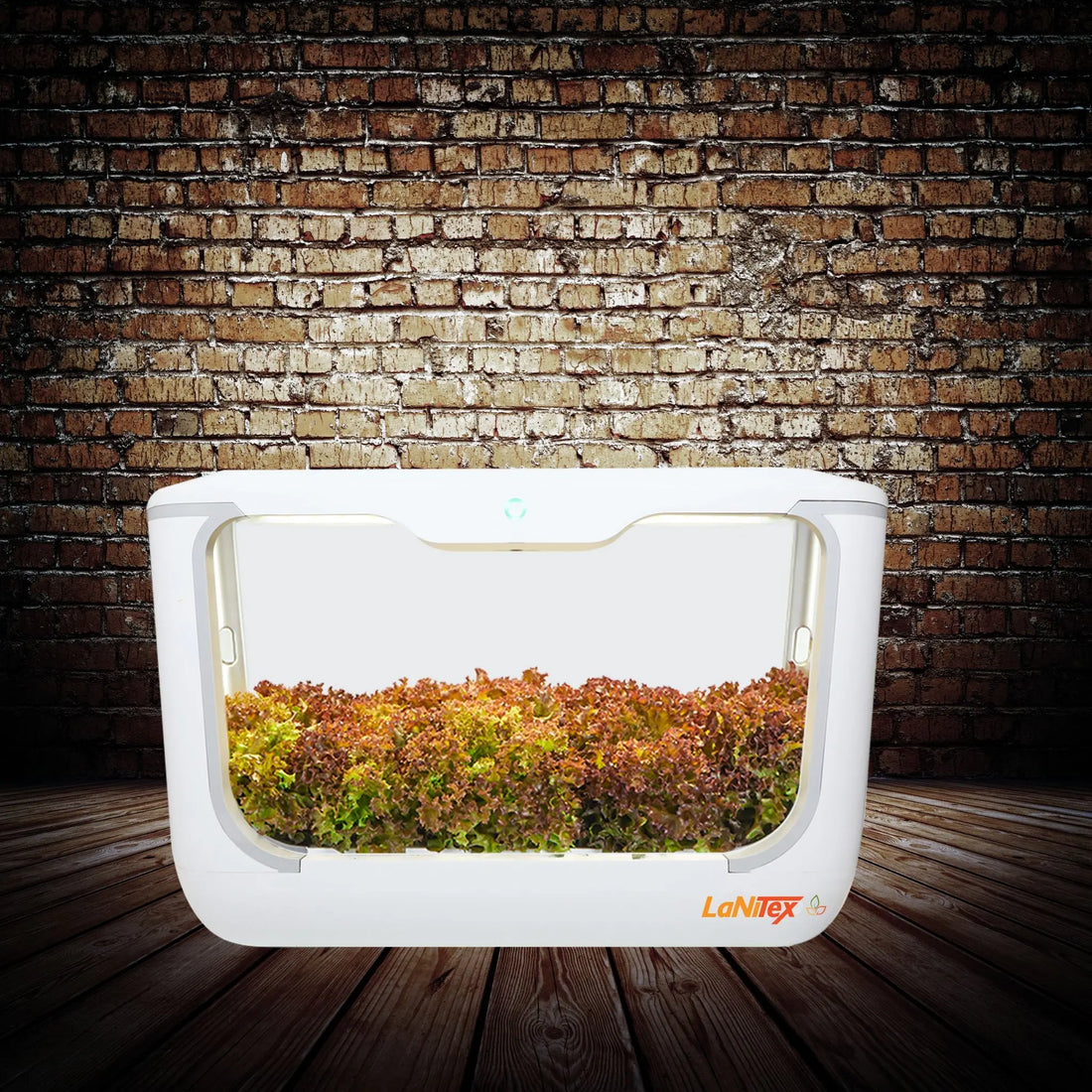
| Smart Grow Box (15-hole) | $429 | 0.36 sq m | 15 plants | Two/Four person household, salad + herbs weekly |
| Smart Grow Box (67-hole) | $429 | 0.36 sq m | 67 plants | Family of 3-5, daily microgreen harvests |
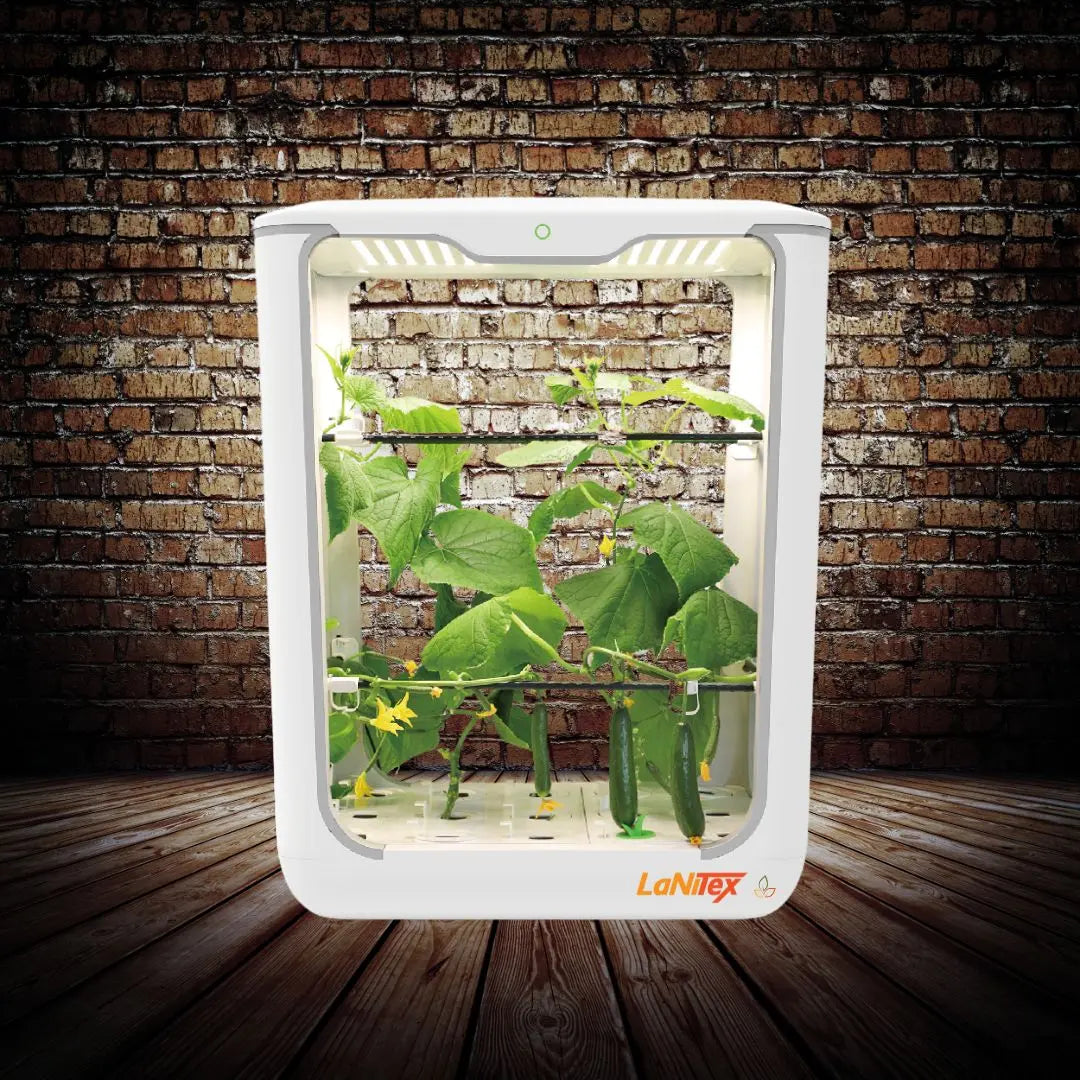
| Grow Box Tall | $650 | 0.36 sq m | 15 plants (tall varieties) | Tomatoes, peppers, chillies |
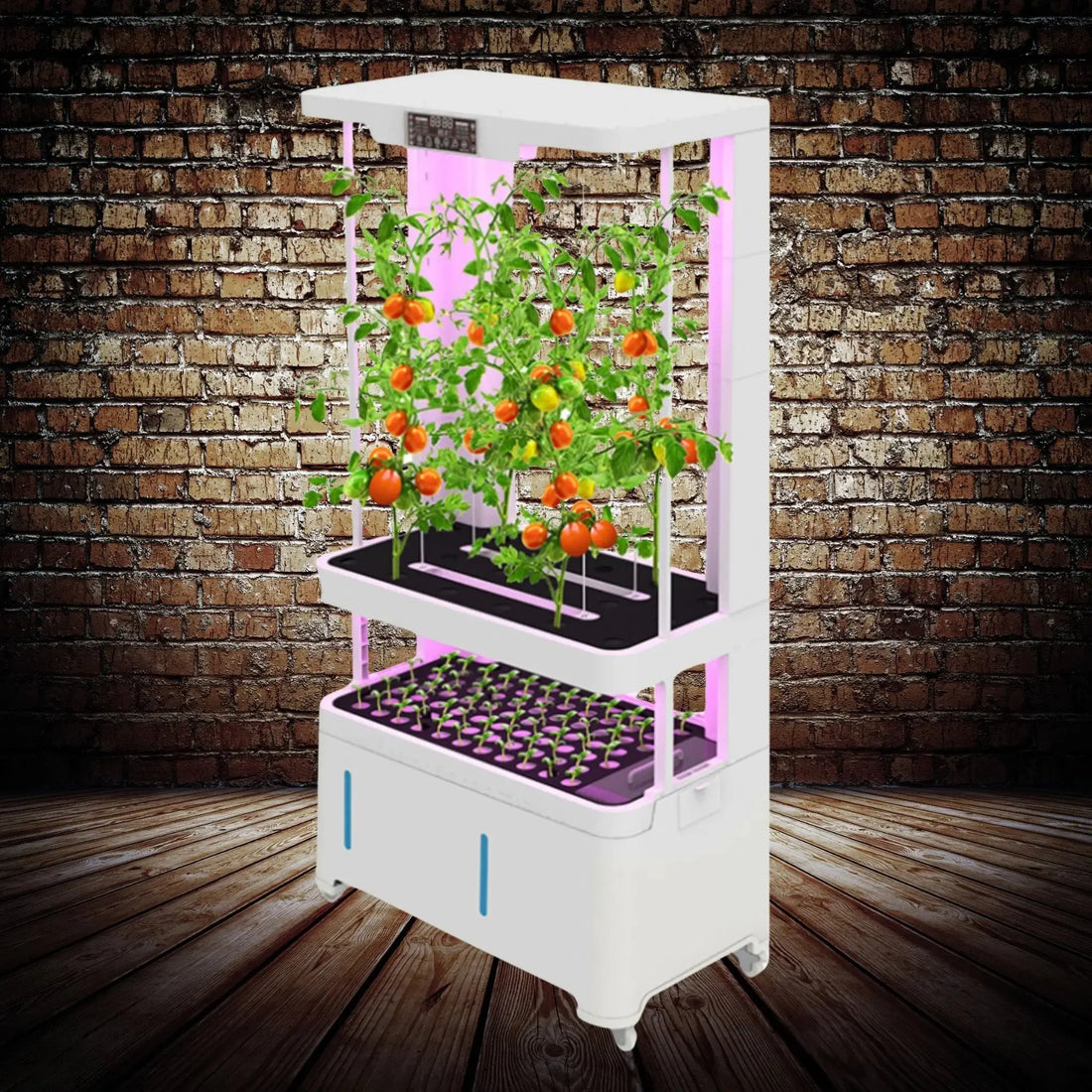
| Automated NFT Hydroponic System V5.2-T | $1,590 | 0.3 sq m, 161cm tall | 18 plants vertical | Tomatoes, peppers, chillies needing vertical clearance |
| Hydroponic Tower V5.2-A | $1,990 | 0.3 sq m, 180cm tall | 76 sowing positions | Maximum yield per sq m, families, small commercial |
Hydroponic Tower V5.2-A vs V5.2-T — quick decision
Both vertical hydroponic towers, 0.3 sq m footprint. The V5.2-A (180cm tall, 72 slots, $1,990) is the maximum-capacity option for families or anyone wanting daily harvests across 30+ varieties. The V5.2-T (161cm tall, 18 slots, $1,590) is the more affordable option for tomatoes, peppers, and chillies. Both run the same sensor stack: an automatic LED cycle and a low-water alarm.
Smart Grow Box: 15-hole vs 67-hole
Same price ($429), same footprint, same hardware — the difference is the lid. The 15-hole variant suits larger plants (lettuce heads, basil bushes, single capsicum) at 15 mature sowing positions. The 67-hole variant suits microgreens, baby salads, and frequent small harvests at 67 dense positions. Most Australian apartments start with 15-hole.

Grow salad greens and herbs indoors year-round without soil. The Smart Grow Box fits 15 to 67 plants on 0.36 m² of bench, running the full-spectrum LED and reservoir on a schedule; you top up and pick.
Start your bench garden →Personally tested at home on the Sunshine Coast before listing.
Which hydroponic type is each LaNiTex system?
Hydroponic guides usually compare six growing techniques: deep water culture (DWC), nutrient film technique (NFT), ebb and flow, drip, aeroponics, and wick systems. Home all-in-one units package the low-maintenance versions of these techniques, so you never plumb anything yourself. It still helps to know which principle each system uses, though.

| LaNiTex system | Hydroponic technique | How it works |
|---|---|---|
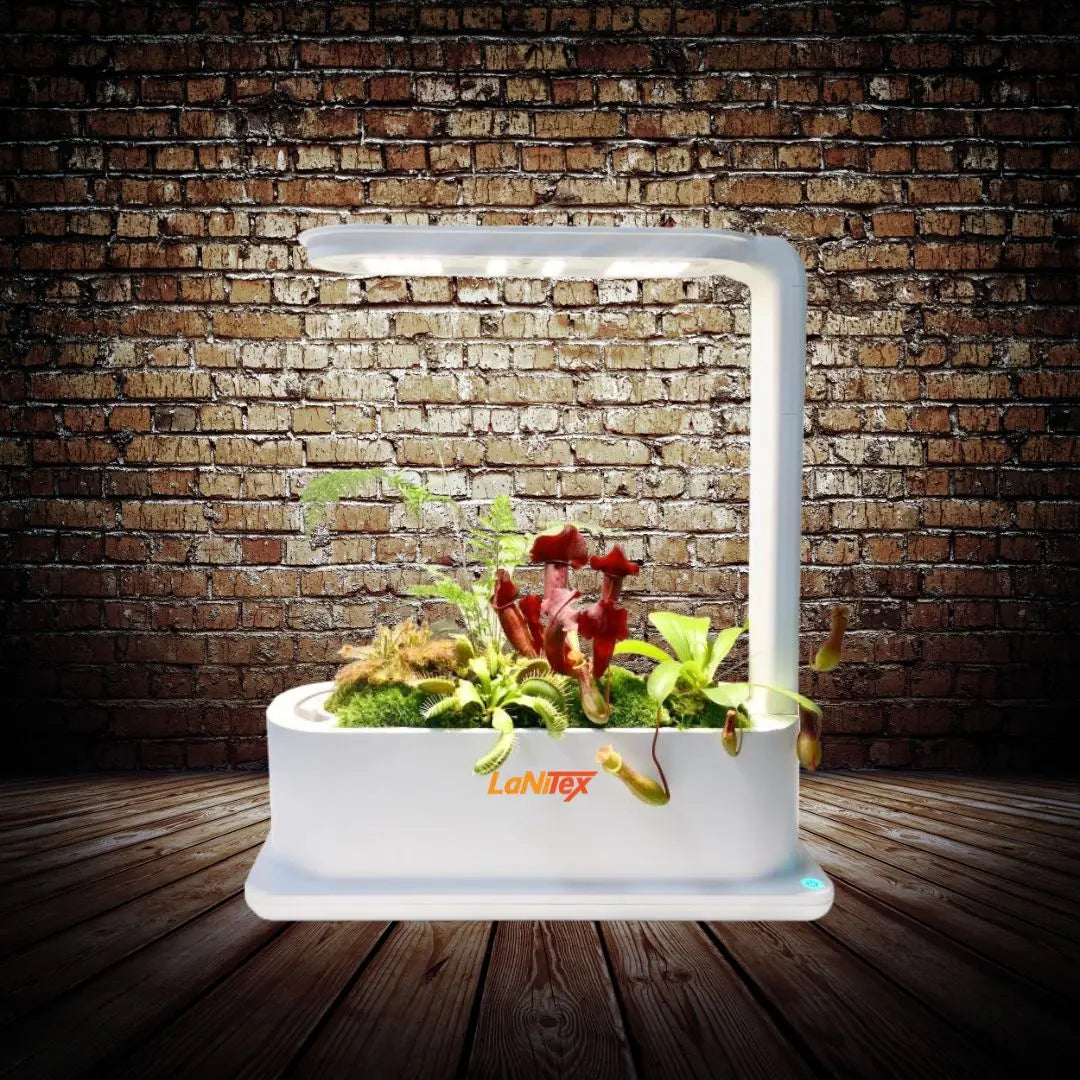
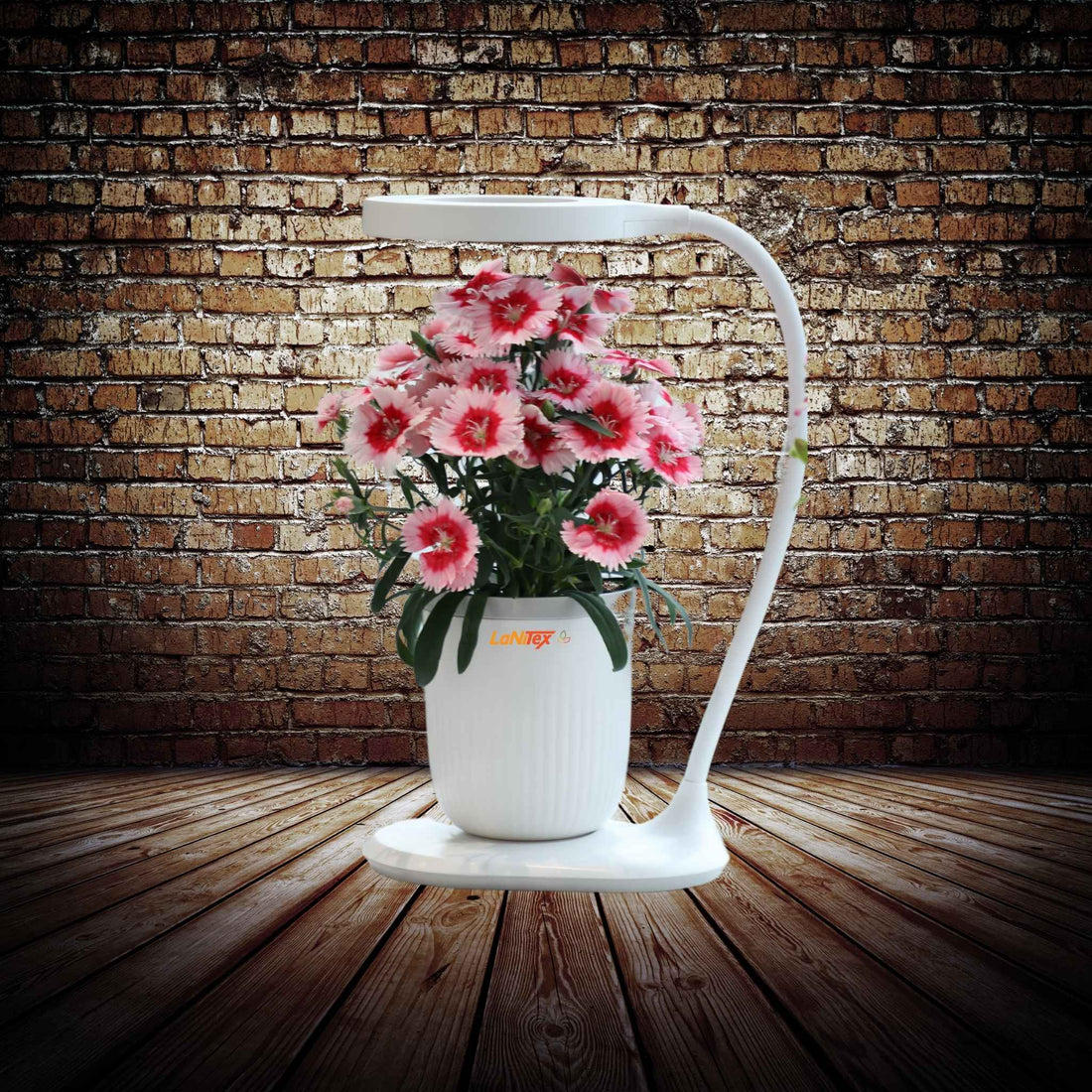
| Mini Grow Pot Z 2.4 | Passive reservoir (wick-style) | The plant draws water and nutrients up from a self-watering reservoir — no pump, no moving parts. |
| Desktop Grow Box, Smart Grow Box (15 and 67-hole), Grow Box Tall | Reservoir-based, deep water culture (DWC) principle | Roots grow down into a nutrient reservoir directly below the seed deck — the home version of DWC, a technique many guides recommend for beginners. |
| Hydroponic System V5.2-T and Hydroponic Tower V5.2-A | Vertical recirculating tower | A pump cycles nutrient solution from the base tank over the stacked root zones — a home-scale relative of the NFT and aeroponic towers used in commercial vertical farms. |
The techniques you will read about but not find here — NFT channels (a thin film of solution flowing through long gullies), ebb and flow (a tray that floods and drains on a timer), and drip systems (a timed emitter line feeding each plant individually) — are commercial and DIY formats that need separate pumps, timers, and plumbing. For a deeper look at how the tower format compares with true aeroponics, see the Hydroponic Tower vs Aeroponic Tower guide.
DIY hydroponic systems vs all-in-one units
A DIY hydroponic system — a bucket of deep water culture, a PVC-pipe NFT rail, or a simple Kratky jar that needs no pump at all — costs less upfront. Parts for a single-bucket build typically come in under $100 from Bunnings or any hardware store (plus pH and EC testing gear if you do not already own it), and build tutorials are everywhere online. The trade-offs are your time and the plumbing: you cut, seal, and leak-test everything yourself, supply your own grow light, and size your own pump with nobody to call when it fails.

An all-in-one unit costs more upfront but arrives as a working system — reservoir, full-spectrum LED, and sensors already matched to each other, with a supplier behind it. A fair rule of thumb: if the build itself is the hobby, DIY is genuinely rewarding; if the vegetables are the point, a finished unit like the Smart Grow Box above gets you planting the day the box arrives.
Microgreen and mushroom kits
| Kit | Price (AUD) | Footprint | First harvest | Best for |
|---|---|---|---|---|
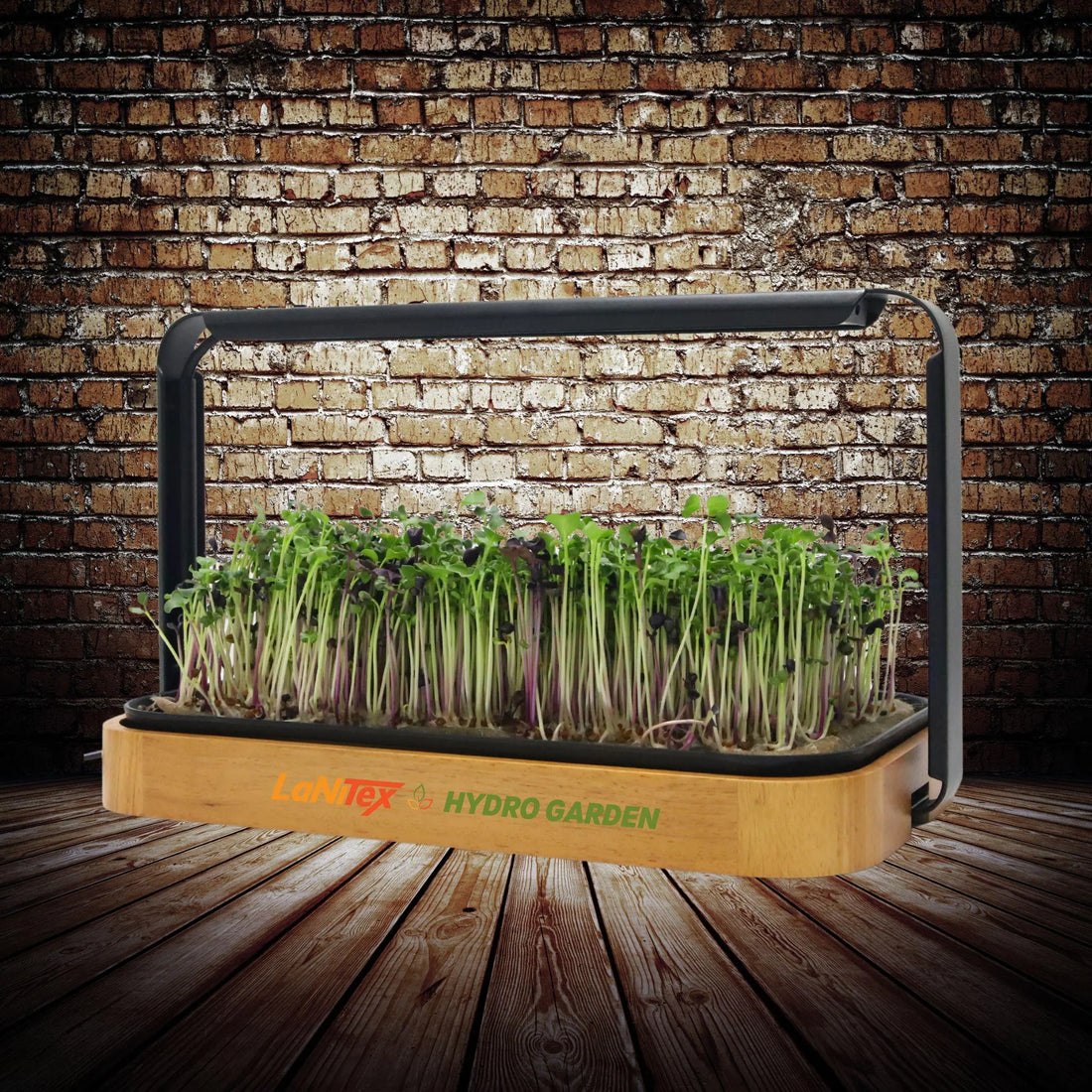
| Microgreen Kit — Black Metal | $129 | Countertop | 8 days | Modern kitchens, black metal finish |
| Microgreen Kit — Wooden | $189 | Countertop | 8 days | Decor-focused kitchens, wood-grain aesthetic |
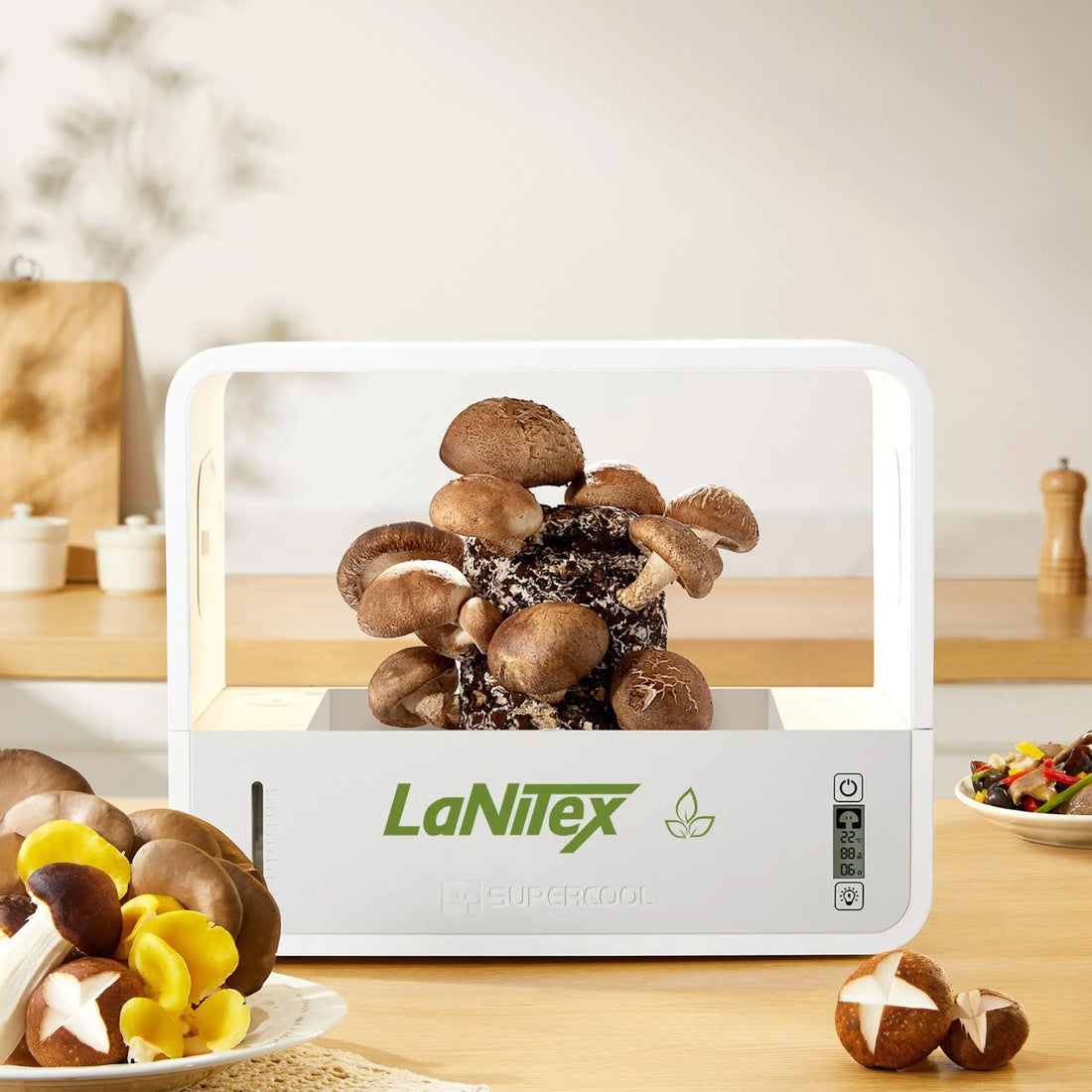
| Smart Mushroom Growing Box | $219 | Countertop | 10-14 days | Gourmet oyster, shiitake, lion's mane mushrooms |
Microgreen kit: Black Metal vs Wooden
Identical growing hardware — same full-spectrum LED, same reservoir, same 8-day harvest cycle. The $60 price difference is finish only. The Black Metal ($129) suits modern apartment kitchens; the Wooden ($189) suits decor-focused kitchens where the kit is visible on the bench daily.
Accessories
| Product | Price (AUD) | Purpose | Pairs with |
|---|---|---|---|
| Germinating Growing Mat (10-pack) | $14.90 | Seed germination + microgreen growing medium | All systems with seedling trays |
| 4-in-1 Water Quality Tester | $49.90 | Tests pH, EC, TDS, water temperature | Essential for any hydroponic system using tap water |
Laszlo's recommendation: The Water Quality Tester is the single most under-bought accessory. Brisbane and Sunshine Coast tap water is typically neutral to slightly alkaline — around pH 7 to 8.5 — and is treated with chloramine. Hydroponic plants prefer pH 5.5-6.5, so most local tap water needs adjusting before it reaches the roots. Untested water is one of the most common reasons a first hydroponic garden struggles in its first month. $49.90 of insurance.
School Term-Grow rentals (curriculum-aligned)
| Programme | Price (per term) | Equipment | Curriculum link |
|---|---|---|---|
| TG-01 — Microgreen Kit | $50/term | Smart Microgreen Kit + 10-pack mats | AC V9.0 — Years F-2, plant biology, food sources |
| TG-02 — Mushroom Box | $75/term | Smart Mushroom Growing Box + grow kit | AC V9.0 — Years 3-6, life cycles, fungi biology |
| TG-03 — Smart Grow Box | $100/term | Smart Grow Box (15-hole) + nutrients | AC V9.0 — Years 3-6, sustainability, hydroponics |
The Term-Grow programme is designed for Queensland primary and secondary schools. Programmes start at the beginning of each school term; LaNiTex delivers, sets up, and provides curriculum resources. Equipment returns at term end. Primary school hydroponics — programme details.
Decision matrix — which one suits you?
| Your situation | Recommended product | Total cost (AUD) |
|---|---|---|
| Renter, never grown anything before, want to try | Mini Grow Pot Z 2.4 + 1 mat pack | $89.90 |
| Apartment couple, want salad + herbs weekly | Smart Grow Box (15-hole) + Water Tester | $478.90 |
| Family of 3-5, want microgreens daily + lettuce weekly | Smart Grow Box (67-hole) + Microgreen Kit + Water Tester | $607.90 |
| Maximum yield, vertical floor space available | V5.2-A + Water Tester + Germination Mats | $2,054.80 |
| Want gourmet mushrooms | Smart Mushroom Growing Box | $219 |
| Modern kitchen, want microgreens countertop | Microgreen Kit (Black Metal) + Germination Mats | $143.90 |
| Australian school, F-2 STEM | TG-01 rental | $50/term |
| Australian school, 3-6 STEM + sustainability | TG-03 rental | $100/term |
Get a fresh grow guide like this every fortnight
Join the LaNiTex Hydro Garden newsletter for practical hydroponic, microgreen and mushroom growing tips for Australian homes. Subscribe to download a free hydroponics starter guide (PDF) and get 10% off your first order.
Join the newsletter →What grows well in each system
"Plant capacity" tells you how many positions a system has — not what thrives in them. Matching the crop first is also the fastest way to choose a hydroponic system for vegetables: for lettuce, the 15-hole Smart Grow Box is the natural fit, while tomatoes want the Grow Box Tall or V5.2-T. From the pre-listing growing cycles (microgreens in under a week, lettuce in 25 to 35 days, capsicum and herbs year-round), this is how the range maps to actual crops:
| System class | Grows well | Less suited |
|---|---|---|
| Mini Grow Pot Z 2.4 | Single herbs — basil, mint, coriander, parsley | Anything fruiting or tall |
| Desktop Grow Box | Herbs, compact lettuce, a small microgreen tray | Fruiting crops, tall varieties |
| Smart Grow Box (15-hole) | Lettuce heads, basil, kale, pak choi, silverbeet | Long-vine crops without support |
| Smart Grow Box (67-hole) | Microgreens, rocket, baby spinach, baby salad mixes | Large single plants |
| Grow Box Tall / V5.2-T | Tomatoes, capsicums, chillies, cucumbers (with support) | — |
| Hydroponic Tower V5.2-A | Mixed planting — leafy greens, herbs, strawberries, 30+ varieties at once | Very tall staked crops |
Running costs — electricity and consumables
The purchase price is only half the comparison; the other half is what a system costs to run. The good news: for home units the numbers stay small, and the LED is almost all of it.
Electricity. One line of arithmetic covers it: multiply the LED's wattage by the hours it runs each day, divide by 1,000, and multiply by your power tariff. Take a 30-watt full-spectrum LED on a 14-hour cycle: 0.42 kWh, which is 13 to 15 cents a day on a typical Australian tariff of 30 to 35 cents per kWh — call it $4 to $4.50 a month. Most home systems stay in single-digit dollars per month at typical tariffs. Each LaNiTex product page lists the unit's power draw, so you can run the same calculation before buying.
Consumables. Budget for germinating mats ($14.90 for a 10-pack), a bottle of hydroponic nutrient concentrate (lasts months at household scale), seeds from Australian suppliers, a pH adjuster, and a carbon filter or water conditioner if you are starting from chloraminated tap water.
No subscription fees. None of the LaNiTex systems carry app or membership charges. That is worth checking on imported smart gardens — WIRED's 2026 testing of US indoor gardens found app subscriptions running to several hundred US dollars a year on top of the hardware price.
What the LED specs actually mean
A bigger wattage number on the box is not a better light — just a hungrier one. The fit between lamp and plant is what counts: a seedling does best with the light close overhead, while a mature capsicum bush needs headroom under it. That is why the range splits the way it does: the compact units keep a fixed lamp close to low crops, while the Grow Box Tall and the two towers are built around vertical clearance for plants that keep climbing. "Full-spectrum" means the LED covers the blue wavelengths that drive leafy growth and the red that drives flowering and fruiting, so one lamp serves the whole cycle.
Maintenance time and water
Across each product's pre-listing growing cycle on the Sunshine Coast, the maintenance routine settled into three tiers:
- Mini Grow Pot + countertop kits: top up the reservoir weekly and rinse the tank between crops — under 10 minutes a week.
- Grow boxes (Desktop, Smart, Tall): weekly water top-up and nutrient dose, plus a 15-minute reservoir clean between growing cycles — around 10 to 15 minutes a week.
- Towers (V5.2-T, V5.2-A): the same weekly cycle plus a full reservoir flush every few months — around 15 to 20 minutes a week.
On water: a useful benchmark from buyer's guides is at least one litre of reservoir per plant position — bigger tanks simply need topping up less often (Gathera's indoor hydroponic buyer's guide uses the same rule of thumb). And if your tap water is hard or chloraminated (as it is across Brisbane and the Sunshine Coast), test it before the first fill; the 4-in-1 Water Quality Tester above exists for exactly this.
Five mistakes Australians make when choosing a system
- Buying capacity for aspiration, not eating habits. Sixty-seven positions is not sixty-seven dinners — start from what your household actually eats each week, then size up.
- Skipping water testing. Untested tap water (pH drift, chloramine) is one of the most common reasons a first hydroponic garden fails in month one.
- Ignoring ceiling height and clearance. The towers need 161-180cm plus headroom; tomatoes and cucumbers keep climbing past the lamp in compact boxes.
- Choosing on looks instead of light. The LED does the growing — a pretty unit with a weak or badly positioned lamp grows leggy, pale plants.
- Forgetting the running costs. They are small but ongoing: power, nutrients, mats, and seeds belong in the comparison alongside the sticker price.
Australian shipping and pricing notes
- All prices in AUD, GST included. No hidden fees.
- Ships from the Sunshine Coast, Queensland. Same-week delivery to Brisbane, Sunshine Coast, Gold Coast. Two to three days to Sydney and Melbourne. Three to five days to Perth, Adelaide, Hobart, Darwin.
- Local pickup available for Sunshine Coast addresses within 30 minutes on the Sunshine Coast (we often drop off ourselves).
- Free founder consultation — book a call with Laszlo before buying if you are unsure which system fits.

Ready to scale up? Grow across 72 vertical planting sites in the same 0.3 m² footprint, under a full sensor stack and automatic LED cycle.
Scale up your grow →Personally tested at home on the Sunshine Coast before listing.
The full range
Find the system that fits your space


Supported in Australia - every model tested before listing.
FAQ — comparing LaNiTex hydroponic systems
What is the difference between the Hydroponic Tower V5.2-A and the V5.2-T?
Both are vertical hydroponic towers with the same 0.3 square metre footprint. The V5.2-A stands 180cm tall with 76 sowing positions and costs $1,990 AUD. The V5.2-T stands 161cm tall with 18 sowing positions and costs $1,590 AUD. The V5.2-T is the more affordable option for tomatoes, peppers, and chillies; the V5.2-A is the maximum-capacity option for families or small commercial growers. Both run the same sensor stack.
Should I buy the 15-hole or 67-hole Smart Grow Box?
Same price ($429 AUD), same hardware — only the lid differs. The 15-hole variant suits larger plants (lettuce heads, basil bushes) at 15 mature positions. The 67-hole variant suits microgreens, baby salads, and frequent small harvests at 67 dense positions. Most Australian apartment buyers start with 15-hole.
What is the difference between the Microgreen Kit Black Metal and Wooden version?
The growing hardware is identical — same full-spectrum LED, same reservoir, same 8-day harvest cycle. The $60 AUD price difference is finish only. The Black Metal ($129) suits modern apartment kitchens; the Wooden ($189) suits decor-focused kitchens where the kit is visible on the bench daily.
Which LaNiTex system is best for a small Australian apartment?
The Smart Grow Box at $429 AUD is the most common starting point for Sydney, Brisbane, and Melbourne apartments. It runs on 0.36 square metres of bench space, holds 15 or 67 plants, and can be stacked vertically as harvest needs grow. The Hydroponic System V5.2-T at $1,590 is the upgrade path when floor space and ceiling height allow.
Do I need the 4-in-1 Water Quality Tester?
Yes, for any system using tap water. Brisbane and Sunshine Coast tap water is typically neutral to slightly alkaline (around pH 7 to 8.5) and is treated with chloramine; hydroponic plants prefer pH 5.5 to 6.5, so tap water usually needs adjusting. The $49.90 AUD tester measures pH, EC, TDS, and water temperature in one device. Untested water is one of the most common reasons a first hydroponic garden struggles in its first month.
What is a hydroponic system?
A hydroponic system grows plants in nutrient-rich water instead of soil. The roots sit in or above a reservoir of dissolved nutrients, and indoors a full-spectrum LED stands in for sunlight. Because the plant no longer has to search for food, growth is typically faster than in soil.
How does a hydroponic system work?
The reservoir holds water with dissolved nutrients, and the roots take up both directly. In passive systems, like the wick-style Mini Grow Pot, the plant draws water up itself; in powered systems a pump circulates the solution past the roots — the towers cycle it from the base tank over each root zone. An LED on a timer supplies the light.
How much does a hydroponic system cost?
The LaNiTex Australian range runs from $75 (Mini Grow Pot) to $1,990 (72-position V5.2-A tower), GST included, with the $429 Smart Grow Box the most popular starting point. Running costs stay small — the LED typically adds a few dollars a month. Every system ships Australia-wide from the Sunshine Coast.
How do you set up a hydroponic system?
For an all-in-one unit: unbox, fill the reservoir, add nutrients, drop seeds into the positions, and switch on. During pre-listing testing, first planting took 15 to 30 minutes on every LaNiTex system, with the towers at the longer end. A DIY build, by contrast, is a weekend project before the first seed goes in.
How do you clean a hydroponic system?
Rinse and wipe the reservoir between crops, and give the system a deeper clean every few months: empty the tank, wash with warm water and a mild food-safe sanitiser or diluted white vinegar, rinse thoroughly, and refill with fresh nutrient solution. It takes around 15 minutes on the grow boxes; the towers add a pump-line flush.
Which hydroponic system requires no electricity?
For watering, wick-style units like the Mini Grow Pot need no pump — the plant draws from the reservoir passively, and Kratky-method jars work the same way. Truly zero-power hydroponics only works outdoors or on a bright windowsill, though: any indoor system still needs its LED, which is the main (small) power draw. Solar and 12-volt rigs are DIY territory.
Which hydroponic system is best?
The one that matches what you eat and the space you have — there is no universal best. For lettuce and salads, the Smart Grow Box (15-hole); for daily microgreens, the 67-hole lid; for tomatoes, capsicums, and chillies, the Grow Box Tall or V5.2-T; for maximum output per square metre, the V5.2-A tower. The decision matrix above maps eight common situations.
How do the school Term-Grow rentals work?
LaNiTex Term-Grow rentals provide equipment plus AC V9.0 curriculum resources to Queensland primary and secondary schools. Programmes start at the beginning of each school term (TG-01 $50/term Microgreen, TG-02 $75/term Mushroom, TG-03 $100/term Smart Grow Box). LaNiTex delivers, sets up, and equipment returns at term end.
Further reading
- Hydroponic System Essentials — pillar guide to systems, costs, and decision-making for Australian growers
- Hydroponic System for Every Home — scenario fitment guide for apartments, balconies, and backyards
- Hydroponic Tower vs Aeroponic Tower — Hydroponic Tower V5.2-A and V5.2-T technical deep-dive
- Grow Tents vs Hydroponic Grow Box — when to use a tent enclosure vs an integrated box
- About Laszlo Bulatko, Founder — the operator behind every product test
- Contact LaNiTex Hydro Garden — book a free founder consultation before buying