By Laszlo Bulatko | Updated 13 May 2026
I've watched coriander bolt in my own Sunshine Coast garden. Once the December-February heat hits, the leaves turn bitter and the plant flowers before the dish is ready. Now I grow coriander in my own kitchen Grow Box: same seeds, no bolting, harvest after harvest right through the QLD summer. At the Eumundi market most weekends, the question I hear from apartment renters and locals isn't "does it work?" -- it's "will it actually beat what I buy at Coles?" This guide answers that, using roughly 90% less water than soil, year-round on your kitchen counter, no garden required.
Quick answer: A hydroponic herb garden is a soil-free indoor system that grows fresh herbs using nutrient-rich water and LED light, typically delivering 3-4 week harvest cycles, year-round, and using roughly 90% less water than soil. That's how it works in plain terms.
A hydroponic herb garden trades soil for water and replaces sunlight with a tuned LED. The two changes solve a problem most renters know well: kitchens don't get enough light for proper herb growth, and pots in soil bolt or wilt the first time a Queensland heatwave hits. If you've ever searched "hydroponic herb garden how it works" and got a tangle of jargon, here's the plain version. I'll walk you through how it works, what it costs to run, and which herbs actually thrive on a kitchen counter.
How does a hydroponic herb garden actually work?
A hydroponic herb garden is a closed-loop indoor system that grows fresh herbs without soil. Roots sit in a small basket (a "pod") above a reservoir of water mixed with mineral nutrients (the A+B liquid mix added at setup). A pump circulates that water past the roots on a timer, typically a 1-2 minute pulse every 30-45 minutes, so the roots drink directly without waiting for soil to soak through. An LED panel above the plants runs for 12-16 hours a day, delivering 300-400 micromoles of red and blue light tuned to what plants actually use (a kitchen window delivers only 50-200). That is the entire mechanism: closed-loop water, controlled light, and a controller that handles the timing. The system does not need rainfall and does not require you to remember to water it, even when a Queensland heatwave hits in February.
How the water and nutrients reach the herbs
The pump moves nutrient water from the reservoir up to the root zone roughly once every 30-45 minutes. Roots drink directly. There's no wait for soil to soak through and no risk of root rot from over-watering, because the system drains itself between cycles. Desktop systems usually run on a 1-2 minute pump cycle, then rest for 30-45 minutes. You don't time it. The controller does.
What the LED light does
Standard kitchen windows aren't strong enough. A north-facing apartment window in Sydney or Brisbane delivers perhaps 50-200 micromoles of usable light per square metre per second. Basil wants closer to 250. Coriander wants 200. The LED on a decent indoor hydroponic herb garden in Australia delivers 300-400 micromoles, tuned to red and blue wavelengths that plants actually use. That's why a hydroponic herb garden with lights in an Australian kitchen performs in winter the same way it performs in summer: the lid above the plants doesn't care what the weather is doing outside.
Why a kitchen window isn't enough
A bright kitchen window helps a potted basil survive. It rarely helps it produce. Apartment kitchens typically get strong light for two to four hours a day, below the seven hours basil needs to leaf out properly. Add winter, a south-facing wall, or a balcony block from the next tower, and growth stalls. Skip the window. Use the panel.
Best herbs to grow hydroponically (and what to skip)
Some herbs love this setup. Others sulk. Here's what actually performs on a kitchen counter in Australia, and where I'd save your time and money.
Basil (the easy winner)
Basil is the herb most people start with, and for good reason. A single seedling in an Australian hydroponic herb garden set up for basil will give you 15-20 grams of leaf every 10-14 days from week three onwards. That's enough for a weekly pesto with leaf to spare. Pinch the top two leaves whenever the plant hits 15 cm and it will branch out instead of going to flower.
Coriander (bolt-proof indoors)
Coriander is where indoor hydroponics earns its keep in Queensland. In soil, December heat triggers bolting within two weeks; the leaves narrow, the flavour turns soapy, and the plant flowers. Indoors at 21-24 degrees under a controlled LED, the plant has no reason to bolt. A hydroponic herb garden in Australia, set up for coriander, keeps it leafy for 8-10 weeks. Sow a fresh pod every three weeks and you have rolling harvests right through summer.
Parsley, mint, and chives (low-light tolerant)
These three are the steady performers. Parsley takes 25-30 days to reach first harvest, then keeps cropping for months. Mint is aggressive; give it its own pod or it will crowd everything else. Chives slot into any spare hole; cut them like grass with kitchen scissors.
What NOT to plant year one
Don't bother with rosemary, sage, or thyme in a small kitchen hydroponic herb garden. They're woody Mediterranean perennials that prefer dry roots and bright sun, the opposite of what a circulating water system delivers. They'll survive a few weeks then go yellow. Buy a single potted plant for those three and put it on the balcony. Save your pods for fast leafy herbs.
How to set up your first hydroponic herb garden in 7 steps
Setting up a hydroponic herb garden takes 15-20 minutes: pick a counter-sized unit, find a power point on a level surface, fill the reservoir with cold tap water, add A+B liquid nutrients, plant pre-grown seedling pods, set the LED on a 16-hours-on schedule, and check the water weekly. If you've never done this before, the setup is shorter than building flat-pack furniture. Here's how a hydroponic herb garden for beginners in Australia actually unfolds, step by step.
Step 1: Pick the right size for your bench
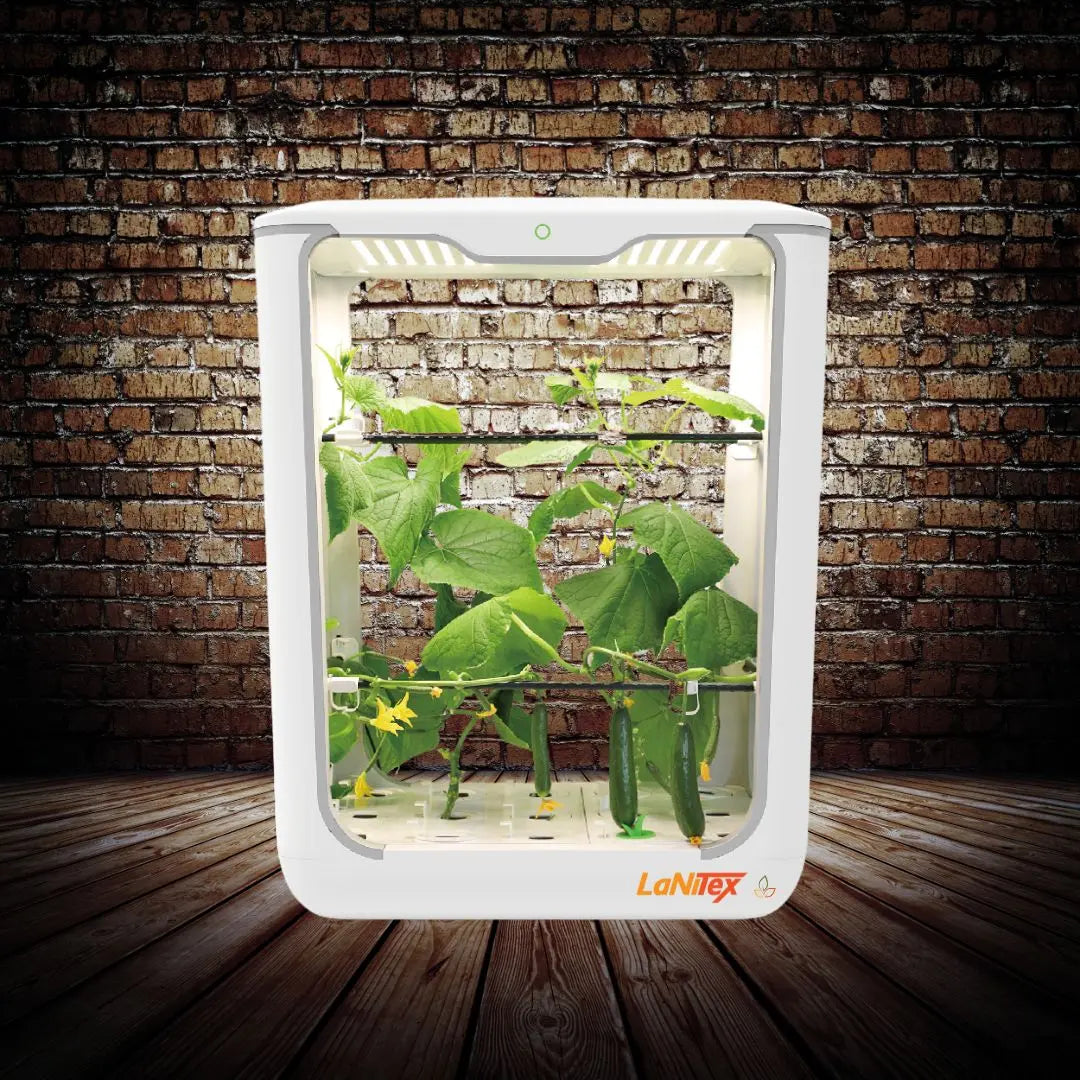
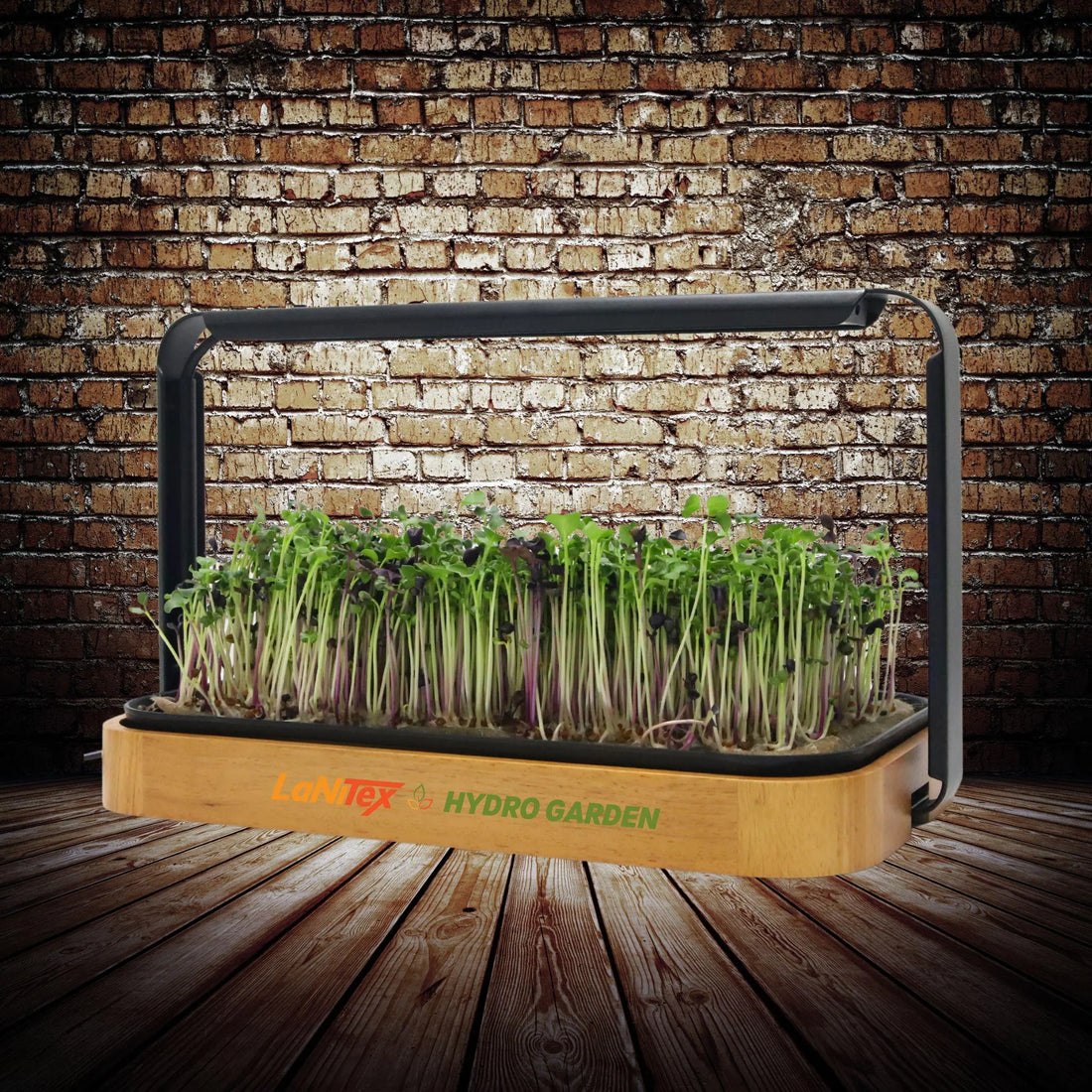
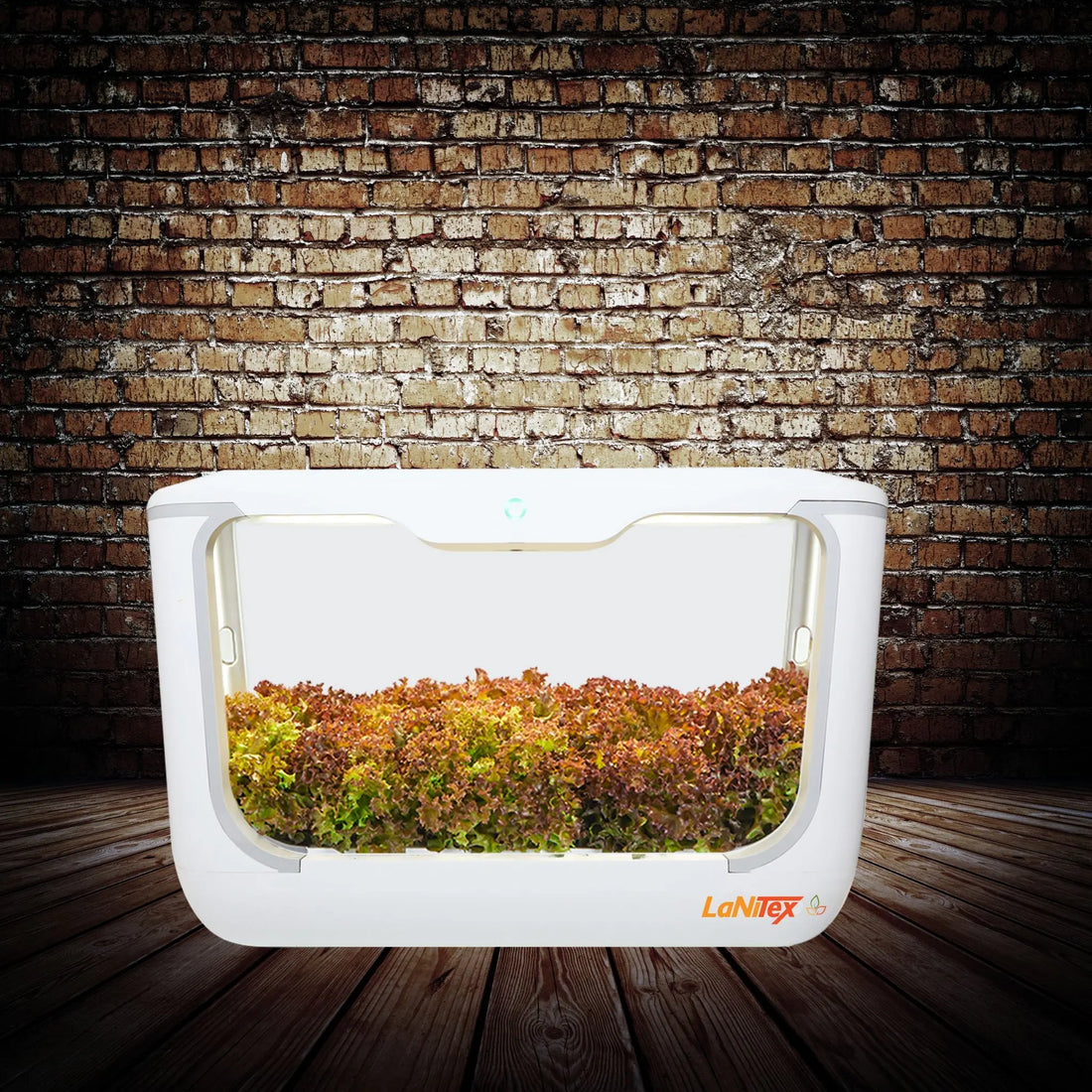
A 15-hole Smart Grow Box Short ($429) fits on a standard kitchen counter at 56 cm wide, and holds enough herbs for a household of two to four. For a smaller bench or a flat-share trial run, the Desktop Grow Box ($139) with 3 pods is the entry-tier choice. Both fit under a standard 40 cm overhead cupboard.
Step 2: Find a power point and a flat surface
The unit plugs into a normal 240V wall socket. It needs to sit level, away from the cooktop splash zone. A kitchen island, a sideboard, or a corner of the bench all work. Don't put it on the fridge; the heat from the fridge motor disrupts the water temperature.
Step 3: Rinse the reservoir and fill with water
Cold tap water is fine. Fill to the line marked inside the tank. A 15-hole unit takes about 6 litres on first fill and roughly 1.5 litres a week after that. Sydney, Brisbane, and Melbourne tap water all work without adjustment; if you're on rainwater or bore water, mix half-and-half with tap for the first month.
Step 4: Add the nutrient mix
Every system ships with a starter pack of A+B liquid nutrients. Add the dose listed on the bottle, usually 5 mL of A then 5 mL of B per litre. Stir gently. Don't pre-mix A and B in the same cup before adding; they react and the nutrients precipitate out.
Step 5: Plant the seedlings or pods
Drop a pre-grown seedling pod into each hole, or sow a fresh seed into a sponge plug. Cover with the included light dome until the first leaves appear (3-7 days). Remove the dome once the seedlings touch the underside.
Step 6: Set the light timer
Most kits ship with a default setting: 16 hours on, 8 hours off. Leave it. Resist the urge to "give them more light." Plants need the dark period to convert energy into leaf.
Step 7: Check the water weekly
Top up the reservoir to the line every 5-7 days. Add a half-dose of A+B every fortnight. Drain and refresh the whole reservoir every 4-6 weeks. That's the entire maintenance routine.
Hydroponic herb garden vs soil herbs vs AeroGarden
Most apartment renters end up choosing between three options: potted herbs in soil, a name-brand kit like AeroGarden, or an Australian-supported hydroponic system. Here's how a hydroponic herb garden vs soil herbs choice plays out in real numbers, with AeroGarden included for the head-to-head most readers ask about.
| Option | Setup cost | Weekly time | Water use | 3-month yield (basil) | AU support |
|---|---|---|---|---|---|
| Soil pot on windowsill | $5-20 | 15-20 min | ~30 L | 80-150 g | n/a |
| AeroGarden Harvest | $250-380 (import) | 5 min | ~12 L | 240-320 g | US-based |
| Smart Grow Box Short (15-hole) | $429 | 5 min | ~10 L | 300-450 g | the Sunshine Coast, QLD |
| Desktop Grow Box (3-pod) | $139 | 3 min | ~6 L | 90-140 g | the Sunshine Coast, QLD |
Soil dries. Hydroponics doesn't. That's the structural reason yields run 2-3x higher per plant. AeroGarden's own marketing notes that with their setup, "I can get perfectly fresh grown basil, thyme, or dill all year long", and that's the right benchmark to beat. The Smart Grow Box Short matches AeroGarden's hydroponic herb garden vs aerogarden yield while shipping from the Sunshine Coast. That means no customs delay or $80 import freight, and replacement pods plus customer support inside the same time zone. For a smaller setup that delivers the same hydroponic principle in a 3-pod footprint, the Desktop Grow Box at $139 is the lowest-friction way in.
Maintenance: 5 minutes a week, year-round
Here's the part most people don't believe until they've owned a unit for a month. A year-round hydroponic herb garden in Australia needs about 5 minutes of attention per week and zero of the seasonal panic that soil herbs trigger. The bolt window disappears in a controlled-temperature system, winter dormancy is irrelevant because the LED handles light, and the "I forgot to water" failure mode goes away with the automatic pump cycle.
In my testing at home on the Sunshine Coast (Laszlo Bulatko, solo operator), a 15-hole Smart Grow Box Short running continuously since November 2024 has needed a single full reservoir change every 5 weeks and a one-minute top-up every Sunday. The herbs themselves get more attention only at harvest, with a quick prune of kitchen scissors when you want fresh leaf for dinner.
Fresh herbs are also worth growing for what they put on the plate, not just convenience. According to Better Health Channel (the Victorian government's health service, with academic input from Deakin University), "Fresh herbs often contain higher antioxidant levels compared to processed or dried herbs." That's the nutritional case for fresh-cut basil over the dried jar from the cupboard.
Year-round availability matters more in apartments than houses. You can't dig up a balcony garden when you move flats. A kitchen unit comes with you in the moving box and goes back on the next bench within an hour.
The same setup works across Australia's main metro markets with only minor tweaks. In Sydney, north-facing apartments with limited bench depth suit the Desktop Grow Box footprint; renters in Surry Hills and Newtown commonly report 5-7 g of basil per harvest from the 3-pod unit. Brisbane apartments and homes on the Sunshine Coast benefit most from the year-round LED, because the December-February humidity bolts outdoor herbs within two weeks; the Smart Grow Box Short keeps coriander leafy when balcony pots have already flowered. Melbourne is where the controlled LED outperforms windowsill growing the hardest, with the 16-hour daily light cycle producing the same yield in July as in December. The unit itself is unchanged across all three cities; only the herb mix changes with what each kitchen wants to cook.
What it costs vs the supermarket (real Aussie numbers)
The maths most renters want to see is whether $429 ever pays back on a kitchen hydroponic herb garden in Australia. Here's the cost-context, with real prices.
The Australian Bureau of Statistics tracks fresh produce prices nationally. According to the ABS Consumer Price Index for March 2026, "Fruit and vegetable prices rose 1.8% in the 12 months to March 2026." Fresh herbs at Coles or Woolies typically sit at $3.50-4.50 for a small punnet of basil or coriander, about 25-30 grams. A weekly Asian-cooking household, or a family that uses herbs in two or three weeknight dinners, often spends $25-45 a week on herbs that go limp inside four days.
At $35 a week in supermarket herbs, the Smart Grow Box Short pays for itself in about 12 weeks. At $50 a week, the break-even is around 9 weeks. The Desktop Grow Box at $139 pays for itself in roughly 4-6 weeks on the same usage. After that point, every harvest is profit, and crisp, not wilted. That's the hydroponic herb garden saving money cooking math without the spin.
Common mistakes to avoid (the 4 I see every weekend at Eumundi)
At the Eumundi market most Saturdays, four mistakes come up over and over. Fair point. Most of them are honest first-year errors, not failures of the system. Here are the patterns I see most often, so you can skip past them.
Mistake 1: Starting with seeds when seedlings save 14 days
Pre-grown seedling pods reach first harvest in 14-21 days. Sowing from seed in a sponge plug pushes that to 28-35 days because germination eats the first two weeks. For your first run, buy seedlings; they ship in the same pack as the unit. Once you have rolling harvests going, switch to seeds for the cost saving (about $0.20 per pod vs $2-4 per seedling).
Mistake 2: Adding more nutrients to "boost" growth
Plants take what they need. Over-dosing burns the roots and turns leaf tips yellow within a week, with brown crispy edges by week two. Stick to the bottle's stated dose: 5 mL of A then 5 mL of B per litre at setup, then a half-dose every fortnight. If the lower leaves yellow without burning, you are under-dosing; if the leaf tips burn, you are over-dosing. Flush the reservoir and re-dose at half the previous amount.
Mistake 3: Skipping the dark period
Leaving the LED on 24/7 doesn't double the growth. Plants stop respiring properly without a dark cycle, leaf colour fades to pale green within 10 days, and yields actually drop by 15-20% compared to a 16-on / 8-off schedule. Use the timer. The default schedule is the right one.
Mistake 4: Trying to grow tomatoes in a herb unit
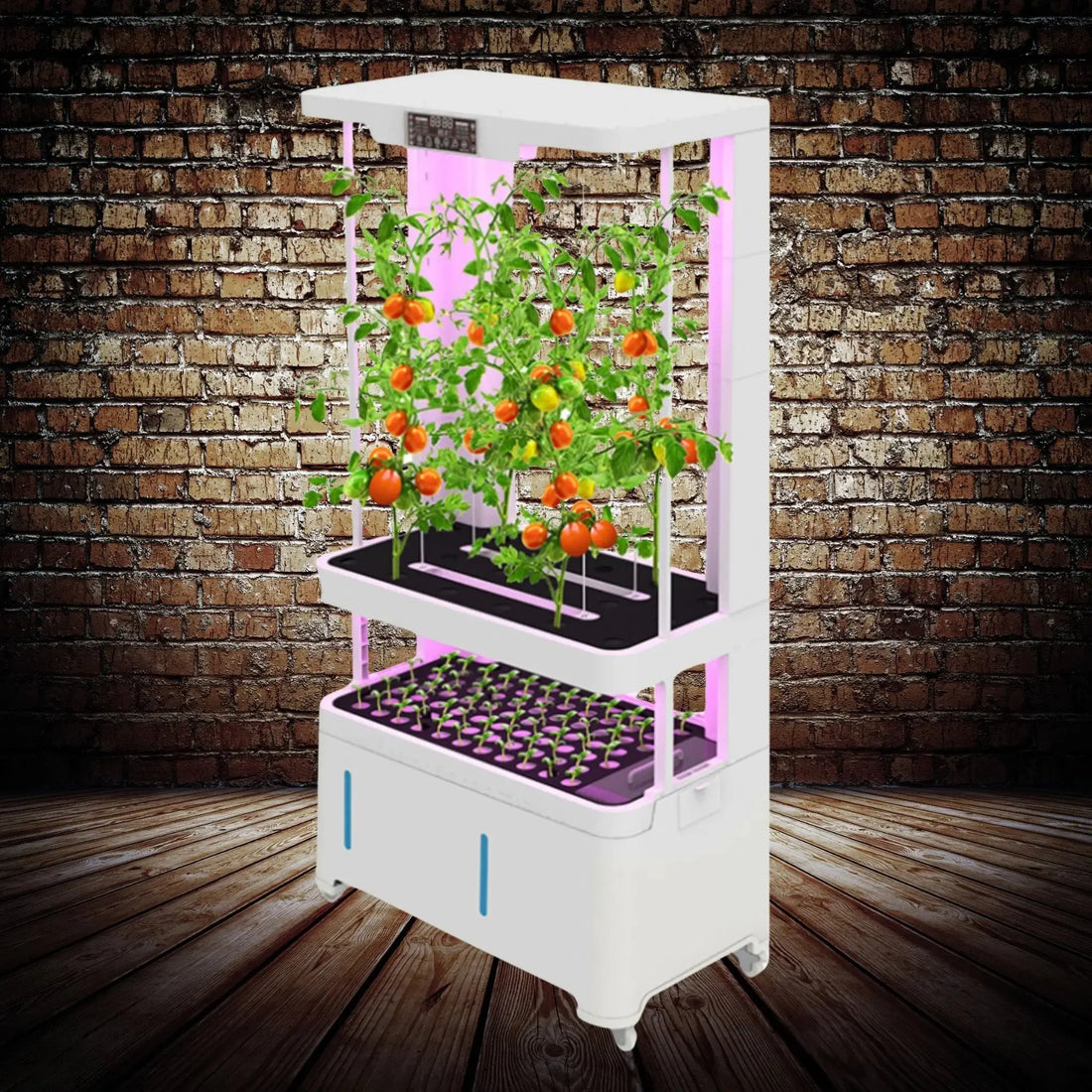
Tomatoes need 40+ cm of vertical space and 6+ litres of root volume per plant. A herb-tray system has neither, and the plant will either stay stunted at 30 cm or topple over when the first fruit sets. For tomato hydroponics, look at the Smart Grow Box Tall or a freestanding vertical system. Same principle, much more capacity.
Key takeaways
- A hydroponic herb garden grows fresh herbs in nutrient water under LED light, indoors and year-round, using about 90% less water than soil.
- Basil, coriander, parsley, mint, and chives are the easy wins. Skip rosemary, sage, and thyme in year one.
- The Smart Grow Box Short ($429) pays for itself in 9-12 weeks at a typical $35-50 weekly Coles herb spend.
- Weekly maintenance is one Sunday top-up plus a reservoir refresh every 4-6 weeks, about 5 minutes a week.
- Coriander does not bolt indoors, so the December-February Queensland heat is no longer the deciding factor for fresh leaf.
- AeroGarden does the same job, but the the Sunshine Coast-based Smart Grow Box Short ships local, no customs and no four-week wait.
FAQ
What is a hydroponic herb garden?
A hydroponic herb garden is an indoor growing system that delivers nutrient-rich water to plant roots directly, without soil. An LED panel above the plants replaces sunlight, and a small pump circulates water on a timer. Most home units are small enough for a kitchen counter and hold between 3 and 15 herb plants. The setup runs continuously, year-round, and produces fresh leaf in 3-4 weeks from seedling.
How do hydroponic herb gardens work?
Water from a reservoir runs to the roots on a pump timer. An LED runs 12-16 hours a day for photosynthesis. Both run automatically. Roots sit in small baskets above the reservoir and drink directly. No soil, no rain dependency, no manual watering. The controller handles pump cycles and light timing on its own.
How to start a hydroponic herb garden indoors in Australia?
Pick a unit sized to your bench (a 3-pod Desktop Grow Box for small kitchens, a 15-hole Smart Grow Box Short for a household of two to four), find a power point near a flat surface away from the cooktop, fill the reservoir with cold tap water, add the included A+B liquid nutrients per the bottle dose, plant pre-grown seedling pods for a faster first harvest, set the LED on a 16-hours-on schedule, and top up the water every Sunday.
What can you grow in a hydroponic garden?
Leafy herbs and salad greens perform best in a small home unit: basil, coriander, parsley, mint, chives, lettuce, rocket, and bok choy. Strawberries also work in some configurations. Avoid woody Mediterranean herbs (rosemary, sage, thyme), root vegetables, and large fruiting plants like tomatoes or capsicum unless you're using a system designed for them with deeper root space and stronger lighting.
Is a hydroponic herb garden worth it for an Australian apartment?
For a household spending $25-50 a week on supermarket herbs, the answer is usually yes. A $139 Desktop Grow Box pays for itself in 4-6 weeks at typical usage; a $429 Smart Grow Box Short pays for itself in 9-12 weeks. Beyond the cost return, apartment renters have practical reasons that matter when renting. No balcony needed. No soil mess on lease inspection. The unit moves with you when the lease ends. Year-round fresh leaf, not just summer harvest.
Further reading
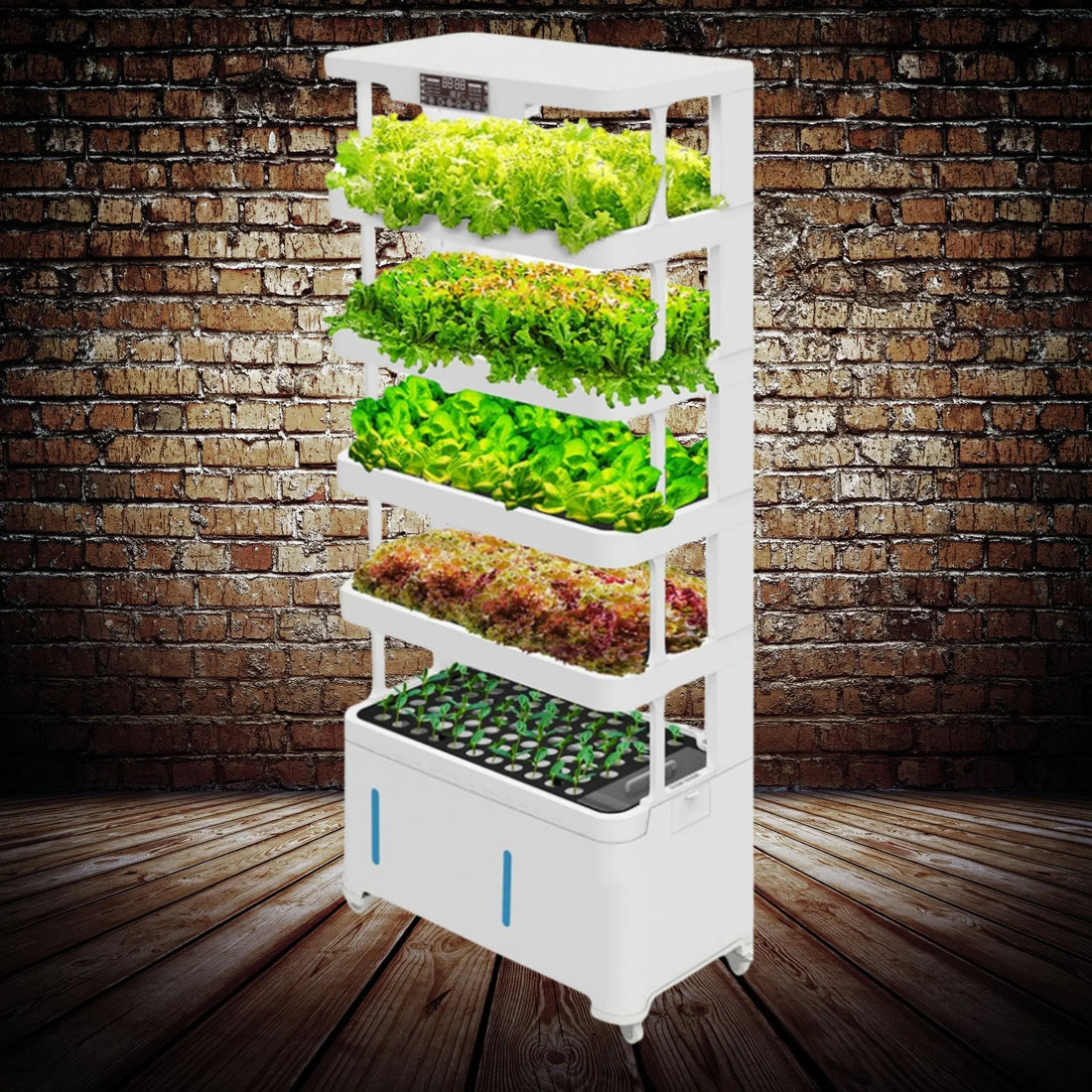
If you live in an apartment and want a complementary guide that covers vertical systems alongside countertop units, see our grow tower for apartments in Australia write-up. It addresses ceiling-height constraints, lease compliance, and which freestanding tower designs actually fit in standard Brisbane, Sydney, and Melbourne apartments.
About the writer
Laszlo Bulatko founded LaNiTex Hydro Garden in December 2024. Solo operator based on the Sunshine Coast. Before hydroponics, Laszlo spent 15 years in sales, marketing, and brand development across the Hungarian fishing tackle market, representing Okuma, Mustad, Savage Gear, Prologic, Mad Cat, Penn, JRC, Plano, Abu Garcia, and Berkley, and helping establish 12% market share. Every product on the LaNiTex site was tested once in his own kitchen on the Sunshine Coast before being added to the catalogue, including the hydroponic herb garden setups covered in this guide.
Sources
- Australian Bureau of Statistics (ABS), Consumer Price Index Australia, March 2026 release: https://www.abs.gov.au/statistics/economy/price-indexes-and-inflation/consumer-price-index-australia/latest-release
- Better Health Channel (Department of Health, Victoria, with academic input from Deakin University), Herbs: https://www.betterhealth.vic.gov.au/health/healthyliving/herbs
- Sustainable Gardening Australia: https://www.sgaonline.org.au/
- AeroGarden (Scotts Miracle-Gro): https://scottsmiraclegro.com/en-us/aerogarden.html
- LaNiTex Hydro Garden, Smart Grow Box Short product page: https://lanitexhydrogarden.com.au/products/indoor-hydroponic-system-grow-box-hydro-garden
- LaNiTex Hydro Garden, Desktop Grow Box product page: https://lanitexhydrogarden.com.au/products/hydroponic-system-hydro-garden-desktop-grow-box
- LaNiTex Hydro Garden, About Laszlo Bulatko (Founder): https://lanitexhydrogarden.com.au/pages/about-laszlo-bulatko-founder-lanitex-hydro-garden
- LaNiTex Hydro Garden, Grow tower for apartments in Australia: https://lanitexhydrogarden.com.au/blogs/hydroponic-blog/grow-tower-for-apartments-in-australia