
Hydroponic System: The Future of Indoor Gardening
Last reviewed:
A hydroponic system is a soil-free growing method that delivers a measured nutrient solution directly to plant roots through water. Closed-loop setups use up to 90 percent less water than conventional soil farming (peer-reviewed Bioinformation, 2023), and aeroponic variants accelerate seedling-to-transplant time from 28 days to 10 (NASA Spinoff, 2008).
Methodology. Every product mentioned in this guide was tested by Laszlo Bulatko at home on the Sunshine Coast, Queensland, across at least one full growing cycle (6 to 12 weeks) before being added to the catalogue. Test conditions: sub-tropical climate, kitchen bench, 25 degrees ambient, mains water with pH adjustment. Products that fail the home test do not get stocked.
I have been growing food this way at home on the Sunshine Coast for three years. Lettuce in five weeks on a kitchen bench, basil running continuously since last spring, capsicum that survived a Queensland summer because the unit sat under aircon. The same hardware now ships to schools and households across the east coast. This guide is the version I wish I had when I bought my first system on a hunch in 2022. Four system types, the research that actually backs the claims, the setup workflow I run on every new unit, and the plants that work in an Australian apartment, suburban kitchen, or classroom.
What is a hydroponic system?
Quick answer. A hydroponic system is a soil-free growing setup that flows nutrient water past plant roots. It uses up to 90 percent less water than soil farming, harvests lettuce in 25 to 35 days, and runs from a $75 benchtop pot up to a $1,990 vertical tower.
A hydroponic system is a soil-free method of growing plants. Instead of soil, the roots sit in an inert medium, a misted chamber, or a flowing channel of nutrient water. The grower controls every input that matters: nitrogen, phosphorus, potassium, pH, light hours, water temperature. Because the plant does not have to hunt for food, it spends more energy producing leaves, fruit, or roots. A hydroponic lettuce typically reaches harvest weight in 25 to 35 days; the same lettuce in ideal soil conditions takes 30 to 40.
The method scales from a single benchtop pot on a kitchen counter to a multi-tier vertical farm. Hardware changes, but the principle does not. Water carries nutrients. Light drives growth. The grower keeps the system stable with regular pH, EC, and water-level checks. Premium units handle the checks with sensors; most home systems still run manual.
The four hydroponic system types
Quick answer. Four system types cover most Australian indoor use cases. Deep Water Culture and Nutrient Film Technique are best for benchtop leafy greens. Aeroponic and hydroponic towers maximise yield per square metre. Pick by floor space, not by spec sheet.
"Hydroponic system" is a category, not a single product. The four types below cover what works in an Australian apartment, classroom, or small commercial space. Scan the comparison table for the short version; the H3 blocks underneath give the longer answer for each.
| System type | Complexity | Water use vs soil | Best for | LaNiTex product | Price (AUD) |
|---|---|---|---|---|---|
| Deep Water Culture (DWC) | Beginner | ~80% less | Bench herbs, leafy greens | Mini Grow Pot Z 2.4, Desktop Grow Box | $75 to $139 |
| Nutrient Film Technique (NFT) | Beginner to intermediate | ~85% less | Continuous leafy harvest | Smart Grow Box | $429 |
| Aeroponic tower | Intermediate | ~98% less (NASA 2008) | High-yield vertical growing | V5.2-A vertical tower | $1,990 |
| Hydroponic tower | Intermediate | ~85 to 90% less | Maximum plants per sq m | V5.2-A (76 sowing positions) | $1,990 |
Deep Water Culture (DWC)
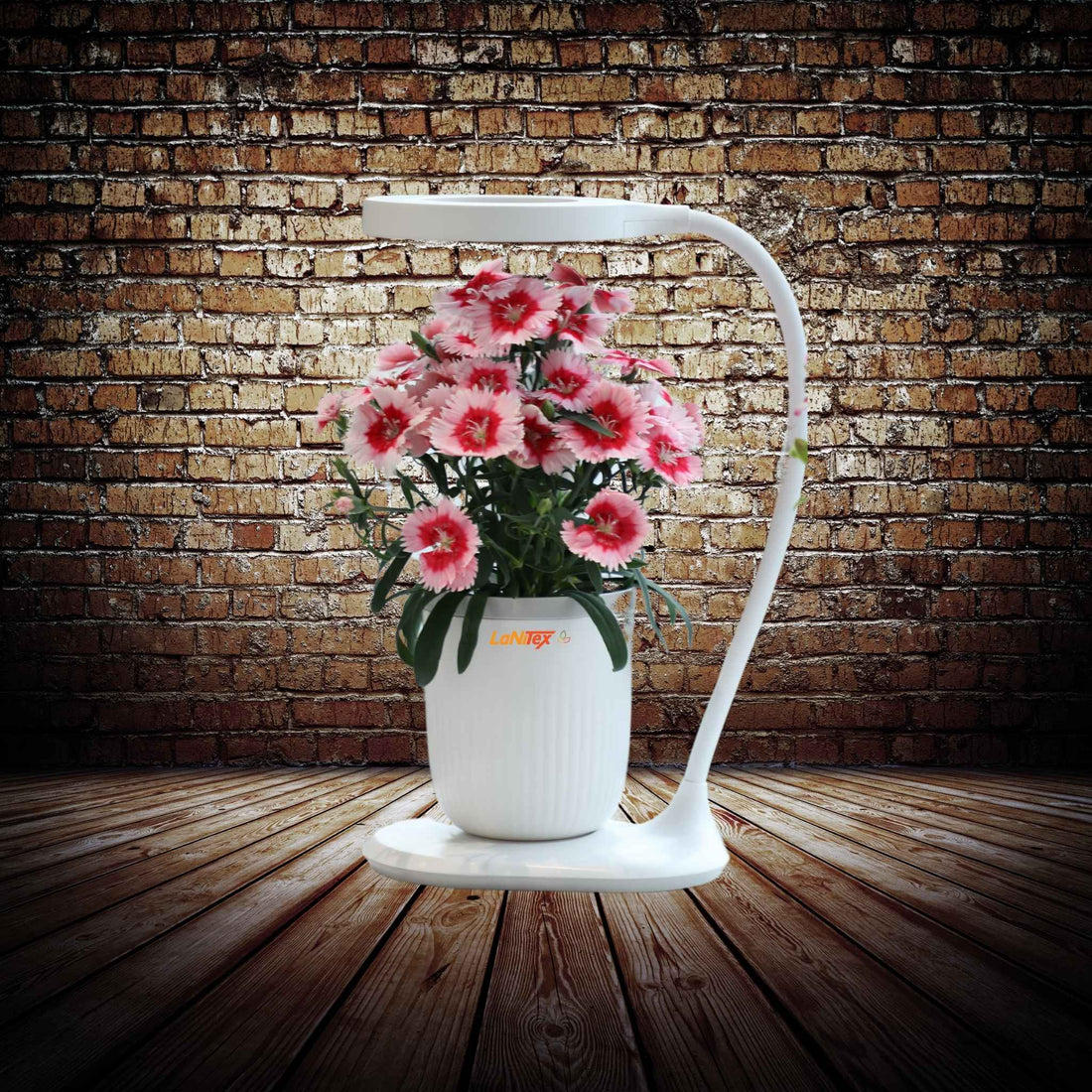
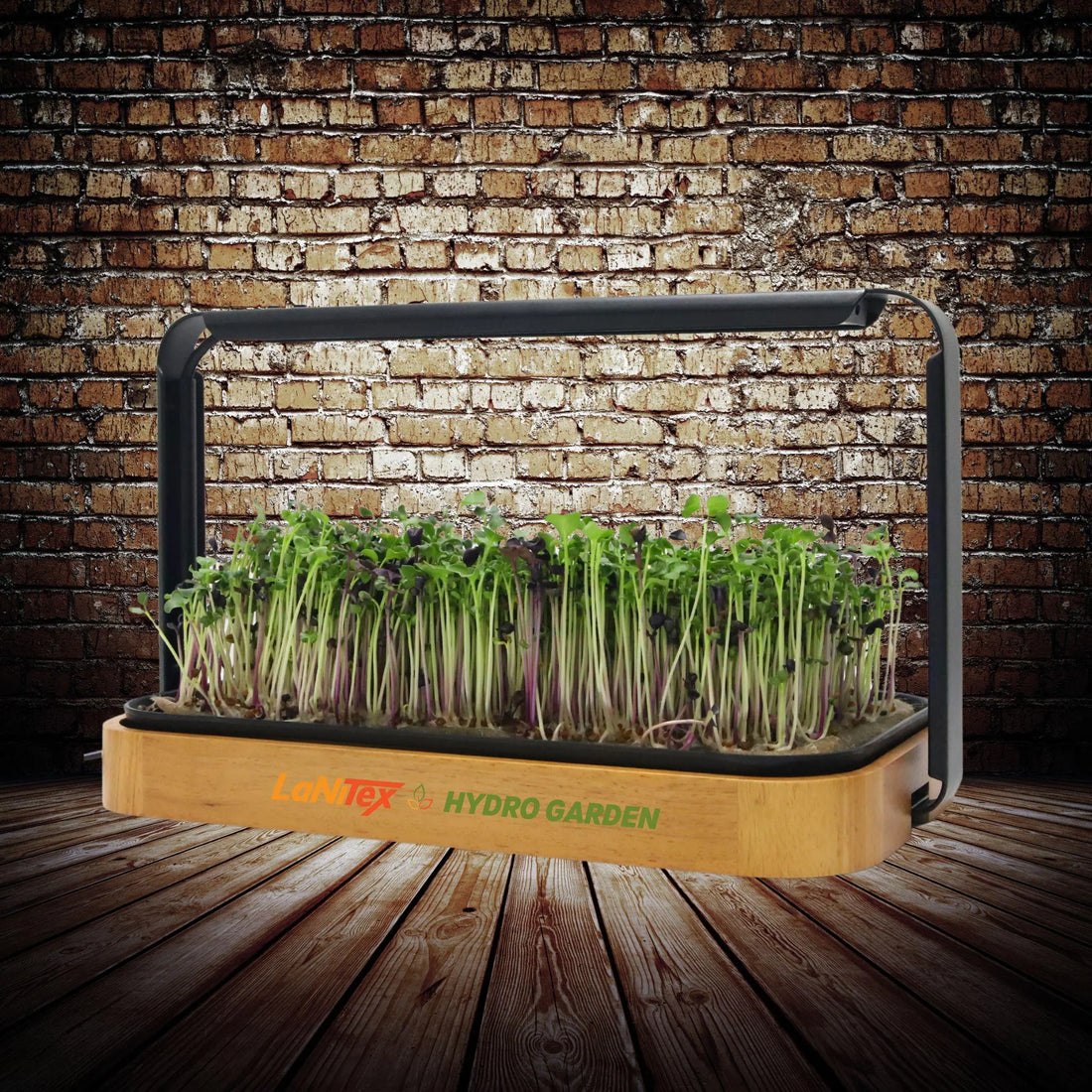
Deep Water Culture suspends plant roots in a reservoir of oxygenated nutrient solution. An air pump bubbles oxygen into the water through an airstone, and the roots stay submerged without suffocating because the bubbles keep oxygen levels high. Setup is simple: reservoir, airstone, net pots, lid. DWC forgives missed maintenance better than any other type, which is why I recommend it to almost every first-time grower who walks into a conversation nervous about hydroponics. A Mini Grow Pot Z 2.4 holds a single plant in 146mm by 178mm of bench space and draws 5 watts of power; a Desktop Grow Box holds 3 plants in roughly the same footprint. Watch one thing: water temperature has to stay below 25 degrees, otherwise root rot risk climbs sharply (a Sunshine Coast summer issue, less so a Melbourne one). Pair with our Mini Grow Pot Z 2.4 at $75 for a single-plant trial, or the Desktop Grow Box at $139 for a three-plant kitchen-counter setup.
Nutrient Film Technique (NFT)
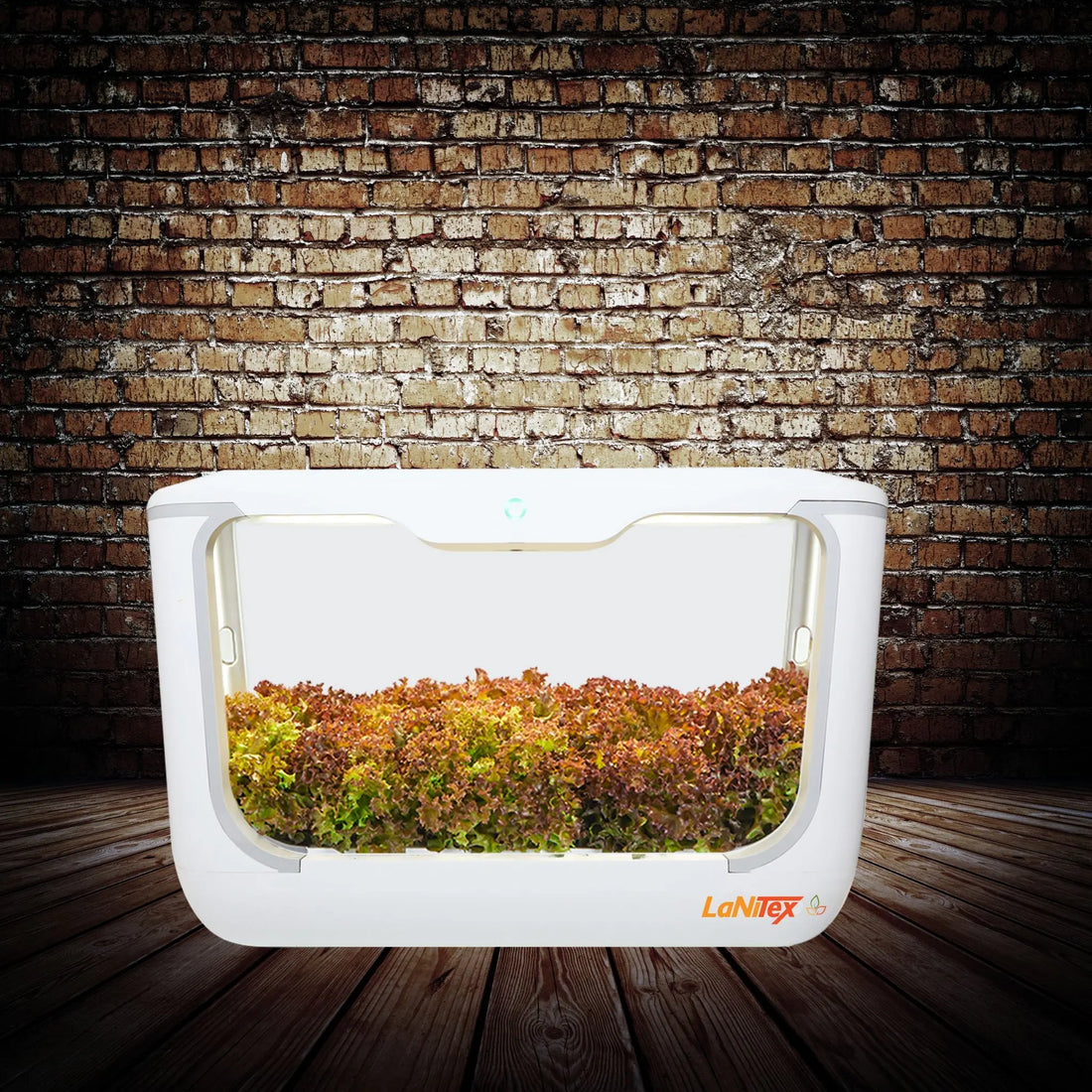
Nutrient Film Technique flows a thin film of nutrient water continuously over plant roots inside a sloped channel. The roots sit in net pots clipped into the channel; water cascades from a header tank to a return reservoir. Most commercial leafy-green farms run NFT because the constant flow keeps oxygen levels high and the slope drains nutrient excess automatically. The Smart Grow Box at 0.36 square metres of bench space holds either 15 or 67 plants depending on the variant, with a 9-litre reservoir and a built-in LED full-spectrum light. If a household wants continuous lettuce or herb harvests, or a primary classroom is running term-by-term cycles and wants more capacity than a benchtop DWC pot, NFT is the upgrade path. Our Smart Grow Box at $429 is the most common first NFT system in our Sunshine Coast and Brisbane customer base.
Aeroponic tower
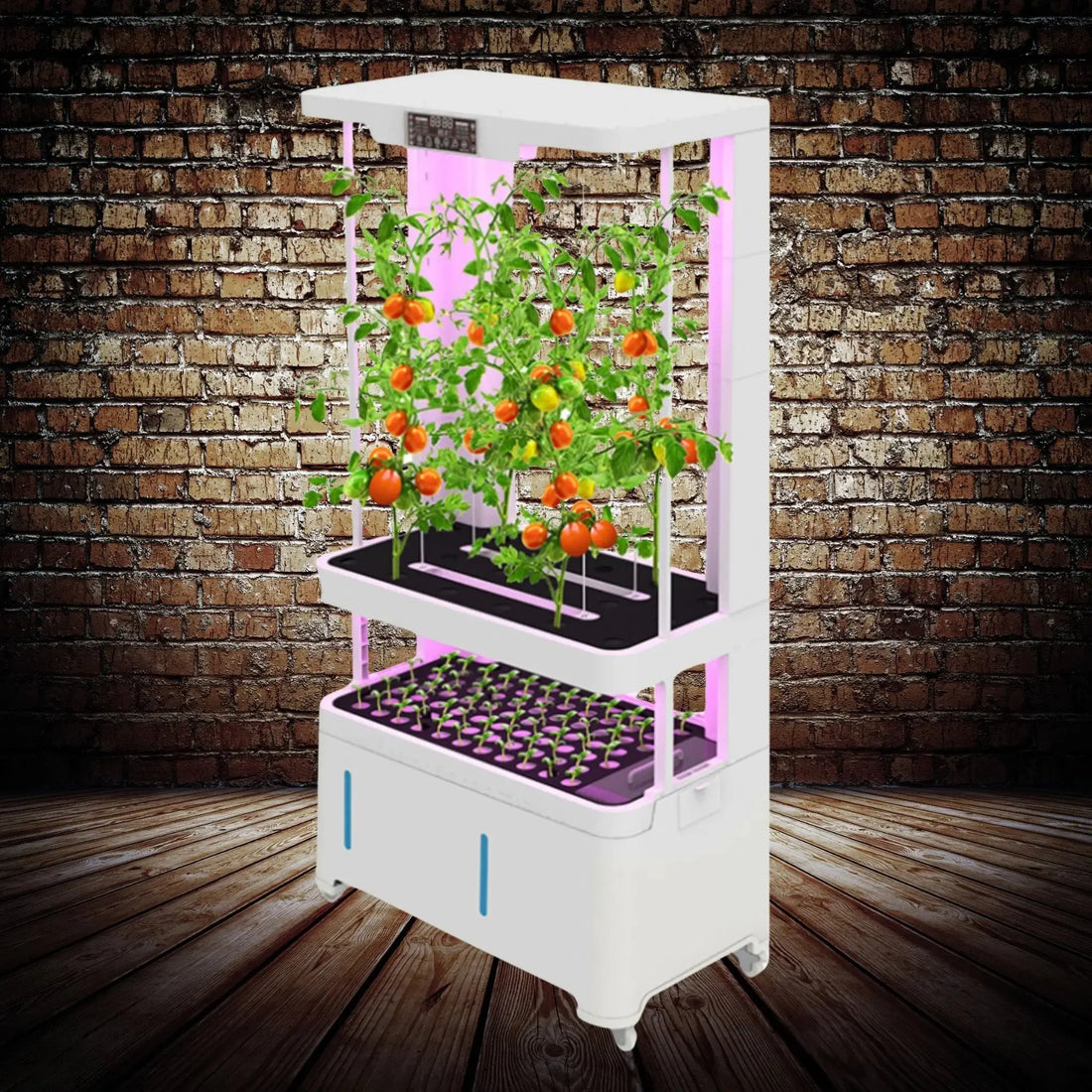
An aeroponic tower suspends plant roots in air inside a vertical column and mists them with nutrient solution every few minutes. There is no medium, no standing water, no soil. NASA Spinoff 2008 reported that "aeroponic systems also reduce water usage by 98 percent, fertilizer usage by 60 percent, and eliminate pesticide usage altogether" in their controlled trials. Roots get more oxygen between misting cycles than any other format, which is why aeroponic towers push the highest yield per square metre. The catch is the hardware. Aeroponic towers need a high-pressure pump and a backup plan for power outages, because roots in air dry out in hours, not days. If you want maximum vertical yield, can monitor the pump weekly, and have $1,990 to spend, this is the format. Our V5.2-A vertical tower at $1,990 ships from the Sunshine Coast with sensors and Australian phone support.
Hydroponic tower
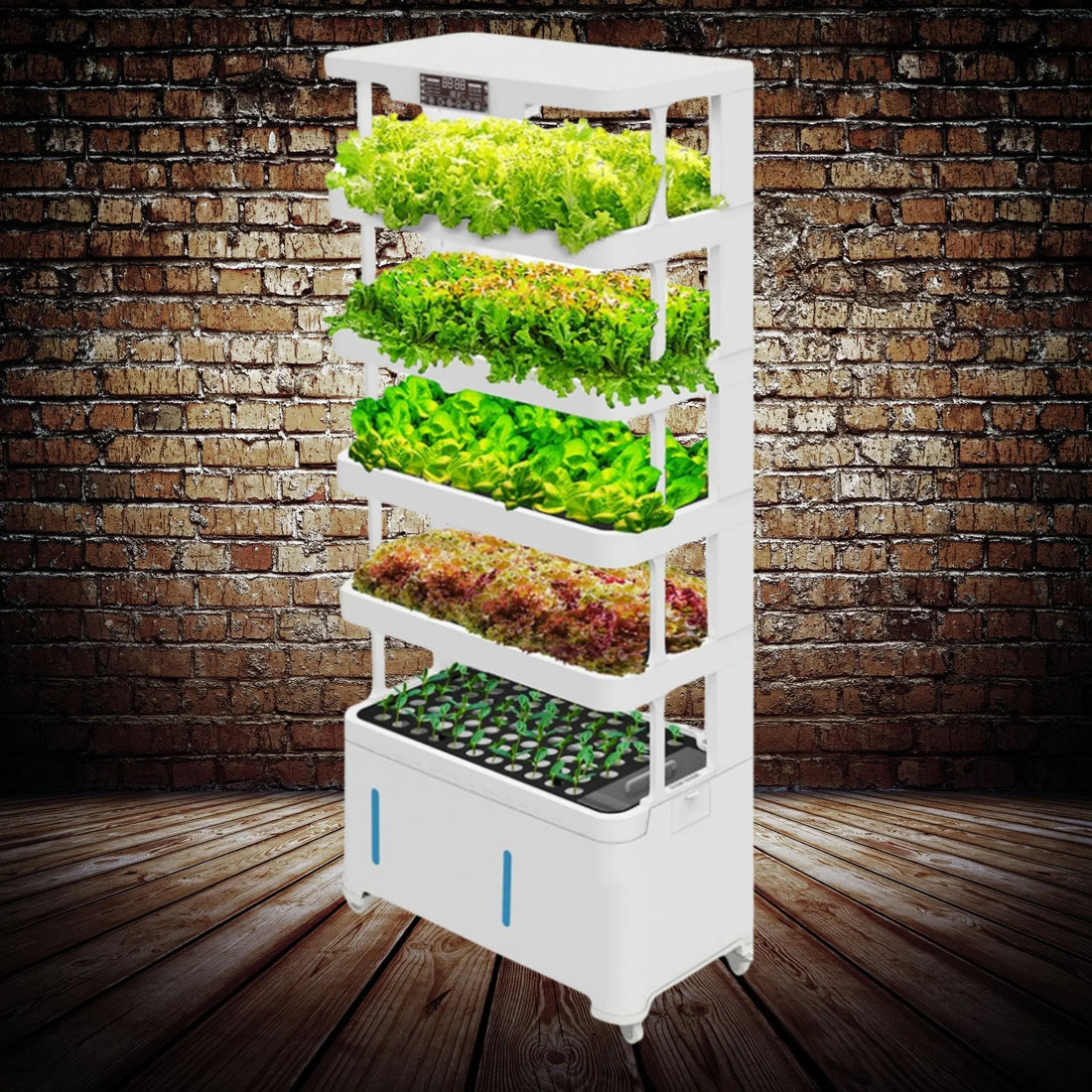
Where aeroponic towers mist roots, a standard hydroponic tower bathes them in a thin nutrient film that flows continuously down the column. The technical name is Nutrient Film Technique applied vertically. The column splits into stacked tiers; plants sit in net pots clipped into the column wall; water cascades from a top tray to a bottom reservoir. The footprint is the win: a 1.8-metre column with 28 to 76 plant positions takes the same floor area as a coffee table. Two practical limits to know about. First, ceiling clearance, because the column needs at least 2.4 metres so a ceiling fan does not shred the top tray. Second, the weekly nutrient check is non-negotiable; a tower running uneven nutrients shows it within a week. The V5.2-A delivers 76 sowing positions in 0.3 square metres of floor at $1,990; for the side-by-side comparison of aeroponic versus hydroponic tower trade-offs, see our hydroponic tower vs aeroponic tower comparison.
Key benefits of indoor hydroponic gardening
Quick answer. Three benefits hold up to peer-reviewed research: up to 90 percent less water (Bioinformation 2023), up to 20x lettuce yield per acre (same source), and a 60 percent fertiliser cut for aeroponic systems (NASA Spinoff 2008). Every figure links to its source so you can verify before you buy.
Every figure below has a named source you can click. If a claim is not sourced, it is not in this section.
"Hydroponic farming techniques have been found to reduce water usage by up to 90% compared to conventional soil-based farming."
Bioinformation, peer-reviewed review (2023), PMC10625363
Maximised growth and higher yield
The same 2023 Bioinformation review reports that "hydroponic systems may increase lettuce yields by as much as 20 times per acre" versus conventional agriculture, and that controlled-environment growing accurately regulates conditions, leading to higher plant growth rates and greater crop yields than traditional farming. NASA Spinoff 2008 documented that, in their controlled aeroponic trials, "tomatoes are traditionally started in pots and transplanted to the ground at least 28 days later; growers using an aeroponic system can transplant them just 10 days after starting the plants". That is a 64 percent reduction in seedling time before transplant. For a school classroom running term-by-term cycles, that is the difference between harvesting before exam week and harvesting after the kids go on holiday. Laszlo Bulatko, who has grown lettuce hydroponically on the Sunshine Coast since 2022, sees the same pattern at home: a Smart Grow Box harvests 6 to 8 lettuce heads every 30 days, year-round.
Space-saving vertical design
Hydroponic towers and vertical NFT columns let you grow more plants per square metre of floor than any soil-based method. CSIRO described this format in 2021 as a setup where "plants are grown inside using hydroponics in trays stacked on top of each other and provided with artificial light". For a Brisbane apartment, the V5.2-A tower fits 76 sowing positions in 0.3 square metres of floor. That is the difference between "I have no space for a garden" and "I am running 76 plants from a coffee-table footprint". Yield per square metre, conservatively, runs at 250 to 350 plants per year on a single tower with continuous succession planting.
Closed-loop nutrient and energy efficiency
Because the nutrient solution recirculates rather than draining away through soil, hydroponic systems also cut fertiliser use sharply. The NASA Spinoff 2008 trial recorded a 60 percent reduction in fertiliser usage and the elimination of pesticide usage in aeroponic conditions. LED full-spectrum lighting, built into every LaNiTex unit, replaces the heat and electricity load of older HID grow lights. The Desktop Grow Box draws just 9 watts to support a full crop of basil, lettuce, microgreens, and small flowering plants. Run it 13 hours a day for a year at the current Queensland average of 32 cents per kWh, and the power bill comes in around $14. The Smart Grow Box at 25 watts runs around $39 a year on the same schedule.
Hydroponic systems vs. traditional soil gardening
Here is the trade-off in plain terms. You give up the simplicity of soil and pick up control, water efficiency, and yield per square metre. The peer-reviewed Bioinformation 2023 review states that "hydroponic farming techniques have been found to reduce water usage by up to 90% compared to conventional soil-based farming". NASA Spinoff 2008 measured aeroponic systems at 98 percent water savings under controlled conditions. Stand either figure next to a soil garden in a Queensland summer and the water bill alone tells the story.
| Feature | Hydroponic system | Traditional soil gardening |
|---|---|---|
| Water use | Up to 90% less (Bioinformation 2023); up to 98% less aeroponic (NASA 2008) | High; most irrigation drains through the soil |
| Space requirement | Vertical-capable; 76 positions in 0.3 sq m (V5.2-A); benchtop units from 0.02 sq m | Open ground, raised beds, or large containers |
| Yield (lettuce per acre) | Up to 20x higher (Bioinformation 2023) | Baseline reference |
| Setup time | 15-30 min (benchtop unit); 1-2 hours (vertical tower) | Days (bed preparation, soil amendment, drainage) |
| Annual cost (run + nutrients) | $50 to $100 nutrients + $14 to $39 power per year (LED-driven units) | Soil amendments, mulch, water bill, occasional pest treatments |
| Weekly maintenance | ~10 minutes (pH check, EC check, top-up) | ~30 to 60 minutes in growing season (weeding, watering, mulching) |
| Pesticide use | Eliminated in NASA aeroponic trial; reduced in home conditions | Common, especially in soil-borne disease outbreaks |
| Year-round growing | Yes, climate-independent indoors | Seasonal in most Australian climates |
Setting up your indoor hydroponic system
Quick answer. Five steps: choose system, set up the environment, mix nutrients to pH 5.5 to 6.5, plant seedlings into rockwool or clay pebbles, monitor weekly. Allow 30 minutes for a benchtop unit or 1 to 2 hours for a vertical tower.
Setup is more about discipline than skill. Below is the five-step pattern I run on every new unit on a customer's kitchen bench, and the same one we teach in our school Term-Grow programme. None of the steps are hard. Skipping any of them is what causes 80 percent of the early failures I see.
Step-by-step guide
At LaNiTex, after testing more than 40 hydroponic configurations in our Sunshine Coast facility across the past three years, this is the workflow we recommend for any first-time grower setting up a benchtop or tower system at home:
- Choose your system type. For a first-time grower in a unit kitchen, start with a Deep Water Culture or NFT benchtop unit. For a household chasing maximum yield in minimum floor space, go straight to a vertical aeroponic or hydroponic tower. The cost breakdown table below covers the typical Australian price tiers.
- Set up the growing environment. Install the unit on a level surface, plug in the LED full-spectrum light, configure the water pump and timer. Leave 30 cm of clear space above the unit for plant growth and ceiling-fan clearance. Keep it out of direct afternoon sun; LEDs are calibrated for indoor use and stray sunlight overheats the reservoir.
- Prepare the nutrient solution. Mix hydroponic nutrients with mains water per the manufacturer's specifications. Adjust pH to 5.5 to 6.5 using a digital pH meter; that is the range most leafy greens and herbs prefer. Australian mains water sits between pH 7.0 and 8.0 in most council areas, so expect to add pH-down on the first mix and again after each top-up.
- Plant your seedlings. Place seedlings or germinated seeds into rockwool cubes or clay pebbles inside the net pots. Roots should reach the nutrient solution within the first three days. If they do not, top up the reservoir slightly until they do. Resist the urge to plant every slot at once; succession planting (one or two new seedlings every 2 weeks) gives a continuous harvest rather than a flood-then-drought cycle.
- Monitor and maintain. Check pH and EC (nutrient strength) weekly with a digital tester. Top up the reservoir when it drops below the marked line. Harvest leafy greens 25 to 35 days after planting, herbs continuously from day 21, and fruiting crops on the timing the seed packet specifies. A daily 30-second glance at the water level catches 90 percent of problems before they become emergencies.
Common hydroponic system problems and fixes
Quick answer. Four problems cover ~80 percent of what new growers face: root rot, pH crash, yellowing leaves, and nutrient burn. Each has a simple fix once you know the cause. The most common cause for all four is skipping the weekly EC and pH check.
Hydroponics is forgiving until it is not. The four problems below cover roughly 80 percent of the support tickets we receive in the first 90 days after a customer takes delivery of a system. Each is fixable in under an hour once identified.
Root rot
You will see brown or black slimy roots, smell something off when you lift the lid, and notice plants wilting even with the reservoir full. The usual culprit is water temperature above 25 degrees, oxygen not reaching the root zone, or biological build-up in a reservoir that has not been cleaned for several cycles. To fix it, drop the reservoir temperature with a frozen 600ml water bottle wrapped in a sock and swap it out daily until ambient cools. Add an airstone if the unit does not already have one. Sanitise the reservoir between every two crop cycles. In a Sunshine Coast summer this is the single highest-leverage maintenance task; the Mini Grow Pot, Desktop Grow Box, and Smart Grow Box each have a reservoir small enough that one frozen water bottle drops the temperature by 3 to 5 degrees within 90 minutes.
pH crash
The signal is a pH meter reading below 5.0 within 24 to 48 hours of the last adjustment, with plants suddenly refusing to take up nutrients even though the EC looks correct. The cause is usually a too-concentrated nutrient mix at top-up, or organic decay (one dead leaf is enough) acidifying the water faster than the buffer can absorb. Test pH daily for the first two weeks of any new system, top up nutrients in small batches (no more than 25 percent of reservoir volume per top-up), and pull any plant debris out at every weekly check. If pH keeps crashing on the same unit, switch to a buffered hydroponic-specific nutrient brand. Generic plant fertiliser meant for soil is the most common cause of repeat pH crashes in a household system; I have lost more than one early test crop to it.
Yellowing leaves
Older leaves at the bottom of the plant turn pale yellow first, then the yellowing creeps up. That is nitrogen deficiency or nitrogen lockout. Lockout happens when the EC is too high (the plant cannot take up nutrients even though they are sitting right there) or when the pH has drifted out of the 5.5 to 6.5 absorption range. Check EC and pH first. If EC is above 2.5, dilute the reservoir with fresh water. If pH is out of range, correct it with pH-up or pH-down. If both look fine and the yellowing keeps spreading, dump the reservoir and mix a fresh nutrient batch. Old solution loses its nitrate balance over 4 to 6 weeks even when EC and pH still read correctly on a meter.
Nutrient burn
Brown or scorched leaf tips, especially on the younger leaves, mean the EC is too high. The plant is trying to push excess salts out through the leaf edges. This usually shows up after a generous top-up where someone used full-strength nutrient solution instead of diluted top-up water. Dilute the reservoir with fresh water until EC drops to the manufacturer's recommended range, which is typically 1.2 to 1.8 mS/cm for leafy greens and 1.6 to 2.4 for fruiting crops. Going forward, top up with plain water first; only add nutrient solution once the EC has dropped below the target range. A digital EC meter costs around $30 in Australia and pays for itself in saved crops within the first month.
Best plants for hydroponic systems
Not every plant suits a hydroponic setup. The table below lists the crops we test and stock for in the Sunshine Coast facility, ranked by ease for a first-time Australian grower.
| Plant | Difficulty | Time to first harvest | Best system type |
|---|---|---|---|
| Lettuce (butter, cos, oak-leaf) | Beginner | 25 to 35 days | DWC or NFT benchtop |
| Basil, mint, coriander, parsley | Beginner | 21 to 28 days, then continuous | DWC or NFT benchtop |
| Spinach, kale, silverbeet | Beginner | 30 to 40 days | DWC or NFT benchtop |
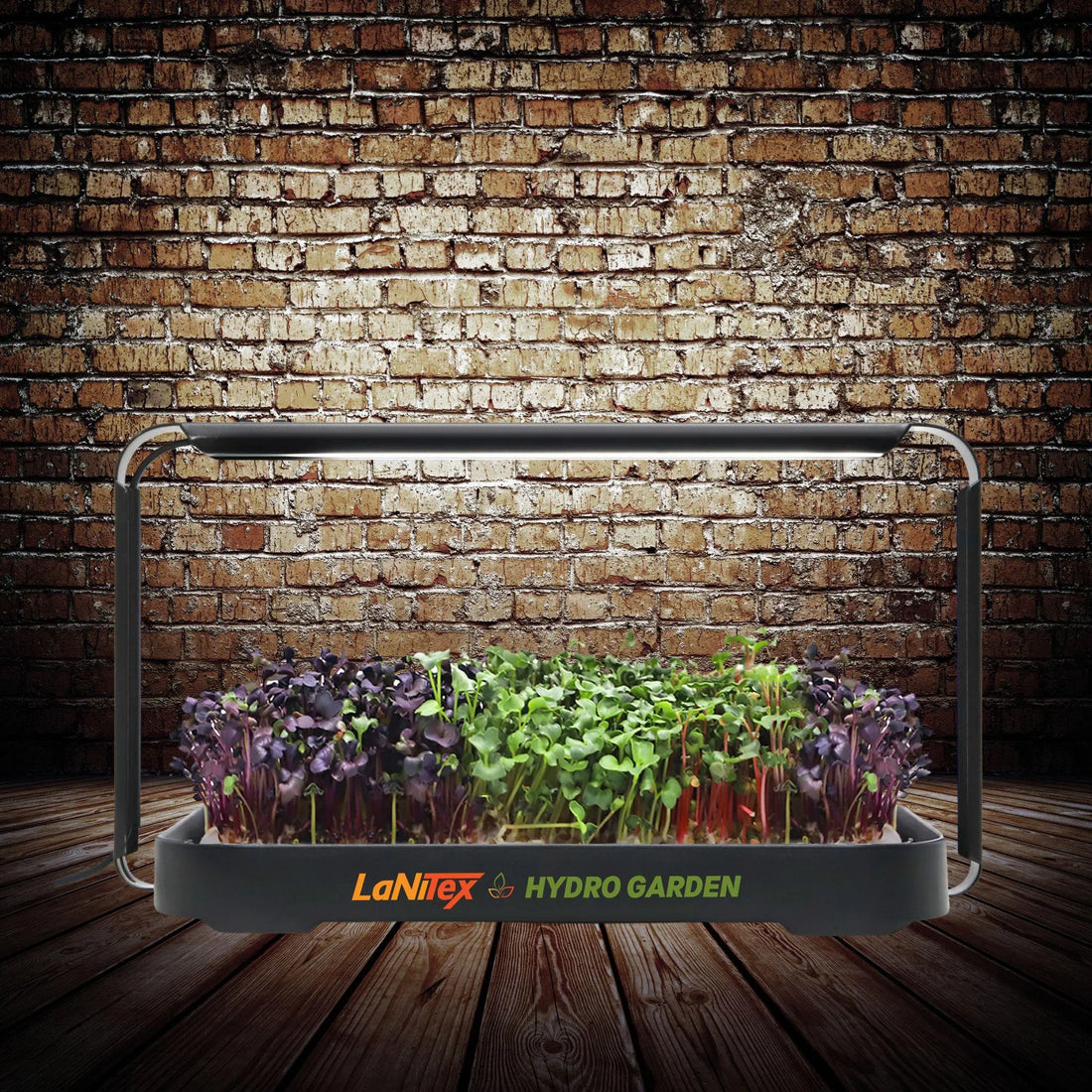
| Microgreens (radish, broccoli, sunflower) | Beginner | 7 to 14 days | Microgreen kit or shallow tray |
| Strawberries | Intermediate | 4 to 6 months | NFT tower or vertical hydroponic tower |
| Capsicum, chilli | Intermediate | 10 to 12 weeks | DWC with light support, or grow tent |
| Tomatoes (cherry, determinate) | Advanced | 10 to 14 weeks | NFT tower or aeroponic tower |
Root vegetables like carrots, potatoes, and beetroot do not suit standard benchtop hydroponic boxes; the roots need depth and a substrate. Tall fruiting plants like indeterminate tomatoes need a tall grow tent or a greenhouse rather than a benchtop unit. For a deeper look at nutrient choices for these crops, see our hydroponic nutrients guide; for a broader Australian context on indoor growing, see our hydroponic gardening guide for Australian homes.
Australian cost breakdown for a hydroponic system
Hydroponic systems in Australia split into four price tiers. The table below covers the LaNiTex household and microgreen range; commercial hydroponic greenhouses sit above this band and are priced individually.
| Tier | Price (AUD) | LaNiTex product | Best for |
|---|---|---|---|
| Entry | $75 to $150 | Mini Grow Pot Z 2.4 ($75), Desktop Grow Box ($139) | First-time renters, single-pot test, gift purchase |
| Mid | $250 to $500 | Smart Grow Box ($429) | 1-2 person household, kitchen bench, continuous lettuce |
| Microgreen | $129 to $189 | Smart Microgreen Kit ($129) | Continuous microgreen production, week-on-week harvest |
| Tower | $1,500 to $1,990 | V5.2-A vertical tower ($1,990) | Households or classrooms wanting 76 plants from a coffee-table footprint |
Annual run cost adds roughly $50 to $100 in nutrient solution plus $14 to $39 in electricity per unit (LED-driven, 13 hours a day, Queensland average 32c/kWh). A heavy basil household covers the Smart Grow Box purchase price in supermarket-equivalent produce within 12 to 18 months, assuming you actually eat what you grow.
Growing hydroponically in Queensland: seasonal notes
Beginner mistakes to avoid
Across roughly 200 customer setups since LaNiTex started shipping in late 2024, four mistakes keep showing up in the first 90 days. None are hard to avoid once flagged.
- Overfeeding nutrients. The instinct is "more nutrients = more growth". The reality is EC creep, leaf burn, and pH crashes. Start at the lower end of the manufacturer's recommended EC range; only step up if growth is genuinely slow after two weeks of stable conditions.
- Ignoring pH. One daily check in the first two weeks, then weekly, is enough. Skipping pH checks for a fortnight is the most common reason a previously thriving system suddenly stalls.
- Wrong light cycle. Most leafy greens and herbs want 14 to 16 hours of light per day, not 24. Plants need a dark phase to convert sugars and grow. The built-in timers on LaNiTex units default to 13 hours light / 11 hours dark, which works for almost every benchtop crop.
- Overcrowding. Loading every net pot on day one feels efficient but cuts off airflow between plants and gives fungal disease a foothold. Plant 60 to 70 percent of the slots; succession-plant the rest as the first crop matures.
Frequently asked questions
What is the difference between hydroponics and aeroponics?
Hydroponics flows or pools nutrient water around plant roots, either in a continuous film (NFT), an oxygenated reservoir (DWC), or a flood-and-drain tray. Aeroponics suspends the roots in air inside a chamber and mists them with nutrient solution every few minutes. Aeroponics uses less water (NASA Spinoff 2008 documented a 98 percent reduction) and reportedly produces faster growth because roots get more oxygen between misting cycles. The catch: aeroponic systems need a high-pressure pump and a backup plan for power outages. That is why most household systems use hydroponics instead.
How much water does a hydroponic system actually save?
Peer-reviewed research published in Bioinformation (2023) puts the figure at up to 90 percent less water than conventional soil-based farming for closed-loop hydroponic systems. NASA Spinoff 2008 reports up to 98 percent water savings for aeroponic systems under controlled conditions. The reason is recirculation: the same nutrient solution cycles back to the reservoir rather than draining away through soil. A 15-plant LaNiTex Smart Grow Box uses 5 to 7 litres per week, compared with 60 to 80 litres for an equivalent soil-based vegetable patch.
What plants grow best in a hydroponic system?
Leafy greens (lettuce, spinach, kale), culinary herbs (basil, mint, coriander, parsley), and microgreens are the easiest crops for a first-time grower in Australia. Fruiting crops like strawberries, capsicum, chilli, and cherry tomatoes work in larger systems with adequate light and a grow tent or tower. Root vegetables like carrots, potatoes, and beetroot do not suit standard benchtop hydroponic boxes because the roots need depth and substrate.
How long does it take to set up a hydroponic system at home?
A benchtop system like the LaNiTex Mini Grow Pot Z 2.4 or Desktop Grow Box takes 15 to 30 minutes to unbox, fill with water, mix nutrients, and plant the first seedlings. A vertical tower like the V5.2-A takes 1 to 2 hours for first-time assembly, mainly because the column is shipped flat-packed. Once running, daily attention is around 30 seconds (a glance at the water level) and weekly attention is around 10 minutes (pH check, top-up, leaf inspection).
Do I need special lighting for an indoor hydroponic system?
Yes. Most indoor locations do not get enough natural light to support a productive harvest year-round. LaNiTex grow units include a built-in LED full-spectrum light tuned to the unit, so you do not need to source a separate light panel. The Desktop Grow Box draws 9 watts for a three-pod harvest. The Smart Grow Box draws around 25 watts for a 15 or 67-hole harvest. Outdoor and greenhouse setups can use sunlight, but most Australian apartment and classroom growers run year-round under LEDs.
Conclusion: start your hydroponic system today
If you want to grow food indoors in Australia, hydroponics is the most resource-efficient way to do it. The numbers are not marketing: up to 90 percent less water (Bioinformation 2023), up to 20x lettuce yield per acre (Bioinformation 2023), and aeroponic seedlings to transplant in 10 days versus 28 (NASA Spinoff 2008). LaNiTex household systems start at $75 for a Mini Grow Pot Z 2.4 and run to $1,990 for the V5.2-A vertical tower. That is roughly the cost of a year of supermarket basil for a heavy user.
If you are weighing it up, my advice is to start small. A benchtop unit on a kitchen bench, a Brisbane balcony, or a school classroom. From there, the path scales: more units, a tower, a grow tent, eventually a greenhouse if you go down that road. If you want a second opinion on which system fits your space, send us a note via the contact page. For the full plant compatibility list, our hydroponic plants page covers every crop we have tested and stocked on the Sunshine Coast.
Sources
- Bioinformation (2023). Peer-reviewed review on hydroponic farming techniques. Used here for water usage, yield per acre, and growth-rate findings. https://pmc.ncbi.nlm.nih.gov/articles/PMC10625363/
- NASA Spinoff (2008). Report on aeroponic systems. Used here for water, fertiliser, pesticide, and tomato-seedling timing figures. https://spinoff.nasa.gov/Spinoff2008/ch_3.html
- CSIRO (2021). Article on durable agripest solutions; the vertical farming description quote comes from here. https://www.csiro.au/en/news/All/Articles/2021/May/durable-agripest-solutions