
Last updated:
A hydroponic system feeds water and nutrients directly to plant roots without soil. Closed-loop setups use up to 90 percent less water than soil farming (peer-reviewed Bioinformation, 2023), and lettuce reaches harvest in 25 to 35 days in our Sunshine Coast testing.
Methodology. Every product mentioned in this guide was tested by Laszlo Bulatko at home on the Sunshine Coast across at least one full growing cycle (6 to 12 weeks) before being added to the LaNiTex catalogue. Test conditions: Queensland sub-tropical, kitchen bench, 25 degrees ambient, tap water with pH adjustment. Products that fail the home test do not get stocked.
Three years ago I bought my first hydroponic system on a hunch. I had spent fifteen years selling fishing gear in Hungary, then moved to the Sunshine Coast and started looking at what I could grow inside a Queensland unit kitchen. The hunch paid off: microgreens in under a week, lettuce in five, capsicum running year-round on a 0.36 square metre footprint, light and warmth permitting. That experience is now the entire reason LaNiTex Hydro Garden exists.
If you have landed here, you are probably weighing up a hydroponic system for your own home, classroom, or small commercial space. Fair point. This is the pillar guide, mate. Six core system types, real Australian prices, the footprints that actually fit a unit kitchen, the rules of thumb I share with every buyer who calls me, and the mistakes I see people make before they buy. No marketing fluff. Just what works. Products mentioned in this guide are made and sold by LaNiTex Hydro Garden, the company I founded in December 2024 after three years of personal hydroponic testing.
What is a hydroponic system
Quick answer. A hydroponic system is a soil-free growing setup that flows nutrient-rich water past plant roots; closed-loop versions use up to 90 percent less water than soil farming and reach lettuce harvest in 25 to 35 days versus 30 to 40 in ideal soil conditions.
A hydroponic system is a soil-free growing method that delivers a measured nutrient solution directly to plant roots through water, instead of relying on soil to hold and release nutrients. Roots sit in an inert or low-biological-activity medium, a misted chamber, or a flowing channel, and the grower controls every input: nitrogen, phosphorus, potassium, pH, light hours, and water temperature. Plants spend less energy hunting for food and more energy producing leaves, fruit, or roots, which is why a hydroponic lettuce typically reaches harvest weight in 25 to 35 days. Soil-grown lettuce in ideal conditions hits 30 to 40 days; the bigger gain from hydroponics is consistency and control, not always raw speed. The method scales from a single benchtop pot on a kitchen counter to a multi-tier vertical farm. The hardware changes; the principle does not. Water carries nutrients, light drives growth, and the grower keeps the system stable through regular pH, EC, and water-level checks. Sensors handle this on premium units; most home systems still run manual.
The reason people switch is the trade-off. You give up the simplicity of soil and pick up control, water efficiency, and yield per square metre. A peer-reviewed 2023 review published in Bioinformation found that "Hydroponic farming techniques have been found to reduce water usage by up to 90% compared to conventional soil-based farming". That headline figure applies to closed-loop recirculating systems; open drain-to-waste setups save less. For an apartment grower or a school classroom, even half that saving is a meaningful drop on the bill.
Why Australians are switching to hydroponic systems
The short version. Australian apartment density (16 percent of dwellings per ABS 2021), permanent water restrictions across Queensland and South Australia, and supermarket basil at $4 per 250-gram packet are the three forces pushing households toward hydroponic systems.
The Australian conditions push people toward indoor growing harder than most countries. The Australian Bureau of Statistics 2021 Census found that "70 per cent were separate houses, 13 per cent were townhouses and 16 per cent were apartments". Brisbane, Sydney, and Melbourne all run higher apartment shares than the national average. That is a lot of households without backyard space.
Water restrictions are the second pressure. Queensland and South Australia both run permanent water-efficiency rules; the eastern seaboard has cycled through drought-level restrictions multiple times in the past decade. A grow setup that uses a fraction of what a soil garden uses shows up on the water bill, not only in the brochure.
Cost-of-living is the third. A 250-gram packet of supermarket basil sits around $4 in Brisbane and Sydney supermarkets right now. A single Smart Grow Box running basil and lettuce can cover its $429 purchase price in supermarket-equivalent produce within 12 to 18 months for a household of two, assuming you actually use what you grow. Heavy basil eaters get there fastest. I have customers in Brisbane, Wollongong, and on the Sunshine Coast who track this on a fridge note. Hydroponic system Brisbane buyers in particular tend to break even fastest because CBD herb prices run higher than the national average.
Then there is the education angle. CSIRO described vertical farming in 2021 as a system where "plants are grown inside using hydroponics in trays stacked on top of each other and provided with artificial light". Schools in Queensland use the same principle in classrooms to teach plant biology, water cycles, and STEM. That is the basis of our Term-Grow Enrolment program. Same hardware, different audience. The hydroponic system Queensland schools run for term-by-term curriculum work is the same Smart Grow Box we ship to households.
Six core hydroponic systems explained
Quick answer. Six system types cover the Australian use cases. Ebb and flow suits renters and beginners. Aeroponic towers chase maximum yield per square metre; hydroponic towers chase maximum plant density. Grow tents wrap any system in a climate-controlled enclosure. LED hydroponic lights run inside any of those. Hydroponic greenhouses are commercial-scale only.
A "hydroponic system" is a category, not a single product. Six types matter for Australian growers because they each solve a different problem. Below is the short comparison; the H3 sections that follow give the full picture for each.
| System type | Best for | Typical footprint | Plant capacity | Water savings vs soil | Cost tier (AUD) | LaNiTex equivalent |
|---|---|---|---|---|---|---|
| Ebb and flow | Bench herbs, leafy greens | 0.1 to 0.4 sq m | 1 to 15 plants | ~80% less (closed-loop) | $$ ($75 to $429) | Mini Grow Pot, Smart Grow Box |
| Aeroponic tower | High-yield vertical growing | 0.3 to 0.5 sq m | 28 to 76 slots | ~98% less (NASA 2008) | $$$$ ($1,000 to $2,000+) | V5.2-A, V5.2-T |
| Hydroponic tower | Maximum plants per sq m | 0.25 to 0.4 sq m | 28 to 76 slots | ~85 to 90% less | $$$ to $$$$ ($800 to $2,000) | V5.2-A (76 sowing positions) |
| Grow tent | Climate-controlled enclosure | 0.6 to 1.2 sq m | depends on system inside | depends on system inside | $$ to $$$ ($150 to $600 enclosure) | Not a LaNiTex product; pairs with our boxes |
| LED hydroponic lights | Any indoor grow without sun | Tabletop to ceiling | N/A (component) | N/A (component) | $ to $$ (built into LaNiTex units) | Built into every LaNiTex grow unit |
| Hydroponic greenhouse | Year-round commercial or hobby | 4 to 100+ sq m | 100+ plants | ~85% less (commercial) | $$$$+ ($2,000 to $50,000+) | Out of LaNiTex scope; commercial only |
Ebb and flow hydroponic system
An ebb and flow system, also known as flood and drain, periodically pumps nutrient solution from a reservoir up into a tray that holds the plant pots, then lets gravity drain it back. The cycle typically runs every two to four hours, depending on the plant and the medium.
It works because plant roots need oxygen as well as water. Sitting in still water suffocates them; cycling water in and out gives roots a soak followed by an air break. The "drain" phase pulls fresh air through the medium, which is why root rot is less common in ebb and flow than in pure deep-water culture. Get the timer or the water temperature wrong and root rot still happens; the cycle helps, it does not immunise.
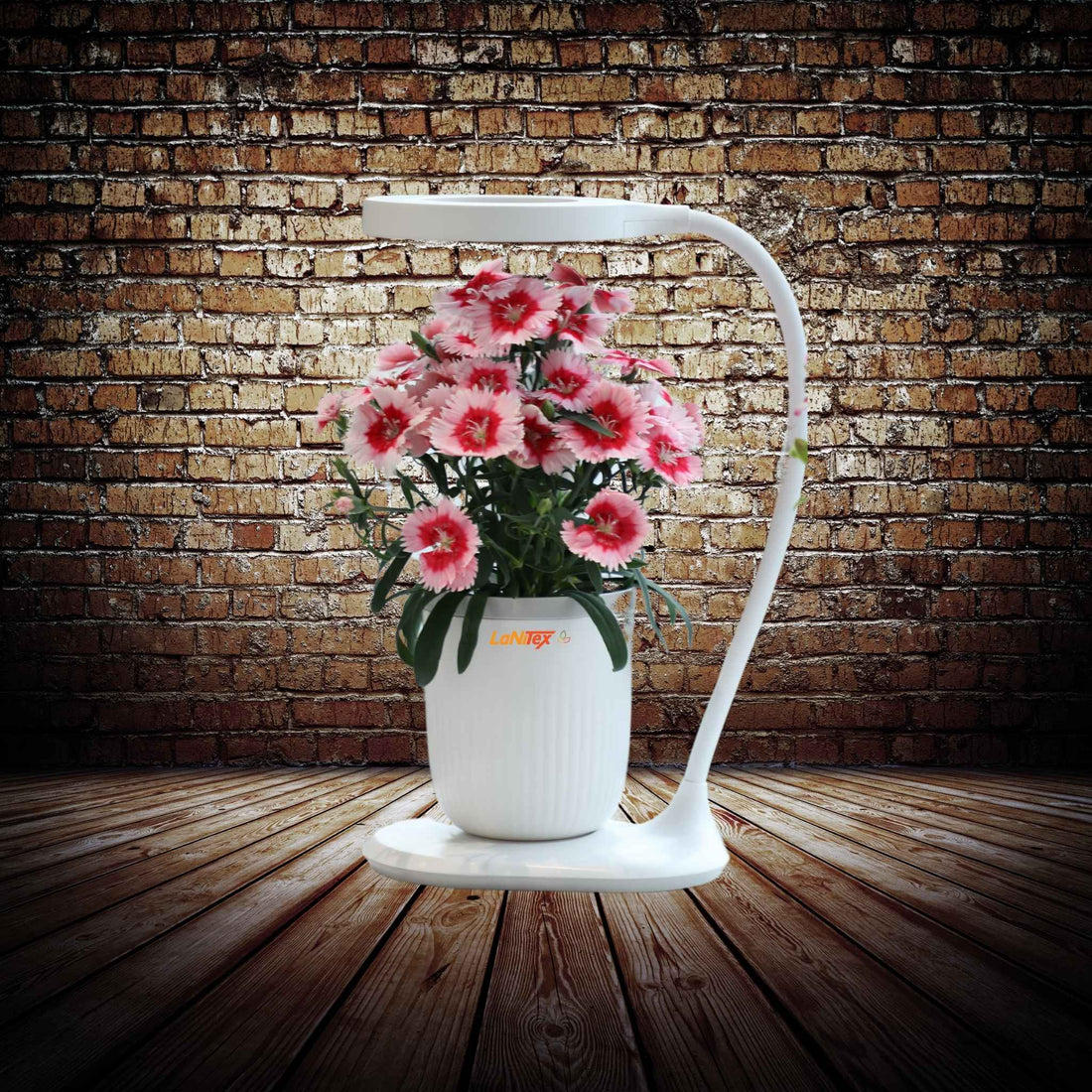
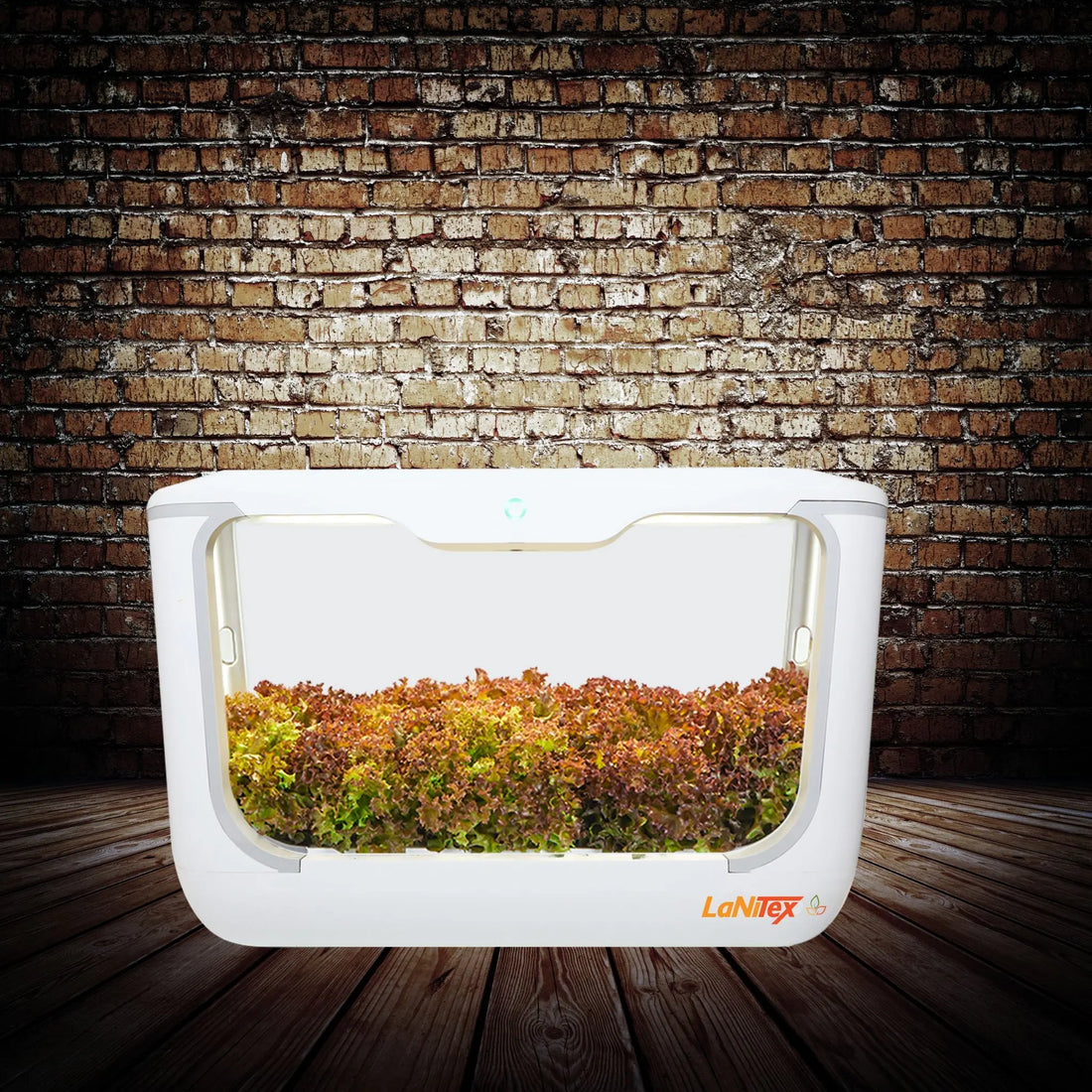
The footprint can be tiny. A Mini Grow Pot Z 2.4 is 146mm wide by 178mm deep, smaller than a kettle, and runs on 5 watts of power. A Smart Grow Box is 0.36 square metres and runs on 9 litres of water in the reservoir. For a renter or a household trying out hydroponics for the first time, this format is the lowest-risk entry. If you are renting, growing herbs or leafy greens, or testing hydroponics for the first time, this is the right starting point. The format forgives missed maintenance better than any other.
Aeroponic tower system
Aeroponics suspends plant roots in air inside a vertical column and mists them with nutrient solution every few minutes. There is no medium and no standing water touching the roots. NASA Spinoff 2008 reported that "Aeroponic systems also reduce water usage by 98 percent, fertilizer usage by 60 percent, and eliminate pesticide usage altogether". That zero-pesticide line applies to NASA's controlled-environment trials; a home aeroponic tower in a Brisbane apartment still meets aphids, thrips, and fungus gnats. Aeroponics reduces pest pressure, it does not abolish it. The same NASA report documented tomato seedlings reaching transplant size in 10 days versus the traditional 28-day soil window.
The catch is the hardware. Aeroponic towers need a high-pressure pump, a mist nozzle that does not clog, and a reservoir below the column. Power outages are the failure mode: roots in air dry out in hours, not days. Worth the hardware overhead if you want maximum yield per square metre, can monitor the pump weekly, and have a backup plan for power outages. The V5.2-A delivers this approach in an Australian-supported, sensor-monitored form. For a side-by-side of aeroponic and hydroponic tower trade-offs, see our hydroponic tower vs aeroponic tower comparison.
Hydroponic tower system
Where aeroponics mists roots, a standard hydroponic tower bathes them in a thin nutrient film that flows continuously down the column. The technical name is Nutrient Film Technique. The column is split into stacked tiers; plants sit in net pots clipped into the wall of the column; water cascades from a top tray to a bottom reservoir.
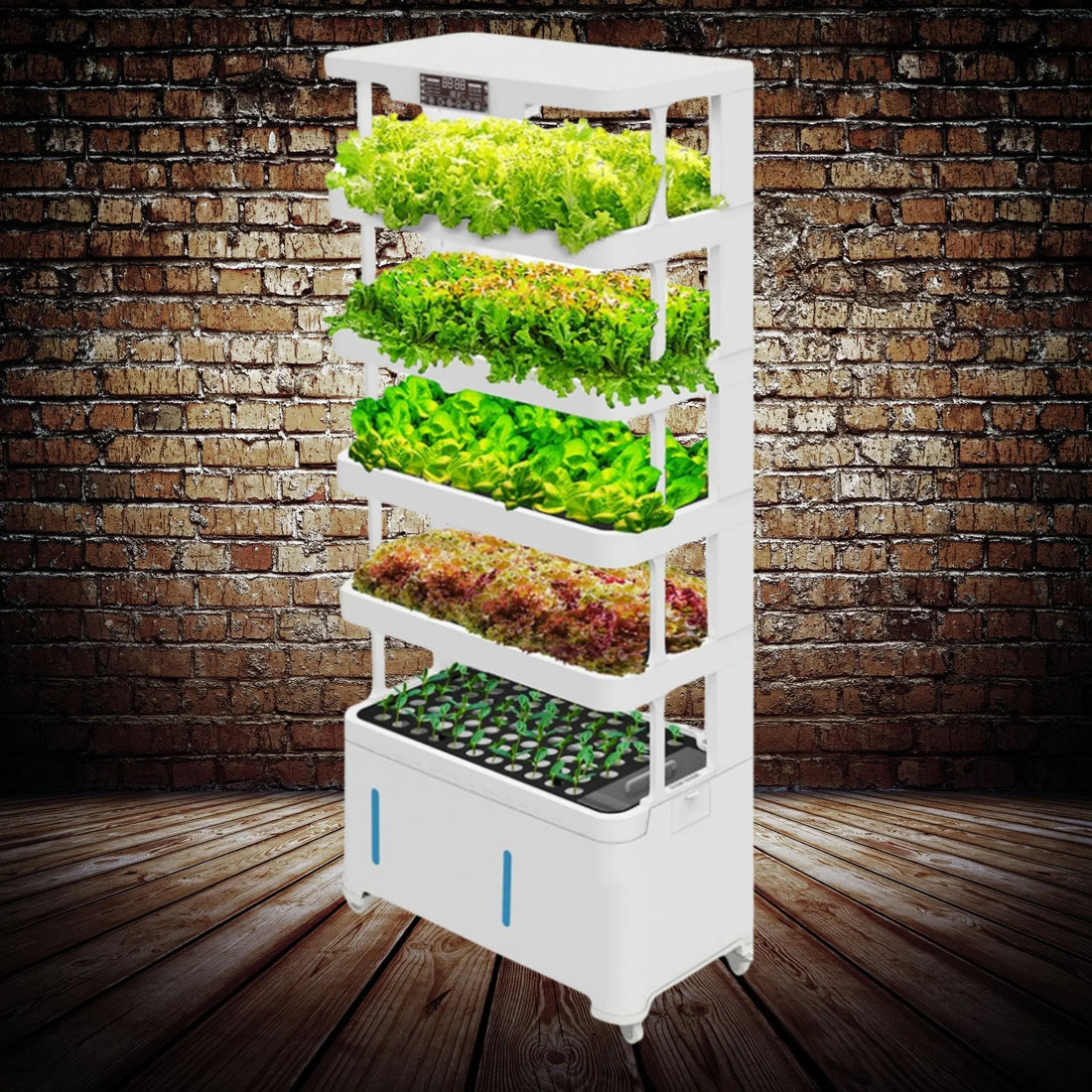
Hydroponic towers maximise plants per square metre of floor. A 1.8-metre column with 28 to 76 plant positions takes the same floor area as a coffee table. For commercial growers it changes the equation completely. For a Brisbane apartment grower, it depends on ceiling height; a ceiling fan can shred the top tray if clearance is under 30 centimetres. The right answer if your ceiling clears 2.4 metres, you want one column doing the work of four shelves of grow boxes, and you can commit to weekly nutrient checks. Our vertical hydroponic system with 76 sowing positions, the V5.2-A, is the LaNiTex answer at $1,990 with a 0.3 square metre footprint.
Hydroponic grow tent
A grow tent is the enclosure, not the hydroponic system itself. The tent is a reflective fabric box that traps light, holds in humidity, and creates a stable microclimate around whatever growing method you put inside it. You can run an ebb and flow tray, a tower, or a row of grow boxes inside a tent.
Tents matter because Australian living rooms are not greenhouses. Air conditioning, open windows, ceiling fans, and afternoon sun all push humidity and temperature around. For sensitive crops like strawberries, capsicums, or chillies, a tent stabilises the air. The reflective inside doubles the effective light from the LED. Add a tent when you are running multiple grow units, growing humidity-sensitive crops, or want the grow setup visually separated from the living space. Pair the tent with one or more LaNiTex grow boxes inside; we do not sell tents directly because the market has dozens of equivalent products from reputable brands. For a direct comparison of when each format wins, our grow tents vs hydroponic grow box guide walks through the trade-offs.

Hydroponic lights (LED full-spectrum)
Every hydroponic system needs a light source. Outdoor systems use sunlight. Indoor systems need LEDs, and the LED is where most of the price-versus-result trade-off happens.
A full-spectrum LED grow light produces wavelengths from blue (which drives leafy growth) through red (which drives flowering and fruiting), at a fraction of the heat and power of older HID or fluorescent grow lights. Every LaNiTex grow system has the LED built in and tuned to the unit; you do not need to source a separate light panel. The Desktop Grow Box, for example, draws 9 watts and runs the Shangri-La 3459 spectrum that supports basil, lettuce, microgreens, and small flowering plants. Worth buying on its own when you are upgrading an existing tent or building a custom multi-shelf rack. Most home growers get the integrated LED in our compact benchtop Smart Grow Box and stop there. For deeper LED spectrum and wattage guidance, see our LED grow lights Australia guide.
Hydroponic greenhouse
A hydroponic greenhouse is the commercial end of the spectrum. The greenhouse provides natural sunlight, climate control, and pest separation; the hydroponic system inside handles the nutrient feed. Australian commercial growers in Stanthorpe, the Lockyer Valley, and the Goulburn Valley use this format to produce hydroponic tomatoes, capsicums, and cucumbers year-round.
For home growers this category is mostly aspirational. Footprints start at 4 square metres for a small backyard unit and run to 100-plus square metres for serious hobbyists. Costs run from $2,000 for a polytunnel kit to $50,000+ for an automated commercial setup. The right scale if you are running a market-garden side business or a hobby farm with outdoor space, water access, and three-phase power. For everyone else, a Smart Grow Box on a kitchen bench delivers the hydroponic basics without the build cost. LaNiTex does not currently stock greenhouse-scale systems; we sell the household and classroom segment.
How to choose the right hydroponic system for your space
Quick answer. Decide in this order: footprint first (measure your bench or floor patch), then plant capacity versus actual eating, then automation level, then power and shipping. Most Australian apartment buyers land on the Smart Grow Box at $429.
| Your space | Best-fit system | Indicative price (AUD) |
|---|---|---|
| Under 30 cm of bench | Mini Grow Pot Z 2.4 | $75 |
| Under 60 cm of bench | Desktop Grow Box or 1 Smart Grow Box | $139 to $429 |
| 0.5 to 1 sq m of floor with 2.4 m ceilings | V5.2-A or stacked Smart Grow Boxes | $1,590 to $1,990 |
| Outdoor 4+ sq m or hobby farm | Polytunnel or hydroponic greenhouse | $2,000+ |
| Renter, unsure long-term commitment | Single Smart Grow Box (modular, stackable) | $429 |
The decision tree for most Australian buyers comes down to four questions, in this order:
- Footprint first. Measure the floor or bench patch before anything else. Under 30 centimetres of bench: a Mini Grow Pot at $75. Under 60 centimetres of bench: a Desktop Grow Box at $139 or one Smart Grow Box at $429. A 1 square metre patch on the floor with 2.4 metre ceilings: a V5.2-A. Bigger than that and you are in greenhouse territory.
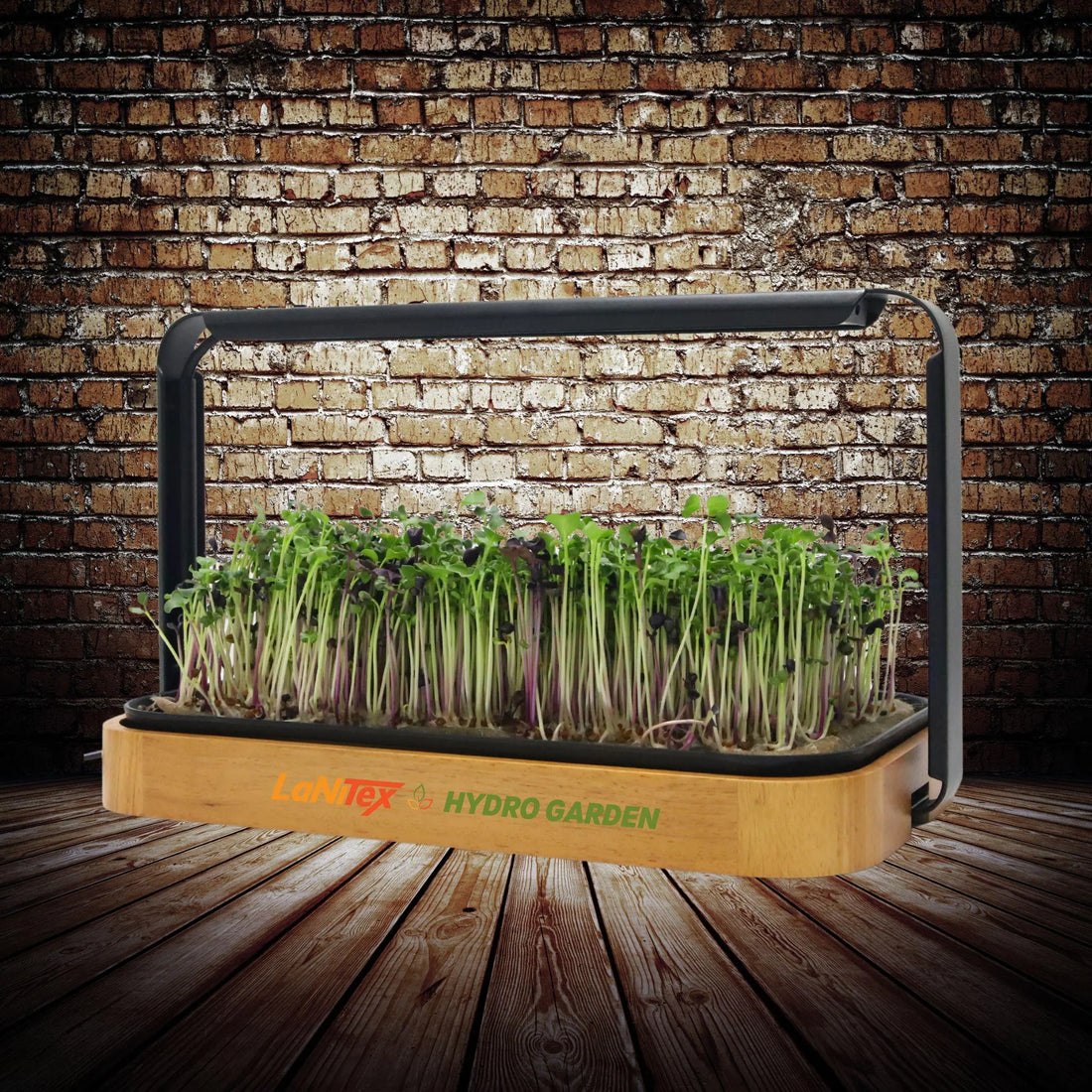
- Plant capacity versus actual eating. Two adults eat about six lettuce heads a fortnight. One Smart Grow Box at 15 holes covers that. A 76-slot V5.2-A is overkill unless you are also running herbs, microgreens, and maybe a Smart Microgreen Kit for daily harvests.
- Automation level. Sensors and self-watering matter more than people expect. The single biggest reason hydroponic gardens fail in Australian homes is forgotten top-ups during summer holidays. A sensor-equipped unit handles that without daily checks.
- Power and shipping. Queensland power runs around 30 cents per kWh. LaNiTex units draw under 100 watts. Australian shipping from our Sunshine Coast warehouse runs same-week to Brisbane and the Sunshine Coast, two to three days to Sydney and Melbourne. Hydroponic system Sunshine Coast orders inside 30 minutes on the Sunshine Coast we often drop off ourselves. Imported towers add two to three weeks of shipping plus harder warranty support.
Choosing a hydroponic system by Australian climate zone
Climate matters more than people expect, especially for fruiting plants. A Smart Grow Box that thrives in a Brisbane unit can struggle in a Hobart winter kitchen without supplementary heating, and an aeroponic tower in Darwin needs aggressive ventilation that a Melbourne grower never thinks about.
Humid tropical (Darwin, Cairns, Townsville). Air movement is the priority. The grow tent or any enclosed system needs an exhaust fan plus an in-line dehumidifier. Mould is the bigger risk than pests. LED heat output is a feature, not a bug, on cool dry-season nights.
Sub-tropical (Brisbane, Sunshine Coast, Gold Coast). The easiest climate for hydroponics, which is partly why LaNiTex started on the Sunshine Coast. Mild winters mean you do not need supplemental heating most years; summer humidity is mild enough to skip a dehumidifier in most cases. Ceiling fans on the high setting are usually the only intervention needed in January.
Mediterranean (Perth, Adelaide). Bright dry summers, cool winters. Strong natural light through a kitchen window is a bonus for leafy greens but pushes EC drift faster because water evaporates quicker. Test EC twice-weekly in January.
Temperate (Sydney, Melbourne, Canberra). Year-round growing works indoors with the unit's built-in LED, but winter kitchen temperatures can drop below 14 degrees, which slows leafy greens noticeably. A small heat mat under the reservoir keeps roots in the 18 to 22 degree sweet spot.
Cool maritime (Hobart, southern Tasmania). Heating is essential year-round for fruiting plants. Leafy greens and microgreens cope fine. The Smart Grow Box reservoir benefits from a heat mat in winter; the V5.2-A's sensor stack handles this automatically.
Smart hydroponic system features
LaNiTex units pack sensors and connectivity that move the daily-check burden off the grower. Which features come standard depends on the SKU:
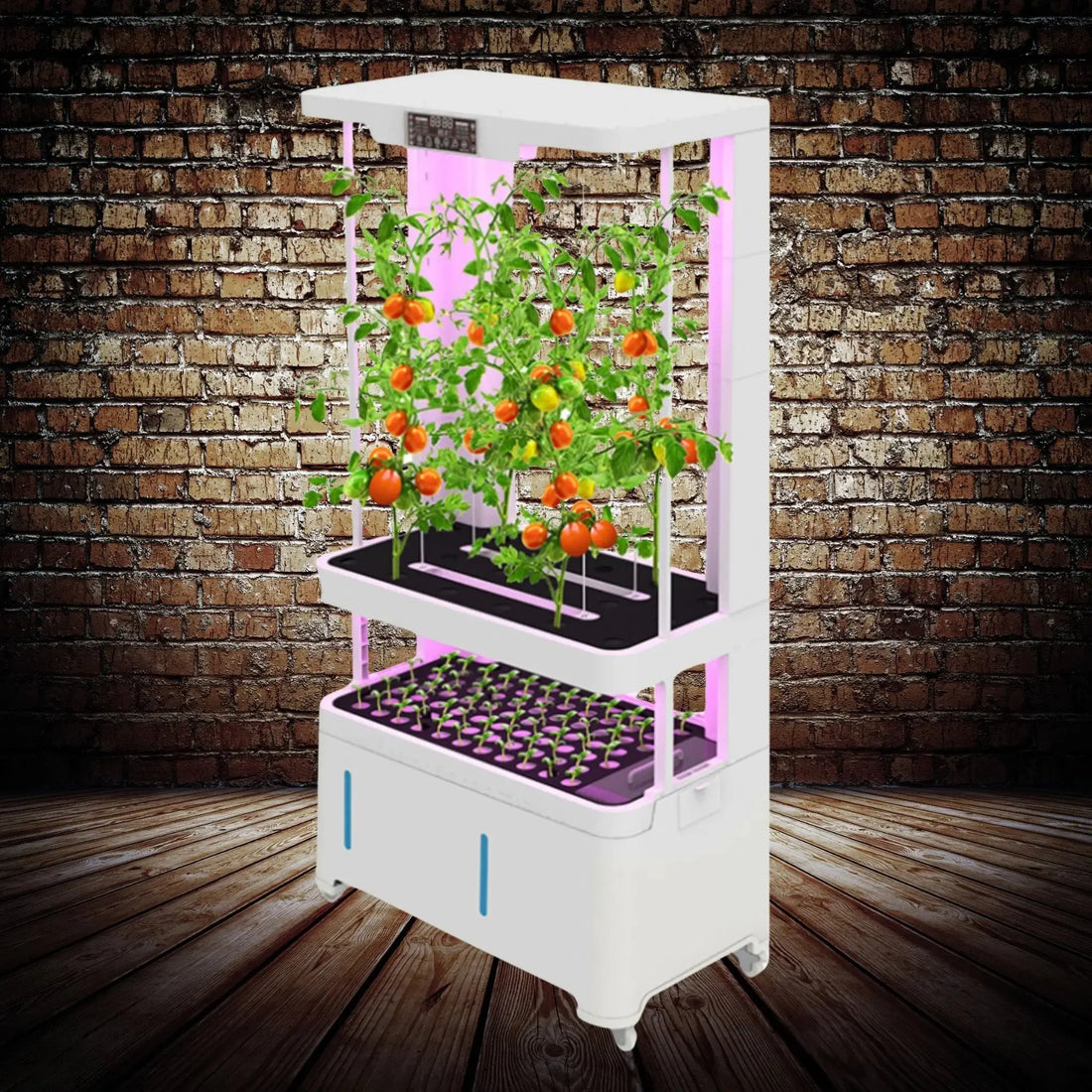
- V5.2-A and V5.2-T. Full sensor stack (temperature, water level, nutrient cycle monitoring), phone app pairing for live readings, automatic LED cycle, and automatic water-temperature cooling above 30 degrees. The closest LaNiTex gets to a phone-controlled grow setup.
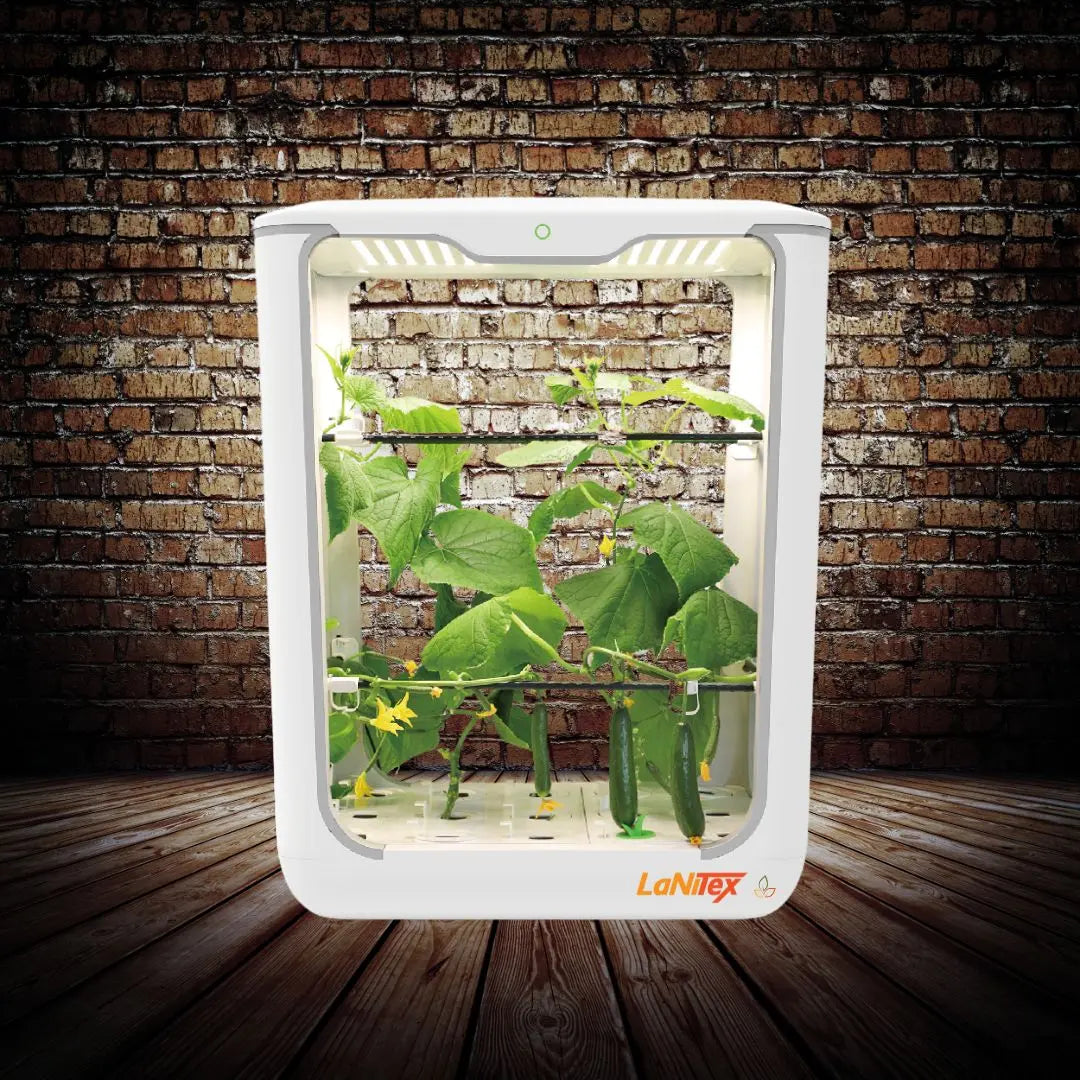
- Smart Grow Box (15-hole and 67-hole). Smart LED full-spectrum lighting, automated cycle, water-level indicator, one-touch controls. No phone app in the standard model.
- Mini Grow Pot Z 2.4. Four lighting modes (Planting, Reading, Beauty, Night Light) plus a manual water-level window. No sensors or app.
- Desktop Grow Box. Patented water-level indicator, automated LED cycle on the Shangri-La 3459 spectrum, no app.
WiFi-controlled apps and automatic pH dosing are still rare in the household price band; expect them on premium units 2027 and beyond. For now, the V5.2-A's phone pairing is the closest thing in the LaNiTex range to a walk-away-for-a-weekend setup.
Common hydroponic system mistakes to avoid
The four mistakes. Buying the biggest unit first, running tap water without testing it, ignoring body corp rules on balcony water, and skipping the cycle timer. Each one kills the system within weeks if uncorrected.
Don't buy the biggest unit first. The most common mistake I see is buying a 76-slot vertical tower as a first system because the photo looks impressive. The buyer cannot reach the top tier, hates the daily maintenance, and abandons it within three months. Start small. A single Grow Box delivers a household of two's salad needs. Add a second unit when the first is producing more than you can eat.
Don't run tap water without testing it first. Brisbane and Sunshine Coast tap water sits around pH 7.5 to 8.0 and contains either free chlorine or chloramine, depending on your utility. Hydroponic plants prefer pH 5.5 to 6.5 and low chlorine, since small amounts can actually help against root pathogens but high free-chlorine levels (above roughly 1 ppm) stress roots. Aging tap water uncovered for 24 hours evaporates free chlorine but does NOT remove chloramine, which many Australian utilities now use; check your local water authority and pair the ageing with a carbon filter or the 4-in-1 Water Quality Tester so you actually know what you have. This single step is what separates a struggling box from a productive one, usually visible within two harvests.
Don't ignore body corp rules. Some Queensland strata schemes ban anything that drops water on a balcony or is visible from the street. Check before you place a system on a balcony. Indoor placement is almost always fine and is what we recommend by default.
Don't skip the timer. Ebb and flow and aeroponic systems both depend on cycle timers because the roots need the drain or air-break phase to oxygenate. Stagnant water with no flow suffocates roots inside a day or two in summer heat. (NFT is the exception, since it runs continuous flow but the nutrient film is so shallow that roots stay oxygenated.) Verify the timer is running before you walk away for a holiday. That is it.
Common hydroponic system problems and how to fix them
These are the issues I help apartment growers and school operators solve most often, in roughly descending order of frequency.
Root rot from oxygen-starved water
Symptoms: brown slimy roots, wilting leaves despite a full reservoir, sweet decay smell. Cause: stagnant water or a warm reservoir above 24 degrees. Fix: drain and refill with fresh nutrient solution, add an air stone if the system does not already have one, and chill the reservoir using ice bottles overnight until ambient drops below 22 degrees. Prevent by sticking to the timer cycle and not letting water sit unmoved for more than four hours.
Algae bloom from light hitting the nutrient solution
Symptoms: green slimy growth on reservoir walls, net pots, or the water surface. Cause: any light reaching the nutrient solution. Fix: wrap the reservoir in opaque tape or move it under the bench; replace the nutrient solution and clean every surface with a 3 percent hydrogen peroxide rinse. Algae itself is harmless but it competes with roots for nutrients and clogs pumps.
EC drift
Symptoms: stunted growth despite a full reservoir, leaf tip burn, or unusually pale leaves. Cause: nutrient strength has either drifted high (water evaporated, salts concentrated) or low (plants consumed nutrients faster than the maths assumed). Fix: test EC weekly with a calibrated meter. If reading is above target, top up with plain water; if below, add nutrient solution to bring it back. Most leafy greens want EC between 1.2 and 1.8 mS/cm. Sunshine Coast testing currently uses HY-GEN Hydro Growth for leafy greens and adjusts ratios for fruiting plants like capsicum; our hydroponic nutrients series walks through brand choices and ratios in more detail.
pH lockout
Symptoms: nutrients are present in the reservoir but plants show classic deficiency signs (yellowing, slow growth). Cause: pH has drifted outside the 5.5 to 6.5 band where most nutrients are bioavailable to hydroponic roots. Fix: adjust with pH-down (phosphoric acid) or pH-up (potassium hydroxide) drops from any hydroponics supplier; never use household vinegar as a long-term adjustment. Check pH at every top-up.
Pump failure
Symptoms: silent system, dry medium, fast wilting in summer. Cause: pump dies, power outage, or a clogged intake. Fix: keep a spare submersible pump on hand (under $30 from any aquarium supplier) and test the existing pump monthly. For aeroponic systems, a battery UPS that covers the pump for 6 to 8 hours is the right investment if your apartment loses power often.
Light burn or leggy plants
Symptoms: bleached leaf tips (too much light) or stretched stems with sparse foliage (too little). Cause: LED distance is wrong for the growth stage. Fix: most full-spectrum LEDs should sit 25 to 35 cm above seedlings and can be lowered to 15 to 20 cm during flowering. Increase the light cycle from 14 to 16 hours per day for leafy growth, drop back to 12 hours when fruiting peppers or strawberries.
The future of hydroponic systems in Australia
Where this goes next in Australia is fairly predictable. Queensland and Victorian state agencies have been backing controlled environment agriculture research because the water-saving maths is hard to argue against. CSIRO has been running vertical hydroponic trials at its Bribie Island Research Centre for pest-control as well as yield reasons.
The consumer side is moving faster than the policy side. Smart hydroponic systems with phone-controlled sensors have dropped to coffee-machine price points. The Term-Grow Enrolment program we run in Queensland primary schools is one slice of the demand; the household side is bigger.
The hardware will look different in five years. Mid-range units will ship with automatic pH dosing and phone-based troubleshooting as standard. The V5.2-A already does the dosing in an early form. The rest follows.
Hydroponic system glossary
- EC (electrical conductivity).
- A measurement of total dissolved nutrient salts in the reservoir, expressed in mS/cm or microsiemens. Most leafy greens want EC between 1.2 and 1.8 mS/cm.
- pH.
- Acidity or alkalinity of the nutrient solution. Hydroponic plants grow best at pH 5.5 to 6.5, where most macro and micronutrients are bioavailable to bare roots.
- NFT (nutrient film technique).
- A continuous-flow method where a thin film of nutrient solution runs over roots in a sloped channel. Used in commercial leafy-green operations.
- DWC (deep-water culture).
- A method where plant roots sit in a deep oxygenated nutrient reservoir, often with an air stone. Simple to build, prone to root rot if water warms above 24 degrees.
- Net pot.
- A perforated plastic pot that holds growing medium and lets roots dangle into the nutrient solution. Standard in towers and DWC setups.
- Full-spectrum LED.
- A grow light that produces wavelengths across blue (450 to 470 nm), red (620 to 660 nm), and white light, mimicking sunlight. Tuned for both leafy growth and flowering.
- Reservoir.
- The water tank that holds the nutrient solution. Size varies from 1 to 100+ litres depending on the system.
- Substrate.
- Any solid material that holds plant roots in a hydroponic system, such as coconut coir, rockwool, perlite, or expanded clay pebbles. Inert by design.
- Transplant shock.
- Stress a plant experiences when moved between media. Hydroponics minimises this because roots stay in the same nutrient solution from seedling to harvest.
- TDS (total dissolved solids).
- An alternative reading to EC, expressed in ppm. Approximate conversion: 1 mS/cm of EC equals around 500 ppm TDS for most nutrient mixes.
FAQ
What is a hydroponic system and how does it actually work?
A hydroponic system grows plants without soil by delivering a measured water-and-nutrient solution directly to the roots. The plant sits in an inert medium, a misted chamber, or a flowing channel; the grower controls pH, nutrient strength, and light hours. Most home systems include a reservoir, a pump, an LED light, and either net pots or a grow tray. Power use is low; a small unit draws under 10 watts.
How much water does a hydroponic system actually save versus soil gardening?
Up to 90 percent less, peer-reviewed. Aeroponic systems hit 98 percent in NASA research. The reason is recirculation: the solution cycles back to the reservoir instead of draining through soil.
Which hydroponic system is best for a small Australian apartment?
Honestly, this is the question I get most. The Smart Grow Box at $429 is the most common starting point for Sydney, Brisbane, and Melbourne apartments. It runs on 0.36 square metres of bench space, holds 15 or 67 plants, and can be stacked vertically as your harvest needs grow. The V5.2-A at $1,990 is the upgrade path when floor space and ceiling height allow. Our hydroponic system for every home guide walks through specific footprint scenarios across apartments, balconies, and backyards.
How much does a complete hydroponic system cost in Australia?
LaNiTex household systems run from $75 for a Mini Grow Pot to $1,990 for the V5.2-A. Imported freestanding towers run $1,000 to $1,500 with two to three weeks of shipping. Commercial hydroponic greenhouses start around $2,000 for a polytunnel kit. Pricing is in Australian dollars; LaNiTex ships from the Sunshine Coast same week to most east-coast addresses.
What can I grow in a hydroponic system, and what won't work?
Lettuce, basil, mint, microgreens, capsicum, chilli, strawberry, spinach, kale, and most leafy herbs grow excellently. Root vegetables like carrots and potatoes do not suit standard hydroponic boxes because the roots need depth and substrate. Tall fruiting plants like indeterminate tomatoes need a tall grow tent or a greenhouse rather than a benchtop box. I'm less certain about long-rooted Asian greens like daikon. I haven't tested them at scale, but the same root-depth limit probably applies.
What is the difference between hydroponics and aeroponics?
Hydroponics flows or pools nutrient water around plant roots inside a medium or a channel. Aeroponics suspends roots in air inside a chamber and mists them with nutrient solution. Aeroponics uses less water and reportedly produces faster growth because roots receive more oxygen between misting cycles. Aeroponics needs a high-pressure pump and a backup plan for outages, which is why most household systems use hydroponics instead.
Further reading
- Grow tower for apartments in Australia: what works: companion guide for Brisbane and Sydney apartment buyers
- Hydroponic system for every home: apartment to backyard: scenario-by-scenario fitment guide
- Hydroponic herb garden: how it works in an Aussie kitchen: herb-specific deep-dive
- How to grow butter lettuce at home in Australia: lettuce-specific growing guide
- Mushroom growing kit: complete Australian guide 2026: if you also want mushrooms in the rotation
- LED grow lights Australia: what actually matters: LED spectrum and wattage guide
- Hydroponic nutrients series: HY-GEN Hydro Growth: nutrient brand walkthrough
- LaNiTex Hydroponic Blog Hub: all LaNiTex grow guides, system reviews, and Australian case studies
- About Laszlo Bulatko, Founder: the operator behind every product test
- Contact LaNiTex Hydro Garden: pre-purchase questions answered same business day
For the full pre-purchase checklist by email, join the newsletter and use code NEWSLETTERDISCOUNT10 for 10 percent off your first order.
Sources
- Manzocco, L. et al. (2023). Hydroponics: current trends in sustainable crop production. Bioinformation, peer-reviewed, published 30 September 2023. Cited verbatim: "Hydroponic farming techniques have been found to reduce water usage by up to 90% compared to conventional soil-based farming." Supports the 90 percent water-savings claim under "What is a hydroponic system" and the FAQ.
- Australian Bureau of Statistics. (2022). Housing: Census, 2021. Australian Bureau of Statistics, released 28 June 2022. Cited verbatim: "70 per cent were separate houses, 13 per cent were townhouses and 16 per cent were apartments." Supports the apartment-share claim under "Why Australians are switching".
- NASA. (2008). Experiments Advance Gardening at Home and in Space. NASA Spinoff, 2008. Cited verbatim: "Aeroponic systems also reduce water usage by 98 percent, fertilizer usage by 60 percent, and eliminate pesticide usage altogether." Supports the aeroponic water and fertilizer claims under "Aeroponic tower system".
- CSIRO. (2021). Durable solutions for pest control in agriculture. CSIRO, published 19 May 2021. Cited verbatim: "Here plants are grown inside using hydroponics in trays stacked on top of each other and provided with artificial light." Supports the controlled environment agriculture context under "Why Australians are switching".